By Emilia Wellesley · Published May 6, 2026 · Updated May 13, 2026
On the morning of 6 July 1907, four days before King Edward VII was due to invest a new knight of the Order of St Patrick at Dublin Castle, a messenger named William Stivey turned a key in a safe in the Bedford Tower and found it empty. The diamond star, the diamond badge, and the five gold collars of the Knights of St Patrick, the regalia known to the press as the Irish Crown Jewels, were gone. They have never been recovered. The case is the rare historical and archaeological mystery whose paper trail is dense and whose conclusion is missing, and the gap between the two is where the work of the historian belongs.
What was taken, and what the regalia actually was
The phrase “Crown Jewels of Ireland” is a Victorian press flourish. The objects in the Bedford Tower safe were not a coronation regalia in the English sense. They were the insignia of the Most Illustrious Order of St Patrick, an order of chivalry founded in 1783 to bind the Anglo-Irish peerage to the Crown, and the most spectacular pieces among them had been a personal gift from King William IV (1765 to 1837) in 1830, drawn from stones inherited from Queen Charlotte and from George III’s Order of the Bath star [1]. Rundell, Bridge and Company assembled the regalia in London. The diamond star measured roughly 4 5/8 inches across, set with Brazilian brilliants around a central ruby cross on sky-blue enamel and a trefoil of emeralds. The badge carried a diamond-set harp beneath a crown. Together with the five collars of living and deceased knights and a small bundle of Vicars’s family jewellery, the safe held a sum that contemporary reporting placed at around £50,000, with the two main pieces alone valued at roughly £30,000 [2].
The figure matters because it shaped the story that followed. £50,000 in 1907 was a viceregal-grade scandal, and the regalia were not Vicars’s to lose lightly. The Order of St Patrick was used most visibly during royal visits, when a new knight might be invested as part of the imperial choreography. The investiture planned for the king’s July 1907 visit had to be cancelled. The choreography failed in public, in front of the Crown.
The custodian: Sir Arthur Vicars and the Office of Arms
Sir Arthur Edward Vicars (1862 to 1921) had been Ulster King of Arms since February 1893, appointed by letters patent after the death of the previous incumbent. He was a genealogist by training, a fellow of the Society of Antiquaries, and the author of a standard reference on Irish prerogative wills published in 1897 [3]. His office, the Office of Arms, sat in the Bedford Tower in the Upper Castle Yard at Dublin Castle, two storeys of heraldic registers and seal presses overseeing the genealogy of the Irish nobility.
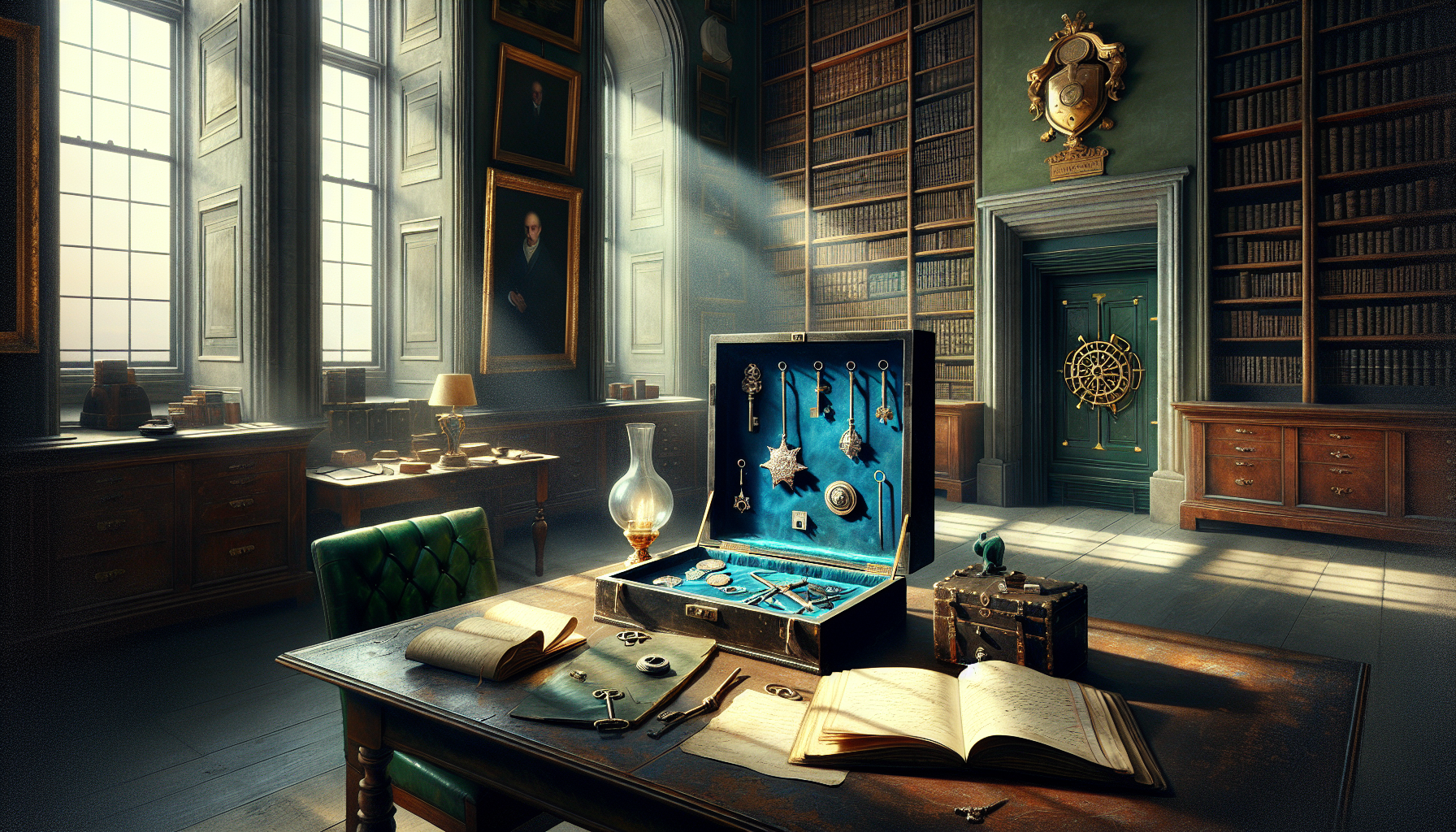
In 1903 the office was reorganised, and a new strongroom was built on the ground floor of the tower to house the regalia. The plan misfired in a way that turned out to be load-bearing for everything that came after. The new Ratner safe ordered for the strongroom was too wide for the strongroom door [2]. Rather than alter the architecture or order a smaller safe, Vicars had the safe placed in the library upstairs, outside the strongroom altogether. Two keys to the safe existed; both were in his sole keeping. Seven keys to the building’s outer doors had been issued over the years.
Vicars had a habit of working late, drinking, and entertaining. Friends recalled him waking once after a heavy evening to find the regalia hanging around his neck, an arrangement set up as a joke by a guest. He was knighted in 1896 and made Knight Commander of the Royal Victorian Order in 1903 [3]. He was a careful scholar and an unwary administrator, and the distance between those two qualities is the moral spine of the story.
The timeline of disappearance, June and July 1907
The last confirmed sighting of the regalia in the safe was on 11 June 1907, when Vicars showed them to John Hodgson, librarian to the Duke of Northumberland, who had stopped at the office on a visit [2]. Between that day and 6 July, three security incidents are documented in the surviving record:
- In May, Vicars left a key on a ring with his office keys; a maid at his lodgings found the ring and returned it. He understood, after the fact, that it had been out of his sight long enough to be copied.
- On 3 July, Mrs Farrell, the office charwoman, arrived to find the front door of the Bedford Tower already unlocked. She did not report it formally; the door’s having been opened was uncommon but not unprecedented.
- On 6 July, the strongroom door itself was found unlocked. At about 2:15 in the afternoon, Vicars asked William Stivey, the office messenger, to deposit the collar of a recently deceased knight, Lord de Ros, in the safe. Stivey opened the safe, found it empty, and reported back. Vicars went to look for himself.
Edward VII (1841 to 1910) and Queen Alexandra were due in Kingstown on 10 July, four days later. The investiture was cancelled. The king was reportedly told only after he had arrived, and he was, by every contemporary account, furious.
The suspect: Francis Shackleton, and the strange shape of the inquiry
Francis Richard “Frank” Shackleton (1876 to 1941) was Dublin Herald in the Office of Arms and the younger brother of the Antarctic explorer Sir Ernest Shackleton (1874 to 1922) [4]. He had lived for a stretch as Vicars’s lodger and remained close to the household. He moved in expensive London circles, including that of John Campbell, ninth Duke of Argyll, the king’s brother-in-law. He was also chronically broke. By the summer of 1907 Vicars had personally guaranteed two bills for him totalling more than £750, and Francis Bennett-Goldney, the Athlone Pursuivant in the office, had endorsed a £1,500 promissory note on his behalf [2].
When the theft was discovered, Vicars’s own first hypothesis was that Shackleton was responsible. He told Detective Sergeant Owen Kerr in September 1907 that the thief was a man “who was a guest in my house, and he treacherously took impressions of my keys when I was in my bath”, and that the man was at that moment in Paris. The unnamed man matched Shackleton in every particular except a name. Shackleton was indeed abroad on the day the safe was opened, an alibi his defenders would lean on hard.
Detective Chief Inspector John Kane of Scotland Yard arrived in Dublin on 12 July and conducted his own investigation [1]. His report has never been released. It is widely believed by historians of the case to have named a suspect; whatever it said, it was suppressed at the highest level, and Kane himself, when called before the inquiry the following winter, told the commissioners flatly that no evidence had been found against Shackleton.
The Lord Lieutenant, John Campbell Gordon, seventh Earl of Aberdeen (1847 to 1934), did not call a public Royal Commission. He instead convened a Viceregal Commission of Inquiry under Judge James Johnston Shaw on 10 January 1908 [1]. The commission sat in private. It had no power to compel witnesses. Vicars refused to appear, holding out for a public hearing he was never granted. The commission’s terms of reference were narrow in a way that historians have generally read as deliberate: it was tasked not with identifying the thief, but with assessing whether Vicars had “exercised due vigilance” as custodian. After two weeks, it found that he had not. He was dismissed on 30 January 1908 [3]. Shackleton, exonerated by name in the report, kept his post a little longer.
The political weather around the case
It is here that the story stops being a heist and starts being something else. The names that swirled around Shackleton’s London life included Lord Ronald Gower and the Duke of Argyll’s circle, and journalists at the time believed, on grounds that have been argued back and forth ever since, that the inquiry had been quietly steered to avoid testimony in open court that might have touched on the private lives of men whose private lives, in 1908, were criminal in themselves. John Cafferky and Kevin Hannafin, in Scandal and Betrayal: Shackleton and the Irish Crown Jewels (2002), make this case explicitly: that the suppression was not aimed at protecting a thief so much as at protecting a class of well-connected witnesses from the witness box during a royal visit [5]. Other historians, including Myles Dungan, are more cautious about the conspiracy reading and emphasise instead the ordinary failure modes of a Victorian custodial culture that placed too much trust in the personal honour of one man with two keys [6]. Both readings can sit on the same shelf. Both fit the surviving paper.
What is documented, beyond dispute, is that the inquiry never asked the question whose answer mattered most. Tomás O’Riordan, in his survey of the case for History Ireland, notes the oddity precisely: “the commission did not investigate the theft itself, but concentrated on whether Vicars had taken proper care of the jewels” [2]. A theft inquiry that does not investigate the theft is, in scholarly terms, a peculiar artefact.
The afterlife of the case: 1908 to 1941
Vicars spent the rest of his life trying to clear his name. He won £5,000 in damages from the London Daily Mail in a libel case in 1913. He moved to Kilmorna House near Listowel, County Kerry, his half-brother’s former seat, married Gertrude Wright in 1917, and was shot dead by an IRA flying column on 14 April 1921 in front of his wife after the house was set alight [3]. The killing was political (Kilmorna was burned for being a loyalist house in a war year), but Vicars’s notebook, recovered after his death, accused the British government of having known the identity of the thief from the start.
Shackleton was tried for an unrelated fraud in 1913, defrauding a friend of Lord Ronald Gower, and sentenced to fifteen months. After his release he changed his name to Mellor and lived quietly as an antiques dealer in Chichester until his death on 24 June 1941, age 64 [4]. Pierce Gun Mahony, Vicars’s nephew and the most persistent advocate for a public inquiry, died in a 1914 “shooting accident” on the family estate at Grange Con whose circumstances were never fully explained. Bennett-Goldney was killed in a car crash in France in 1918. Captain Richard Howard Gorges, the army friend of Shackleton named in some later accounts as a co-conspirator, killed a Dublin Metropolitan Police constable in 1915, served ten years, and died under a London Underground train in 1944.
No one in the small cast of likely suspects survived to be formally questioned in a setting that could compel an answer. The regalia themselves were almost certainly broken up; Myles Dungan’s working hypothesis, on circumstantial grounds, is that the diamonds were prised from their settings within months and sold separately into the European trade [6]. A 1927 memo to the Irish Free State government raised the possibility that the regalia could be bought back for a few thousand pounds; nothing came of it.
What the documentary record now supports
It is a discipline of this kind of case to separate what the surviving records support from what the literature has imagined. On the documentary side, the following claims are well-attested in contemporary sources, the inquiry transcripts, and post-1990 archival work:
- The safe was outside the strongroom because the strongroom door was too narrow.
- Vicars’s keys had been out of his sight long enough to be copied.
- There was no forced entry on 6 July; whoever opened the safe had a working key.
- Detective Inspector Kane’s full report was withheld from publication, and remains unreleased.
- The Viceregal Commission’s narrow remit was a political choice made under pressure to spare a royal visit.
- No member of the office was ever charged with the theft.
On the speculative side: the identity of the thief, the destination of the stones, the precise mechanism of the suppression, and the role, if any, of Lord Aberdeen’s son Lord Haddo (whose name surfaced in a 1982 Irish Times account that has since been treated sceptically) all remain open. Historians who have worked the case longest, Cafferky and Hannafin in Dublin and Dungan in Galway, agree that the available record points hardest at Shackleton acting with at least one accomplice, and that the inquiry was steered. They disagree on motive and on how widely the steering reached [5][6].
The Crown Jewels of Ireland are a case where the absence of a verdict is itself the historical fact. The procedural reconstruction holds: a regalia gifted by a dying king, a custodian whose vigilance failed in mundane ways, a closed inquiry whose terms of reference foreclosed its own answer, and a generation of suspects who died early and inconveniently. The jewels are still missing. The record is not.
For deeper context across the historical and archaeological mysteries archive, consider The Burke and Wills Expedition and The Hollow Earth Theory.