By Emilia Wellesley · Published May 6, 2026 · Updated May 13, 2026
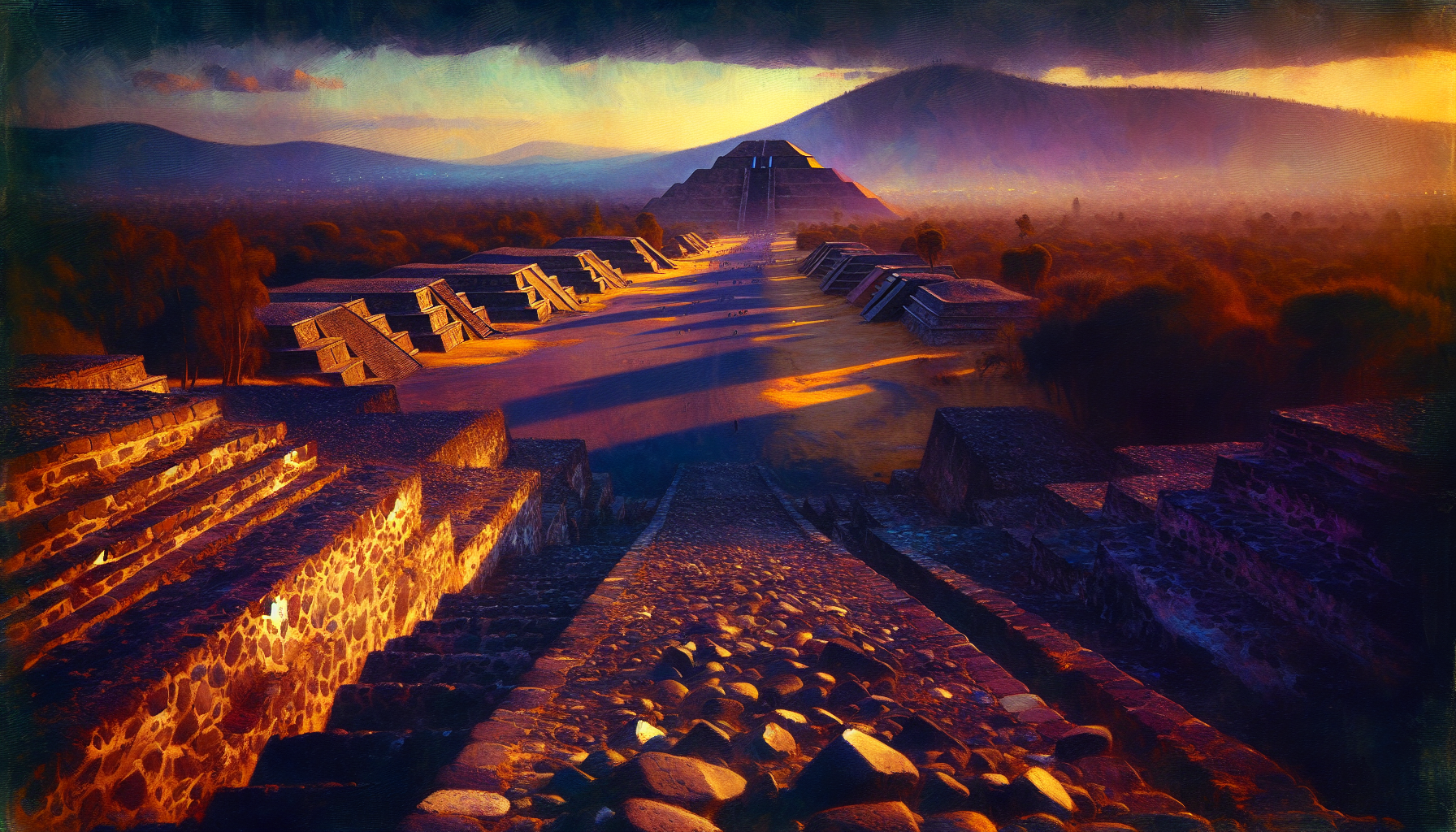
The pyramids of Teotihuacan rise from the Valley of Mexico like a problem the surviving record cannot quite resolve. By the time the Mexica encountered the abandoned city in the late fourteenth century, its three great monuments — the Pyramid of the Sun, the Pyramid of the Moon, and the Temple of the Feathered Serpent — had stood empty for roughly seven hundred years. The Mexica named the place Teotihuacan, “where the gods were created,” because the absence felt sacred to them and they could not name the people who had built it [1]. Modern archaeology has spent more than a century trying to do what the Mexica did not, and the question of who lifted these stones is still open.
The Direct Answer
Teotihuacan’s pyramids are three monumental stepped platforms — the Pyramid of the Sun (about 65 meters tall), the Pyramid of the Moon, and the Temple of the Feathered Serpent — built between roughly 100 BCE and 250 CE in central Mexico. Their builders left no decipherable script, so the city’s ethnic identity, language, and political founders remain unresolved questions of Classic Mesoamerican archaeology [1][2].
What the Mexica Found, and What They Named
When the Mexica priests came to the ruined city as pilgrims, they found a layout that was already alien to their own cosmology and yet legible enough to read as sacred. The central spine of the city, the Avenue of the Dead, runs roughly two and a half kilometers and is oriented about 15.5 degrees east of true north, pointing toward the sacred peak of Cerro Gordo [3]. Lining this axis are the platforms of the Sun and Moon pyramids and, southward in the precinct called the Ciudadela, the smaller but iconographically dense Temple of the Feathered Serpent. The Mexica did not build any of this. They named what they could not author. The Nahuatl word Teotihuacan, “the place where the gods were created,” is a religious gloss applied to a void in the historical record [3][4].
The original name of the city is unknown. The original language of its inhabitants is unknown. Even the broad chronology — when the Avenue was laid out, when the Pyramid of the Sun was finished, when the city was burned and abandoned — sits on dating evidence that has been revised more than once in the last fifty years. To stand at the foot of the Pyramid of the Sun is to stand at the foot of one of the largest preindustrial monuments in the Americas while reading the work of an author whose signature has been deliberately removed.
The Three Pyramids: A Quick Anatomy
The Pyramid of the Sun is the largest of the three. Its base measures roughly 220 by 230 meters and it stands about 65 meters tall, completed in its principal phase around 200 CE [5]. The Pyramid of the Moon, smaller but ceremonially more central to the city’s northern terminus, rises from a base of approximately 130 by 156 meters to a height near 43 meters [3]. The Temple of the Feathered Serpent (also called the Temple of Quetzalcoatl), at the south end of the Avenue inside the Ciudadela, is smaller still in elevation but iconographically the most ambitious: its talud-tablero facade once carried alternating sculpted heads of the Feathered Serpent and a second deity often identified with rain or fire serpents.
The Sun
A natural cave runs beneath the Pyramid of the Sun, modified in antiquity into a four-lobed chamber. Recognized by Jorge Acosta and explored more systematically in 1971, the cave is widely interpreted as a primordial threshold, an axis between the world above and the world below [6]. Why the pyramid was placed atop it is the obvious question, and one of the older mysteries of the site: was the cave found and built over, or was the cave itself dug to suit the cosmology?
The Moon
The Pyramid of the Moon was built in seven successive construction stages, each one enclosing the last like nested boxes. Saburo Sugiyama (b. 1952) of Aichi Prefectural University and Arizona State University, working alongside Rubén Cabrera Castro of Mexico’s Instituto Nacional de Antropología e Historia (INAH), spent seven years opening these layers between 1998 and 2004 [7]. What they found altered the city’s reputation. Inside Burial 6, set at the center of the pyramid’s fifth construction stage, the team recovered the remains of twelve sacrificial victims; ten had been decapitated. Two further bodies, lavishly ornamented with greenstone and shell, were arranged among the others. Sugiyama described the deposit as one of the most violent ritual events documented anywhere in Mesoamerica and read it, like the earlier Burial 2 with its bound hands and offering of canid skeletons, as state ceremony made physical. The pyramid had not been built only to be beautiful. It had been built to consume people.
The Feathered Serpent
The Temple of the Feathered Serpent was, on the evidence of its dedicatory burials, even more brutal. Excavations led by Sugiyama and others in the late 1980s and 1990s recovered more than two hundred individuals interred in mass dedicatory burials beneath and within the structure, many bound, many in soldier’s gear, deposited in patterned groups around the building’s foundations. The sculpted facade, with its serpents emerging from feathered ruffs, became after Sugiyama’s work less a piece of solemn iconography and more a marker for the political ideology that the burials enacted in flesh.
The 2003 Sinkhole and the Tunnel Beneath Quetzalcoatl
In late 2003, after a heavy rain, a sinkhole opened in the plaza in front of the Temple of the Feathered Serpent. Sergio Gómez Chávez, an INAH archaeologist who had worked at Teotihuacan for years, lowered himself in. What he found was a deliberately sealed shaft. Beyond it lay a tunnel running roughly 100 meters from the Ciudadela toward the temple, intentionally closed nearly two thousand years earlier and untouched since [8]. The discovery was, in a real sense, the recovery of a sealed letter the city had written and then refused to send.
Excavation continued for more than a decade. Ground-penetrating radar refined the shape of the tunnel before excavators ever reached its end. Two small remote-controlled robots, nicknamed Tláloc and Tlaloque, mapped the chambers at the terminus before any human entered. Roughly 75,000 artifacts came up from the fill: jaguar bones, rubber balls, polished obsidian blades, amber, mica sheets, beetle wings, and a Pacific conch shell carried in from a coast hundreds of kilometers distant. The walls had been hand-rubbed with powdered pyrite — fool’s gold — so that, in lamplight, they would catch and throw the light back as a field of stars [8].
The most arresting find, announced by INAH in April 2015, lay near the end of the tunnel: pools of liquid mercury collected on the chamber floor, with a miniature landscape of carved stone mountains and what appears to be a representation of an underworld river. Liquid mercury, in the small quantities the Teotihuacanos could refine from cinnabar ore, is reflective, mobile, and disturbing. Gómez has interpreted the chamber as a model of the underworld and a likely indicator that a royal tomb is nearby — the first identifiable royal tomb at Teotihuacan, in a city that for a hundred years has refused to give its rulers names. The chamber has not yet yielded such a tomb, but the search continues.
The Map That Made the City Legible
Before any of these tunnel discoveries, the city had to be made legible as a city. That was the contribution of René Millon (1921–2021) of the University of Rochester, whose Teotihuacan Mapping Project, conducted between 1962 and 1970, produced the first comprehensive plan of the urban grid. Millon, with R. Bruce Drewitt and George L. Cowgill, walked over twenty square kilometers, recorded more than five thousand structures, and published the results as Urbanization at Teotihuacan, Mexico, Vol. 1: The Teotihuacan Map (University of Texas Press, 1973) [9].
What the map showed changed the field. Teotihuacan was not a ceremonial center with a small attached town. It was a planned city of perhaps 100,000 to 200,000 people at its peak around 500 CE, gridded on the same orientation as the Avenue of the Dead, with apartment compounds, craft workshops, and ethnic neighborhoods (a Oaxacan barrio, a Merchants’ Barrio with Gulf Coast and Maya material) spread across an area larger than imperial Rome inside the Aurelian walls [9][10]. The city was, in the strict sense, urban, and that recognition reframed every later question about who governed it and how.
Who Built It? The Open Question
There is no decipherable Teotihuacan script. The few signs painted on murals and incised on pottery — calendrical glyphs, name signs for individuals or lineages — have not been read in the way Maya glyphs were eventually read by Yuri Knorozov and the linguists who followed him. This silence is the heart of the mystery, and it is also the discipline of the field. Several hypotheses about the founders have been proposed and held in tension:
- Proto-Otomi. The Otomi-Pamean languages were anciently spoken in the Basin of Mexico and surrounding highlands, both before and after the Classic period. Some scholars argue the Otomi presence is the longest-rooted and therefore the likeliest founding stratum.
- Proto-Nahua. Linguistic and later cultural continuities link Nahua-speaking peoples to the Basin, and the Mexica’s later identification of Teotihuacan as their ancestral cosmological capital is sometimes taken as a memory trace of an actual ethnolinguistic continuity.
- Totonacan or Mixe-Zoquean. In 2001 the linguist Terrence Kaufman (b. 1937) presented evidence that an important segment of Teotihuacan’s population was Totonacan or Mixe-Zoquean in linguistic affiliation, on the basis of loanword distributions across Mesoamerican languages [11].
- Multi-ethnic from the outset. The likeliest reading, supported by the residential evidence and the strontium-isotope work on burial populations, is that no single ethnos founded Teotihuacan. The city drew migrants from Oaxaca, the Gulf Coast, and the Maya lowlands from early in its growth, and the dominant elite ideology may have been deliberately pan-Mesoamerican rather than the property of one group [12].
Each hypothesis fits part of the evidence. None has yet been falsified. The honest position, the one most working Mesoamericanists hold, is that the founders’ identity is unresolved and may remain so unless a readable text is recovered.
The Burning of the City
Sometime between roughly 550 and 600 CE, the central monumental core of Teotihuacan was burned. The fire was concentrated on elite and ceremonial structures along the Avenue of the Dead and in the Ciudadela, sparing much of the residential city. Whether the burning came from internal revolt, from external invasion, or from some combination of drought, internal stress, and climatic disruption around the global cooling event of 535–536 CE remains debated. The city’s population thinned over the following century, and by about 750 CE it was effectively empty [3]. When the Mexica arrived seven centuries later, they found the monuments standing, the avenues clear, and no one to ask.
What Has Recently Changed, and What Has Not
Two decades of work have transformed what we can say about Teotihuacan. Sugiyama and Cabrera’s Pyramid of the Moon excavations gave the city a recognizable political character — militaristic, sacrificial, expanding through ceremony. Gómez’s tunnel beneath the Feathered Serpent gave the city back a sealed ritual chamber that had been closed since around 250 CE. In 2017, archaeologists working with electrical resistivity tomography identified a previously unknown tunnel and chamber roughly ten meters beneath the Pyramid of the Moon, mirroring the geometry of the older tunnels and reinforcing the sense that the city’s three principal pyramids share a single underworld grammar [13].
What has not changed is the central silence. The founders are still unnamed. The script, if it ever existed in extended form, is still unread. The royal tombs that Gómez believes lie at the end of the Quetzalcoatl tunnel, or in some unopened chamber beneath the Sun or the Moon, have not been found. Several of these questions may be answered in the next decade. Several may not be answered at all. The discipline of working at Teotihuacan, like the discipline of reading any text whose author refused signature, is to keep both possibilities open at once.
For readers tracing the broader pattern, this site sits among the most consequential historical and archaeological mysteries of the ancient Americas — a city the size of imperial Rome, with monumental architecture rivaling Egypt’s, whose builders left no name we can yet pronounce. The pyramids are not silent. They speak in stone and bone and pyrite-lit corridor. We are still learning the alphabet.
For deeper context across the historical and archaeological mysteries archive, consider The Burke and Wills Expedition and The Hollow Earth Theory.