By Emilia Wellesley · Published May 6, 2026 · Updated May 13, 2026
What Are the Megalithic Temples of Malta?
The Megalithic Temples of Malta are a group of prehistoric stone sanctuaries built on the islands of Malta and Gozo between roughly 3600 and 2500 BCE. Six of them carry UNESCO World Heritage status, awarded in 1980 and extended in 1992, and they rank among the earliest free-standing stone buildings anywhere on earth, predating Stonehenge by about a thousand years and the Egyptian pyramids by half that.
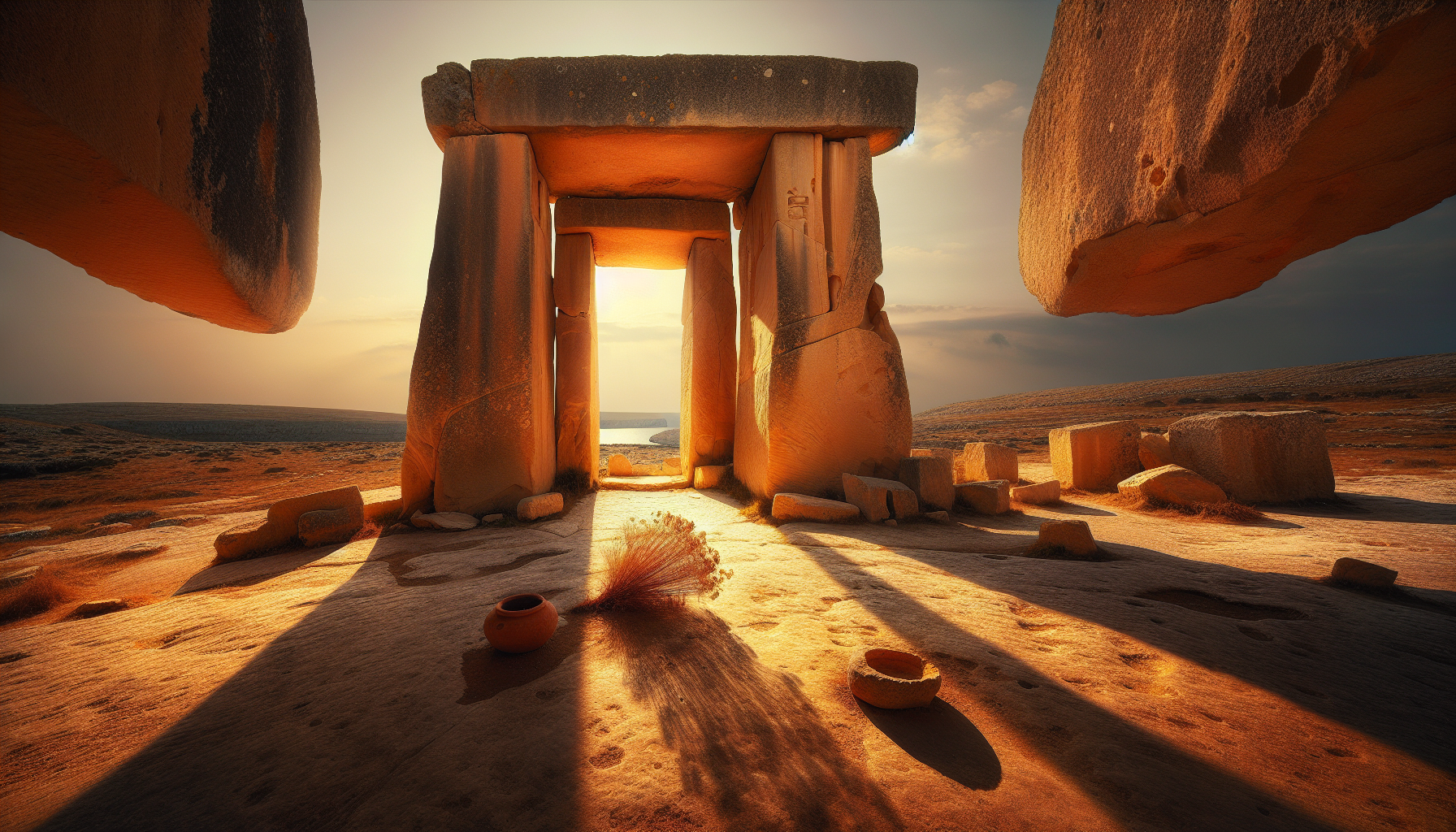
A visitor walking the limestone plateau above the cliffs of Qrendi at midday in late summer will smell wild fennel, sun-warm stone, and dust. The temples sit low and patient. Their walls curve. Their thresholds are worn smooth by feet that vanished four and a half thousand years ago. The people who shaped these chambers left no writing, no king-list, no surviving name. They left only the stones, a handful of figurines, and a pattern of doorways oriented to the seasons.
This guide moves site by site, names the scholars who have read these stones for over a century, and shows where the evidence ends and the interpretive frames begin within the broader landscape of historical and archaeological mysteries.
Six UNESCO Temple Sites, Read in Order
The six sites carrying UNESCO inscription are Ġgantija on Gozo, and Ħaġar Qim, Mnajdra, Tarxien, Ta’ Ħaġrat, and Skorba on the main island of Malta. Each developed independently and at its own pace, but all share the same architectural grammar: a curved facade of upright megaliths, a corbelled passageway, and lobed inner chambers built around a central axis. The walls were dry-laid, fitted without mortar, and finished inside with smaller stones and a layer of plaster that has mostly weathered away.
Ġgantija on Gozo
Ġgantija, whose Maltese name means “place of giants,” is the oldest of the surviving temples and the namesake of the earliest temple-building phase, the Ġgantija phase, dated to roughly 3600 to 3200 BCE. The southern of its two structures rises about six metres and uses limestone blocks weighing up to fifty tonnes. Local folklore credited a giantess named Sansuna with raising them, a reading the British colonial administrator Col. John Otto Bayer’s 1827 clearance neither confirmed nor laid to rest, since the spoil from that early dig was discarded without record.
Ħaġar Qim and Mnajdra
Ħaġar Qim sits on a wind-scoured ridge above the southern cliffs, its main temple built between 3600 and 3200 BCE with northern chambers older still. One of its limestone slabs measures more than seven metres in length and is among the largest single megaliths from the temple period. Mnajdra, five hundred metres downslope toward the sea, holds three connected structures, the lowest of which contains apertures aligned to sunrise at the equinoxes and the solstices, an alignment first noted by twentieth-century surveyors and confirmed by Heritage Malta’s later instrumental measurement.
Tarxien, Ta’ Ħaġrat, and Skorba
Tarxien, in the suburbs of modern Valletta, is the most decorated of the temples and the latest to remain in use. Its altars carry low-relief spirals, files of running animals, and a fragmentary colossal figure whose surviving lower body, broad-hipped and skirted, stands nearly a metre high. Ta’ Ħaġrat at Mġarr and Skorba at Żebbiegħ are smaller and older in their foundations, with Skorba in particular preserving stratified evidence from before the temples themselves were raised, going back to a Neolithic village around 5000 BCE.
Older Than Stonehenge, Older Than the Pyramids
The chronological standing of the Maltese temples surprises most readers. Construction at Ġgantija began around 3600 BCE. Stonehenge’s earliest stone phase began around 2500 BCE. The first Egyptian pyramids, the step pyramid of Djoser at Saqqara, dates to roughly 2630 BCE. The Maltese builders were finishing their last great temple at Tarxien around the time the pyramid age was beginning. Only the recently uncovered ceremonial enclosures at Göbekli Tepe in Turkey, dated to about 9500 BCE, predate the Ġgantija phase as architectural complexes, according to summaries published by the Encyclopaedia Britannica.
The radiocarbon framework that pinned these dates was assembled in the second half of the twentieth century. The British archaeologist David H. Trump (1931-2016), curator at the National Museum of Archaeology in Valletta during the 1960s and a steady presence in Maltese fieldwork for the next four decades, published the synthesis that most general readers still rely on, Malta: Prehistory and Temples (Midsea Books, 2002), with the photographer Daniel Cilia. Trump replaced the older bipartite divisions with a tripartite one of Neolithic, Copper Age, and Bronze Age, and attached calibrated radiocarbon dates to each phase for the first time.
Themistocles Zammit and the Underground Twin
No name is more closely tied to these temples than Sir Themistocles “Temi” Zammit (1864-1935), a Maltese physician, microbiologist, and the founding director of the National Museum in Valletta. Zammit ran the Tarxien excavations from 1914 to 1919 after a farmer’s plough struck stone in 1913. He also took over work at a related underground site that had been opened by accident a decade earlier, and which would prove central to understanding the people who built the temples.
The Hypogeum of Ħal Saflieni
In 1902, workers cutting cisterns for a housing development in Paola broke through the roof of an underground chamber. The site, the Hypogeum of Ħal Saflieni, turned out to be a three-level subterranean labyrinth carved from the soft globigerina limestone of the island, in continuous use from around 3300 to 2500 BCE. Manuel Magri, a Jesuit missionary, began documenting the site in 1903; his death in Tunisia in 1907 cost archaeology his fieldnotes. Zammit took over the work and published a sober first report in 1910, followed by a series of further notices that established the Hypogeum as a mortuary complex of national significance, a parallel publication record now archived through the Internet Archive’s holding of his 1910 monograph.
What the Hypogeum Held
The Hypogeum’s chambers held the commingled remains of an estimated seven thousand individuals, along with red ochre, polished pottery, beads of shell and stone, and a small but extraordinary group of clay figurines. UNESCO inscribed the Hypogeum on the World Heritage List separately in 1980, the same year as Ġgantija, and the site was closed to general visitors between 1991 and 2000 for environmental restoration overseen by Anthony Pace, Nathaniel Cutajar, and Reuben Grima. Visitor numbers are now capped at eighty per day to preserve the site’s fragile microclimate.
The Sleeping Lady and How to Read Her
Among the figurines from the Hypogeum, the most famous is the so-called Sleeping Lady, a clay figure roughly twelve centimetres long depicting a broad-hipped woman in a pleated skirt, lying on her side on a low couch. Traces of red ochre still cling to her hair. She belongs to the Saflieni phase and was probably made between 3300 and 3000 BCE, according to the catalogue of Heritage Malta’s National Museum of Archaeology.
The figurine has been read in at least four ways since her discovery. Some scholars see a mother goddess in the broader Mediterranean tradition Marija Gimbutas (1921-1994) made famous in the 1970s and 1980s. Others read her as a representation of the dead in eternal sleep, fitting the Hypogeum’s mortuary use. A third reading suggests an incubation rite, in which a priest or a worshipper slept in the chamber to receive a dream or a vision. A fourth, more cautious frame holds that any single interpretation outruns the evidence, and that the figurine is best treated as one element in a wider repertoire of corpulent female imagery whose social meaning remains unsettled.
All four frames are still in serious play. The British archaeologists Caroline Malone and Simon Stoddart, whose Cambridge-based FRAGSUS project (2013-2018) produced the most thorough recent synthesis, treat the goddess reading as one plausible interpretive frame rather than a settled conclusion, and the Wild Hunt’s recent coverage of Malta’s prehistoric goddess scholarship tracks the same caution in the wider field.
The FRAGSUS Project and the Bones
FRAGSUS, short for “Fragility and Sustainability in Restricted Island Environments,” was a five-year research consortium led by Malone (Queen’s University Belfast) with Stoddart (University of Cambridge), supported by the European Research Council and including Heritage Malta and the University of Malta. Its three published volumes constitute the largest single re-examination of the Maltese temple culture in a generation. Temple Landscapes (2020) reconstructed the islands’ palaeo-environment from sediment cores. Temple Places (2020) presented new excavation work at four temple sites. Temple People (2023) analysed more than two hundred thousand fragments of human remains recovered from the Brochtorff Circle on Gozo, a second large mortuary complex contemporary with the temples.
The bone evidence has shifted the picture in several ways. The temple builders were short-statured, slightly smaller than their mainland European contemporaries, and their teeth show heavy wear from a stone-ground cereal diet. Children carried marks of nutritional stress in their growth lines. By the late Tarxien phase, the proportion of subadults among the dead had risen sharply. Adult skulls from the same period show greater morphological variation than earlier ones, consistent with the arrival of new populations from continental Europe and possibly farther afield, a pattern reconstructed in part by the Cambridge team’s 2023 monograph and discussed in summary by the consolidated entry on the Megalithic Temples of Malta.
What Happened After 2500 BCE?
The temple-building culture stops being visible in the archaeological record around 2500 BCE. No successor takes up the architectural tradition. The same plateau that held Tarxien shows, in the next phase, a Bronze Age people using cremation cemeteries and bronze daggers whose closest parallels lie in Sicily and southern Italy. The shift is so abrupt that for most of the twentieth century it was treated as an “ending” without an explanation. Recent work has narrowed the candidate causes without yet resolving the question.
Soil Exhaustion and Deforestation
FRAGSUS sediment cores show extensive deforestation beginning around 3800 BCE, accelerating during the Tarxien phase, and culminating in topsoil loss across most of the upland farming zones by the late third millennium BCE. The temple builders cultivated wheat, barley, lentils, peas, and flax, and kept sheep, goats, pigs, and cattle. On a 316-square-kilometre archipelago without rivers, that subsistence base was always thin. By the closing centuries of the Tarxien phase, the productive margin had probably been cut by half or more.
Climate Stress and Possible Disease
A separate strand of evidence places a sharp regional climate event around 2350 BCE, when tree-ring sequences across the eastern Mediterranean record a multi-year period of cooler, drier conditions. The cause may have been a major volcanic eruption whose dust veil disturbed harvests for a generation. The bone record from this period also shows skeletal markers consistent with widespread infectious illness, though the specific pathogens cannot yet be identified. None of these strands alone explains the disappearance. Together they suggest a small island society pressed at multiple seams at the same time.
Holding the Question Open
The honest reading is that the temple culture’s end is still partly a mystery. The mix of soil exhaustion, climate disturbance, immigration, and possible epidemic disease is well-supported, but the causal weighting between these factors remains contested. The temple-building people may have moved off the islands. They may have absorbed incoming populations and lost their architectural tradition in the process. They may simply have stopped, in the way other small-scale societies have stopped, when the conditions that made the work meaningful no longer held. The new arrivals built nothing comparable for two thousand years.
Why the Maltese Temples Still Matter
For students of prehistory, the temples force two questions that other monumental traditions do not. First, how does a population estimated by the FRAGSUS team at perhaps four to ten thousand people, on a small island chain with no metal tools, organize the labour and the imagination required to raise structures of this scale? Second, what does it mean that an entire architectural and ritual tradition can disappear without leaving an inheritor? Stonehenge has Avebury and the Avebury landscape. The Egyptian pyramids fold into a continuous dynastic record. Tarxien stops, and nothing follows.
For visitors, the experience is quieter and more particular. The honey-coloured limestone catches the late sun. The thresholds are worn. The lobed chambers, smaller than they look in photographs, hold a stillness that survives the modern visitor centres and the protective tents that now shelter the most fragile sites. The people who walked these floors are gone past recovery. The walls remain.
Frequently Asked Questions
How old are the Megalithic Temples of Malta?
The earliest temple structures, at Ġgantija on Gozo, were built around 3600 BCE, and the latest, at Tarxien, were in active use until about 2500 BCE. The radiocarbon framework that fixes these dates was developed by David Trump and refined by the FRAGSUS project’s Cambridge-led research between 2013 and 2018.
Are the temples really older than the Egyptian pyramids?
Yes. Ġgantija predates the step pyramid of Djoser, the earliest Egyptian pyramid, by about a thousand years. Tarxien was still in use as the first pyramids were being raised. The temples also predate Stonehenge’s earliest sarsen settings by roughly a thousand years.
Who excavated the temples?
Sir Themistocles Zammit (1864-1935) led the first scientific excavations at Tarxien from 1914 to 1919 and at the Hypogeum of Ħal Saflieni from around 1907 onward. David Trump (1931-2016) shaped the modern radiocarbon framework. More recent work has been carried out by Anthony Pace, Caroline Malone, and Simon Stoddart, among others.
What is the Hypogeum of Ħal Saflieni?
The Hypogeum is a three-level underground mortuary complex carved from limestone in Paola, Malta, in use from about 3300 to 2500 BCE. It held the commingled remains of an estimated seven thousand people. UNESCO inscribed it on the World Heritage List in 1980, separately from the surface temples but from the same culture.
Who is the Sleeping Lady?
The Sleeping Lady is a clay figurine about twelve centimetres long, recovered from the Hypogeum and dated to the Saflieni phase (3300-3000 BCE). She has been read as a goddess, as a representation of the dead in eternal repose, as a participant in an incubation rite, and as a figure whose meaning remains genuinely uncertain. All four readings are still in scholarly play.
What language did the temple builders speak?
It is not known. The temple builders left no writing. The modern Maltese language belongs to the Semitic family and arrived with Arabic-speaking populations in the early medieval period, more than three thousand years after the temples ceased to function. The prehistoric language of the islands has not been recovered.
Why did the temple culture collapse around 2500 BCE?
The cause is still debated. Soil exhaustion from intensive farming, deforestation, a regional climate event around 2350 BCE possibly linked to a volcanic eruption, and the arrival of new populations from continental Europe all appear in the evidence. None of these factors alone explains the disappearance. The honest reading is a convergence of pressures on a small island society without a margin for error.
Can visitors see the temples today?
Yes. Ġgantija on Gozo, Ħaġar Qim and Mnajdra near Qrendi, and Tarxien near Valletta are all open to visitors and managed by Heritage Malta, the national heritage agency. The Hypogeum requires advance booking, with visitor numbers capped at eighty per day to protect its microclimate. Ta’ Ħaġrat and Skorba are smaller sites and open during limited hours.
What does Ġgantija mean in Maltese?
Ġgantija means “place of giants” or “the giantess.” Local folklore long credited a giantess named Sansuna with raising the temples, a tradition recorded in the early nineteenth century and still cited in the standard guides. The name reflects the size of the megaliths, some of which weigh up to fifty tonnes.
What can a beginner read first?
David Trump and Daniel Cilia’s Malta: Prehistory and Temples (Midsea Books, 2002) is the standard introduction. For the recent scientific picture, Caroline Malone and Simon Stoddart’s three FRAGSUS volumes, especially Temple People (McDonald Institute, 2023), give the current synthesis. Heritage Malta’s site guides are accurate and inexpensive.