By Emilia Wellesley · Published May 6, 2026 · Updated September 10, 2026
Last updated: September 10, 2026.
What Was the Burke and Wills Expedition?
The Burke and Wills expedition, formally the Victorian Exploring Expedition, was the 1860 to 1861 attempt to cross the Australian continent from south to north. Robert O’Hara Burke (1821-1861), an Irish-born police inspector, led nineteen men out of Melbourne’s Royal Park on 20 August 1860 with twenty-three horses, twenty-six camels, and roughly twenty tons of supplies. By April 1861 a forward party of four had reached the mangroves near the Gulf of Carpentaria, and three of those four were dead within ten weeks of returning to Cooper Creek. The fourth, John King (1838-1872), survived because the Yandruwandha people of Cooper Creek fed and sheltered him for nearly four months.
The expedition survives in two intersecting archives. On one side sit the official papers held in the Royal Society of Victoria’s Burke and Wills collection at the State Library of Victoria, William John Wills‘s field notebook, and the parliamentary commission of inquiry that reported in 1862. On the other sits the oral and ethnographic record of the Yandruwandha and Yawarrawarrka peoples whose Country the expedition crossed and whose generosity is the reason the journey produced any survivor at all. The story below traces the chronology as the evidence allows, within the broader landscape of historical and archaeological mysteries.
The Royal Society of Victoria and the 20 August 1860 Departure
The expedition was a colonial-scientific commission. The Royal Society of Victoria, founded in 1854, established an Exploration Committee in 1857 to organise a transcontinental crossing. Public subscription, a Victorian government grant, and a £1,000 contribution from the businessman Ambrose Kyte raised the budget. Camels were imported from British India, an experiment in arid-zone transport that arrived in 1860 with the camel-master George Landells. The committee selected Burke as leader by ballot in June 1860, over candidates with more bush experience. He had served as a Victorian police inspector since 1853 but had no record of inland exploration. William John Wills (1834-1861), an English-born surveyor trained at the Melbourne Magnetic Observatory, was appointed third-in-command, surveyor, and astronomical observer.
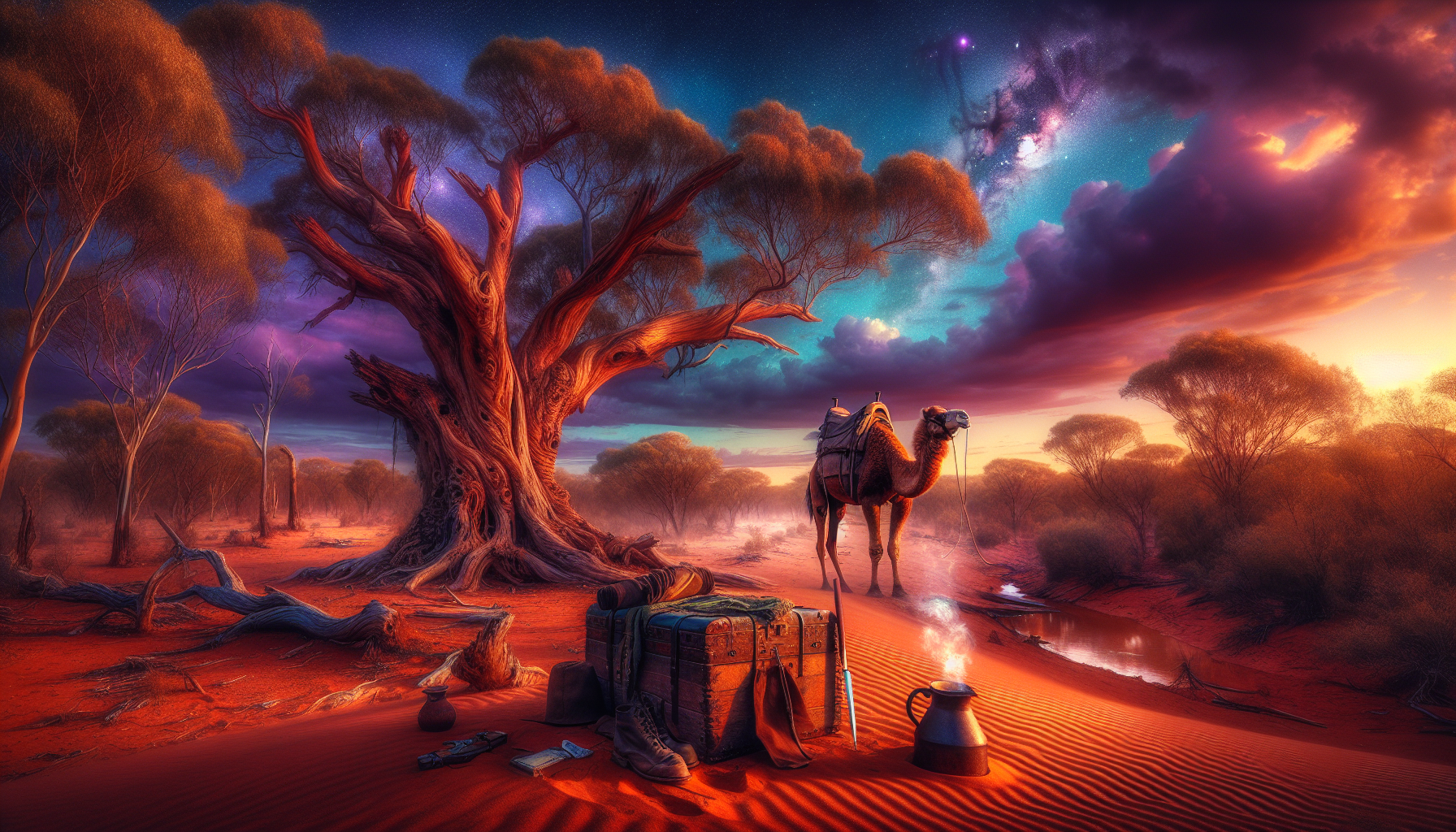
Royal Park on the afternoon of 20 August 1860 was watched by an estimated fifteen thousand spectators. The supply train included a cedar-topped oak camp table, a Chinese gong, an enamel bath, twelve dandruff brushes, and rocket flares. The wagons broke down within hours of departure. By the time the expedition reached Menindee on the Darling River on 12 October 1860, Burke had already replaced his second-in-command Landells, suspended several officers, and lost roughly a quarter of the original supply.
Menindee, the Cooper Creek Depot, and the Forward Push
Burke split the expedition at Menindee on 19 October 1860. He took eight men, fifteen horses, and sixteen camels and pushed ahead to establish an advance depot at Cooper Creek, leaving William Wright, the manager of nearby Kinchega Station, in charge of the rest of the supply column with instructions to follow as soon as he could. The choice has been read in two ways. The first reading, advanced in Tim Bonyhady’s Burke and Wills: From Melbourne to Myth (David Ell Press, 1991), treats the split as a reasonable response to summer heat and to public pressure for visible progress; the second, articulated forcefully in Sarah Murgatroyd’s The Dig Tree (Text Publishing, 2002), treats it as the first of a chain of decisions in which Burke privileged speed over the cohesion of his own command [1].
The advance party reached Cooper Creek on 11 November 1860. They established Camp LXV, the depot the world would later know as the Dig Tree camp, on a southern bend of the Bullah Bullah Waterhole on 6 December 1860. Burke, Wills, John King, and Charles Gray (the Scottish-born ex-sailor Burke had hired at Swan Hill) departed for the Gulf of Carpentaria from this depot on 16 December 1860. Burke left William Brahe, an experienced bushman, in charge of Camp 65 with explicit instructions to wait three months. Wills, in a private aside Brahe later reported to the 1862 inquiry, asked him to wait four if he could.
To the Gulf of Carpentaria, February 1861
The forward party of four left the depot with six camels, one horse, and provisions for three months. They moved north through the Sturt Stony Desert, into Yandruwandha and Wangkangurru Country, then on to the Selwyn Range and the headwaters of the Cloncurry. Wills’s field journal, preserved in the State Library of Victoria’s Burke and Wills collection, records distances of fifteen to twenty miles a day in temperatures the party estimated above one hundred Fahrenheit [2].
On or about 9 February 1861 Burke and Wills pushed forward from Camp CXIX (119), the camp Wills had established on the Bynoe River, in an attempt to reach the open Gulf coast. The mangroves and tidal flats defeated them. They tasted the brackish tidal water; they did not see the open sea. The Australian transcontinental crossing had been functionally completed without ever being visually confirmed. The two men returned to Camp 119, the four-man party turned south, and the slow death of the return march began.
The Return: Gray’s Death and the Missed Depot
By late March the party was on starvation rations. Charles Gray, weak from dysentery and what later sources have read as scurvy, was caught taking flour from the common store; Burke beat him for it. Gray died on 17 April 1861 at Polygonum Swamp, four days short of the Cooper Creek depot. Burke, Wills, and King spent a day digging his grave in ground hard enough to break their tools, then continued south with three of the original six camels. The decision to bury Gray rather than push on cost them roughly twenty-four hours of marching time.
They reached Camp 65 on the evening of Sunday, 21 April 1861. The depot was deserted. William Brahe, after waiting eighteen weeks rather than the thirteen Burke had ordered, with one of his men (William Patton) injured and the supply column from Menindee nowhere in sight, had ridden out that morning. The forward party had missed him by approximately nine hours. Brahe had blazed the coolibah at the camp with the inscriptions “B / LXV” on the creek-side trunk, “DEC 6.60 APR 21.61” on an upstream limb, and “DIG 3 FT NW” on the landward side, marking the position of a small cache of food buried for the returning party. The cache held flour, oats, sugar, and dried meat sufficient for perhaps a month [3].
Why the Depot Was Empty
The simultaneous failure of two timetables produced the empty depot. Burke had taken longer to reach the Gulf and return than he had budgeted; Brahe had waited five weeks longer than Burke had ordered, then left the day Burke was nine hours away. Behind both men stood William Wright, who had not departed Menindee with the supply column until the end of January 1861, and whose progress north toward Cooper Creek had stalled at the Bulloo River, where three of his men, including the artist and naturalist Ludwig Becker, would die before the relief expedition reached them. The 1862 Royal Commission of Inquiry apportioned blame across all three command levels. Wright was named most directly; Burke was criticised for the speed of his northern push and for failing to leave clearer instructions; the Royal Society of Victoria’s Exploration Committee was criticised for under-supervising the entire enterprise [4].
The Yandruwandha and the Survival of John King
Burke, Wills, and King rested at the Dig Tree on 21 to 22 April 1861, ate the cache, and argued about what to do next. Burke chose to push southwest toward the police outpost at Mount Hopeless on the South Australian border, against Wills’s advice to wait at the depot for Brahe to return. They left a buried message in the cache pit reporting their arrival and direction. Brahe and Wright actually returned to Camp 65 about three weeks later, found the pit apparently undisturbed (the men had reburied it carefully), and rode away again without realising the survivors were alive within forty miles of the depot.
The Mount Hopeless attempt failed. The party turned back toward Cooper Creek and was reduced, by mid-May, to following the local Yandruwandha people from waterhole to waterhole. The Yandruwandha gave them fish, the seed of the nardoo fern, and showed them, several times, how to gather it. They did not, the modern record suggests, fully demonstrate how to prepare it. Nardoo (Marsilea drummondii) contains thiaminase, an enzyme that destroys vitamin B1; the Yandruwandha disabled the enzyme by extensive grinding, leaching the meal in water, and roasting on hot stones. The expedition party ground the spore-cases on Burke’s bowie knife, mixed the meal into a paste, and ate it without the leaching step. The thiaminase persisted. The men slowly developed beriberi: weakening, peripheral neuropathy, edema. They were starving even as their stomachs were full [5].
Wills’s last journal entry is dated 29 June 1861. He died at Breerily Waterhole shortly afterward, alone in a wurley the Yandruwandha had helped build. Burke died, by King’s later account, the following morning at a place called Yaenimemgi, asking King not to bury his body. King, by now too weak to move, was found by a group of Yandruwandha women collecting nardoo. They led him back to their camp.
What the Yandruwandha Did
The Yandruwandha kept John King alive for approximately eleven weeks. They fed him daily rations of properly prepared nardoo and occasionally fish; in his journal, recovered later, King recorded shooting birds with his pistol to share with the camp in return. He befriended a man recorded in the relief party’s notes as Pitchery and treated, with such medicines as he had, a skin sore on a Yandruwandha woman recorded as Carrawaw. The Australian government’s Burke, Wills, King and Yandruwandha National Heritage listing, gazetted in 2013, formally recognises this care. The same listing names Yandruwandha Country as a place where the expedition was “rescued by the generosity of the Yandruwandha people,” a phrasing the colonial press of 1861 would not have used [3].
Howitt’s Relief Expedition and the 15 September Recovery
News that something had gone wrong reached Melbourne in early June 1861, when Brahe’s party returned to Menindee. The Royal Society of Victoria appointed Alfred William Howitt (1830-1908), an experienced bushman who would later become one of Australia’s first systematic ethnographers, to lead a Victorian Contingent Party. Howitt, with the surveyor Edwin Welch as second in command, left Melbourne on 26 June 1861 and reached Cooper Creek in mid-September.
Welch was riding ahead of the main column on 15 September 1861, scanning the south bank for tracks, when he saw a group of Yandruwandha gesturing across the creek. He crossed. They led him to a man so emaciated he could not stand. King’s surviving journal, the breastplate Howitt later commissioned to gift the Yandruwandha leaders in thanks, and the recovered field notebooks of Wills entered the State Library of Victoria’s collection over the next decade. Howitt buried Burke and Wills near where they had died, returning in 1862 to exhume the remains for the state funeral that filled Melbourne’s streets in January 1863 [6].
Was It Leadership Failure, Supply Failure, or Climate Misjudgment?
The 1862 Royal Commission did not pick one cause and the modern historiography has not picked one either. Burke’s command decisions are easy to itemise: the Menindee split, the speed of the northern push, the choice of Mount Hopeless over the depot, the beating of Gray. The supply line failed at two nodes simultaneously: Wright at Menindee did not move with adequate urgency, and the Royal Society of Victoria’s Exploration Committee did not impose a timetable that would have detected his delay. The climate killed three men by depriving the supply chain of the water margin its planners had assumed. The interpretive frame Sarah Murgatroyd advanced in 2002, picked up by curators at the National Museum of Australia, treats the expedition as a colonial-scientific enterprise undone by its own organising premise: the assumption that European bush skill, imported camels, and a quasi-military command structure could substitute for the local knowledge that had sustained human life on Cooper Creek for tens of thousands of years before the Royal Society of Victoria existed [5]. King’s survival, by that reading, was the only outcome consistent with the evidence the country itself supplied.
What the Record Will Not Tell Us
Several questions remain genuinely open. Wills’s last private letter to his father, dated 27 June 1861, suggests he believed Brahe would return; he did not, in that letter, blame anyone. Burke’s last verbal instructions to King, reproduced after the rescue, contain a request that his body be left unburied with a pistol in his hand; whether sincere wish or hallucination cannot now be settled. The exact dates of Burke’s and Wills’s deaths are inferred from journal evidence and from Yandruwandha testimony; the 1862 commission fixed them as 28 June 1861 by convention. The Dig Tree, listed on the Queensland Heritage Register since 28 February 2003, still stands at Nappa Merrie Station. The inscriptions Brahe carved are now eroded into the bark, but legible. They mark the precise nine hours that decided the rest.
Frequently Asked Questions
When did the Burke and Wills expedition take place?
The Victorian Exploring Expedition departed Melbourne’s Royal Park on 20 August 1860 and the relief party recovered its sole survivor on 15 September 1861. Major waypoints were the Menindee split (19 October 1860), the establishment of the Cooper Creek depot at Camp 65 (6 December 1860), the forward party’s departure for the Gulf (16 December 1860), the Bynoe River turnaround (around 9 February 1861), the missed depot at Cooper Creek (21 April 1861), and the rescue of John King by Edwin Welch and Alfred Howitt (15 September 1861).
Who led the expedition and what were their backgrounds?
Robert O’Hara Burke (1821-1861), an Irish-born Victorian police inspector with no inland exploration record, was selected by Royal Society of Victoria ballot. William John Wills (1834-1861), an English-born surveyor trained at the Melbourne Magnetic Observatory, was appointed third-in-command and astronomical observer. The forward party of four also included John King (1838-1872), an Irish ex-soldier in charge of the camels, and Charles Gray, a Scottish-born ex-sailor hired at Swan Hill in September 1860.
What is the Dig Tree and what was carved on it?
The Dig Tree is a coolibah (Eucalyptus coolibah, formerly E. microtheca) on the Bullah Bullah Waterhole of Cooper Creek at Nappa Merrie Station in southwestern Queensland. William Brahe blazed it on 21 April 1861 with three inscriptions: “B / LXV” identifying Burke and Camp 65, “DEC 6.60 APR 21.61” recording the camp’s establishment and his departure, and “DIG 3 FT NW” directing returning men to a buried cache of supplies. The tree is estimated at two hundred to two hundred and fifty years old and has been on the Queensland Heritage Register since 28 February 2003.
Why did Burke, Wills, and King miss the depot?
Two timetables failed at the same moment. The forward party arrived on the evening of 21 April 1861, approximately nine hours after William Brahe rode out for Menindee. Brahe had waited eighteen weeks rather than the thirteen Burke had ordered, with one of his men injured and the supply column from Menindee, under William Wright, having stalled at the Bulloo River. The cache Brahe buried at the foot of the tree held about a month of food. Burke chose to push southwest toward Mount Hopeless rather than wait at the depot. Brahe and Wright, returning briefly weeks later, did not realise the survivors were alive within forty miles.
How did the Yandruwandha keep John King alive?
The Yandruwandha, the traditional owners of the Cooper Creek country, gave King daily rations of properly prepared nardoo seed and occasional fish for approximately eleven weeks after Burke and Wills died in late June 1861. Properly prepared nardoo (the seed of Marsilea drummondii) requires extensive grinding, leaching in water, and roasting to disable a thiaminase enzyme that otherwise causes beriberi; the expedition party had not learned this preparation. King recorded the names of at least two Yandruwandha individuals (a man Pitchery and a woman Carrawaw) and shot birds for the camp in return for food. The Burke, Wills, King and Yandruwandha National Heritage Place, gazetted in 2013, formally recognises this care.
What killed Burke and Wills?
Both men died of starvation compounded by beriberi. The expedition’s nardoo, ground without leaching, retained the thiaminase enzyme that destroys vitamin B1; the men were eating but their bodies could not absorb the nutrients. Wills’s last journal entry, dated 29 June 1861, describes himself as “weaker than ever, my legs and arms nearly skin and bone.” Burke died the following morning at a place King’s account names Yaenimemgi. The 1862 Royal Commission fixed both deaths as 28 June 1861 by convention; the actual dates are inferred from the journals and from Yandruwandha testimony.
Who was William Brahe and what did he do wrong?
William Brahe was an experienced German-born bushman left in charge of Camp 65 when Burke departed for the Gulf on 16 December 1860. Burke ordered him to wait three months; Wills privately asked for four. Brahe waited eighteen weeks (about four months and one week) before riding out on the morning of 21 April 1861, the day the forward party returned. Modern assessments, including Sarah Murgatroyd’s 2002 reconstruction, treat Brahe as having waited longer than instructed but not long enough; his decision was made under the constraint of an injured man and a non-arriving supply column. The 1862 commission did not censure him.
What does Sarah Murgatroyd’s “The Dig Tree” argue?
Sarah Murgatroyd’s The Dig Tree: The Story of Burke and Wills (Text Publishing, 2002) is the standard modern English-language narrative reconstruction. Murgatroyd retraced the route three times in the late 1990s while ill with cancer, integrated archival, scientific, and Yandruwandha sources, and read the disaster as a chain of avoidable command decisions compounded by a colonial-scientific premise that European preparation could substitute for local knowledge of arid Australia. She died in March 2002, weeks after the book’s publication.
What does Tim Bonyhady’s “From Melbourne to Myth” argue?
Tim Bonyhady’s Burke and Wills: From Melbourne to Myth (David Ell Press, 1991) treats the expedition’s afterlife as primary subject: the cultural production of the explorers as Australian myth across paintings, sculpture, poetry, drama, and film over the 130 years following 1861. The first half reconstructs the expedition; the second half traces how the Royal Society of Victoria, the colonial press, and successive generations of Australian artists and historians shaped a story of heroic failure that often elided the Yandruwandha role.
Where can the expedition be studied today?
The Royal Society of Victoria’s Burke and Wills collection, deposited in 1875, is held at the State Library of Victoria and contains roughly twelve thousand pages across thirteen boxes, including the original Wills field journals, Burke’s correspondence, and the records of Howitt’s relief expedition. The Burke and Wills Web (burkeandwills.net.au) provides digital access to expedition records. The Dig Tree itself is preserved on the Queensland Heritage Register at Nappa Merrie Station. The Burke, Wills, King and Yandruwandha National Heritage Place at Innamincka, gazetted in 2013, formally commemorates both the expedition and the Yandruwandha care of King.
For deeper context across the historical and archaeological mysteries archive, consider The Hollow Earth Theory and The Yonaguni Monument.