By Wren Ashby · Published May 7, 2026 · Updated September 10, 2026
Last updated: September 10, 2026.
A working ethologist will tell you that the most informative animals in a story are the ones nobody is looking at. In the case of the lost tomb of Genghis Khan (born Temüjin, c. 1162-1227), the animals nobody is looking at are the horses. A thousand of them, by tradition. Driven across the burial pit until the soil read like any other patch of steppe. Then the riders themselves, killed where they stood, so that the only witnesses left to the resting place of the Mongol Empire’s founder were the wind and a sacred mountain.
I came to this topic the way I come to a stranding event or an out-of-place migration: by watching the animal first. The thousand-horse legend is not a flourish. It is a behavioral data point about a culture that worshipped the horse as kin and the mountain as ancestor, and it shapes every modern attempt to find Khan’s tomb without breaking the ground he chose.
Direct Answer: Where Is the Tomb of Genghis Khan?
The tomb of Genghis Khan has never been found. Most scholars place it on or near Burkhan Khaldun, the sacred mountain in Mongolia’s Khentii range that the Khan named as his spiritual anchor and that UNESCO inscribed as a World Heritage site in 2015. The Mongolian government prohibits excavation. Modern work uses non-invasive satellite, UAV, and geophysical survey instead. [1][2][3]
The Death of Temujin and the Birth of a Burial Secret
Genghis Khan died in August 1227, during the final siege of Yinchuan in the Tangut-ruled Western Xia state. The exact day is given by some chroniclers as 18 August, by others as 25 August. The cause is contested: a fall from his horse during a winter hunt the year before, an arrow wound, illness, or some combination of all three. [4]
What happened next was deliberate. His commanders kept the death a secret long enough to finish the campaign. They then carried the body north, by tradition all the way back to the homeland in the Khentii Mountains. The Persian historian Rashid al-Din Hamadani (1247-1318), writing in the Jami al-Tawarikh (Compendium of Chronicles) under the Mongol Ilkhanate around 1310, describes the funeral cortege killing every person it met along the route. The Italian merchant Marco Polo (1254-1324), who served at the Yuan court two generations later, wrote in his Travels that the bodies of the slaves who had attended the burial were also put to the sword, and that the soldiers who killed them were killed in turn. The earlier Tarikh-i Jahangushay of the Persian historian Ata-Malik Juvayni (c. 1226-1283), composed around 1260, is the source for the trampling tradition. After the Khan was placed in the earth, a thousand horses were driven across the surface until the ground gave no sign of what lay beneath. [1][5][6]
Whether every detail is literal or partly retrospective myth, the secrecy itself is well documented. By the time Marco Polo arrived in Mongol territory in the 1270s, even the ruling family had reportedly lost the location. That is not a failure of the Mongols. That is the success of a burial protocol designed, by the Khan and by those loyal to him, to be unrecoverable.
Burkhan Khaldun: A Sacred Mountain, Not a Dig Site
The most likely resting place is Burkhan Khaldun, a 2,340-meter peak in Khentii Province in northeastern Mongolia. Its name translates loosely as “God Mountain” or “Willow God Mountain.” The Secret History of the Mongols, the foundational thirteenth-century Mongolian text recognized by UNESCO in 1990 as a literary work of universal significance, mentions the mountain by name twenty-seven times. The young Temujin took refuge on its slopes when an enemy raid pushed him into the woods. He emerged, by his own account, owing the mountain his life, and he formalized its worship as part of his political program. [2][7]
In 2015, UNESCO inscribed the Great Burkhan Khaldun Mountain and its surrounding sacred landscape as a World Heritage site under criteria (iv) and (vi), recognizing 443,739 hectares of core property and a 271,651-hectare buffer zone. The protected designation rests on two pillars: a tradition of mountain and nature worship that runs back several millennia, and the mountain’s role in the founding epic of the Mongol nation. The peak sits inside the Khan Khentii Strictly Protected Area, established by the Mongolian government in 1992 and covering roughly 12,000 square kilometers. [2]
For an ethologist, the cultural designation is also an ecological one. Strict protection means a roadless, low-traffic interior with intact taiga forest, peat bogs, and mid-elevation steppe. Brown bear, gray wolf, Eurasian lynx, moose, and a roster of forest-and-steppe birds use the watershed. The same rules that keep the burial undisturbed keep the ecosystem intact. The two protections have been mutually reinforcing for almost eight centuries.
The Thousand-Horse Burial as Comparative Bioarchaeology
Sit with the legend of the thousand horses long enough and a question forms: is there independent archaeological evidence that Mongol-steppe burial practice ever involved horse sacrifice on this scale? The answer, drawn from the wider zooarchaeological record, is yes.
Bronze Age khirigsuur burial mounds, distributed across the central and northern Mongolian steppe and dated roughly between 1200 and 700 BCE, are circled by satellite mounds that contain the heads, neck vertebrae, and lower-limb phalanges of horses. Some sites preserve the remains of dozens to hundreds of individual animals. A 2019 study of the Tsatsyn Ereg complex in Arkhangai Province described the slaughter pattern: blunt trauma to the forehead, occasional throat-slitting, and selective deposition of skulls and hooves rather than whole carcasses. The horses were almost certainly butchered off-site, and only the symbolically loaded body parts (head, mane, lower legs, that is, the parts of the horse a rider sees and touches) were brought to the burial. [8]
The continuity from these Bronze Age complexes through later Scythian and Turkic burials is one of the most consistent threads in Inner Asian bioarchaeology: the horse as psychopomp, the soul-guide carrying the deceased into whatever lies beyond. By the time the Mongol confederations consolidated under Genghis Khan in the early thirteenth century, that ritual grammar had been spoken on the steppe for more than two thousand years. A burial protocol that involved the deaths of a great many horses is therefore not a flight of poetic exaggeration. It is a familiar idiom turned up in volume to match the scale of the man being buried.
What the Animals Tell Us About the Place
Domesticated horses leave a heavy ecological signature. They compact soils. They alter grass community composition. Their dung lingers as a phosphorus marker in the sediment record. A burial that involved a thousand animals, even briefly, would have produced a localized geochemical and palynological anomaly that, in principle, should still be measurable in lake-core or peat-core records sampled at the right place. None of the published surveys to date claim to have found such a signal pinpointing a specific 1227 event. That is not surprising. The Khentii is a big watershed and the proxies are noisy. But it is a research handle that the non-invasive program should keep open.
Modern Searches: Non-Invasive by Necessity
The Mongolian government does not permit excavation at Burkhan Khaldun. The position is consistent with the ikh khorig, the “Great Taboo” enforced under the empire itself: a sealed-off area, by tradition guarded by the Darkhad tribe, with trespass historically punishable by death. The taboo persisted through the Soviet period, when access was restricted for political reasons that happened to coincide with the cultural ones. It persists now. From a research-design point of view, this is not an obstacle to overcome. It is a constraint that disciplines method. [1][7]
The largest modern effort, the Valley of the Khans Project, was led by the National Geographic explorer and University of California, San Diego, scientist Albert Yu-Min Lin between 2008 and 2015. Lin and his team made a deliberate decision early on: nothing would be excavated, nothing would be published with coordinates that could direct looters, and the work would be conducted in cooperation with the Mongolian Academy of Sciences and local custodians. The peer-reviewed result, “Crowdsourcing the Unknown: The Satellite Search for Genghis Khan,” appeared in PLOS ONE in December 2014. [3]
The methodology stacks layers of remote sensing. GeoEye-1 satellite imagery at 0.5-meter resolution, pan-sharpened and ortho-rectified, was tiled into 84,183 semi-overlapping images and presented to a public audience through a National Geographic web platform. More than 10,000 volunteers contributed roughly 30,000 hours of looking, producing 2.3 million feature categorizations across 6,000 square kilometers. Consensus algorithms based on kernel density estimation pooled the human perception into anomaly maps. Ground truth followed by drone (UAV) photography, magnetometry, electromagnetic survey, and ground-penetrating radar. The project has confirmed 55 archaeological sites of independent significance even though the burial itself remains unidentified. [3]
A separate effort by the French archaeologist Pierre-Henri Giscard, working with drone-borne photogrammetry around 2015 and 2016, has proposed that a 250-meter-long earthen mound on Burkhan Khaldun itself, modeled on Chinese imperial tombs of the period, may be a candidate structure. The Mongolian authorities have not authorized invasive testing. The proposal sits where it should: as a hypothesis that the next generation of geophysics may, or may not, be able to resolve from the surface.
Why the Tomb Should Stay Where It Is
As an ethologist, I am used to studies that cannot be done. The bowhead whale’s complete vocal repertoire requires a level of pelagic acoustic monitoring that takes decades to assemble. The full social structure of a wolf pack does not yield to a single field season. We learn to want the answer less than we want the truth, which is sometimes a slower thing.
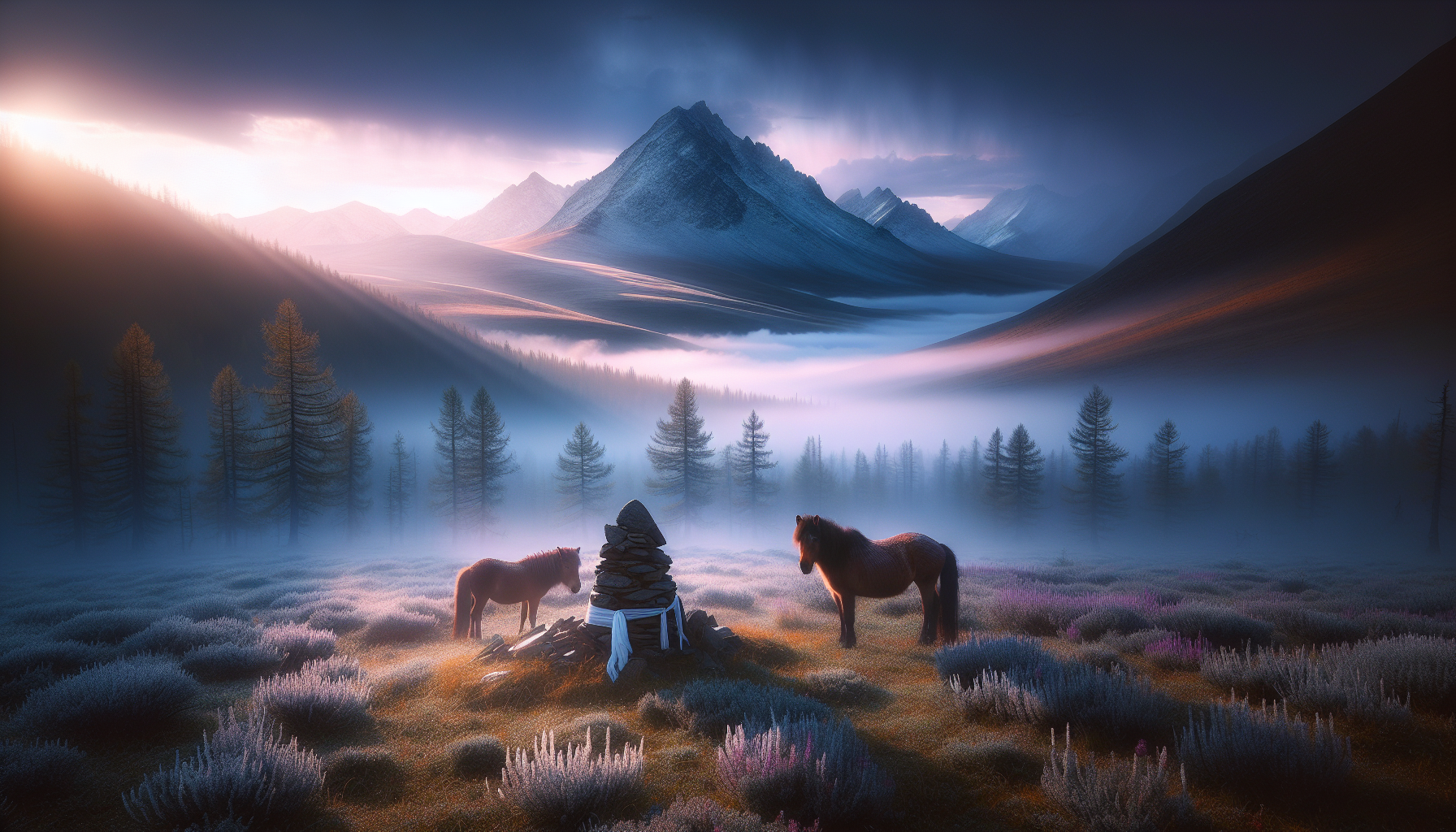
The tomb of Genghis Khan is a different kind of unfinished study. The reason it has not been resolved is not technical. It is ethical and cultural. The ikh khorig is a living tradition. Burkhan Khaldun is sacred to a population that still sends ovoo offerings (cairns of stone, prayer flags, libations of fermented mare’s milk) up the slopes. The Mongolian state’s prohibition on excavation is not a procedural delay. It is the policy of a sovereign nation regarding its founding ancestor and its most spiritually weighted landscape.
The honorable research path runs through cooperation, non-invasive instruments, and patience. Lin’s project model (academic partnership, no looter-actionable disclosure, refusal to excavate) is the right shape. The same satellite, magnetometric, and palynological tools used to map khirigsuur fields elsewhere on the steppe can be brought to bear here without ever turning a single shovel. That work is slow. So is good biology.
The Animal in the Center of the Mystery
If the legend is accurate, somewhere on or near Burkhan Khaldun there is a layer of soil that, eight centuries ago, was passed over by a thousand hooves. The horses are gone. Their genetic descendants still graze the same valleys, in herds tended by the same families’ descendants. Mongolian horses today are short, hardy, multi-coated animals that the Food and Agriculture Organization recognizes as a breed of significant cultural and biodiversity value. They sleep standing, they tolerate temperatures below minus 40 Celsius, and they navigate by something that is not yet fully understood by ethologists, including this one.
When you stand on the steppe and watch a Mongolian horse turn its head toward a sound the human ear does not register, it is easy to believe that the burial protocol of 1227 chose its accomplices well. The horses kept the secret. The mountain kept it. We can sit with that, hold the historical and archaeological mysteries open, and continue the work that does not break the ground.
What the Search Tells Us About How to Look
The lost tomb of Genghis Khan is the rare archaeological problem that is best left mostly unsolved. Each new tool (LiDAR, hyperspectral imaging, low-altitude UAV magnetometry, AI-assisted feature detection) extends the surface-readable record. Each new conversation with the Darkhad and the Mongolian Academy of Sciences refines what counts as appropriate inquiry. The research is genuinely cumulative, and the answer it is converging on may turn out to be: yes, it is here, and no, we will not open it.
That is a satisfying ending for an ethologist. The animal you study most carefully is not always the one you catch. Sometimes the work is to map the territory, name the behaviors, and let the subject keep the part of itself that does not belong to you.