
By EsoVitae Editorial · Published
Drafted with AI assistance from the sources listed; images are AI-generated illustrations. How EsoVitae is made
On 4 March 1918 the collier USS Cyclops cleared the harbor at Bridgetown, Barbados, bound north for the Norfolk Navy Yard with a hold of 10,800 tons of Brazilian manganese ore and 306 souls aboard. She never arrived. No SOS, no debris field, no oil slick — and, more than a century later, no wreck. The single largest non-combat loss of life in United States naval history is also one of its most thoroughly documented disappearances, which is exactly why it has resisted the romantic readings imposed on it. The record is fuller than the silence suggests, and it points away from the supernatural.
Direct Answer: What Happened to the USS Cyclops
The USS Cyclops (AC-4), a 19,360-ton Proteus-class collier of the United States Navy, vanished in March 1918 between Barbados and Norfolk while carrying 10,800 tons of manganese ore and 306 men. The leading scholarly explanation, supported by the near-identical 1941 losses of her sister ships Proteus and Nereus, is structural failure under cargo overload in heavy Atlantic weather [1].
The Ship and Her Last Voyage
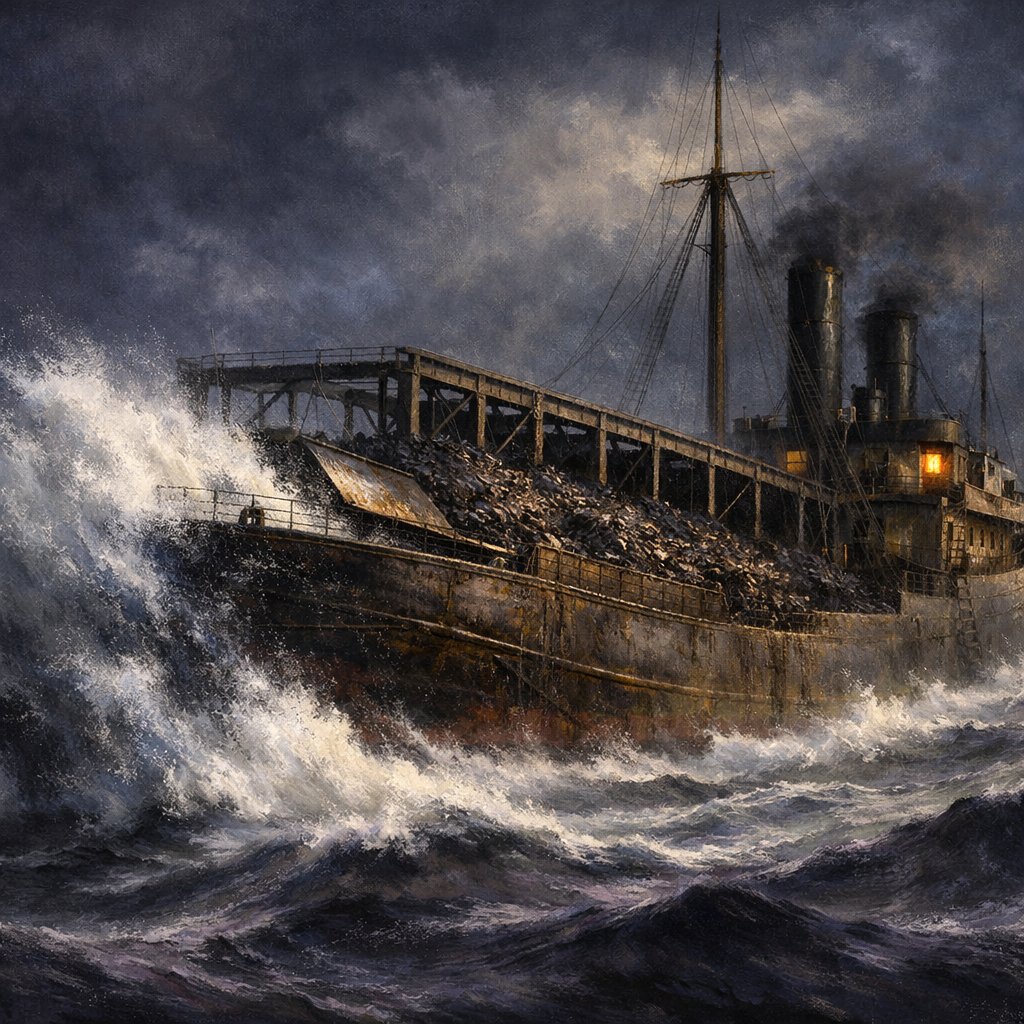
The Cyclops was a workhorse of an unromantic kind. Built at the William Cramp & Sons yard in Philadelphia and commissioned in 1910, she was 542 feet long, displaced 19,360 tons fully loaded, and was designed to do one thing well: move tens of thousands of tons of coal between fleet bases. Her hull was an open-sided I-beam frame around an enormous central bunker, more bridge than box, with twenty-four hatched cargo holds. The Naval History and Heritage Command’s official ship’s history, drawn from her surviving deck logs and from the 1918 Court of Inquiry record, describes her as “a vessel of unusual construction” — language that would acquire weight after she was gone [1].
By 1918 the United States had been at war with the Central Powers for eleven months, and the Naval Overseas Transportation Service was straining every collier and cargo bottom in the inventory. The Cyclops, requisitioned from her peacetime fleet-coaling rounds, was reassigned to bulk-mineral haulage. On 16 February 1918 she sailed from Rio de Janeiro under Lieutenant Commander George Worley with 10,800 tons of manganese ore consigned to the Bethlehem Steel works at Sparrows Point — a strategic cargo, since manganese was indispensable for the alloying of armor-grade steel [2].
She made a brief, unscheduled stop at Bridgetown, Barbados, on 3 and 4 March, ostensibly for additional provisions and water. The American consul there, Brockholst Livingston, reported the ship “deeply laden” and noted that Worley had paid for stores in cash and seemed agitated. The Cyclops cleared Barbados on the afternoon of 4 March. She was due at Hampton Roads on 13 March. She did not arrive [3].
Captain Worley and the Wartime Frame
A great deal of the popular literature, written before the structural argument was fully developed, fixates on the captain. George W. Worley had been born Johann Frederick Wichmann in Sandstedt, Hanover, in 1862; he emigrated to the United States, naturalized, and changed his name. By 1918 his German birth, in a Navy at war with Germany, had attracted attention from his officers and from naval intelligence. Court of Inquiry depositions describe him as moody, at times harshly disciplinary, and prone to walking the bridge in his underclothes — colorful detail that has been carried into a hundred secondary accounts [3].
It is one thing to note that Worley was an idiosyncratic commander whose loyalty was scrutinized in wartime, and quite another to read his disappearance as evidence of sabotage or defection. The Office of Naval Intelligence ran an inquiry into the loss in 1918 and again, with renewed attention, after the United States entered the Second World War. Both inquiries declined to find evidence of treachery, and no German naval record uncovered after 1945 mentions a captured American collier of Cyclops‘s description in March 1918 [3]. The captain’s biography is part of the story; it is not the story.
The Bermuda Triangle Reading and Its Demolition
From the late 1960s the Cyclops was conscripted into a different narrative. Vincent Gaddis’s 1964 Argosy article and Charles Berlitz’s 1974 bestseller The Bermuda Triangle made the ship a centerpiece of the supposed paranormal zone bounded by Miami, Bermuda, and San Juan. The framing was emotionally satisfying and bibliographically careless: it omitted the cargo, the ship’s structural specification, and the Atlantic weather record for the loss window.
The corrective came in 1975, when the librarian and pilot Lawrence David Kusche published The Bermuda Triangle Mystery — Solved. Kusche’s method was the unglamorous one. He pulled contemporary newspaper archives, U.S. Hydrographic Office weather reports, Lloyd’s of London casualty records, and the surviving Court of Inquiry depositions, and he checked the Triangle’s celebrated cases against the documentary record one by one. For the Cyclops, Kusche showed that a serious storm had been working the ship’s likely track between 9 and 10 March, that her overloaded cargo lay outside her design parameters, and that the “Triangle” geometry was an artifact of selective mapping — several of the supposed anomaly cases occurred well outside the named region. His chapter on the Cyclops remains, fifty years later, the cleanest single piece of historiography on the loss [4].
The Structural-Failure Hypothesis
The argument that has consolidated in the half-century since Kusche treats the Cyclops as a marine-engineering case rather than a mystery. Three strands tie it together. First, the ship’s construction. The Proteus class colliers carried their cargo in a long open frame stiffened by transverse I-beams; this gave them excellent loading flexibility but unusually low torsional rigidity for a ship of their length. In a quartering or following sea, the hull was prone to working — flexing along its longitudinal axis under wave-induced shear [5].
Second, the cargo. Manganese ore is roughly twice as dense as the bituminous coal the ship was designed to carry. Even at her rated tonnage of 10,800 long tons of cargo, the ore occupied a far smaller stowage volume, concentrating mass low in the hull and producing what naval architects call a “stiff” stability profile — short, snappy roll periods that whipped the structure under wave loading rather than dampening it. The cargo was further prone to shifting and to liquefaction in the presence of trapped moisture, both of which would have placed sudden, asymmetric loads on the I-beam framework [5].
Third, the comparative evidence from her sisters. The Cyclops had two near-identical Proteus-class siblings, USS Proteus (AC-9) and USS Nereus (AC-10). In late 1941 both were lost in the western Atlantic within weeks of each other, both carrying bulk mineral cargoes (bauxite, in their case) along comparable routes, both in moderate-to-heavy weather, and both without survivors or wreckage. The 1941 losses were initially blamed on German U-boats, but post-war examination of Kriegsmarine patrol logs found no boat in position to claim either kill. The pattern that the Naval History and Heritage Command and Marvin Barrash, in his exhaustive 2010 family history USS Cyclops, both highlight is the same: same hull form, same cargo class, same ocean, same outcome [1, 6].
Three Proteus-class colliers, three losses in heavy weather under dense bulk-mineral cargo, three vanishings without trace. The probabilistic reading writes itself. Whatever destroyed the Cyclops in March 1918 destroyed her sisters in late 1941, and the common factor is not a triangular zone of the Atlantic but a structural specification that could not bear the duty it was being asked to perform.
What the Search Has and Has Not Found
The Cyclops wreck has never been located. The Navy mounted a contemporary search in March and April 1918 along the projected track and out to two hundred miles east of the Atlantic seaboard; nothing was recovered. Modern side-scan and multi-beam efforts in the 1960s, 1970s, and again in the early 2000s have surveyed plausible debris fields off the Virginia and Carolina coasts and the Blake Plateau without confirmation. The continental shelf in the area falls away rapidly to depths of 4,000 to 5,000 meters, which would make any wreck a difficult target even if its position were known to within a few miles. Her likely position is not known to within a few miles [1].
A persistent secondary line of investigation, taken up by Marvin Barrash — the great-nephew of crewman James Davis Barrash and the most diligent private archivist of the case — concerns the Bridgetown stop. Barrash’s research recovered the consular file, the Bethlehem Steel cargo manifest, and the personal effects of several crewmen, and it suggests that the ship may already have been laboring before she left Barbados, possibly with one of her two main engines disabled. Worley’s request for tugs on departure, refused by the local British harbor authority, would be consistent with that reading. If the ship sailed already partly crippled, her capacity to ride out the 9-10 March storm would have been further reduced [6].
Why the Loss Still Matters
Three hundred and six men is the operative figure. It exceeds the loss of any American warship in either world war that did not result from enemy action, and it exceeds the loss aboard the battleship Maine in Havana harbor in 1898. Thirty-eight of the dead were officers and crew of three other naval vessels, hitching passage home; the rest were the ship’s own complement. They are listed by name in the Naval History and Heritage Command’s Cyclops file, with hometowns, ranks, and dates of enlistment — a register that grounds the case in the human scale that the Bermuda Triangle literature tends to flatten [1].
The honest reconstruction holds three things at once. The hull form was inadequate to its wartime cargo specification. The captain was an idiosyncratic figure whose German birth in 1918 made him a focus of suspicion that the evidence does not bear out. The Atlantic weather of 9-10 March 1918 was severe enough to put a marginally seaworthy ship under fatal stress. None of these alone explains the loss; together, they explain it well. The mystery the popular literature insists on is, by the standards of marine historiography, largely solved [4, 5].
A Note on Reading the Material
For the reader who wants the primary record, three doors are open. The Naval History and Heritage Command’s “USS Cyclops” file at the Washington Navy Yard contains the surviving Court of Inquiry depositions, the Norfolk Navy Yard departure logs, and the consular cable from Bridgetown. Lawrence David Kusche’s The Bermuda Triangle Mystery — Solved remains the cleanest meta-historiographic treatment. Marvin Barrash’s USS Cyclops (2010) is the standard family-and-archival monograph. Read them alongside the 1941 loss reports for Proteus and Nereus, and the structural argument carries itself.
Frequently Asked Questions
What was the USS Cyclops?
The USS Cyclops (AC-4) was a 19,360-ton Proteus-class collier of the United States Navy, commissioned in 1910 and built to carry coal for the fleet. By 1918 she was assigned to bulk mineral haulage in support of the war effort.
When and where did the Cyclops disappear?
She left Bridgetown, Barbados, on 4 March 1918, bound for the Norfolk Navy Yard. She was due at Hampton Roads on 13 March 1918 and never arrived. Her last reliably reported position was Barbados.
How many people were lost?
Three hundred and six. This remains the single largest loss of life on a U.S. Navy vessel not directly attributable to enemy action.
What cargo was she carrying?
10,800 long tons of manganese ore loaded at Rio de Janeiro on 16 February 1918, consigned to the Bethlehem Steel works at Sparrows Point, Maryland. Manganese was a strategic alloying element for armor-grade steel.
Was Captain Worley a German agent?
No credible evidence supports that reading. George Worley was born Johann Wichmann in Hanover and naturalized in the United States. The Office of Naval Intelligence investigated in 1918 and again after 1941 and found no evidence of espionage or defection. No German naval record references the capture of an American collier in March 1918.
Did the Bermuda Triangle take her?
No. The Bermuda Triangle framing was popularized by Vincent Gaddis in 1964 and Charles Berlitz in 1974. Lawrence David Kusche’s 1975 documentary review, The Bermuda Triangle Mystery — Solved, demolished the framing for the Cyclops case by recovering the contemporaneous storm record, the cargo manifest, and the Court of Inquiry depositions.
What is the leading scholarly explanation?
Structural failure under cargo overload in heavy weather. The Proteus-class hull form had low torsional rigidity, manganese ore concentrated mass low in the hull producing a stiff roll, and an Atlantic storm worked the ship’s track on 9-10 March 1918.
What about her sister ships, Proteus and Nereus?
Both Proteus-class sisters were lost in the western Atlantic in late 1941 carrying bulk bauxite cargoes in heavy weather, both without survivors or wreckage, and post-war German naval records exclude U-boat attack in either case. The same hull form, the same cargo class, the same ocean, the same outcome — the strongest single piece of comparative evidence for the structural-failure hypothesis.
Has the wreck ever been found?
No. Searches in 1918, the 1960s, the 1970s, and the early 2000s have not located her. The probable area of loss falls into very deep water on or beyond the continental shelf, and the position of loss is not constrained well enough to make the search tractable.
Where can I read the primary documents?
The Naval History and Heritage Command’s “USS Cyclops” archival file in the Washington Navy Yard holds the Court of Inquiry depositions, the Norfolk Navy Yard departure logs, the Barbados consular cable, and the full crew register.
Who was Marvin Barrash?
Marvin Barrash is the great-nephew of crewman James Davis Barrash and the author of USS Cyclops (2010), the standard private-archival monograph on the case. His research recovered the Bethlehem Steel cargo manifest, the Bridgetown consular file, and personal effects of several crewmen, and supports the reading that the ship may have sailed from Barbados already mechanically compromised.
Why does the story still circulate as a mystery?
Because the wreck is missing, the ship sailed before radio gave continuous position fixes, and the popular literature found a clean human-scale narrative in the captain’s biography and the Triangle framing. The structural-failure reading is the more accurate account, but it is harder to dramatize than a paranormal zone or a wartime defector.