By Emilia Wellesley · Published May 7, 2026 · Updated September 10, 2026
Last updated: September 10, 2026.
What Was the Viking Sunstone?
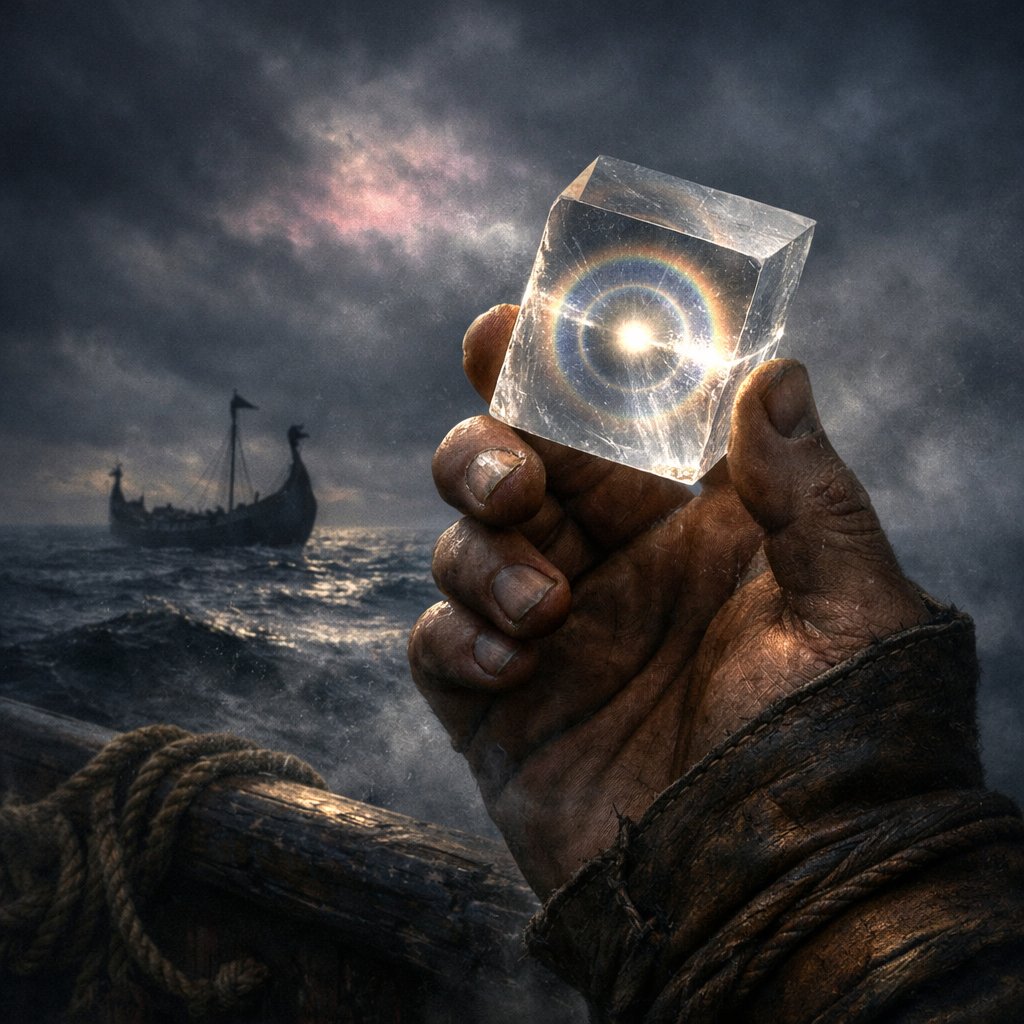
The Viking sunstone, called solarsteinn in the medieval Icelandic sources, is a navigational stone described in saga literature as a tool for locating the sun in overcast skies. The leading hypothesis, advanced in 1967 and confirmed experimentally in 2011, identifies it as a birefringent crystal, most likely Iceland spar calcite, that resolves polarized skylight into two beams whose intensities equalize when the crystal is aimed at the hidden sun.
The North Atlantic between Norway and Vinland is not a forgiving stretch of water. Cloud and fog cover it for weeks at a stretch in the sailing months. Yet between the late ninth and early eleventh centuries, Norse seafarers crossed it in open clinker-built ships without magnetic compasses, without astrolabes, and without sea charts. They reached Iceland by 874, Greenland by 985, and Newfoundland by around 1000. Their navigational toolkit has long puzzled historians of medieval seafaring, and one item from that toolkit, the solarsteinn, sits at the center of the puzzle.
The sunstone is unusual among lost artifacts because it lives in two evidentiary worlds at once. The textual world preserves it in a thirteenth-century redaction of an earlier saga; the experimental world has reconstructed how a calcite crystal can do what the saga claims. What the sunstone lacks, still, is a confirmed Viking-period exemplar pulled from a Norse grave or shipwreck. The case sits at the productive boundary between literary survival and material absence, which is where many of the most interesting questions about historical and archaeological mysteries tend to live.
The Saga of Saint Olaf and the Earliest Mention
The crucial textual witness is a passage in Olafs saga helga, the Saga of Saint Olaf, preserved in the thirteenth-century compilation Heimskringla attributed to Snorri Sturluson and in earlier saga manuscripts. The episode, set during the reign of King Olaf II of Norway (995-1030), describes a snowy day when the king asks a man named Sigurd where the sun is. Sigurd answers, and the king then takes a sunstone, holds it up, and sees a glow that confirms the sun’s position behind the cloud cover. Birger Pering’s 1944 edition Heimskringla: Saga of King Olaf Tryggvason situates the passage within the broader saga corpus, and the Icelandic philologist Hjalmar Thorsteinsson’s 1967 translation of the relevant solarsteinninn phrase made the term legible to English-speaking historians of science.
What the Saga Actually Says, and What It Does Not Say
The saga is brief. It names the object, names a use, and moves on. It does not describe the stone’s mineralogy, its size, the technique of holding it to the sky, or any chain of custody back to a known crystal source. The medieval audience presumably understood the reference. A twenty-first-century reader does not, and the gap is what every reconstruction of the sunstone has to bridge. The saga gives the historian a target. It does not give the physicist a recipe.
Other Saga and Inventory References
A handful of medieval Icelandic church inventories list solarsteinar through the fourteenth and fifteenth centuries, suggesting that the stones survived as recognized objects long after the Viking Age. None of these later references describes their use. Whether they kept their navigational role or drifted into ornament is an open question.
Thorkild Ramskou’s 1967 Hypothesis
The Danish archaeologist Thorkild Ramskou (1915-1985) proposed in a short 1967 paper, expanded in his 1969 book Solstenen, that the saga’s solarsteinn was a birefringent mineral capable of detecting polarized skylight. Ramskou drew on a then-recent observation that aviators in Arctic skies used polarization filters in the Kollsman sky compass to navigate in cloudy conditions. If a Polish-built aircraft instrument could find the sun by reading the polarization pattern of the sky, Ramskou argued, a Viking with a calcite crystal could do something analogous.
How Polarized Skylight Encodes the Sun’s Position
Sunlight scattered by atmospheric molecules acquires a partial polarization that runs in concentric rings around the sun, perpendicular to the solar direction. This pattern, first described mathematically by John William Strutt (Lord Rayleigh) in 1871 and refined by Sir George Stokes earlier, persists through thin cloud cover and through fog because the atmospheric scattering above the cloud layer continues to polarize the diffuse light that filters down. Read the polarization, and you have read a vector that points back toward the sun.
Why Iceland Spar Calcite Was the Strongest Candidate
Iceland spar is a cleaved transparent variety of calcium carbonate found in basaltic cavities in eastern Iceland and famously studied by Erasmus Bartholin (1625-1698), who in 1669 described the mineral’s double refraction. A beam of light entering Iceland spar splits into two beams, an ordinary and an extraordinary ray, whose relative intensities depend on the polarization angle of the incoming light. Rotate the crystal until the two beams shine at equal brightness, and the crystal’s axis points along the polarization direction, which in turn locates the sun. Ramskou named tourmaline and cordierite as plausible alternative birefringent minerals, but Iceland spar’s transparency, abundance in Norse-controlled territory, and clean cleavage made it the strongest candidate.
Ropars, Le Floch, and Martinez: Experimental Confirmation in 2011
For four decades after Ramskou’s proposal the hypothesis remained suggestive but unverified. The decisive turn came in November 2011, when Guy Ropars, Albert Le Floch, and Gerard Martinez of the University of Rennes, working with colleagues at the University of Bordeaux, published a paper in the Proceedings of the Royal Society A that demonstrated experimentally how a calcite crystal could find the sun under realistic Viking-Age sailing conditions. Their method paired a thin Iceland spar slab with a small aperture above it; observers rotated the crystal until the two refracted images of the aperture matched in brightness, then read off the angle.
Accuracy Under Realistic Conditions
The Rennes team reported sun localization to within roughly five degrees under heavy cloud cover and at twilight, with skilled observers achieving better than one-degree accuracy under cleaner conditions, according to the Proceedings of the Royal Society A paper by Ropars and colleagues. Five degrees is enough to set a usable course over an open ocean. One degree is enough to keep a longship on a useful great-circle approximation between Bergen and Greenland. The 2011 work did not prove that Vikings used such a crystal. It proved the technique works.
Replications and Refinements
Subsequent work refined the protocol, tested degraded crystals, and modeled the technique against Norse Atlantic sailing schedules. The hypothesis now sits stably in the historiography of pre-modern navigation alongside dead reckoning, latitude sailing, and bird release.
The Alderney Wreck Calcite of 2002
In 2002, divers excavating the wreck of an Elizabethan warship lost off Alderney in the Channel Islands in 1592 recovered a fist-sized block of optically clear calcite from the captain’s cabin area. The wreck dates to nearly six centuries after the Saga of Saint Olaf, well into the era of the magnetic compass, but the find is striking. A team led by Guy Ropars analyzed the block and demonstrated that, despite three and a half centuries on the seabed, the crystal still functioned as a polarimeter accurate to within about one degree of solar azimuth. The Alderney calcite is now the closest physical object to a sunstone the historical record has produced.
Why a Sixteenth-Century Sailor Carried Calcite
The likeliest explanation is that magnetic compasses of the period were vulnerable to the iron of cannons and ferrous fittings stowed below deck. A crystal that read polarized skylight gave a redundant, non-magnetic sun-bearing on cloudy days, useful as a cross-check before committing to a long tack. The Alderney find suggests that the polarimetric technique persisted in maritime practice well past the Viking Age, surviving as a backup tool in working sailors’ kits even when the saga reference itself was forgotten.
What the Alderney Calcite Does and Does Not Prove
It does not prove that a Viking captain in 985 carried Iceland spar across the Denmark Strait. It does prove that the technique was known, used, and effective in working maritime contexts. That is a different category of evidence, and a careful historian honors the distinction.
Why No Viking-Period Sunstone Has Been Excavated
The absence is the hard part. Viking burials and ship caches have produced thousands of objects, including jewelry, tools, weapons, weights, and combs. No specimen of Iceland spar, tourmaline, or cordierite has been pulled from a Viking-period context with a documented navigational use. The absence has several plausible causes, and reading them requires patience.
Preservation and Recognition Bias
Calcite is fragile, slowly water-soluble, and easily mistaken in field reports for common quartz or a beach pebble. An archaeologist excavating a burial in 1925 had no reason to set aside a transparent stone for laboratory analysis. The object would be catalogued generically, if at all. Recognition bias compounds preservation bias.
The Tool-Versus-Talisman Question
A working navigator may have carried a sunstone as a personal tool that returned home with him rather than going into the funerary record. Working tools, like a carpenter’s plane today, often pass to apprentices rather than into graves. The graves that have produced rich archaeological assemblages tend to belong to elite figures whose status objects were ornamental or symbolic, not utilitarian.
Cordierite and Tourmaline as Alternatives
Iceland spar is the most discussed candidate, but it is not the only birefringent mineral that could serve. Two alternatives carry their own arguments.
- Cordierite: A pleochroic silicate that changes color depending on the angle of polarized light passing through it. Rotate a cordierite crystal in skylight, and the visible color shifts from pale blue to yellow to clear. Norwegian and Greenlandic deposits make the mineral geographically plausible. Some researchers consider cordierite the more likely candidate precisely because the color shift is easier for an untrained eye to read than the brightness equalization required for calcite.
- Tourmaline: A strongly dichroic mineral that absorbs one polarization more than the other. Tourmaline crystals from Scandinavian and Greenlandic localities exist, though the trade in tourmaline as a recognized stone is poorly documented for the Viking Age. The dichroic effect is striking, and it works without the careful alignment that calcite demands.
What This Tells Us About Viking Navigation
Even at its strongest, the sunstone is a single instrument in a larger navigational toolkit. Norse sailors used latitude sailing, holding a course at a known latitude until landfall. They used the polestar, the noon sun’s altitude, and the shadow board, a wooden disk with carved gnomon scales attributed to a 1948 Greenland find. They released ravens at sea to spot land beyond the horizon, a technique recorded in Landnamabok, the medieval Icelandic Book of Settlements. They read swell direction, water color, bird traffic, and cloud-stack signatures over distant islands. The sunstone, if used, supplemented the polestar and the noon sun on cloudy days. It did not replace dead reckoning. It made dead reckoning survivable when the sky closed in.
Frequently Asked Questions
What does solarsteinn mean in Old Norse?
Solarsteinn translates literally as “sun stone.” The compound combines sol (sun) and steinn (stone). The form appears in the Saga of Saint Olaf and in later Icelandic church inventories, where it names a recognized class of object whose precise use is described only in the saga passage.
Did the Vikings really use a crystal to navigate?
The textual evidence is clear that they recognized such an object. The experimental evidence is clear that calcite, cordierite, or tourmaline can in fact locate the hidden sun. The archaeological evidence, meaning a Viking-period crystal pulled from a Norse context with documented navigational use, has not yet been recovered. Honest historians treat the case as well-supported but not conclusively proven.
How accurate could a sunstone get?
The 2011 Ropars team reported about five-degree accuracy under heavy cloud cover and better than one-degree accuracy under cleaner conditions. Five degrees is enough to navigate the open Atlantic. One degree is comparable to the accuracy of magnetic compasses in routine maritime use centuries later.
Is Iceland spar the same as Iceland calcite?
Yes. Iceland spar is the gem-trade name for transparent crystalline calcium carbonate, particularly the optically pure variety found in the basaltic cavities of eastern Iceland. Erasmus Bartholin’s 1669 study of Iceland spar’s double refraction laid the groundwork for the optics that would later validate the sunstone hypothesis.
Why does a calcite crystal split light into two beams?
Calcite is birefringent. Its crystal structure refracts light at two different speeds depending on the polarization of the incoming wave, which separates the beam into ordinary and extraordinary rays. The two rays exit the crystal as two distinct images, whose relative brightness depends on the polarization of the incoming light. Rotate the crystal, and the brightness ratio changes. The angle at which both images shine equally points toward the sun.
How does the Alderney shipwreck fit into the story?
The 1592 Elizabethan wreck off Alderney produced a clear calcite block that still works as a polarimeter today. The find shows that the polarimetric technique persisted in working maritime kits well past the Viking Age. It does not directly prove Viking use, but it places the practice on the spectrum of historical reality rather than purely literary speculation.
What were the alternatives to a sunstone for cloudy-day navigation?
Norse navigators relied on dead reckoning, latitude sailing, the polestar at night, the noon sun’s altitude, swell direction, water color, bird movements, and the recorded release of ravens at sea. The sunstone supplemented these methods on overcast days. Dead reckoning carried the bulk of the navigational load on most voyages.
Could cordierite work better than calcite?
For an untrained user, possibly. Cordierite shifts visible color as the polarization angle changes, which an inexperienced observer can read more easily than the brightness equalization that calcite requires. The trade-off is that cordierite is rarer in optically clear specimens and is more sensitive to the cleanness of the cleavage face. Both minerals remain candidates in the literature.
Has any Viking-period sunstone ever been excavated?
No. As of the most recent archaeological surveys of Norse burial and settlement contexts, no birefringent crystal has been recovered with documented navigational provenance. The absence is real, and it constrains how strongly the case can be stated. The case rests on text plus experiment, with the Alderney calcite as a sixteenth-century material analogue.
What sources should a serious reader start with?
Begin with the Ropars, Le Floch, and Martinez 2011 paper in the Proceedings of the Royal Society A, available in the open literature. Read it alongside Thorkild Ramskou’s 1969 Solstenen for the historiographic context. The Birger Pering 1944 edition of the relevant Heimskringla saga is the canonical primary text. Snorri Sturluson’s Heimskringla in modern English translation gives the broader saga setting.