By Felix Chen · Published May 7, 2026 · Updated May 13, 2026
Last reviewed: May 7, 2026.
What the “Sky Sounds” Phenomenon Actually Is
Between August 2011 and the spring of 2012, a string of YouTube videos showing low, groaning, trumpet-like noises overhead went viral, with clips uploaded from Kiev, Costa Rica, southern Finland, Saskatchewan, Tampa Bay, and roughly two dozen other locations. The phenomenon as a sensory event is genuine in some cases and demonstrably fabricated in others. The phenomenon as a single global mystery is a 2010s social-media artifact.
Most so-called anomalies dissolve under the third significant figure. The “strange sounds from the sky” wave is the rare case where almost every individual datum has a documented mechanism, and the only thing that requires explanation is the spread of the meta-story. The catalog breaks into three buckets. A subset are infrasound and low-frequency acoustic events from genuine atmospheric, auroral, or geophysical sources. A subset are routine industrial noises from cranes, tunneling machinery, train yards, and quarry blasting, redescribed as cosmic. And a substantial subset are admitted or audibly demonstrable audio dubs reusing the Kiev master clip [1][2].
The case-by-case audit method runs the same way as Larry Kusche‘s 1975 work on a different popular mystery: take each named clip, name the actual mechanism, and refuse to accept “unexplained” as the answer when the mechanism is sitting in the public record within the broader landscape of science and natural anomalies.
The Auroral Sounds Are Real, and the Mechanism Is Now Known
For roughly a century, hikers and Sami reindeer herders below active aurora reported faint claps, crackles, and hissing whose timing tracked the visible curtains. The scientific consensus, until recently, dismissed these as folklore on the simple objection that the aurora forms 80 to 150 kilometers up. Audible sound from a source that high should not be possible. Energy at low frequencies attenuates over kilometer distances, and the surrounding air is too thin at the source to launch a pressure wave that would survive the trip.
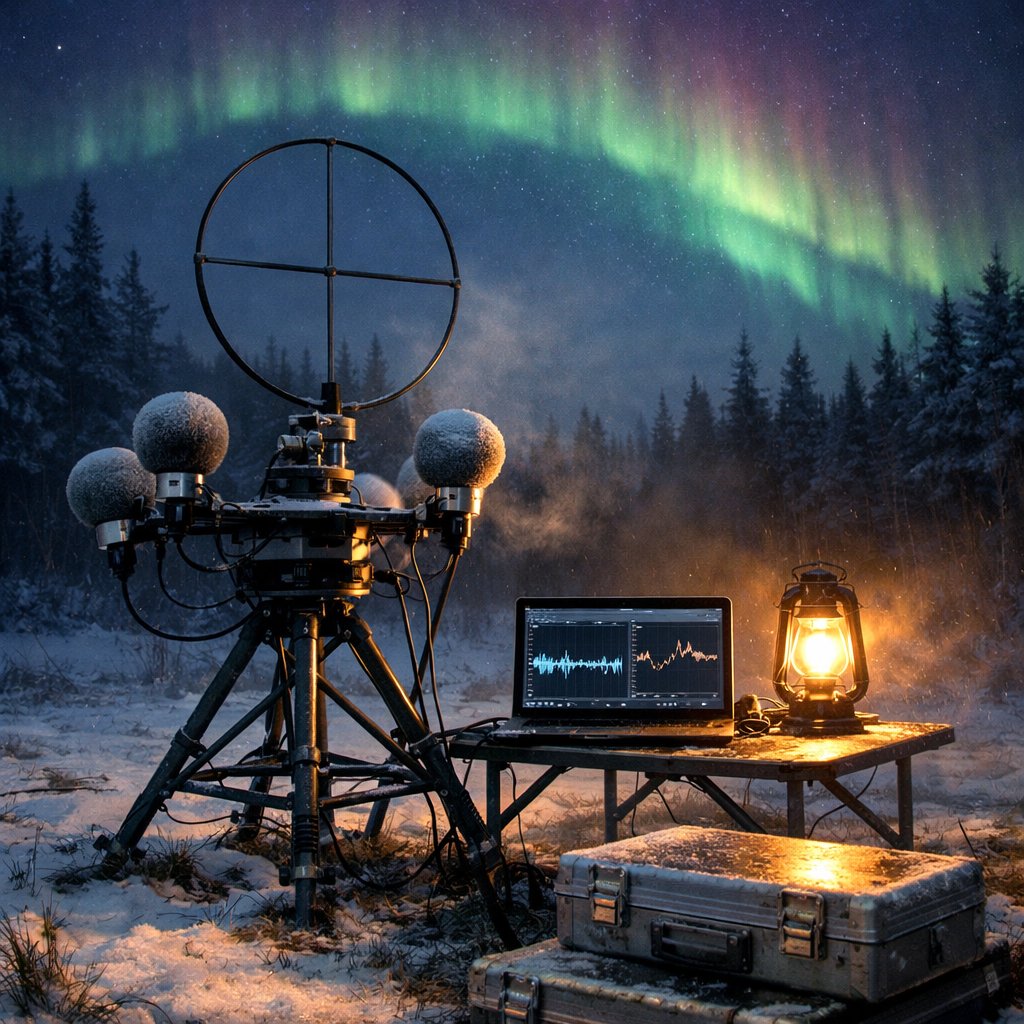
The Aalto University acoustician Unto K. Laine spent two decades testing the folklore against instruments. On the night of March 17 to 18, 2013, during a strong geomagnetic storm over southern Finland, his team operated a three-microphone array with a co-located loop antenna for magnetic-field measurement. They captured hundreds of short-duration sound events whose direction-of-arrival converged on a height of about 75 meters above the array, with rank correlation between magnetic-pulse RMS values and the sound RMS values yielding a roughly 99.9 percent probability of causal relation [3].
Laine’s Inversion Layer Hypothesis, formalized by 2017, accounts for the geometry. On clear cold nights, a temperature inversion forms 60 to 100 meters above ground. Charged-particle showers from the aurora deposit a static field in the air. The inversion acts as a thin capacitive boundary. When the auroral electrojet pulses, that boundary discharges, producing brief audible cracks and infrasound centered around 14 hertz. The sound, in other words, is not made at the curtain. It is made just above the listener’s head, by the curtain’s electrical signature [4].
Auroral Chorus and the Whistler-Mode Confusion
A separate phenomenon often conflated with the audible aurora is auroral chorus, the very-low-frequency electromagnetic radiation generated by electrons spiraling along Earth’s magnetic field lines in the radiation belts. NASA’s Van Allen Probes recorded these waves on September 5, 2012, using the EMFISIS instrument. When the captured electric and magnetic-field oscillations are shifted into the audible range, they sound like flocks of birds, hence “chorus.”
This is a real, replicable, peer-reviewed phenomenon. It is also not actually a sound. It is electromagnetic radiation in the kilohertz range, audible only when a radio receiver demodulates it. People who have heard chorus on shortwave receivers, or watched the NASA audio renderings, sometimes report it as confirmation that the sky “really sings.” It does, in a sense, but the singing is not arriving at your ears as pressure waves. The conflation between auroral chorus (a radio phenomenon) and the Laine-style audible auroral sounds (a near-ground acoustic phenomenon) is a common error in popular treatments [5].
The Infrasound Catalog: What the Monitoring Networks See
The serious instrumental answer to “what is the sky actually doing acoustically” is the infrasound monitoring network. The USArray Transportable Array, a rolling grid of around 400 broadband seismic stations deployed across the contiguous United States from 2007 onward, added infrasound microphones to its sites starting in 2011. Each station carries a Setra 278 barometer for low-frequency atmospheric pressure and an NCPA IFS-4532 microphone for the higher infrasound band. At peak deployment more than 400 sites returned continuous infrasound data from DC up to 20 hertz [6].
The complementary global system is the International Monitoring System operated by the Comprehensive Nuclear-Test-Ban Treaty Organization, with 60 infrasound array stations distributed worldwide for nuclear-test verification. Both networks log a routine catalog of long-range infrasound from severe storms, jet-stream interactions, ocean microbaroms, volcanic activity, bolides, sprite-producing thunderstorms, and tectonic-scale events. None of these networks has reported the 2011-2012 viral sky-sound clusters as anomalous events. The signature you would expect, if a globally distributed novel acoustic source had appeared, is exactly what the networks are designed to register, and they did not register it.
The Mechanisms Behind the Real Cases
Of the videos that record genuine sounds rather than dubs, the documented mechanisms cluster into a short list.
Atmospheric Infrasound from Solar and Auroral Activity
During strong geomagnetic storms, the upper atmosphere couples energy down through Joule heating and gravity-wave forcing. The Joint Acoustic Propagation Experiment and subsequent USArray campaigns have logged auroral-zone infrasound at amplitudes detectable thousands of kilometers from source. In rare cases under quiet boundary-layer conditions, the audible component reaches the ground as a low rumble. The Finland and Saskatchewan reports during active aurora are consistent with this category.
Tectonic Low-Frequency from Settlement Stress
Many “booms” reported alongside the trumpet sounds are tectonic-origin acoustic-coupled signals from minor seismic events, often from fault-related stress release in old basement rock. The phenomenon is sometimes called “Seneca guns” along the U.S. East Coast and “mistpoeffers” in Belgium. Both are documented across centuries. Where seismic networks were dense enough, recent booms have been correlated to micro-earthquakes too small to feel but loud enough to vault into the audible band as the wavefront refracts through the ground-air interface.
Jet Stream Interaction at High Altitude
High-altitude wind shear at the tropopause, particularly when the jet stream’s velocity gradient exceeds about 30 meters per second per kilometer of altitude, generates Kelvin-Helmholtz instabilities that radiate infrasound downward. Standing-wave resonance with mid-latitude inversions can produce a low groaning audible component. Several of the Tampa Bay and Costa Rica clips date from periods of unusually strong jet activity at relevant latitudes.
Industrial and Anthropogenic Sources
The most common real source, by a wide margin, is human activity that the listener has not previously noticed. Tunneling machinery, large industrial cranes shifting load, freight train coupling at low temperatures, quarry blasting echoing off cloud layers, and aircraft on unusual approaches all produce the kind of metallic, sustained groan that the viral genre rewards. Sharon Hill’s 2013-14 “Sounds Sciencey” column for Skeptical Inquirer documented dozens of cases where the local newspaper, days later, identified the source as a specific construction crane or a railyard within two miles of the recording [7].
The Hoax Catalog
A meaningful share of the 2011-2012 corpus is fabricated. The Kiev master clip from August 2011 is the closest thing to a patient zero. Its audio is identifiable by a distinctive pattern of background bird calls, which then appears in subsequent uploads from Mexico, Czech Republic, Canada, and several Russian regional clips. The bird audio is a fingerprint; identical bird calls in supposedly distinct geographic recordings is dispositive evidence of dubbing. A Canadian uploader admitted on January 14, 2012, that his “balcony recording” was filmed while a laptop on the kitchen table played the original Kiev video [1].
The Kiev clip itself overlaps with the soundtrack from the 2007 Transformers feature film, particularly the metallic transformation sound effects. Sharon Hill noted in her 2013 review that one early hypothesis was that the Kiev video was viral marketing for either a film property or a video game, an explanation that has never been definitively confirmed but that fits the audio evidence better than any geophysical mechanism. Russian copycat videos, including several attributed to Krasnoyarsk Krai, used the Kiev master audio with substituted visuals [2].
The Spread Itself as the Real Phenomenon
If the individual data points have ordinary explanations, the question shifts. Why did the meta-story spread so fast in 2011-2012, and why does it persist? The window aligns with three reinforcing trends. YouTube monetization had matured enough that uploaders had a financial incentive to chase virality on apocalyptic themes, and the December 21, 2012 Mayan calendar prediction was approaching. Smartphones with reasonable microphones had reached saturation, so any unfamiliar industrial sound now generated a ready upload. And the availability heuristic, the cognitive shortcut by which judgments of frequency follow ease of recall, was being amplified by a recommendation algorithm that surfaced similar clips to anyone who clicked the first.
The result was a textbook information cascade. Hill’s 2013 review identified the dynamic explicitly: people heard sounds they had heard before, but now noticed them, attributed them to a circulating mystery rather than to a local source, recorded them, uploaded them, and reinforced the meta-story for the next listener. None of the participants were lying, in most cases. They were doing what motivated humans with cameras have always done. The novelty was the speed at which a thousand independent local observations could be braided into a single global narrative.
What Actually Counts as Unexplained
A small residue of recordings does resist easy attribution. Some Pacific Northwest forest clips show clean low-frequency content with no nearby industry, no active aurora, no local seismicity, and no obvious dubbing fingerprint. These are interesting precisely because they are not the headline cases. They are the kind of data the IMS infrasound network can sometimes back-solve to a distant source: a stratospheric volcanic eruption thousands of kilometers away, an unusual atmospheric ducting condition, or a long-period gravity wave that resonated against a particular topography.
The honest accounting runs roughly as follows. Of perhaps two hundred substantial 2011-2012 clips with enough provenance to investigate, about half are clearly hoaxes or dubs, about a third are routine industrial or anthropogenic noise, around 10 percent are genuine atmospheric, auroral, or tectonic infrasound coupled to the audible band, and the residual 5 to 10 percent remain ambiguous on existing data. The interesting frontier is in that residual, where the IMS and USArray catalogs occasionally turn up signatures that match known mechanisms days or weeks later. We don’t yet know the source for every datum. We do know we don’t need a new physics to explain the corpus.
Frequently Asked Questions
What were the “strange sounds from the sky” videos of 2011-2012?
A wave of YouTube uploads showing low, groaning, trumpet-like noises overhead, beginning with a Kiev clip in August 2011 and spreading through 2012 to Costa Rica, Tampa Bay, southern Finland, Saskatchewan, and other locations. They became associated with end-of-the-world speculation tied to the December 21, 2012 Mayan calendar date. Most were either dubs of the Kiev master audio or routine industrial noise.
Are auroral sounds real?
Yes. Unto K. Laine’s group at Aalto University recorded hundreds of short-duration sound events during the geomagnetic storm of March 17 to 18, 2013, with direction-of-arrival converging on about 75 meters above the array. The Inversion Layer Hypothesis, formalized by 2017, locates the sound source not at the aurora itself, 80 to 150 kilometers up, but in electrical discharges across the temperature inversion just above the listener.
What is auroral chorus?
Very-low-frequency electromagnetic radiation generated by electrons spiraling along Earth’s magnetic field lines in the Van Allen radiation belts. NASA’s Van Allen Probes recorded chorus waves on September 5, 2012, using the EMFISIS instrument. The audio renderings sound like birdsong only because the original signals are shifted into the human hearing range. The phenomenon is electromagnetic, not acoustic, and is not what produces the audible auroral cracks.
What did the Kiev video actually show?
A view of central Kiev with metallic, trumpet-like audio overdubbed. The audio’s signature bird calls then reappeared in subsequent uploads from Mexico, Canada, Russia, and other regions, indicating reuse of the same sound file. Some analysts noted overlap with sound effects from the Transformers film franchise. A Canadian uploader admitted in January 2012 that his “live” recording was actually filmed with the Kiev clip playing on a laptop in the background.
Do infrasound monitoring networks see these events?
The USArray Transportable Array’s infrasound sensors and the International Monitoring System’s 60 worldwide infrasound array stations log routine atmospheric acoustics, including auroral infrasound, severe-storm signals, and bolide events. Neither network reported anomalous global signals during the 2011-2012 viral wave, which is what they would have logged had a genuine novel acoustic source appeared at the scale the popular accounts implied.
What are “Seneca guns” or “mistpoeffers”?
Documented low-frequency booms heard along the U.S. Atlantic coast (Seneca guns) and along the North Sea coasts of Belgium and the Netherlands (mistpoeffers, “fog farters” in literal translation). They are likely caused by minor tectonic events, distant supersonic aircraft, or atmospheric refraction of remote storm or industrial signals. Reports go back to the early nineteenth century, predating both YouTube and most of the proposed exotic explanations.
Could the jet stream produce audible sky sounds?
Yes, in principle and in some cases. Strong vertical wind-shear at the tropopause generates Kelvin-Helmholtz instabilities that radiate infrasound downward. When mid-latitude inversions resonate with that infrasound, a low audible groan can reach the ground. Several Tampa Bay and Costa Rica clips date from periods of unusually intense jet activity at the relevant latitudes.
Why did the meta-story spread so fast?
Three factors aligned in 2011-2012: YouTube monetization rewarded apocalyptic content as the December 21, 2012 Mayan-calendar date approached; smartphone microphones reached household saturation, so any unfamiliar local sound was now uploadable; and the recommendation algorithm surfaced similar clips to anyone who clicked one. The result was an information cascade in which independent local observations were braided into a single global narrative without requiring any of the participants to be dishonest.
What do skeptical researchers conclude?
Sharon Hill’s “Sounds Sciencey” column for the Skeptical Inquirer (2013-14) audited many of the highest-circulation clips and found that local newspapers identified specific industrial sources for a substantial share of them within days of the recording. Her summary: “It’s not Godzilla, it’s not the alien robots. It’s just modern civilization.” The cases that resist easy attribution are a small residual, not the genre’s headline material.
Is there any case where a “sky sound” represented unknown physics?
No documented case in the 2011-2012 corpus required mechanisms outside the known catalog of atmospheric, auroral, tectonic, and anthropogenic infrasound. A residual of perhaps 5 to 10 percent of clips remains ambiguous on currently available data, but ambiguity is not evidence for novelty. The corpus is consistent with the hypothesis that all of it is explainable by mechanisms in the existing literature, with the meta-story itself being the only genuinely novel phenomenon.
Where can a curious reader follow the science?
For the auroral acoustics work, the Aalto University Auroral Acoustics Project page and Laine’s published proceedings are the primary entry points. For the infrasound monitoring science, the IRIS USArray data products and the CTBTO IMS infrasound documentation cover instrumentation and data access. For the skeptical-review framing, Sharon Hill’s “Sounds Sciencey” archive and her 2013 essay “The Mystery of the Sky Noises” remain the cleanest case-by-case treatments.
Adjacent reading in science and natural anomalies: Cold Fusion: Fact or Fantasy? and The Bermuda Triangle: Unraveling the Atlantic Enigma.