By Felix Chen · Published May 7, 2026 · Updated May 13, 2026
Last reviewed: May 7, 2026.
The 1989 Announcement That Outran Its Own Data
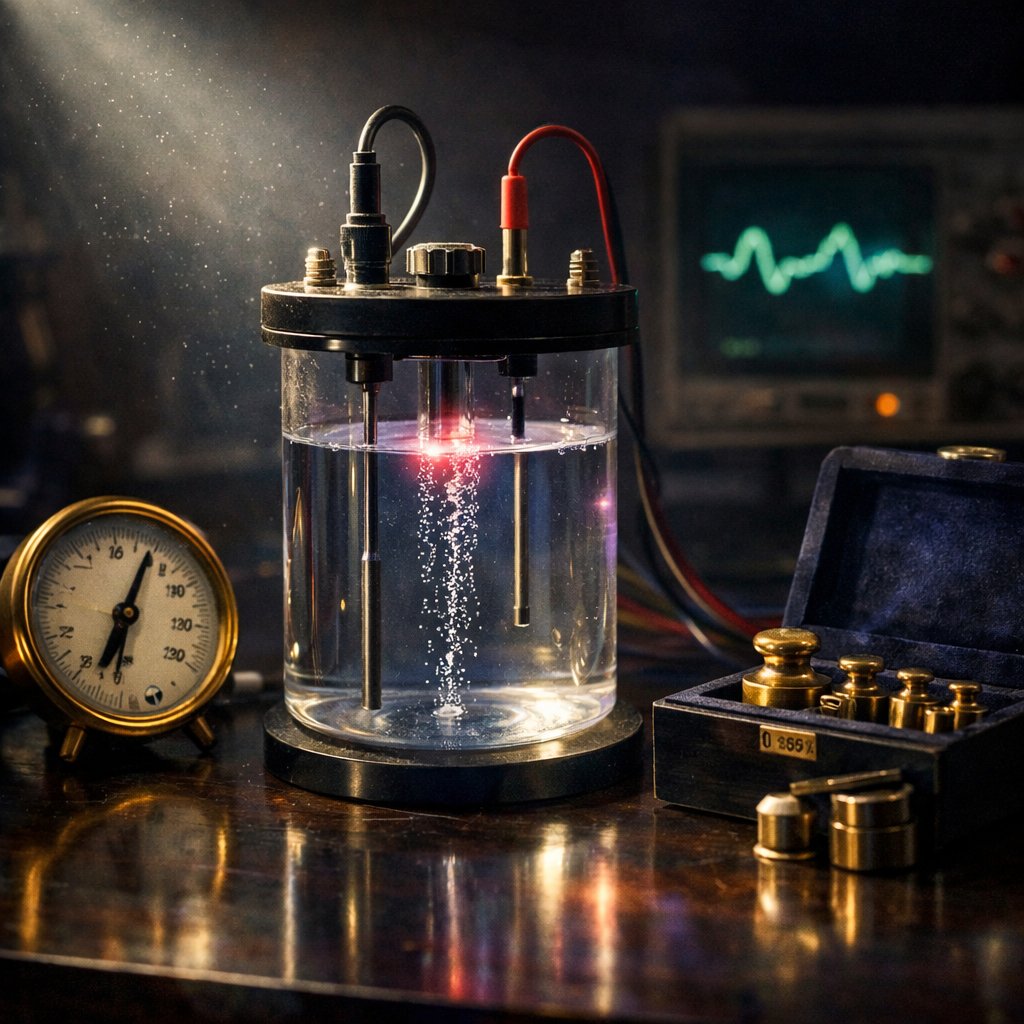
On March 23, 1989, two electrochemists walked into a press conference at the University of Utah and told the world they had achieved nuclear fusion in a glass jar at room temperature. Stanley Pons of Utah and Martin Fleischmann of the University of Southampton claimed their tabletop apparatus, a palladium electrode immersed in heavy water with a small electrical current running through it, was producing more heat than the input electricity could account for. The implication was straightforward and astonishing. If true, the energy crisis was effectively over. Seawater would power civilization. The press ran with it. The physicists, almost without exception, did not [1][2].
The Fleischmann and Pons announcement is the canonical example of what happens when a scientific claim outruns its scientific verification. Their paper had not yet been peer-reviewed. The press conference was scheduled, in part, to protect patent claims the university had filed earlier that month. A competing group at Brigham Young University, led by physicist Steven Jones, was working on related questions, and the two teams had reportedly agreed to submit simultaneously, an arrangement Pons and Fleischmann then broke [2]. Within weeks, dozens of laboratories tried to reproduce the result. Most failed. The few early positive reports were withdrawn or attributed to calorimetry errors and stray heat sources [1][3].
What the Original Experiment Actually Claimed
The chemistry behind the 1989 claim is worth describing precisely, because precision is where the argument lives. Fleischmann and Pons placed a palladium cathode and a platinum anode in a calorimeter filled with heavy water, water in which the hydrogen has been replaced by its heavier isotope deuterium. They ran a current through the cell for many weeks. Palladium has an unusual property among metals: it absorbs hydrogen, and its heavier isotopes, into its crystal lattice at extraordinary densities. The Fleischmann-Pons hypothesis was that the compression of deuterium inside the palladium might be high enough to overcome the electrostatic repulsion between deuterium nuclei and trigger fusion at room temperature [3][4].
They reported two findings. The first was a thermal anomaly, an excess heat output that they argued exceeded any plausible chemical explanation. The second was a small flux of fusion byproducts, neutrons and tritium, which would be the signatures of deuterium-deuterium reactions. The trouble began almost immediately. The reported neutron flux was many orders of magnitude lower than what the claimed heat output should have produced if real fusion was the source. The tritium readings were inconsistent. And the calorimetry, when other groups tried to repeat it, proved very difficult to do well at the small heat differences involved [3][4].
The Scientific Verdict, Twice Delivered
By late 1989, the U.S. Department of Energy had convened the Energy Research Advisory Board to evaluate the claims. The 25-member panel spent six months reviewing more than 114 papers, attended a dedicated workshop, and visited six laboratories. Their conclusion, delivered in November 1989, was unambiguous: the experimental evidence did not present a convincing case that excess heat was associated with a nuclear process, and present evidence for cold fusion was not persuasive [5]. The federal government declined to fund a dedicated cold fusion research program.
Fifteen years later, in 2004, the DOE was asked to look again. A letter from MIT physicist Peter Hagelstein, along with a body of new papers from researchers who had continued working in the field under the renamed banner of low-energy nuclear reactions, prompted Secretary of Energy Spencer Abraham to commission a second review. Eighteen reviewers read eight selected papers; eleven attended a daylong presentation by six LENR researchers in August 2004. The verdict mirrored the first: the panel was not persuaded that excess heat correlated with a nuclear origin, and the agency again declined to fund a dedicated program [5][6]. Two reviews, fifteen years apart, reached the same conclusion on the same fundamental question.
From Cold Fusion to LENR: The Rebrand and the Diaspora
After 1989, mainstream physics largely closed the file. A small community of researchers did not. They renamed the field. The terms “low-energy nuclear reactions” (LENR) and “condensed matter nuclear science” (CMNS) replaced “cold fusion” in the literature these researchers continued to publish, partly to escape the stigma and partly because they argued the underlying physics, whatever it turned out to be, might not be conventional fusion at all [4]. Conferences continued under the ICCF banner (International Conference on Cold Fusion). Research groups at SRI International, the U.S. Naval Research Laboratory, and several Italian and Japanese laboratories kept producing papers reporting various anomalies. None of these reports has been replicated to a standard the broader physics community has accepted [4].
What Calorimetry Actually Has to Do
A short technical aside, because this is where most of the disagreement lives. The Fleischmann-Pons cell ran at low input power, on the order of a few watts. The claimed excess heat was a fraction of that input. To measure a 10 percent excess on a 5-watt input means resolving heat differences smaller than half a watt, in a cell whose thermal coupling to the room changes with electrolyte level, with bubble formation, with cathode degassing, and with ambient temperature drift across many weeks. Open-cell and closed-cell calorimetry behave differently. Recombination of evolved deuterium and oxygen at the cathode releases real chemical energy that an inattentive calorimeter can mistake for nuclear excess. None of this proves the original signal was an artifact, but it explains why the disagreement is technical rather than ideological, and why modern programs like the Google effort and ARPA-E place so much emphasis on calibrated calorimetry and parallel nuclear diagnostics rather than on heat measurements alone [3][8].
The Rossi E-Cat and the Cost of Credulity
The LENR diaspora has not been free of bad actors. The most consequential was the Italian entrepreneur Andrea Rossi, who announced in January 2011 that he had a commercial cold fusion device, the Energy Catalyzer or “E-Cat,” which used heated hydrogen and nickel powder. No peer-reviewed independent test of the device was ever published. A 2011 patent application received an unfavorable international preliminary report on the grounds that the claims contradicted accepted physics. In 2012, Australian skeptic Dick Smith publicly offered Rossi one million dollars to demonstrate the device under controlled conditions where the input power could be independently measured; Rossi declined [7]. New Energy Times documented multiple instances of falsified power readings in early demonstrations. The episode is a reminder that the surface plausibility of an extraordinary claim is not, by itself, a reason to believe it.
The Google Replication: 2015 to 2019
The most rigorous modern attempt to settle the question came from an unexpected sponsor. Beginning around 2015, Google funded a roughly 10 million dollar, multi-institution effort, with collaborators at the University of British Columbia, MIT, the University of Maryland, and Lawrence Berkeley National Laboratory. The team, led by Curtis Berlinguette of UBC and including Yet-Ming Chiang, Jeremy Munday, Thomas Schenkel, David Fork, Ross Koningstein, and Matthew Trevithick, set out to test the central LENR claims with modern materials science, calorimetry, and nuclear diagnostics that the original 1989 experiments lacked [8][9].
The headline result, published in Nature in May 2019, was negative. The team tested 420 separate samples of nickel-hydrogen systems and found no evidence of excess heat. Schenkel’s group at Berkeley ran deuterium-loaded samples for weeks and saw no enhanced tritium production [8][9]. What the team did produce was a substantial body of work on metal-hydrogen interactions and on the detection sensitivities required to distinguish a genuine signal from chemistry, contamination, or instrument drift. The authors were careful in their framing. They did not claim the case was forever closed. They argued, instead, that the experimental conditions reported in the historical literature could now be tested at modern sensitivity, and that under those conditions the claimed phenomena did not appear [8].
Why the Question Has Not Quite Died
In September 2022, the U.S. Department of Energy’s Advanced Research Projects Agency-Energy (ARPA-E) announced up to 10 million dollars in funding for eight LENR research projects under its LENR Exploratory Topic. The framing was deliberate. ARPA-E asked the funded teams to test specific physical hypotheses, not simply to attempt replication, and to publish their results in mainstream peer-reviewed journals [10]. Two government reviews had returned a non-result, and the Google effort had returned a non-result; ARPA-E’s bet was that the older experiments lacked the diagnostic tools to either confirm or rule out a real but small effect, and that a fresh hypothesis-driven look was scientifically defensible at modest cost.
There is a careful position to hold here, and it is not the same as either the dismissive or the credulous one. The reproducible signature of nuclear fusion at room temperature, in the form Fleischmann and Pons proposed, has not been demonstrated. The historical record of failed replications is long and well-documented. The Google study, with the best modern instrumentation, found no signal. At the same time, the underlying questions about deuterium loading in palladium, exotic metal-hydrogen states, and the limits of low-energy nuclear cross-sections are legitimate physics questions, and the federal government has decided that 10 million dollars to test them carefully is a reasonable price for a definitive answer either way [10].
What the Data Actually Says, in 2026
Read as a body of evidence, the cold fusion file looks like this. One announcement in 1989 that was rushed to press conference before it had survived peer review. Two federal reviews, in 1989 and 2004, that found the evidence unpersuasive. A small but persistent research community working under the renamed LENR banner, producing papers that have not been replicated to mainstream-physics standards. One well-funded modern replication attempt that returned null results across 420 samples and multiple laboratories. One commercial fraud, the Rossi E-Cat, that drained credibility from the field for years. And one ongoing federal program that is funding eight teams to do hypothesis-testing rather than re-litigation [1][2][3][4][5][6][7][8][9][10].
For a reader looking for the honest answer to “fact or fantasy,” the answer in 2026 is that the original Fleischmann-Pons claim, as presented, has not survived. There is no convincing evidence that the room-temperature fusion they described actually occurred in their cell or in any subsequent cell. There is also no proof of impossibility, and the ARPA-E program may yet produce a clean signal or a clean ceiling on the size of any effect. The interesting position, the position the data supports, is that the announcement was premature, the science is not closed, and the truth is almost certainly less exciting than the 1989 version and more interesting than dismissing the whole field outright.
A useful frame for any reader is to track three numbers as the field develops. First, the signal-to-noise ratio of any claimed excess heat: a real nuclear effect should be many orders of magnitude above any chemical or instrumental baseline, and the historical reports have hovered uncomfortably close to that baseline. Second, the ratio of claimed heat output to detected fusion byproducts: a genuine deuterium-deuterium fusion reaction has a fixed branching ratio, and any cell producing real fusion heat must produce neutrons, tritium, or helium-3 in proportions the standard physics fixes precisely. Third, the rate of independent replication, measured not in friendly laboratories but in hostile ones run by skeptical groups using shared materials and protocols. Until those three numbers move, the right register is genuine open uncertainty rather than either belief or dismissal. For more on the broader landscape of science and natural anomalies where evidence resists easy categorization, the same disciplined skepticism applies.
Frequently Asked Questions
What did Fleischmann and Pons claim in 1989?
Stanley Pons and Martin Fleischmann announced on March 23, 1989, at a University of Utah press conference, that an electrolytic cell using a palladium cathode in heavy water produced excess heat they attributed to room-temperature nuclear fusion of deuterium. The paper had not yet been peer-reviewed at the time of the announcement [1][2].
Has cold fusion ever been replicated?
The original Fleischmann-Pons effect has not been independently replicated to a standard the mainstream physics community has accepted. Many laboratories tried in 1989 and failed; some early positive reports were later withdrawn. Subsequent LENR research has produced anomaly reports, but none has met the replication bar required for the result to be considered established [3][4].
What did the 1989 DOE review conclude?
The 25-member Energy Research Advisory Board panel concluded after six months of review, including 114 papers and visits to six laboratories, that the experimental evidence did not present a convincing case that the excess heat was associated with a nuclear process. The DOE declined to establish a dedicated cold fusion research program [5].
What did the 2004 DOE review conclude?
The 2004 DOE review, prompted by a letter from MIT physicist Peter Hagelstein and a body of new LENR papers, reached substantively the same conclusion as the 1989 review. The panel did not find the case for nuclear-origin excess heat persuasive, and the DOE again declined to fund a dedicated program [5][6].
What is LENR and how does it differ from cold fusion?
LENR stands for low-energy nuclear reactions, a term, along with condensed matter nuclear science (CMNS), adopted by researchers who continued to investigate the Fleischmann-Pons claims after 1989. The rebrand reflected both an attempt to escape the cold fusion stigma and an acknowledgment that the underlying physics, if real, might not be conventional fusion [4].
What did the Google-funded 2019 study find?
The team led by Curtis Berlinguette, publishing in Nature in May 2019, reported null results across 420 nickel-hydrogen samples and saw no enhanced tritium production in deuterium-loaded experiments at Lawrence Berkeley. The authors stopped short of declaring the case closed and argued the field could now be tested at modern sensitivity [8][9].
Was the Andrea Rossi E-Cat real?
No peer-reviewed independent test of the E-Cat was ever published. A 2011 international patent report found the claims contradicted accepted physics. Skeptic Dick Smith offered one million dollars for an independent demonstration in 2012; Rossi declined. Multiple investigations documented falsified power readings in demonstrations [7].
Why is the U.S. government funding LENR research again in 2022?
ARPA-E announced up to 10 million dollars across eight projects under its LENR Exploratory Topic in September 2022. The agency asked teams to test specific hypotheses with modern diagnostics, not simply attempt replication, and to publish in mainstream journals. The bet is that older experiments lacked the diagnostic precision to either confirm or rule out a small real effect [10].
Is cold fusion physically impossible?
No, cold fusion is not strictly forbidden by known physics in the same way perpetual motion is. Some forms of low-energy nuclear reactions, such as muon-catalyzed fusion, are well established. The question is whether the specific Fleischmann-Pons mechanism, deuterium fusion at room temperature in a palladium lattice, occurs at any rate detectable above experimental noise. The current data says no, but proof of impossibility is much stronger than absence of evidence [4][8].
What would settle the cold fusion question?
A reproducible experiment, replicated by independent groups using shared protocols and modern calorimetric and nuclear diagnostics, that produces excess heat correlated with the predicted fusion byproducts at consistent ratios. Forty years on, no such experiment exists. The ARPA-E LENR Exploratory Topic is the most serious modern attempt to either produce one or rule out the possibility [8][10].
Sources
[1] Browne, M. W. “Physicists Debunk Claim of a New Kind of Fusion.” The New York Times, May 3, 1989. Coverage of the rapid scientific pushback against the March 23 announcement.
[2] University of California Museum of Paleontology, “Cold fusion: A case study for scientific behavior – Publication by press conference.” Available at https://undsci.berkeley.edu/cold-fusion-a-case-study-for-scientific-behavior/publication-by-press-conference/.
[3] Wikipedia contributors. “Cold fusion.” Wikipedia, accessed May 2026. https://en.wikipedia.org/wiki/Cold_fusion. Comprehensive sourced overview of the experimental record.
[4] Storms, E. (2007). The Science of Low Energy Nuclear Reaction. World Scientific. Standard reference within the LENR research community.
[5] U.S. Department of Energy, Energy Research Advisory Board. “Report of the Cold Fusion Panel to the Energy Research Advisory Board.” November 1989.
[6] U.S. Department of Energy. “Report of the Review of Low Energy Nuclear Reactions.” December 1, 2004.
[7] Bryce, I. “Rossi’s E-Cat: Expose of a Claimed Cold Fusion Device.” Skeptical Inquirer, May 2019. https://skepticalinquirer.org/2019/05/rossis-e-cat-expose-of-a-claimed-cold-fusion-device/.
[8] Berlinguette, C. P., Chiang, Y.-M., Munday, J. N., Schenkel, T., Fork, D. K., Koningstein, R., Trevithick, M. D. “Revisiting the cold case of cold fusion.” Nature 570, 45-51 (2019). DOI: 10.1038/s41586-019-1256-6.
[9] Castelvecchi, D. “Google revives controversial cold-fusion experiments.” Nature News, May 27, 2019. https://www.nature.com/articles/d41586-019-01683-9.
[10] U.S. Department of Energy, ARPA-E. “U.S. Department of Energy Announces 10 Million Dollars in Funding to Projects Studying Low-Energy Nuclear Reactions.” September 2022. https://arpa-e.energy.gov/news-and-events/news-and-insights/us-department-energy-announces-10-million-funding-projects-studying-low-energy-nuclear-reactions.
Adjacent reading in science and natural anomalies: Unexplained Sky Noises Heard Worldwide and The Bermuda Triangle: Unraveling the Atlantic Enigma.