
By EsoVitae Editorial · Published
Drafted with AI assistance from the sources listed; images are AI-generated illustrations. How EsoVitae is made
Direct Answer: What the Giant’s Causeway Actually Is
The Giant’s Causeway is a field of roughly 40,000 interlocking basalt columns on the County Antrim coast of Northern Ireland, formed about 50 to 60 million years ago when tholeiitic lava cooled and contracted into prismatic joints. It became a UNESCO World Heritage site in 1986. The folklore credits the giant Fionn mac Cumhaill; the petrology credits cooling-induced fracture mechanics [1][2].
A Coastline That Reads Like a Solved Equation
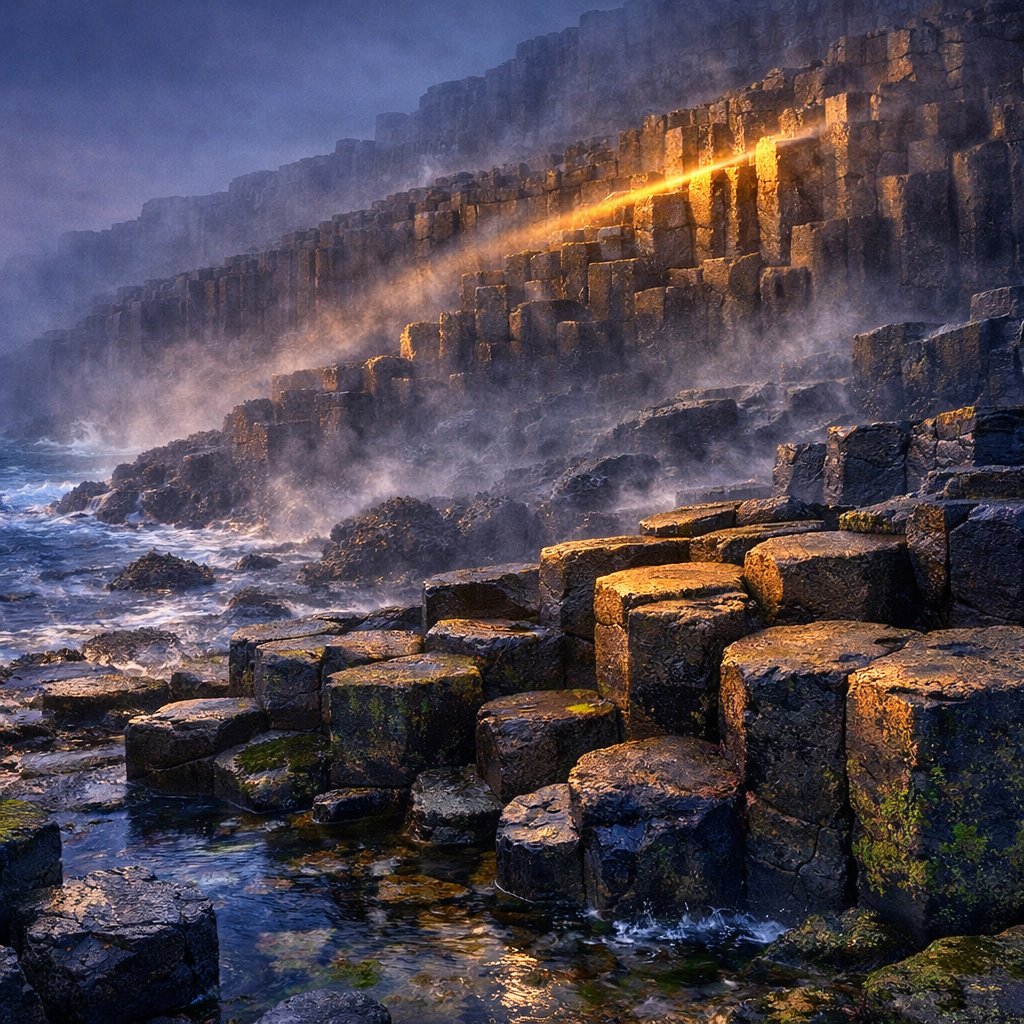
Stand at the lower colonnade on a wet October afternoon and the basalt looks tiled rather than poured. The columns rise from the surf in clean prisms, most with six sides, some with five, a few with four or seven. They fit together with so little gap that water beads on the seams rather than running through them. The site, on the edge of the Antrim plateau in Northern Ireland, was inscribed on the UNESCO World Heritage List in 1986 under criteria for outstanding natural phenomena and for representing major stages of Earth’s history [1][2].
The folklore is older than the geology, and it deserves to be acknowledged before the arithmetic begins. The Irish hero Fionn mac Cumhaill, anglicized as Finn McCool, was said to have torn chunks of the Antrim coast and hurled them into the sea to build a causeway across to Scotland, where the rival giant Benandonner waited [3]. The story has a satisfying physical anchor: identical hexagonal columns appear at Fingal’s Cave on the Scottish island of Staffa, the supposed other end of the bridge [4]. Folklore got the geometry right and the agency wrong. The columns at both sites are members of the same Paleocene lava field [4][5].
Numbers First: What the Lava Did, and When
The Antrim Plateau sits on basalts of the North Atlantic Igneous Province, an enormous flood-basalt event tied to the early opening of the North Atlantic Ocean roughly 55 to 60 million years ago [5][6]. The Causeway columns themselves belong to the Causeway Tholeiite Member, two flows of quartz-tholeiitic basalt sandwiched between earlier olivine basalts and a weathered laterite horizon called the Port na Spaniagh Member [6]. The whole package is part of the Antrim Lava Group, recognized by the British Geological Survey and the IUGS as a globally significant Palaeogene volcanic succession [2][7].
The columns are not delicate. Diameters cluster between 38 and 51 centimeters; column heights at the famous Giant’s Organ exposure reach about 25 meters [1]. Counts in the published literature put the number of columns at the headland at roughly 40,000 [1][2]. Hexagonal cross-sections dominate, accounting for roughly six in ten columns, with most of the remainder showing five sides; four-, seven-, and eight-sided columns appear at lower frequencies as the cooling stress field deviated from the ideal symmetric case [8].
Why Six Sides Wins
A hexagonal tiling minimizes the total length of crack required to relieve a uniform two-dimensional contraction stress. The argument is older than columnar jointing as a topic; it is the same packing argument that pushes honeycomb cells, soap froths, and certain mud cracks toward six-fold geometry. When a slab of cooling lava contracts horizontally, the easiest way to release that stress is a network of cracks that meet at 120-degree triple junctions, which produces hexagons in the limit. Real lavas never reach the ideal limit, and so real outcrops show a distribution: hexagons most often, pentagons next, then everything else [8][9].
The Convection-Cell Story, Carefully
Older popular accounts describe Bénard convection cells inside the cooling lava lake imprinting a hexagonal pattern from the top down. There is a real physical idea here, but it is worth stating with care because the mechanism is not the only one and may not be the dominant one [9][10]. Rayleigh-Bénard convection produces hexagonal cell patterns when a fluid layer is heated from below and the Rayleigh number exceeds a critical threshold; the cells can preserve themselves as the layer solidifies and contracts, leaving a polygonal joint network behind [10].
In the modern literature, however, columnar jointing is more often modeled as a propagating crack-tip instability driven by cooling-front advection, with the column scale set by the competition between heat conduction and crack-front advance [9][11]. Lucas Goehring and Stephen Morris, working at the University of Toronto, showed in a 2006 Physical Review E paper and follow-up PNAS work that desiccating starch slurries reproduce the column geometry under controlled laboratory conditions, with column area scaling as the inverse of the drying-front (or cooling-front) velocity [11][12]. The starch experiment is a cracking analog: drying replaces cooling, but the math of the moving front and the fracture pattern is the same.
The Toronto Starch Experiment, in One Paragraph
Goehring and Morris poured cornstarch and water into transparent dishes, dried them under heat lamps with measured evaporation rates, and tracked the columnar fracture pattern as it propagated downward. They reported that mean column cross-sectional area scales inversely with drying rate; a tenfold faster front produced columns roughly a tenth the area [11]. They also showed that column area at any depth depends not only on present conditions but also on the geometry of the pattern at previous depths, a hysteresis effect that mirrors what field geologists see in well-exposed lava flows [12]. Their conclusion was that columnar jointing is selected by an advective-diffusive front instability, which is consistent with the observation that the Giant’s Causeway columns are roughly an order of magnitude wider than starch columns even though the geometry is identical: the cooling front in basalt advanced about ten thousand times slower than the drying front in their kitchen-scale apparatus.
Above the Colonnade: The Entablature
A Causeway Tholeiite flow is not a single uniform stack of regular columns. Each flow typically shows a tripartite structure: a lower colonnade of clean wide columns, an entablature of finer chaotic columns above that, and an upper colonnade thinner than the first [6]. Field workers at the BGS describe the entablature as forming where water flooded the cooling upper surface, accelerating heat removal and producing many smaller, less-regular fractures [2][6]. A 2018 Nature Communications study, using clumped-isotope thermometry and fracture-mechanics modeling, narrowed the temperature window of incipient column formation to roughly 890 to 840 degrees Celsius, well below the lava’s solidus, which constrains the cooling state at which the joints actually nucleate [13].
Folklore Got the Geometry Right
The Fionn mac Cumhaill story is documented in medieval Fenian Cycle texts and in the Manx tradition, where his rival is sometimes a buggane rather than Benandonner [3]. The folklore version of the bridge actually captures something the petrology confirmed in the twentieth century: the Antrim columns and the Staffa columns are part of the same lava field, dated to roughly 55 to 58 million years ago, and the seabed between them does preserve continuous basaltic stratigraphy [4][5]. The legend’s geographical claim is not quite “two giants built a road”; it is closer to “the same lava body surfaces in two places.” That is, in fact, what the data shows.
A site like the Causeway sits in an interesting category of the world’s so-called wonders. There is no missing physics. The columnar jointing is described, modeled, and reproduced experimentally. We can compute the column scale from the cooling rate, recover that relationship in starch, and predict the entablature where water cooled the flow’s upper surface. The wonder does not come from a gap in the textbook; it comes from the unreasonable visual confidence with which thermodynamics chose hexagons.
Open Questions, Honestly Stated
A few questions about Causeway-class columnar jointing are still genuinely contested. The first is the temperature of joint nucleation: the 2018 Nature Communications paper put it between 840 and 890 degrees Celsius, but other groups have argued for slightly higher onset temperatures with different assumptions about cooling-front geometry [13]. The second is the depth scaling of column width within a single flow: the hysteresis effect Goehring and Morris reported in starch is consistent with field observations, but the field statistics are noisy enough that the scaling exponent is not yet settled to within a factor of two [11][12]. The third is whether deep-water flooding of the upper surface is a necessary or merely sufficient condition for entablature formation [6][13]. None of these undermine the textbook account; they refine it.
If you are interested in the broader landscape of unusual landforms and Earth-process anomalies, the parent Science and Natural Anomalies hub on this site collects related coverage of strange geological formations, gravity hills, magnetic mountains, and other places where ordinary physics does something visually unreasonable.
Frequently Asked Questions
Q1: How old is the Giant’s Causeway?
The columns belong to the Causeway Tholeiite Member of the Antrim Lava Group, emplaced during the Paleocene Epoch roughly 50 to 60 million years ago, with most published radiometric work clustering near 55 to 60 million years [1][5][6].
Q2: How many columns are there?
Roughly 40,000 interlocking columns are exposed on the headland and adjacent stacks, the figure UNESCO and the British Geological Survey both quote [1][2].
Q3: Why are most of the columns hexagonal?
Hexagonal tiling minimizes total crack length under uniform contraction stress; cracks meeting at 120-degree triple junctions release the most stress per unit length of fracture. About six in ten Causeway columns are hexagonal, with most of the remainder pentagonal [8][9].
Q4: What rock type are the columns made of?
Quartz-tholeiitic basalt of the Causeway Tholeiite Member, sandwiched between olivine-bearing basalts of the Lower Basalt Formation and the laterite-rich Port na Spaniagh Member [6][7].
Q5: Did Bénard convection cells make the columns?
Bénard convection can produce hexagonal cell patterns in fluids cooled or heated through their depth, and this idea has been applied to columnar jointing. Modern work treats the dominant mechanism as a cooling-front fracture instability rather than frozen convection cells, though convection may contribute in some flows [9][10][11].
Q6: How do drying starch experiments help explain basalt columns?
Starch slurries dried under controlled heat lamps produce columnar fracture networks geometrically identical to lava columns, with column area scaling inversely with drying-front velocity. Goehring and Morris (2006) used this analog to argue that columnar jointing is selected by an advective-diffusive front instability [11][12].
Q7: What is the difference between a colonnade and an entablature?
A single basalt flow at the Causeway typically shows a lower colonnade of wide regular columns, an entablature of finer chaotic columns above, and an upper colonnade. The entablature forms where water flooding the upper surface accelerates cooling and produces many smaller fractures [2][6].
Q8: Are the Giant’s Causeway and Fingal’s Cave really part of the same formation?
Yes. Fingal’s Cave on Staffa in the Inner Hebrides is hewn from the same Paleocene lava field as the Antrim columns, dated to about 55 to 58 million years ago, with continuous basaltic stratigraphy across the intervening seabed. The folkloric bridge story is geologically defensible at the lava-body level [4][5].
Q9: When was the site recognized by UNESCO?
The Giant’s Causeway and Causeway Coast were inscribed on the UNESCO World Heritage List in 1986 under natural-heritage criteria for outstanding natural phenomena and for representing major stages in Earth’s geological history [1][2].
Q10: How tall are the tallest columns?
At the Giant’s Organ exposure, individual columns reach about 25 meters in height, with diameters typically between 38 and 51 centimeters [1].
Q11: Who first described the formation scientifically?
The Causeway was a focal point of the late-eighteenth-century Neptunist-versus-Plutonist debate over the origin of basalt. James Hutton and his successors used the Antrim columns as evidence that basalt is an igneous rather than a sedimentary rock, work that helped establish modern volcanology [2].
Q12: Is there any genuine geological mystery left at the site?
The dominant mechanism is well constrained, but the precise temperature of joint nucleation, the depth-scaling of column width within a flow, and whether upper-surface flooding is required for entablature formation are still actively debated in the literature [11][13].
Adjacent reading in science and natural anomalies: The Wow! Signal: A Space Mystery and Swarming Behavior: Unraveling Animal Group Dynamics.