
By EsoVitae Editorial · Published
Drafted with AI assistance from the sources listed; images are AI-generated illustrations. How EsoVitae is made
On the morning of December 1, 1948, a man was found propped against the seawall on Somerton Park beach, just south of Adelaide. He was dead. He carried no wallet, no identification, and no name anyone could match. The case opened that day has been worked, reopened, and re-examined for more than seventy years. It produced one of the strangest pieces of evidence in Australian police history: a torn scrap of paper, two words long, that read Tamam Shud. This is the file as it stands now [1].
Direct Answer
The Somerton Man was an unidentified body discovered on Somerton Park beach near Adelaide on December 1, 1948. A scrap reading Tamam Shud, torn from a copy of FitzGerald’s translation of the Rubaiyat of Omar Khayyam, was found in his fob pocket. In 2022, University of Adelaide researchers using genetic genealogy identified him as Carl “Charles” Webb, a Melbourne-born electrical engineer [1][2][6].
The Body on the Beach
Build the timeline first. December 1, 1948, 6:30 a.m. A jeweller named John Bain Lyons, walking with his wife near the Crippled Children’s Home, saw a man slumped against the seawall, head against the stone. The previous evening witnesses had reported a man in the same posture, apparently asleep, smoking a cigarette. Constable John Moss attended the scene at 7:00 a.m. and confirmed death. The body was warm enough to suggest a recent hour [1].
The clothing was unremarkable and ordinary, except in one specific way: every label, every laundry mark, every retailer tag had been removed. He wore a brown knitted pullover, a fawn double-breasted coat, and brown trousers. He carried cigarettes, matches, an aluminium comb, a packet of Juicy Fruit gum, and a used train ticket from Adelaide to Henley Beach. He carried no wallet, no driver’s licence, no letters, and no money worth speaking of. The pathologist, John Dwyer, recorded congestion of organs consistent with poisoning, though no toxin was ever isolated by the standards of 1948 chemistry [1][3].
The Suitcase at Adelaide Railway Station
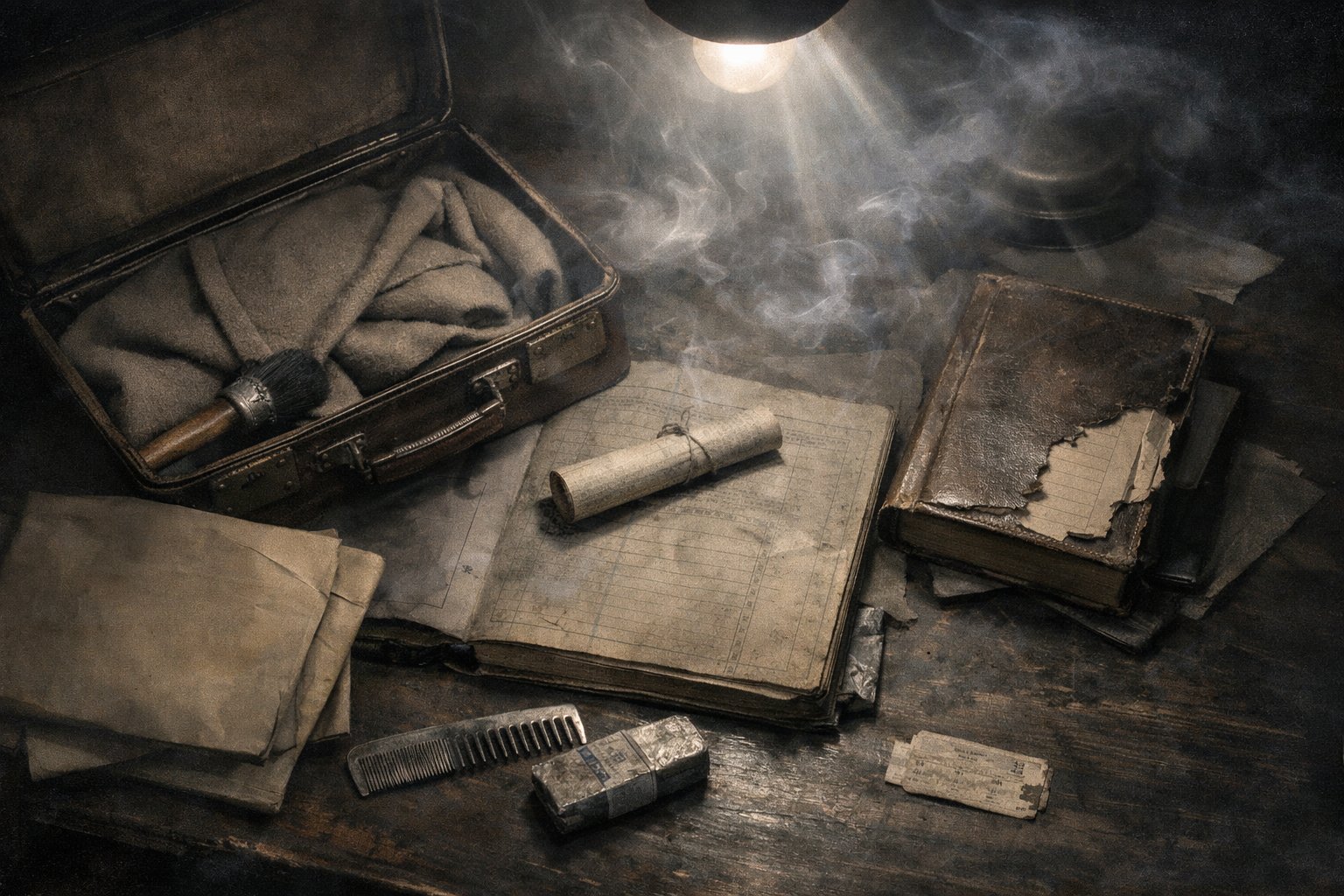
On January 14, 1949, staff at the Adelaide Railway Station cloakroom flagged an unclaimed brown suitcase that had been checked in around 11:00 a.m. on November 30, 1948 — the day before the body was found. Detective Sergeant Lionel Leane and his team opened it. Inside they found clothing, again with most labels removed, and a few telling exceptions. A coat carried a tag that traced to a manufacturer in the United States. A laundry-mark sequence — variously transcribed as T. Keane, Keane, or Kean — appeared on a tie, a singlet, and a laundry bag. Police searched every Keane in Australia. None matched [1][3].
The suitcase contained other quiet anomalies. A stencilling brush of the type used on cargo crates. Waxed thread of a make consistent with merchant-marine kit. A small pair of scissors. Nothing in itself proved a profession, but the kit suggested someone whose hands knew tools. The pathology, the suitcase, and the absent identity were now three pieces of one file [1][3].
The Tamam Shud Scrap
Reexamining the body’s clothing in late April 1949, Constable Sergeant John Brown noticed a small fob pocket sewn into the waistband of the trousers — a deeper pocket inside the regular pocket. Inside it was a tightly rolled scrap of paper. Unrolled, it read Tamam Shud. The phrase is Persian, conventionally translated as “ended” or “finished.” It is the closing line of Edward FitzGerald’s English translation of the Rubaiyat of Omar Khayyam, a Persian quatrain collection wildly popular in the late nineteenth and early twentieth centuries [1][2].
The Rubaiyat, the Code, and Jestyn
In July 1949, after newspaper appeals, a man came forward — anonymous in the public record, but on file with police. He had found a copy of FitzGerald’s Rubáiyát on the back seat of his car, parked near Somerton Beach around the time of the death. The book’s last page had been torn off cleanly, and its dimensions matched the scrap recovered from the body’s fob pocket. Pathologists and forensic photographers later confirmed the match by paper grain and torn-edge alignment [1][2].
Two further details on the inside back cover of that book made the case famous. The first was a sequence of capital letters — five rows, fifty-odd letters, with the second row crossed out — that has been called, perhaps too glamorously, the Somerton Man Code. Cryptanalysts at Australian Defence have re-examined it for decades. The most defensible reading is that the letters represent acrostic initials of an English text, possibly a private mnemonic; what is not defensible is the long-running claim that it is a sophisticated cipher [4].
The second item was a faintly written telephone number. Detectives traced it to a former nurse who lived close to Somerton Beach. In contemporary press accounts she was kept anonymous and identified only as “Jestyn,” a nickname Detective Leane noted in his diary. Decades later researchers identified her as Jessica “Jo” Thomson, born Jessica Powell. She told police, when shown a plaster bust of the dead man, that she did not know him. Witnesses present at the interview reported she appeared shaken; police did not press the point further. She kept silence on the matter for the rest of her life [1][2][3].
Cold-War Currents
The case unfolded against a particular backdrop. Adelaide is a coastal city about eighty kilometres south of Woomera, a rocket and weapons test range that became central to British and Australian Cold War defence work. The early postwar period in South Australia carried real espionage anxiety, and a body without identity in a coastal city sometimes was a body with a foreign service file. Two consequences followed [3].
The first is that the case attracted speculation about Soviet or other foreign-intelligence operations. Cited evidence included the unidentified labels, the deliberate scrubbing of personal markers, the apparent poisoning, and the proximity to defence work. The second is that those same features are equally consistent with a man who simply wished to disappear from a private life. The record will bear the espionage hypothesis as a possibility, not as a finding. Forty years of declassified archives have produced no document that names this body as an asset of any service [3][5].
Genetic Genealogy and the 2022 Identification
In 2021, after years of legal effort, the South Australian government authorised the exhumation of the body from West Terrace Cemetery in Adelaide. The case was now on procedural ground: a coronial reopening with modern DNA in view. Professor Derek Abbott of the University of Adelaide, who had studied the case for nearly two decades, partnered with the American forensic genealogist Colleen Fitzpatrick. Their team extracted nuclear DNA from hair preserved on the original plaster bust made in 1949 — itself an unusual chain of custody, requiring proof the bust hair had not been swapped or replaced [6].
In July 2022, Abbott and Fitzpatrick announced an identification. The Somerton Man, they reported, was Carl “Charles” Webb, born November 16, 1905, in Footscray, Melbourne. He was an electrical engineer and instrument maker. He had married Dorothy Robertson in 1941; the marriage was unhappy and the couple had separated. He was reported to have struggled with depression. South Australia Police accepted the identification on the strength of the genealogical evidence, and the State Coroner reopened the formal inquest. As of this writing, the inquest has heard the genealogical case, and the death is treated as an identification rather than as a closed homicide investigation [2][6][8].
What the Record Will Bear
A clean accounting of the file looks like this. The body’s identity is now provisionally established, on a balance of evidence consistent with modern forensic genealogy standards. The cause of death remains medically uncertain; 1948 toxicology could not isolate the agent, and the exhumed remains were too degraded for a definitive answer. The Tamam Shud scrap is documented; the matched Rubaiyat copy is documented; the code’s status as a cipher is not. The connection to Jessica Thomson remains an unresolved question whose answer she chose not to give. The espionage angle stands as a hypothesis that has not been corroborated by any released archive [1][6].
In short: the case is no longer of an unknown man. It is the case of a man named Carl Webb who travelled from Melbourne to Adelaide in late November 1948 and died on a beach the next day. Why he travelled, what was in the small fob pocket of his trousers when he wrote it, and what he had to say to a woman who would not say it back — those questions, the file does not yet close.
Frequently Asked Questions
Where exactly was the Somerton Man found?
He was discovered propped against the seawall on Somerton Park beach, a southern suburb of Adelaide, South Australia, near the Crippled Children’s Home. The location is recorded as approximately twenty metres south of where Beach Road meets the foreshore [1].
What does Tamam Shud mean?
Tamam Shud is Persian for “ended” or “finished.” It is the closing phrase of Edward FitzGerald’s English translation of the Rubaiyat of Omar Khayyam, a quatrain collection by the eleventh-century Persian polymath Omar Khayyam [2].
Was the Somerton Man’s death ruled a suicide?
The original 1949 inquest could not determine cause of death and returned an open finding. Pathology was consistent with poisoning, but no toxin was isolated. The scrap and Webb’s reported depression have led some investigators to favour a suicide hypothesis, but it is not a formal verdict [1][3].
Who is Jestyn, and was she ever publicly identified?
Jestyn was a contemporaneous police nickname for the woman whose phone number was written in the Rubaiyat copy. She was a nurse who had lived near Somerton Beach. Researchers later identified her as Jessica Thomson, born Jessica Powell. She declined to discuss the case publicly during her lifetime [1][3].
Was the Somerton Man Code ever broken?
No fully accepted decryption exists. Australian Defence cryptanalysts and academic researchers have re-examined the letters since 1949. The current consensus among careful analysts is that the letters are most likely an acrostic mnemonic of an English text, not a sophisticated cipher [4].
How was the body identified in 2022?
Professor Derek Abbott of the University of Adelaide and the American forensic genealogist Colleen Fitzpatrick used genetic genealogy methods on DNA extracted from hair embedded in the 1949 plaster death bust. The match traced to a Melbourne family and pointed to Carl Webb [6].
Was Carl Webb a spy?
No surviving public archive supports the claim that Webb worked for any intelligence service. He was an electrical engineer and instrument maker from Melbourne, with a documented troubled marriage and reported depression. The espionage hypothesis is not supported by the record as it currently stands [6][8].
Why were the labels removed from his clothing?
No documented reason exists. The deliberate removal is consistent with someone wishing to disappear, with someone hiding from a former life, or with espionage tradecraft. None of these is corroborated. The labelling absence is recorded as a fact in Detective Sergeant Leane’s reports without an attached motive [1][3].
Where is the Somerton Man buried now?
He was originally buried at West Terrace Cemetery in Adelaide in June 1949. The grave was exhumed in May 2021 for DNA work. Following the 2022 identification, the family of Carl Webb has been involved in subsequent decisions regarding the remains and any reinterment [6].
Is the case officially closed?
The body has been identified, but the formal coronial inquest reopened in 2021 has not delivered a final verdict on cause and manner of death as of recent reporting. The case is in a transitional posture: identified, but not concluded [6][8].
Other open cases from the unsolved mysteries archive: The Enfield Poltergeist: Unsettling Sounds and Sights and Ball Lightning: A Glowing Globe of Mystery.