
By EsoVitae Editorial · Published
Drafted with AI assistance from the sources listed; images are AI-generated illustrations. How EsoVitae is made
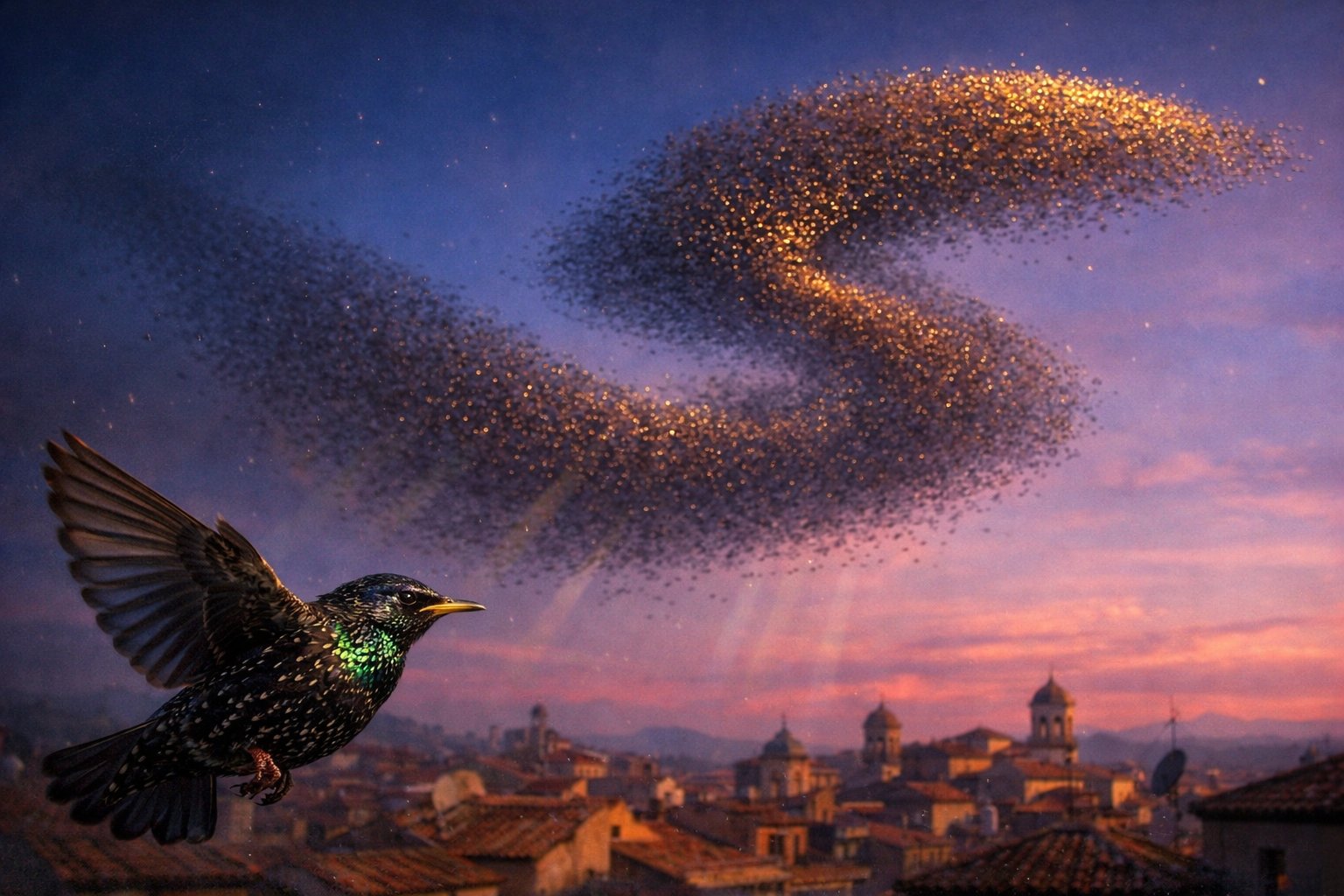
A starling murmuration of 30,000 birds turns as if it were a single organism, yet no bird is in charge. A locust swarm covering 1,200 square kilometers strips the vegetation from a Sahelian valley in a morning, and every locust inside it was, three weeks earlier, a solitary insect that actively avoided its neighbors. A school of 50,000 sardines bends around a sailfish lunge in roughly 200 milliseconds, faster than any individual fish’s nervous system can plan a route. These are the canonical examples that brought collective animal behavior out of natural history and into quantitative science. The interesting question is not whether group coordination is real. It is whether a small set of local interaction rules, applied independently by each animal to a handful of neighbors, can reproduce the global pattern we see from a hilltop or a research drone. The honest current answer: yes for several systems, partially yes for several more, and not yet for the hardest cases [1][2].
What the data actually shows
The modern era of swarm science begins, by common agreement, in 1986. Craig Reynolds, working in computer graphics rather than biology, published a model called Boids that produced lifelike flocking from three simple rules followed by every simulated agent: separation (steer to avoid crowding nearby flockmates), alignment (steer toward the average heading of nearby flockmates), and cohesion (steer toward the average position of nearby flockmates) [3]. The simulation was striking because nothing in those three rules instructs the flock to be a flock. The flock-shape is emergent. Reynolds was not trying to explain biology; he was trying to animate it. The biologists noticed.
Nine years later, the physicist Tamas Vicsek and colleagues at Eotvos Lorand University formalized a stripped-down version of the same idea as a statistical-mechanics problem. In the Vicsek model (1995), each particle moves at constant speed and, at each timestep, adopts the average direction of all neighbors within a fixed radius, plus a small noise term. As the noise drops below a critical value, the system undergoes a phase transition from disordered motion to coherent collective motion [4]. That phase transition is the thing physicists care about, because it tells you that flocking is not a special property of birds. It is a generic property of self-propelled particles with local alignment.
Topological versus metric: the starling correction
For two decades after Reynolds, almost everyone assumed each animal interacted with neighbors inside a fixed distance. The STARFLAG project, led by Andrea Cavagna and Irene Giardina at the University of Rome and the Italian National Research Council, tested that assumption directly. Between 2005 and 2008 they used stereometric photography to reconstruct the three-dimensional positions of every individual bird in starling murmurations over Rome, flocks of up to about 2,600 individuals [5].
The result was a surprise. Each starling responded not to the birds inside a fixed metric distance but to a fixed number of nearest neighbors, on average between six and seven, regardless of how dense the flock was. This is a topological rule, not a metric one. The functional difference matters: when a predator dives at the edge of a flock and locally compresses it, a metric-rule flock would respond differently in the dense region than in the sparse region. A topological-rule flock responds uniformly. The Cavagna group argued that topological interaction is what gives starling murmurations their characteristic resilience under attack [6]. The seven-neighbor result has since been replicated and is now the textbook reference for starlings, though the rule is not necessarily universal across species.
Locusts: a phase transition you can hold in your hand
A separate strand of swarm research came from entomology. The desert locust, Schistocerca gregaria, has been an agricultural problem for as long as agriculture has existed. The reason it is also a scientific problem is that Schistocerca gregaria exists in two forms that look, behave, and pheromonally signal so differently that they were once classified as separate species: a green, retiring, solitary phase and a black-and-yellow, aggregating, gregarious phase. The transition between phases is reversible and is triggered by population density.
In 2009, Stephen Simpson and colleagues at the University of Sydney showed in Science that the gregarious behavioral switch is mediated by serotonin. Within four hours of forced crowding, hindleg-stimulated solitary locusts release roughly threefold more serotonin in the thoracic ganglia, and that surge is sufficient to flip the behavior from neighbor-avoiding to neighbor-seeking [7]. Block the serotonin receptors and the swarm does not form, even at high density. This is one of the cleanest causal mechanisms in collective behavior: a measurable neurochemical, a measurable behavioral threshold, a measurable replication.
Fish schools and the predator confusion effect
Why bother to school in the first place? The leading hypothesis since the 1970s has been the predator confusion effect: a single predator, faced with many similar, moving prey, takes longer to lock onto any one target and is more likely to miss [8]. Iain Couzin’s lab at Princeton (now at the Max Planck Institute of Animal Behavior in Konstanz) has spent the last twenty years quantifying this with controlled experiments. In one widely cited 2013 study using golden shiners, the researchers showed that information about a predator threat propagates through the school as a wave at roughly one body length per 150 milliseconds, considerably faster than individual reaction times [9]. The school transmits an alarm before any individual fish has finished processing it.
That result is consistent with both the topological-interaction finding in starlings and the local-rule philosophy of Boids and the Vicsek model. The shared insight: collective behavior is not a centralized signal. It is a fast cascade of local responses that, in aggregate, behaves like a signal.
Honeybee swarms: a quorum decision in real time
A honeybee colony reproduces by splitting. The old queen leaves with roughly half the workers and bivouacs as a swarm — a writhing, fist-sized cluster — on a tree branch while several hundred scout bees fan out to find a new nest cavity. Within hours or days, the swarm collectively chooses one of perhaps a dozen candidate sites and flies to it as a coherent group. The decision-making was reverse-engineered in detail by Thomas Seeley at Cornell over four decades and is now textbook material for distributed consensus [11].
Each scout that finds a candidate cavity returns and waggle-dances on the swarm cluster; the duration and vigor of the dance are proportional to the scout’s assessment of the cavity’s quality. Scouts dancing for poor sites soon stop dancing; scouts dancing for good sites recruit other scouts to inspect those sites; once roughly fifteen scouts are simultaneously committed to one site, that site reaches quorum and the swarm lifts off. The mechanism is not a single dominant scout broadcasting a decision. It is positive feedback restricted to the best-quality option through individually-stochastic but collectively-reliable behavior. Seeley has explicitly compared the system to a neural decision circuit, with each scout playing the role of a single neuron and quorum playing the role of a firing threshold.
What we still don’t know
Several open questions in this field are honest. The first is whether the local-rule framework scales. David Sumpter’s 2010 monograph Collective Animal Behavior notes that most quantitative work has been done on flocks and schools of, at most, a few thousand individuals; the dynamics of a 100-million-locust swarm or a billion-fish anchovy bait ball may include effects that small-group studies cannot reveal [10]. The second is the role of leadership. Most swarm models assume identical agents, but field data on migrating ungulates, honeybee swarms, and homing pigeons all show that a small number of informed individuals can reliably steer much larger groups. How that information gets weighted is still being worked out.
The third is the nature of the phase transition itself. The Vicsek model predicts that ordered collective motion appears suddenly as a control parameter crosses a critical value. Real flocks appear to live close to that critical point — close enough that small perturbations propagate across the whole group, but not so close that the group disintegrates. Whether biological collectives are tuned to criticality by selection, by physics, or by both is an active debate [6][10].
What a 1,200-square-kilometer locust swarm actually looks like in numbers
The 2020 East African desert-locust outbreak, the most severe in 25 years for Kenya and Ethiopia and the worst in 70 years for Somalia, produced documented swarms with densities of 40 to 80 million individuals per square kilometer and consumption rates of 1.8 metric tons of vegetation per square kilometer per day [12]. A modest swarm of 50 square kilometers therefore eats, in one day, the daily food intake of roughly 35,000 humans. The point is not the lurid headline number. The point is that the same local-rule framework that explains a starling murmuration of 30,000 birds also has to explain a coordinated foraging front three to four orders of magnitude larger. Whether the rules are exactly the same or merely closely analogous is empirically open.
Where the framework is honestly silent
A few cases of apparent collective coordination remain genuinely unresolved. The synchronized flashing of fireflies in Southeast Asia (Pteroptyx) is well-modeled as a network of coupled oscillators, but the underlying neural mechanism is still being mapped. The dawn chorus of starling roosts and the mass takeoffs of bat colonies have plausible local-rule explanations but no equivalent of the STARFLAG dataset behind them yet. And the largest-scale collective phenomenon in vertebrates — the synchronized arrival of birds at remote ocean islands during long-distance migration — almost certainly involves a different class of rules entirely (magnetic, celestial, and route-memory cues) and is not really a swarm in the technical sense at all. Honest taxonomy of which animal aggregations are emergent swarms versus other things is part of the unfinished work.
The take-home
Swarming is not magic and it is not metaphor. It is a measurable consequence of self-propelled agents following local rules, with the specific rules differing by species: metric in some, topological in others, density-triggered and serotonin-mediated in locusts, vision-and-pressure-mediated in fish, quorum-thresholded in honeybees. The framework that ties it together — emergence from local interactions, with phase transitions between disordered and ordered states — is one of the cleaner success stories of complexity science applied to biology. The frontier is not whether the framework holds. It is how far it scales to populations of 10^7 or 10^8 individuals, how leader-follower asymmetries fit in for migrations and homing, and whether evolution has tuned animal groups to operate near criticality on purpose. Each of those questions is being attacked right now with new tools — drone-mounted multi-camera arrays, individual-level GPS tags, and machine-learning trajectory reconstruction — that did not exist a decade ago. The next decade should sharply narrow the answers.
Adjacent reading in science and natural anomalies: The Wow! Signal: A Space Mystery and Giants Causeway: Earth’s Footsteps of the Gods.