By Emilia Wellesley · Published May 8, 2026 · Updated May 13, 2026
Between August 1977 and September 1978, a council house in Enfield, North London, became the most heavily documented poltergeist case on record. Two investigators logged roughly 180 visits, 25 all-night vigils, and over 140 hours of tape. The file remains open. The evidence remains contested.
The address was 284 Green Street. The household was Peggy Hodgson and her four children. The case file was kept by Maurice Grosse and Guy Lyon Playfair on behalf of the Society for Psychical Research [1]. What follows is a reconstruction by hour and witness, not a verdict.
Direct Answer: What Was the Enfield Poltergeist?
The Enfield poltergeist refers to alleged paranormal activity at 284 Green Street, Enfield, between August 1977 and September 1978, centered on sisters Janet (11) and Margaret Hodgson (13). Investigators Maurice Grosse and Guy Lyon Playfair documented over 2,000 incidents across 180 visits. The case remains unresolved, with credible witnesses on both the paranormal and hoax sides [1][2].
The Timeline: First Call to Last Knock
The first incident logged was on the night of 30 August 1977. Peggy Hodgson reported a chest of drawers sliding across an upstairs bedroom and knocking sounds from the walls. She called the neighbors, then she called the police [1].
Police Constable Carolyn Heeps signed a written statement that she saw a chair slide approximately three to four feet across the floor. She could not identify the cause. That statement is the closest thing the case has to a chain-of-custody document from a non-aligned witness [1].
By early September, the family had contacted the Daily Mirror. The Mirror’s photographer Graham Morris and reporter Douglas Bence visited and reported objects in motion. The Mirror referred the case to the SPR. Maurice Grosse arrived on 8 September 1977 [2].
Grosse was a retired inventor in his sixties; Playfair was a Brazil-experienced parapsychology researcher. The pair logged the case until activity tapered in autumn 1978. The last recorded major incident was September 1978; sporadic events continued for roughly a year afterwards [2].
The Witness Roll
Witnesses ranged from family and neighbors to journalists, police, plumbers, a vicar, and members of the SPR. Total head count over the eighteen-month active phase: more than 30 named individuals, with later cumulative tallies of 180 attesting to some degree of phenomena [2].
The neighbors Vic and Peggy Nottingham were on site within minutes of the first night’s incident. Vic Nottingham reported being unable to identify the source of the knocking on the walls. John Burcombe, Peggy Hodgson’s brother, became a regular witness across the eighteen months [2].
Witness lists are not evidence ladders. They are a starting point. Each witness saw a different room, on a different night, under different lighting. Each had a different relationship to the family. The case file weighs more by hours-of-tape than by witness-count, and the tape weighs more than any single signed statement.
The Evidence Inventory: What Survived
Three classes of artifact survived the case in usable form: audio tape, photographs, and signed witness statements. The volumes are unusual for a poltergeist file.
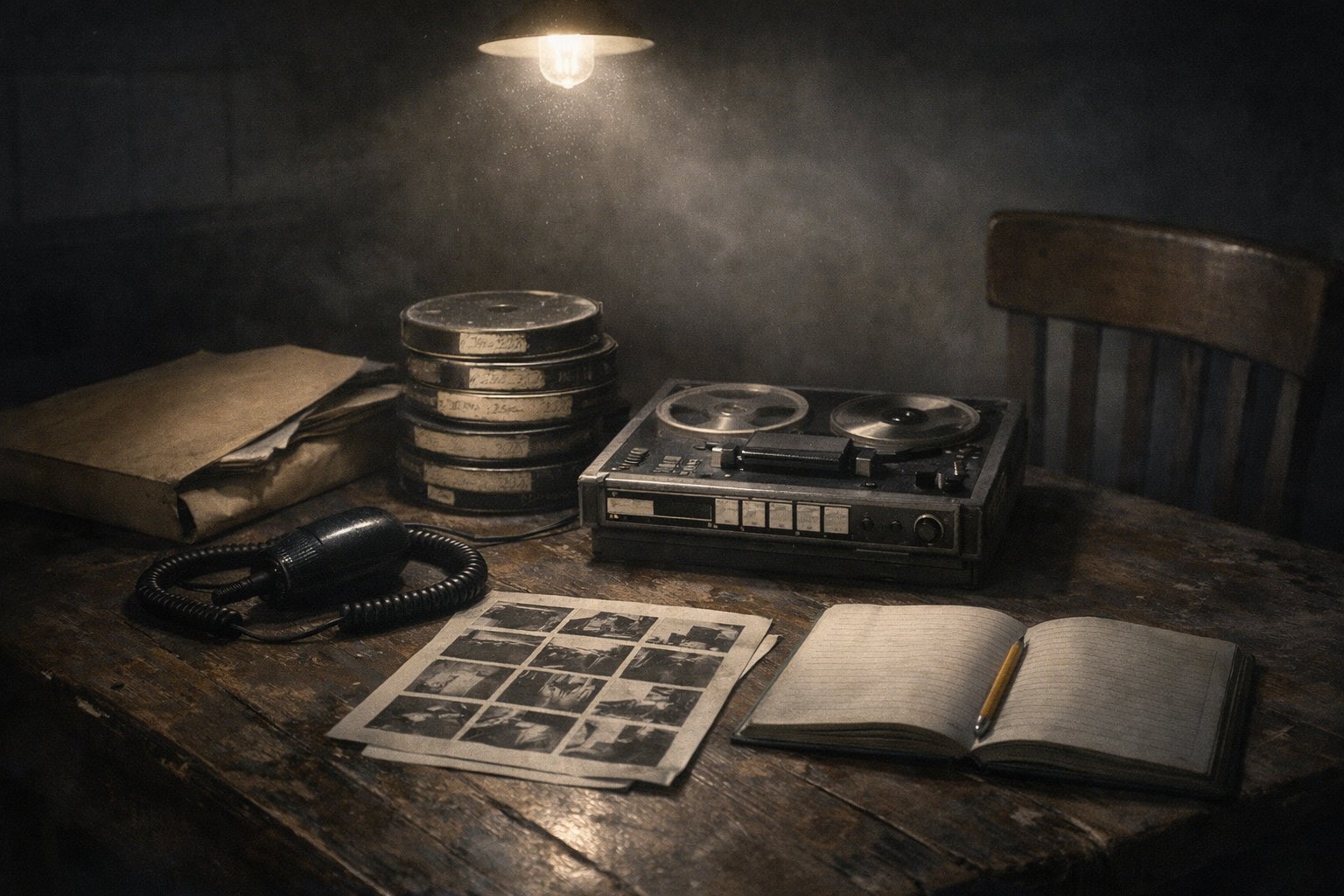
- Audio tape: Grosse and Playfair recorded over 140 hours during the active phase, with the cumulative archive reportedly reaching 250-plus hours by the case’s close [3]. The tapes are now held by the SPR and were licensed for the 2023 Apple TV+ documentary.
- Photographs: Daily Mirror photographer Graham Morris produced a sequence using a motor-drive camera, including images that appear to show Janet airborne in her bedroom [1].
- Witness statements: PC Heeps’ contemporaneous statement, plus signed accounts from neighbors Vic and Peggy Nottingham, John Burcombe (Peggy Hodgson’s brother), and a number of SPR members [2].
What did not survive is the kind of controlled-environment record a fraud examiner would want. No camera ran continuously. No microphone was sealed against tampering. The investigators stayed long but not always alert; one all-night vigil at a time has limits [4].
The Bill Wilkins Voice
In December 1977, Janet began to produce a deep male voice that she said came from the back of her neck. The voice identified itself as Bill Wilkins, claiming to have died of a haemorrhage at age 72 in a chair downstairs [1].
Council records later showed a Bill Wilkins had occupied the house and died there. The cause of death on the certificate, however, was coronary thrombosis, not haemorrhage, and the age at death was 61 [1]. The investigators treated the partial corroboration as significant. Skeptics treated the misses as fatal.
A practical detail in the case notes: the voice generally refused to speak unless the girls were alone in the room with the door closed [5]. Playfair recorded this himself.
Other voices appeared on the tapes too. The recorded register over the months included a voice claiming to be a man named Joe Watson and at least one other unidentified male persona. The Bill Wilkins voice was the most persistent and the most evidentially consequential because of the partial council-records corroboration [5].
A magician’s note enters the file here. Playfair tested whether Janet could speak in the deep voice with her mouth full of water, and reported she could. Joe Nickell observed that ventriloquial production from the false vocal folds is well-documented and reproducible without paranormal hypothesis [4]. The file does not contain a controlled experimental design that would distinguish the two readings.
The Skeptical Case: What Cuts the Other Way
A poltergeist file is only as strong as the disqualifications it can rule out. The Enfield file has several pieces of counter-evidence, and they are not minor.
Anita Gregory, an SPR member with a doctorate in the history of psychology, visited the house and concluded that the case was overrated. Her published critiques in the Journal of the Society for Psychical Research argued the girls staged incidents for visiting press, that Playfair’s book was unsystematic, and that Janet had taught herself the deep-voice trick [6].
CSICOP investigator and stage magician Joe Nickell, writing in Skeptical Inquirer in 2012, noted three patterns the file struggles to answer [4]:
- The phenomena tended to occur most strongly when no adult investigator had clean line of sight on Janet or Margaret.
- A reel-to-reel tape malfunction Grosse cited as supernatural was a known threading jam on older machines.
- The pattern of phenomena fits the standard repertoire of two playful, bored, attention-seeking pre-teen girls in a tabloid-intensified household.
The third strike against the file is a self-strike. Janet and Margaret admitted to journalists that they had faked some incidents. Janet’s later quoted estimate was that they cheated about two percent of the time, with the remaining 98 percent being, in her view, real [7]. The investigators agreed that some incidents were faked but maintained a residual core of unexplained activity. Both retracted their hoax confessions soon after.
What a Two-Percent Admission Means
A two-percent admission is procedurally awkward. In a non-paranormal investigation, a witness who admits to fabricating two percent of the testimony can have the remaining 98 percent treated as compromised, not validated. The girls’ retraction does not restore credibility either way; it adds noise [4].
A charitable read: children under siege from poltergeist activity, journalists, and the camera flash imitate what they see. An uncharitable read: children produced what the adults wanted to see. The file does not adjudicate between these. The investigators picked the charitable read; Gregory and Nickell picked the uncharitable one.
The Media Layer: BBC, Daily Mirror, and the Tabloid Effect
The case did not unfold in a vacuum. The Daily Mirror was on site within the first week. BBC Scotland’s Stewart Lamont visited the house twice in 1978, producing the only surviving video footage of the case. His Nationwide segment is the closest thing the file has to broadcast-grade documentation [1].
Lamont’s footage shows Janet in her bedroom, the family in the kitchen, and Grosse on site. The audio reportedly captured anomalies on Lamont’s tape; the visual footage did not show flying objects. Television was less generous to the case than the still photographers had been [1].
Tabloid presence has a documented effect on this kind of case. When journalists are paying for stories, witness behavior shifts. The Hodgson sisters were 11 and 13 in a North London council house with the Mirror’s photographer parked in the front room. That detail belongs in the case file as a chain-of-custody flag, not as a dismissal.
There is a separate background variable worth noting. Peggy Hodgson was a single mother with four children on a council tenancy in 1977. The household was under economic and emotional pressure independent of any phenomena. Cold-case reconstruction does not weight that against the witnesses; it logs it as context. Stress on a household correlates with both authentic stress reactions and with the kind of attention-seeking the skeptics describe. The file cannot tell which mechanism dominates without controls it never produced [4][6].
The Warrens’ Brief Visit
Ed and Lorraine Warren, the American demonologist couple, visited 284 Green Street once, briefly, in mid-1978. Their attendance is the basis for the 2016 film The Conjuring 2. Playfair’s case notes characterize the visit as short and uneventful relative to the rest of the file. Treating the Warrens as primary investigators of Enfield is a Hollywood reconstruction, not a procedural one [1].
What the Record Will Bear
The Enfield file supports a small set of provisional conclusions and a larger set of unanswered questions. The conclusions:
- Something happened at 284 Green Street between August 1977 and September 1978 that produced more than 30 named witnesses, signed police testimony, contemporaneous press accounts, and 140-plus hours of audio tape.
- A non-trivial fraction of incidents was faked by the children; both Janet and Margaret admitted as much, then retracted [7].
- A non-trivial fraction of incidents has not been satisfactorily explained by either the investigators or the skeptics, depending on which file you read.
- No controlled-environment record was produced. The case is reconstructible, not replicable.
The questions the file leaves open are the ones that matter for paranormal-investigation epistemology. How much of an 18-month case can a two-investigator team actually witness? How does tabloid presence corrupt a record that is otherwise contemporaneous? At what threshold of admitted fabrication does the residual evidence stop counting [4][6]?
For investigators interested in similar long-form cases, see the parent file at Unsolved Mysteries and Enigmas. The Enfield case is now in its fifth decade. The tapes have been digitized. The witnesses are aging out. The file is still open, and the disagreement between Grosse-Playfair and Gregory-Nickell is still unresolved on the merits.
A cold-case investigator would not call the Enfield poltergeist solved. Nor would a careful one call it a hoax. The honest entry in the notes column is: incomplete record; insufficient controls; credible witnesses on both sides; verdict pending further evidence that is unlikely to arrive.
Other open cases from the unsolved mysteries archive: The Somerton Man: Tamam Shud’s Unknown End and Ball Lightning: A Glowing Globe of Mystery.