
Drafted with AI assistance from the sources listed; images are AI-generated illustrations. How EsoVitae is made
In April 2026, a paper in Biodiversity Data Journal described a small, pale, bilaterally symmetrical organism that had been filmed gliding above the floor of the Ryukyu Trench at roughly 9,130 meters [1]. The authors, working with the Minderoo-UWA Deep-Sea Research Centre at the University of Western Australia, did the careful thing. They circulated the footage to specialists in nudibranchs, sea cucumbers, and deep-sea molluscs. The specialists could not agree. So the paper logged the animal under the oldest, most honest entry in the Linnaean system: Animalia incertae sedis, of uncertain placement [1][2].
I want to walk through what that label actually means, what the Japan footage actually shows, and why discoveries like this are not anomalies in the literary sense. They are the ordinary product of a young, technically constrained discipline that is still in its first century of seeing the deep sea at all.
Direct Answer: What Was Filmed Off Japan?
A two-month 2022 expedition led by the Minderoo-UWA Deep-Sea Research Centre filmed an unidentified pale, bilaterally symmetrical organism with stiff, antenna-like projections at roughly 9,130 meters in the Ryukyu Trench off Japan. The April 2026 paper catalogues it as Animalia incertae sedis: a placeholder used when no current phylum will confidently accept the animal [1][3].
What "Incertae Sedis" Actually Means
The Latin phrase translates to "of uncertain seat." In Linnaean taxonomy it is a formal placeholder used at any rank, from kingdom down to genus, when there is not yet enough evidence to assign the organism a position [4]. It is not a mystical category. It is a discipline-wide bookmark that says: we logged the specimen, we described what we could see, and we are waiting on better data before we file it.
The classification can sit on different rungs of the ladder. A beetle whose family is unclear might be Coleoptera incertae sedis. A microbial fossil whose phylum is unclear might be Eukaryota incertae sedis. The Japan organism sits at the highest possible level of uncertainty: Animalia incertae sedis. The team felt confident it was an animal. They were not willing to claim a phylum.
In short: incertae sedis is the taxonomic equivalent of writing "TBD" in pencil. It is the field telling the truth about what it does and does not know.
The Japan Footage, In Plain Description
Three of Japan’s deepest trenches were surveyed during the 2022 expedition aboard DSSV Pressure Drop: the Japan Trench, the Izu-Ogasawara Trench, and the Ryukyu Trench [1][2]. The team used baited and unbaited landers and the crewed submersible Limiting Factor. Across depths from 4,534 to 9,775 meters they catalogued 108 distinct organism groups, including the supergiant amphipod Alicella gigantea, carnivorous sponges, crinoid meadows of more than 1,500 individuals, and a feeding snailfish at 8,336 meters that set a new depth record for in-situ predation [1][2].
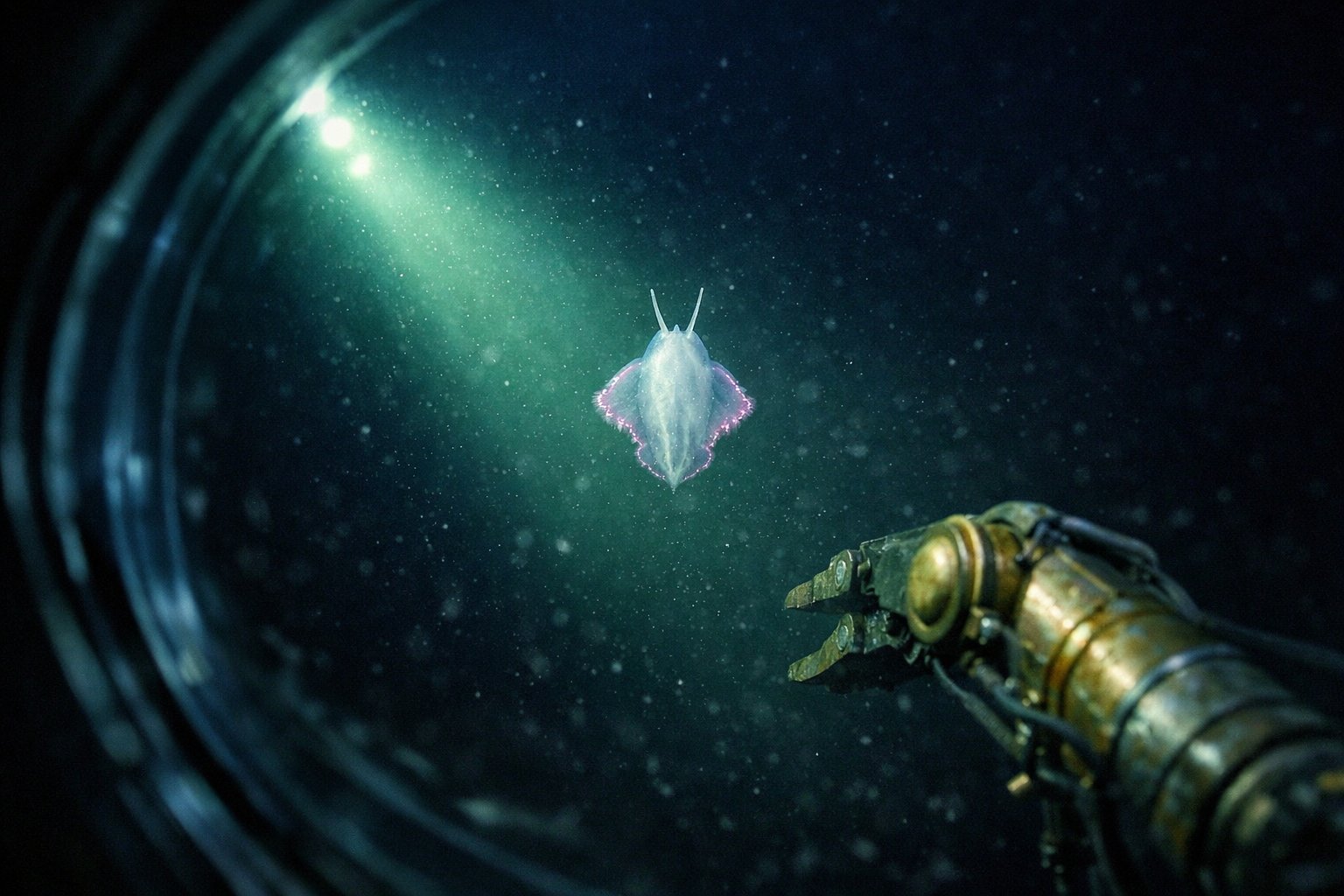
The unidentified animal appeared near the Ryukyu Trench seafloor at approximately 9,130 meters [1][3]. On the video it is small, pale, and approximately bilaterally symmetrical. Two anterior projections stand stiffly above the body, in roughly the position where a sea slug carries its rhinophores. The motion is slow and gliding, not pulsing, not crawling. The animal does not visibly retract from the lights.
The team’s first guess was reasonable: nudibranch. Sea slugs are widespread, they can be ghostly white, and many carry the kind of paired anterior sensors the video shows. But three problems stacked up. The previously deepest known nudibranch sat at roughly 4,000 meters [3], which would make this one more than twice as deep as any congener. The appendages, multiple consulted specialists noted, looked too rigid for a soft-bodied sea slug. And the body plan, while consistent with a mollusc in some respects, did not match the diagnostic features of any described family [1][2][3]. So the authors did the thing that working taxonomy demands when the data underdetermine the answer. They wrote "Animalia incertae sedis" into the species column and published.
What The Video Cannot Resolve
Video alone is a thin sliver of evidence. It captures gross morphology, behavior in the cone of LED light, response to a baited lander, occasional interactions with other fauna. It does not capture internal anatomy, tissue type, gut contents, gametes, larval stage, or DNA. Most deep-sea identifications that resolve to species require at least one of those secondary lines of evidence, and usually several [5]. The Japan team has the footage. They do not, by the paper’s own account, have a specimen.
The Deep-Sea Census Context
This kind of finding is not rare. It is the expected output of a research program that has been steadily peeling back the bathyal and hadal zones since the early 2000s.
The Census of Marine Life, a ten-year international project that ran from 2000 to 2010, involved more than 2,700 scientists from 80 nations and produced more than 6,000 candidate new marine species, of which roughly 1,200 had been formally described by 2010 with another 5,000-plus still in the pipeline [6]. After the Census closed, the deep-sea infrastructure it helped build, including coordinated submersibles, eDNA capacity, deep-towed cameras, kept producing finds. The Schmidt Ocean Institute’s Falkor and Falkor (too), JAMSTEC’s Shinkai 6500 and Kaiko, the Ocean Exploration Trust’s Nautilus, MBARI’s Doc Ricketts, NOAA’s Okeanos Explorer with Deep Discoverer, the Minderoo-UWA fleet, all of them have routinely returned footage and specimens that needed taxonomic care.
The deep sea remains genuinely under-sampled in the way fisheries scientists mean the term. As of April 2026, the Seabed 2030 initiative reports that 28.7 percent of the global seafloor has been mapped at modern resolution [7]. The other 71.3 percent has not. Bathyal and hadal biodiversity sits, almost by definition, inside that unmapped fraction.
How Past "Mystery" Animals Got Resolved
A short pair of case histories is the cleanest way to show what the next chapter of the Japan story is likely to look like.
The Yeti Crab (Kiwa hirsuta)
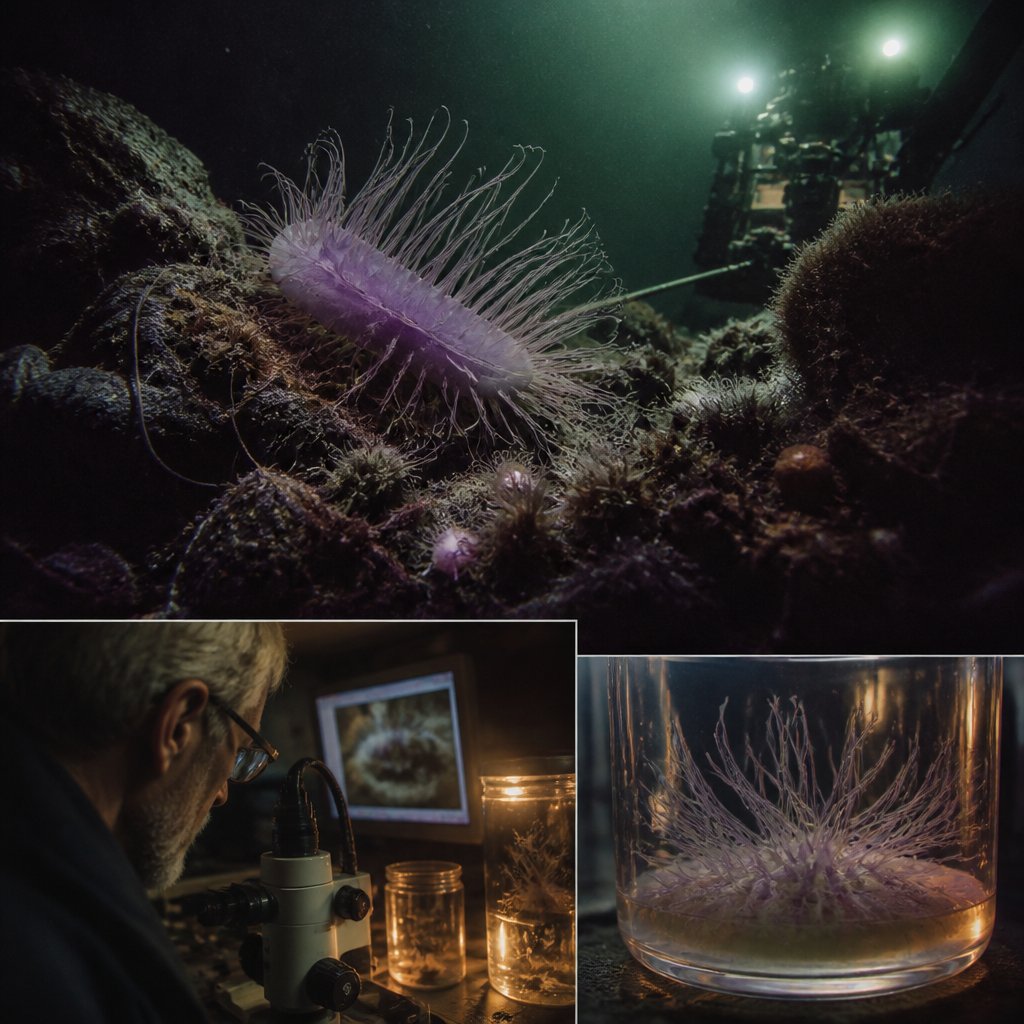
In March 2005, the deep-submergence vehicle Alvin, operating from R/V Atlantis, encountered a hairy white decapod on hydrothermal vents along the Pacific-Antarctic Ridge at roughly 2,200 meters [8]. The animal was so morphologically distinctive, with its bristled pereiopods covered in symbiotic bacteria, that the original team, led by Robert Vrijenhoek (MBARI) and Michel Segonzac (IFREMER), could not place it in any existing family of squat lobsters. They collected specimens, ran molecular and morphological work, and erected a new family, Kiwaidae, around it [8]. The animal went from "mystery" to "type specimen of a new family" in roughly one publication cycle, because the team had a specimen and a sequencing pipeline.
The "Casper" Octopus
In February 2016, NOAA’s Okeanos Explorer filmed a ghost-white, finless, single-sucker-row octopod sitting on bare basalt at roughly 4,290 meters off Necker Island, in the Hawaiian Archipelago [9]. Specialists agreed it was almost certainly undescribed, possibly belonging to the genus Muusoctopus or close to it. Ten years later, the animal still has no formal scientific name. The reason is simple: nobody has yet collected a specimen, and you cannot describe an octopus to the standards of cephalopod taxonomy from video alone [9][10].
The yeti crab and Casper bracket the two paths a footage-only mystery animal can take. With a specimen, the science moves quickly. Without one, an animal can sit at the edge of the catalogue for decades, scientifically real but taxonomically homeless.
What The Classification Process Looks Like Next
If the Japan animal is ever to leave incertae sedis, four lines of work need to converge.
First, morphometric analysis from the footage itself. Frame-by-frame measurement of body length, appendage-to-body ratio, swimming kinematics, and behavioral response can shrink the candidate phylum list even without a specimen. Mollusca, Cnidaria, and an aberrant member of Echinodermata have all been informally floated by readers of the paper [2][3]; morphometrics can rule out at least one of those.
Second, environmental DNA sweeps. Water sampled at the encounter depth, run through cytochrome c oxidase subunit I (COI) barcoding or 18S rRNA pipelines, can match the organism’s shed DNA to known sequences, or, more interestingly, fail to match anything and flag a divergent lineage [5].
Third, a voucher specimen if a return expedition can collect one. Hadal-zone collection is technically demanding, the animals are fragile at surface pressure, and the trench is twelve hours of transit each way for a submersible. But a single intact body would unlock histology, scanning electron microscopy of the appendages, and whole-organism sequencing.
Fourth, peer-review publication of any candidate placement. The deep-sea taxonomic community is small. The same dozen or so specialists in nudibranch, octopus, and aberrant-bilaterian morphology review most of the relevant manuscripts. A confident phylum assignment will involve them.
Why Deep-Sea Discoveries Keep Coming
The basic answer is geometric. The bathyal zone (1,000-4,000 m) and hadal zone (below 6,000 m) together cover a surface area larger than every continent combined, and we have visited a vanishingly small fraction of it [7][11]. Roughly 71 percent of the seafloor remains unmapped at modern resolution. The fraction visited by crewed or remotely operated vehicles is smaller still, by orders of magnitude. Inside that gap, the local communities are often distinctive: chemosynthetic vent fields, cold seeps, brine pools, manganese-nodule plains, each with its own endemic fauna [11].
The discovery rate is not slowing. The World Register of Marine Species (WoRMS) accessions roughly 2,000 new marine species per year, with a healthy share coming from depths greater than 1,000 meters [11]. Some of those entries spend years in incertae sedis categories before they settle. That is what active science looks like at a frontier.
The Cryptid Appeal And The Working Biology
A footage-only animal at 9,130 meters is irresistibly suggestive. Headlines have called it a "mystery monster," a "baffling alien," a creature that "defies classification." That language is not wrong, exactly. The animal does sit outside the catalogue right now. But the framing pulls the reader’s attention away from the careful, slow work the taxonomists are doing and toward an older folkloric register, the one that gave the early modern period its sea monks and sea serpents.
The working biology is more interesting than the monster framing. A small, slow, pale animal in the cone of an ROV light is data. It tells the field that something with bilateral symmetry and apparent sensory anterior projections is present at 9 kilometers depth. It tells the field that current phylum diagnostics do not capture it. It tells the field, by extension, that the diagnostics themselves may need revising once enough such finds accumulate.
That last point matters. Phyla are not eternal categories. They are working hypotheses about deep evolutionary relationships, periodically rearranged when molecular work overturns morphological intuitions. Xenacoelomorpha was elevated to phylum status only in 2011. Loricifera was described as a phylum in 1983. Animal phyla can be added, merged, or split, and the deep sea has historically been a place where that happens, because it preserves lineages that lost out on the shelf and the continents.
What To Watch For
Two things will move this story in the next twenty-four months. Either the Minderoo-UWA team or a collaborator (the Tokyo University of Marine Science and Technology has been a partner on related Japan-trench work) mounts a return expedition with collection priority, or eDNA reanalysis of the existing water samples from the encounter site produces a phylogenetic placement. Either result will appear in the deep-sea literature first, likely in Biodiversity Data Journal, Deep Sea Research, or Marine Biodiversity, before any popular press picks it up.
Until then, the animal stays where the original authors put it: in the column marked Animalia incertae sedis, with a date, a depth, and a behavioral description, waiting for the next piece of evidence that the system needs to seat it properly. That is not a mystery. It is method.
Frequently Asked Questions
What does "Animalia incertae sedis" mean in plain English?
It means "an animal of uncertain position." Taxonomists use it as a formal placeholder when an organism is confidently identified as an animal but cannot yet be assigned to any known phylum, class, or family [4].
Where exactly was the creature filmed?
Near the seafloor of the Ryukyu Trench, in the Philippine Sea east of Japan’s Ryukyu Island chain, at a depth of approximately 9,130 meters [1][3].
Who led the expedition?
A team from the Minderoo-UWA Deep-Sea Research Centre at the University of Western Australia, with collaborators at the Tokyo University of Marine Science and Technology, working aboard DSSV Pressure Drop with the crewed submersible Limiting Factor [1][3].
Could it be a deep-living nudibranch?
It was the team’s first guess. But the previously deepest known nudibranch sat at roughly 4,000 meters, and consulted specialists noted the animal’s appendages looked too rigid for a soft-bodied sea slug. Nudibranch placement is currently unconfirmed [1][3].
Why don’t they just collect a specimen?
Hadal-zone collection is technically expensive and the animals are often fragile when brought to surface pressure. Trench cruises are scheduled years in advance and the encounter site is twelve hours of transit each way from a surface vessel.
How often does this kind of thing happen?
The World Register of Marine Species accessions roughly 2,000 new marine species per year. Most are placed quickly. A handful, like this one or the "Casper" octopus, sit in incertae sedis categories for years pending more data [9][11].
Will the animal ever be formally named?
It depends on whether a specimen is collected or eDNA recovers a usable sequence. The Casper octopus, discovered on video by NOAA in 2016, still has no formal name after ten years for exactly this reason [9].
Is the deep sea really that unexplored?
Yes. As of April 2026, the Seabed 2030 initiative reports 28.7 percent of the global ocean floor has been mapped at modern resolution. Submersible visits cover an even smaller fraction [7].
How is this related to bizarre animal mutations?
It isn’t, in the strict mutational sense. Hadal-zone fauna are not mutants of shallower species. They are typically deep-evolved lineages adapted to pressure, cold, and food scarcity. The "bizarre" quality is evolutionary divergence, not pathology.
Where can readers follow updates?
Watch the Biodiversity Data Journal, Deep Sea Research, and Marine Biodiversity. The Minderoo-UWA Deep-Sea Research Centre and the Schmidt Ocean Institute also publish expedition reports on the same field.
Field Note
Headline shorthand of the "experts stumped" variety tends to flatten what is actually a careful, slow process. The Japan team was not stumped. They observed an animal, asked the appropriate specialists, recorded what those specialists said, and labelled the entry honestly. That is the discipline doing its job. The mystery, if there is one, is in the fact that we know so little about so much of the planet that filming a small pale animal at 9 kilometers deep still produces a phylum-level surprise. Watch the animal. Then keep watching.
For more context on how the field handles unusual biology, see our Animal Anomaly Mysteries pillar.