By Emilia Wellesley · Published May 4, 2026 · Updated May 13, 2026
Last reviewed: May 4, 2026.
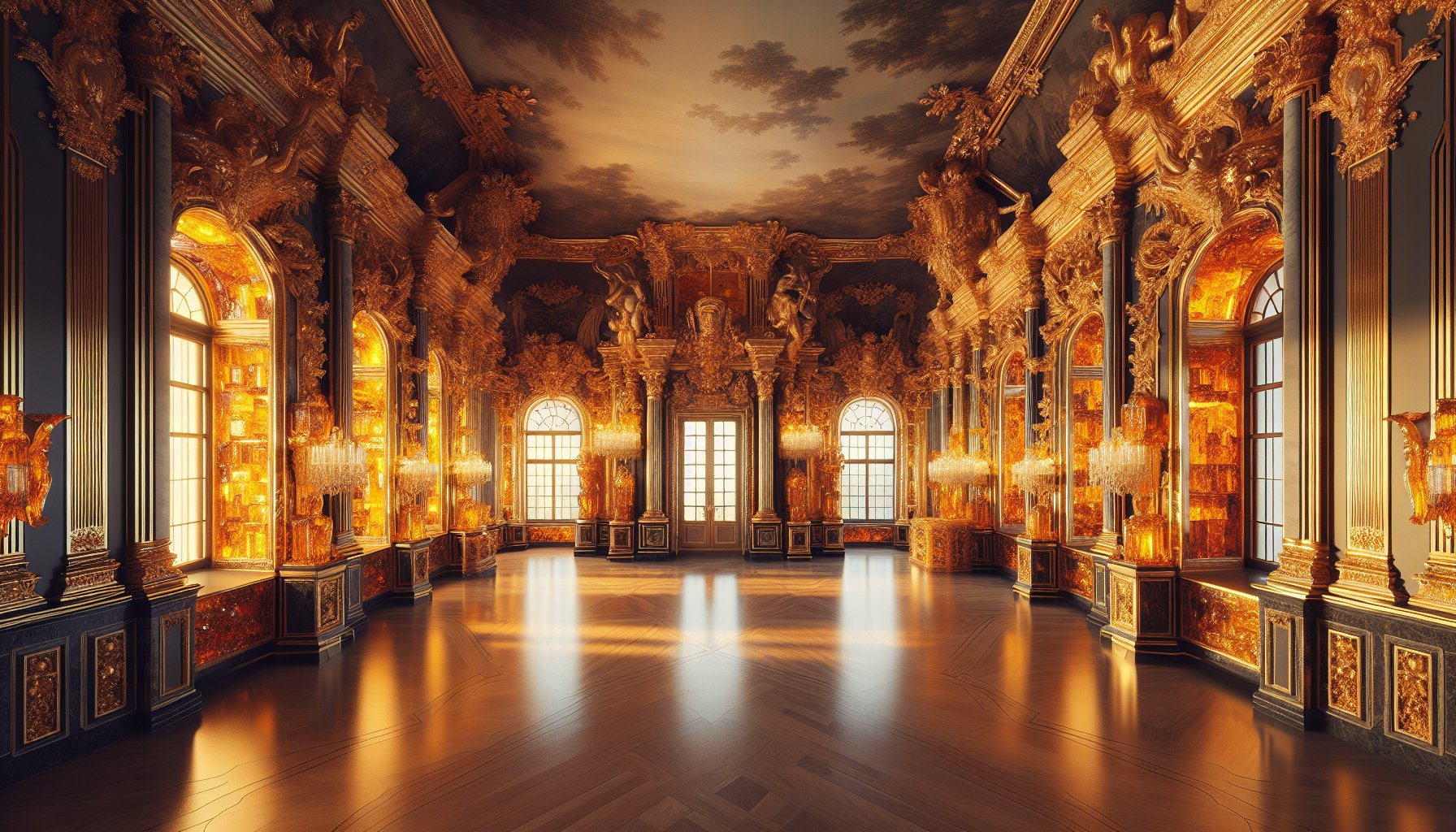
Explore the history and myths surrounding the Amber Room, a masterpiece of baroque art originally in Catherine Palace, Saint Petersburg, and its mysterious disappearance during World War II. This outline will delve into key aspects surrounding this artwork, from its conception to the efforts made for its recovery.
Historical Background
The Amber Room, an incomparable masterpiece of baroque art, has intrigued historians, artists, and mystery seekers alike for centuries. Initially conceived by the German sculptor Andreas Schlüter and built by the Danish amber craftsman Gottfried Wolfram in the early 18th century, this room has been a focal point of art and diplomatic history. The panels, made of Baltic amber, backed with gold leaf and mirrors, represent a zenith in artistry and opulence.
Origin and Diplomatic Significance
- Conception: The room was designed by Andreas Schlüter, a German sculptor.
- Craftsmanship: Constructed by Gottfried Wolfram, utilizing Baltic amber and luxurious decorations.
- Purpose: Symbolized peace and respect among European powers.
The room’s journey began as a symbol of peace and shared respect between the great powers of Europe. It was gifted to Peter the Great of Russia in 1716 by Frederick William I of Prussia. The gift, rich with political undertones, was part of a diplomatic strategy to secure Russian allegiance in the unfolding European alliances. Upon its arrival in Russia, the Amber Room was first installed at the Winter House in Saint Petersburg before finally being moved to the Catherine Palace at Tsarskoye Selo.
Modifications and Enhancement
- 18th Century Changes: The room underwent several modifications to suit changing tastes and political climates.
- Architectural Influence: Italian architect Bartolomeo Rastrelli was tasked with expanding its grandeur during the reign of Elizabeth of Russia.
- Additions Made: Rastrelli added more amber panels and intricate Florentine mosaics.
Throughout the 18th century, as tastes and the political climate changed, the Amber Room underwent significant modifications under the watchful eye of Italian architect Bartolomeo Rastrelli. Tasked with expanding its grandeur during the reign of Elizabeth of Russia, Rastrelli infused the room with additional amber panels and elaborate Florentine mosaics, transforming it into a breathtaking symbol of Russian cultural heritage. These enhancements not only solidified its status as a Russian masterpiece but also intertwined its identity with the grandeur and historical narrative of the Catherine Palace itself.
Cultural and Artistic Impact
- Symbol of Opulence: The room epitomized Baroque art and the lavish tastes of Russian tsars.
- Host to Dignitaries: It captivated dignitaries and scholars, enhancing cultural exchanges and appreciation.
- Cultural Artifact: Stands as a testament to German craftsmanship and Russian cultural heritage.
This section of the palace, epitomizing opulent Baroque art, continued to captivate all who viewed it, playing host to countless dignitaries and scholars. It stood as a testament not only to German craftsmanship but also to the lavish tastes of Russian tsars. The room's historical journey, marked by cultural exchange and artistic collaboration, underscores its significance as a cultural artifact—far beyond its physical beauty and artistic composition.
World War II and the Disappearance
The Looting by Nazi Germany
During the ominous stretches of World War II, the Amber Room, a resplendent chamber decoration initially housed in Catherine Palace, was subjected to ruthless looting by Nazi Germany. This act was not merely a theft but a calculated extraction carried out by the German Army in 1941. Historically, the Room served as a cultural emblem, showcasing the opulence of Prussian kings and Russian tsars alike, from its conception by Frederick I of Prussia to its cherished residence in Russia.
The invasion and subsequent dismantling were meticulously planned—panels of Baltic amber and gold leaf were stripped away and packed up for transportation. The destination was Königsberg Castle, a site that later became a focal point of numerous theories concerning the Room's ultimate fate. The removal of the Amber Room was part of a broader strategy by the Nazis to seize control of Russian cultural heritage, an act that aligned with Hitler's vision of eradicating the influence of Russian art and encapsulating German supremacy.
Theories on its Disappearance
Post-looting, the trail of the Amber Room grows cold, shrouded in mysteries and conflicting hypotheses. The prominent theory suggests that the Room was destroyed during the 1944 Allied bombings of Königsberg, a city reduced to rubble under the assault of artillery shells. However, the lack of concrete evidence to support this claim leads to a host of alternative theories brimming with intrigue and speculation.
Art historians and treasure hunters alike have posited that the Room's panels could have been concealed within the labyrinthine mines and bunkers scattered across Eastern Europe. Others speculate about the involvement of the Stasi or even local Kaliningrad authorities hiding the treasure in plain sight during post-war chaos. The disappearance of the Amber Room has not only spurred countless theories but also ignited a flame of curiosity and determination among researchers and history enthusiasts determined to uncover the truth of its fate.
Search and Reconstruction Efforts
Pioneering the Quest for the Lost Masterpiece
The relentless search for the Amber Room has been a saga marked by twists, turns, and dead ends, fascinating historians and search parties alike. After World War II, the trail of the vanished room led several researchers, including Alexander Brusov and Igor Konovalov, to comb through archives, former battlefields, and ruined edifices.
Brusov, a dedicated Soviet historian, concentrated his efforts on deciphering German wartime records, hoping to unearth clues about the fate of the Amber Room post looting. Concurrently, Konovalov scoured the remnants of Königsberg Castle and its environs, hypothesizing that the room might have been hidden or overlooked in the chaos of the post-war period. Despite their exhaustive searches, both faced considerable geopolitical and bureaucratic obstacles during the Cold War, making access to certain sites and archives near impossible. Their investigations, though rich in effort, yielded little concrete evidence, leaving the whereabouts of the Amber Room enveloped in mystery.
Crafting from Remnants: The Rebirth of a Cultural Icon
Resolved to recovering a piece of its lost heritage, Russia embarked on an ambitious project to reconstruct the Amber Room. By the late 1990s, the decision was made not merely to remember the old but to recreate it. The laborious process of reconstruction began at Catherine Palace, spearheaded by a dedicated team of Russian artisans and historians. Utilizing traditional techniques and basing their work on surviving photographs and descriptions from historical texts, the team faced the monumental task of replicating the ornate amber panels, intricate gold leaf ornamentations, and the elaborate Florentine mosaics.
One of the most daunting challenges was the sourcing of the necessary Baltic amber—tons were required. The painstaking process involved not just the meticulous assembly of the amber and its complementary materials but also ensuring the recreated room echoed the original’s grandeur and opulence. In 2003, after decades of work fueled by a blend of historical respect and national pride, the reconstructed Amber Room was unveiled to the public. This act was celebrated not just as a feat of artistic and historical reconstruction but as a poignant statement of cultural resilience and restitution.
Through these extensive efforts, the Amber Room’s saga—from its creation to loss, and subsequent rebirth—continues to captivate and inspire a global audience, underscoring the ongoing dialogue between the past and present, and the enduring importance of preserving cultural heritage.
Cultural Impact and Significance
Role in Russo-German Relations
The Amber Room has long stood as a poignant emblem of the waxing and waning tensions between Russia and Germany. Originally a gift from Frederick I of Prussia to Peter the Great, the room's journey through history mirrors the complex relationships and power dynamics between the two nations. Over the centuries, this masterpiece of German craftsmanship and Russian cultural heritage has witnessed diplomatic alliances and bitter conflicts, becoming a symbol of interconnected European history.
In contemporary times, the Amber Room's fate during World War II—where it was looted by Nazi Germany and subsequently lost—serves as a stark reminder of the cultural ravages of war. The debate around its disappearance and the ethical questions of cultural restitution continue to influence Russo-German diplomatic conversations. Efforts to recover and restore the room have often been paralleled with attempts to mend political relations, making the Amber Room not just a lost treasure but also a bridge in cultural diplomacy.
The Amber Room in Arts and Media
The mystery of the Amber Room extends far beyond its physical presence, captivating the imaginations of artists, filmmakers, and writers around the globe. Its story has been adapted into various forms, serving as a central theme in novels where it often symbolizes lost grandeur or the elusiveness of beauty. Documentaries and historical analyses explore its historical significance and the ongoing quests to uncover its fate, resonating with audiences fascinated by wartime secrets and the plunder of cultural gems.
Moreover, the Amber Room's influence is evident in public exhibitions and educational programs that highlight the importance of art preservation and the protection of cultural heritage. These portrayals not only bring attention to the historical and artistic value of the Amber Room but also raise awareness about the broader issues of art theft and the recovery of looted treasures. Through these narratives, the Amber Room continues to inspire a wide-reaching dialogue about history, art, and the complexities of cultural identity.
For deeper context across the historical and archaeological mysteries archive, consider The Disappearance of Amelia Earhart and Göbekli Tepe: The World’s First Temple.