By Emilia Wellesley · Published May 4, 2026 · Updated May 13, 2026
What Happened to the Mary Celeste?
The Mary Celeste was an American merchant brigantine found abandoned and adrift in the North Atlantic on 4 December 1872 by the Canadian ship Dei Gratia. Her crew of seven, Captain Benjamin Briggs, his wife, and their two-year-old daughter were gone. The cargo of denatured alcohol, the chronometer, the sextant, and the lifeboat told a story no one has been able to finish.
No nineteenth-century shipping case has produced a longer paper trail of competing reconstructions. The vessel was seaworthy when boarded. Most of her cargo was intact. Provisions, personal effects, and a half-eaten meal were found in place. And yet ten people, including a small child, had stepped off a sound ship into a winter ocean and were never seen again. The Mary Celeste sailed back into Genoa under a salvage crew, and into a public imagination that has not let her go.
What follows is a sober reading of the surviving documents, the salvage hearing in Gibraltar, and the modern explanations that have tried, with varying success, to account for the specific physical evidence the boarding party recorded. The case sits inside the broader landscape of historical and archaeological mysteries precisely because the evidence is unusually well preserved and stubbornly under-determined.
The Brigantine, the Captain, and the Voyage
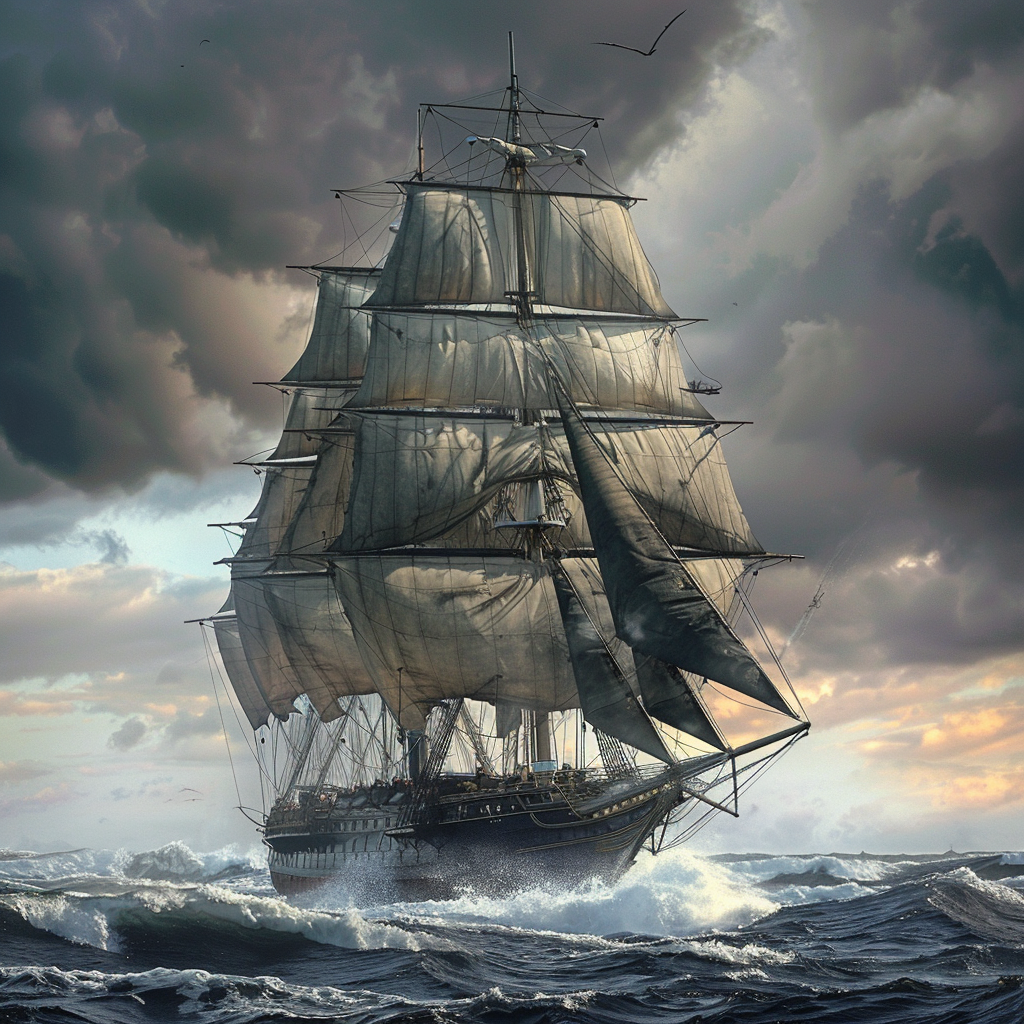
The Mary Celeste began her career as the Amazon, built at Spencer’s Island, Nova Scotia in 1861. She was a 282-ton, two-masted brigantine, registered American after a sale in 1868 and renamed. By 1872 she was owned in part by James H. Winchester of New York and captained by Benjamin Spooner Briggs (1835-1872?), a forty-year-old Massachusetts mariner with a reputation for sobriety and competence in a trade where sobriety was not assumed [1].
On 7 November 1872 the ship cleared New York Harbor bound for Genoa with 1,701 barrels of denatured alcohol intended for the fortification of Italian wines. Aboard were Briggs, his wife Sarah Elizabeth Cobb Briggs, their daughter Sophia Matilda, and a crew of seven: a German first mate named Albert G. Richardson, second mate Andrew Gilling, steward Edward William Head, and four sailors, three of them German brothers from the Frisian island of Föhr. The crew list, preserved in U.S. consular records, is the foundation document of every subsequent reconstruction [1].
The Atlantic crossing was uneventful in its first week. The captain’s logbook, recovered intact from the cabin, ends on 25 November 1872 with a position roughly six miles north-northeast of the Azorean island of Santa Maria. Ten days later, the ship was found drifting nearly six hundred miles east-northeast of that point, sails set in disarray, with no living soul aboard [2].
The Discovery by the Dei Gratia, 4 December 1872
At about 1 p.m. on 4 December 1872, Captain David Reed Morehouse of the Canadian brigantine Dei Gratia sighted a vessel making erratic progress under shortened sail roughly four hundred nautical miles east of the Azores. Morehouse, who had dined with Briggs in New York shortly before the Mary Celeste’s departure, recognized her at distance. He ordered chief mate Oliver Deveau and two seamen to launch a small boat and investigate [2].
Deveau’s testimony at the subsequent salvage hearing in Gibraltar is the most detailed first-hand account of the abandoned vessel. He found the deck wet but the ship structurally intact. The main hatch was secured, the fore and lazarette hatches were off and lying on deck. Three and a half feet of water stood in the hold; the pump sounded. One pump had been disassembled, suggesting the crew had been checking the rate of intake. The single lifeboat, a yawl carried over the main hatch, was missing. So was the sextant, the chronometer, the navigational books, and the ship’s papers, with the conspicuous exception of the captain’s logbook, which lay on the cabin desk [2].
The galley was orderly. Provisions for six months were aboard. Sarah Briggs’s harmonium stood in the cabin with sheet music open. Sophia’s small bed was made. The crew’s belongings, including pipes, oilskins, and a sea chest of clothing, were all in their quarters. Nine of the 1,701 alcohol barrels were later found empty when the cargo was off-loaded at Genoa. No body, no blood, and no obvious sign of struggle was recorded by Deveau or by the Vice Admiralty Court that subsequently examined the vessel [3].
The Gibraltar Inquiry and Frederick Solly Flood
The Dei Gratia’s salvage crew brought the Mary Celeste into Gibraltar on 13 December 1872. The case was heard before the Vice Admiralty Court there, with Frederick Solly Flood, the Attorney General and Proctor for the Queen in her Office of Admiralty, conducting the inquiry. Solly Flood was, by temperament, suspicious. He concluded almost immediately that he was looking at a crime, and his proceedings turned the abandoned ship into a courtroom thriller before the salvage was even adjudicated [4].
His leading hypotheses cycled between mutiny and conspiracy. In one version the crew had broached the alcohol cargo, killed the Briggs family, and fled in the yawl. In another, Morehouse and Briggs had colluded in an insurance fraud, with Briggs’s people quietly disembarking and the Dei Gratia delivering the vessel for salvage money. A surveyor named John Austin produced a report that interpreted some marks on the bow as ax cuts and a stained sword in the captain’s cabin as evidence of violence. A second, more careful examination found the bow marks to be ordinary weathering and the stain on the sword to be rust [4].
The Vice Admiralty Court ultimately awarded the Dei Gratia’s owners £1,700, roughly one-fifth of the vessel and cargo’s value, an unusually low salvage settlement that signaled lingering suspicion without establishing wrongdoing. No charges were ever brought. Solly Flood’s narrative, however, escaped the courtroom and entered the press, where it would soon be eclipsed by a piece of fiction that nearly everyone, eventually, mistook for a primary source [4].
How a Conan Doyle Story Became the Mythology
In January 1884 a young, unknown Arthur Conan Doyle published “J. Habakuk Jephson’s Statement” anonymously in Cornhill Magazine. The story was a first-person fictional narrative purporting to explain the Mary Celeste’s fate as a politically motivated abandonment by an escaped slave avenging himself on the captain. Conan Doyle changed the spelling to “Marie Celeste,” moved the abandonment date, and invented passengers and motives wholesale. Newspapers reprinted the story as fact within weeks [5].
The “Marie Celeste” spelling, the half-eaten meals laid out on the cabin table, the still-warm cup of tea, the captain’s pipe abandoned mid-smoke: all are Conan Doyle inventions or later embellishments stacked on his frame. None appear in Deveau’s testimony or in the Gibraltar court records. The cumulative drift of the popular legend over more than a century has produced an iconic empty ship that bears only a partial resemblance to the actual brigantine Deveau boarded in December 1872 [5][6].
The most thorough corrective remains Charles Edey Fay’s 1942 monograph Mary Celeste: The Odyssey of an Abandoned Ship, prepared for the Peabody Museum of Salem from the original consular and admiralty records. Fay’s reconstruction is the source most subsequent serious historians, including Brian Hicks in his Smithsonian-published research, have relied on for the documentary baseline [6][7].
Modern Explanations: Four Reconstructions Tested Against the Evidence
Four broadly accepted modern hypotheses have replaced the mutiny-and-piracy frame. Each tries to explain why a competent captain would order a sound ship abandoned in open ocean, with the lifeboat launched in haste but the navigational instruments and ship’s papers carried, and the cabin left in domestic order.
The Alcohol-Vapor Hypothesis
The cargo of denatured alcohol is the leading prop in most modern reconstructions. Nine barrels were found empty at Genoa, all of them red oak rather than white oak, a wood that breathes and leaks more readily. A working theory, advanced in detail by Brian Hicks for the Smithsonian, holds that ethanol seepage and a sudden temperature shift produced an audible vapor release in the hold. Briggs, fearing imminent explosion, ordered the yawl launched and the family and crew put into it on a tow-line behind the ship while the hatches were opened to vent. A snapped tow-line in rising weather could then have left them adrift while the ship sailed on [7].
The Waterspout Hypothesis
A second reading proposes that a waterspout, an oceanic tornado common in Azorean waters, struck the brigantine briefly. The disassembled pump and the standing water in the hold are consistent with a sudden, localized inundation that drove the barometer reading erratic and persuaded Briggs that the ship was foundering. The U.S. National Oceanic and Atmospheric Administration’s documentation of waterspouts notes that even modest waterspouts can drive sudden volumes of water into open hatches and produce alarming hold-readings without sinking the vessel [8].
The Seaquake Hypothesis
A third explanation attributes the abandonment to a seaquake, an underwater seismic event whose surface effects can include violent shaking, the appearance of waterspouts, and sudden barrel displacement in cargo holds. The Azores sit on a tectonically active triple junction. A seaquake fits the disturbed cargo, the disassembled pump, and the absence of damage to the rigging. It does not, on its own, explain why the lifeboat would be launched rather than the ship simply ridden out under reduced sail.
The Abandonment-Cascade Hypothesis
The last hypothesis, favored by some recent historians, treats the abandonment as a cascade rather than a single event. A misread sounding rod, suggesting more water in the hold than was actually present, combined with vapor or weather anomalies, could have convinced Briggs that the ship was going down. The crew launches the yawl with the chronometer, sextant, and ship’s papers, the captain takes the time to log a final entry and leaves the logbook on the desk, and the tow-line snaps as the wind freshens. The cascade reading absorbs elements of the other three.
What the Physical Evidence Actually Constrains
Each hypothesis has to account for a stubborn cluster of facts. The lifeboat was missing, with no davit damage indicating a violent launch. The chronometer, sextant, and navigational books were taken, suggesting an orderly but hurried departure. The ship’s papers, including the bill of lading, were missing; the captain’s logbook was not. Three and a half feet of water in the hold is non-trivial but not catastrophic for a brigantine of this tonnage. Nine empty alcohol barrels are anomalous but not by themselves diagnostic.
No surviving evidence supports a piracy or mutiny reading. The crew’s belongings, including a chest of valuables, were untouched. There were no bodies, no blood, no signs of forced entry to the cabin or hold. Solly Flood’s instinct toward criminality has not survived a careful reading of the same record he was working from. The Encyclopaedia Britannica’s entry on the case, which summarizes the documentary baseline, treats the abandonment as natural in cause though indeterminate in mechanism [9].
The strongest single explanation, weighing parsimony against fit, is probably some combination of the alcohol-vapor and abandonment-cascade readings. The empty red-oak barrels are a real anomaly. A captain of Briggs’s reputation does not abandon a sound ship without cause, but he might abandon one he believed was about to explode under his daughter’s feet. The cascade frame supplies the missing step: he launched the yawl as a precaution, planning to reboard, and the weather refused him.
What the Mary Celeste Asks of Us
The case sits at the edge of what archival historiography can do. The documents are unusually rich for a maritime mystery: a salvage hearing transcript, a captain’s logbook, a careful first-mate testimony, a U.S. consular crew list, a Vice Admiralty Court ruling. They constrain the answer without producing it. The same documents that rule out piracy refuse to choose between the four naturalistic hypotheses.
A scholar reading this record learns the discipline of the negative. The Mary Celeste is not a story whose ending is missing because the evidence was lost. It is a story whose ending is missing because the evidence is present and insufficient. Briggs and his family stepped off the ship, into a yawl, into a December Atlantic, and the trail ends there. The disciplined response is to name the four reconstructions, weight them honestly, and accept that the case will probably remain unresolved.
That is, in the end, what historical research often demands. A careful reading does not always produce a verdict. Sometimes it produces only a more accurate description of what the surviving record can and cannot say. The brigantine drifted for ten days in the open Atlantic, sails set, cabin in order, lifeboat gone. She has been drifting in the historical imagination for a hundred and fifty-three years. There is no reason to expect her to stop.