By Emilia Wellesley · Published May 5, 2026 · Updated May 13, 2026
Last reviewed: May 5, 2026.
What a Solar Eclipse Meant to Ancient Cultures
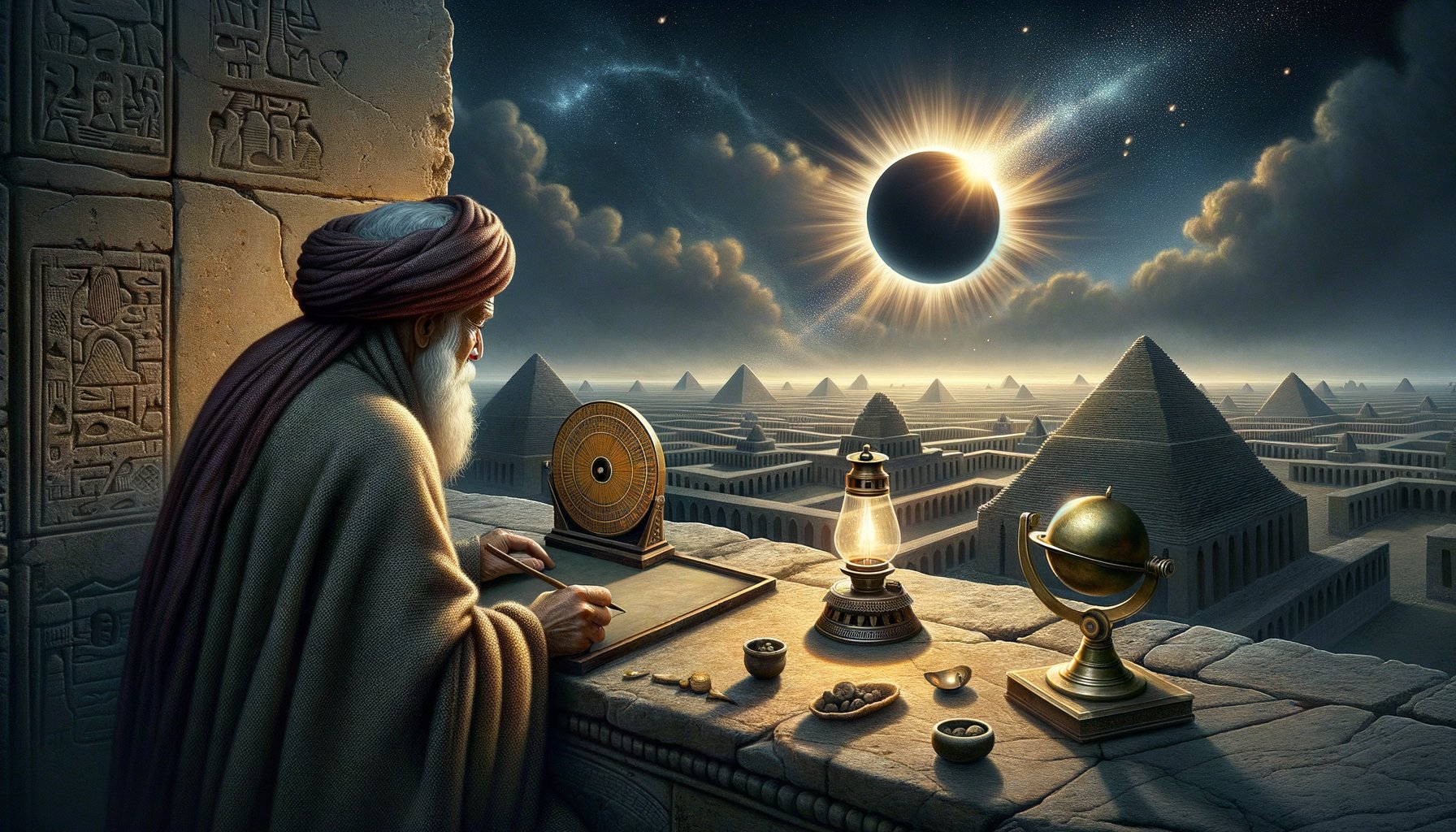
A solar eclipse was widely read in the ancient world as a bad omen tied to kings, war, plague, and the displeasure of the gods. Across Mesopotamia, China, Greece, Mesoamerica, and the medieval West, scribes recorded eclipses with care and tied them to political fortune. Practical rituals, treaties, and astronomical models grew directly from these readings.
Few sky events have left a longer paper trail than the solar eclipse. Court diviners in Nineveh, scribes in late Shang China, philosophers in Miletus, and chroniclers in twelfth-century England all paused their other work to record the moment when daylight failed. Their reactions were not uniform, but they shared a working assumption: the sun had a meaning, and its sudden absence was a message addressed to the king and to the realm. Reading those records carefully, with attention to what was inscribed and what was tactfully omitted, opens a window onto how premodern societies governed themselves under a sky they only partly understood. This guide moves through those records, names the figures who interpreted them, and traces how the omen tradition shaped ritual, war, and the slow growth of astronomy within the broader landscape of mystical and occult practices.
How Mesopotamian Scribes Read the Sun
The longest sustained tradition of eclipse interpretation comes from Mesopotamia. From at least the early second millennium BCE, Babylonian and Assyrian scholars treated celestial events as messages from the great gods, written in a script the trained scribe could decode. Their handbook was the Enūma Anu Enlil, a series of roughly seventy clay tablets compiled over centuries that catalogued between six and seven thousand omens drawn from the sun, moon, planets, and weather, according to the survey published by the Encyclopaedia Britannica.[1]
The Substitute King Ritual
When the omen pointed to the death of the king, Assyrian court ritualists turned to the šar pūḫi, the substitute king ritual. A commoner was dressed in royal robes, seated on the throne, and addressed with the unfavorable omens read aloud. The real king went into hiding, attended only by close advisors. After roughly one hundred days, the substitute was put to death, and the recorded danger was considered to have passed with him.[2] The Metropolitan Museum’s curatorial essay on the rite, drawing on the Neo-Assyrian state correspondence, notes that Esarhaddon (reigned 681 to 669 BCE) used the ritual at least seven times, including after eclipses that affected both Akkad and Subartu, the Babylonian and Assyrian quadrants of the sky.[3] One substitute, a young man named Damqi, was put to death together with his queen.
Watching for the Saros
Centuries of meticulous observation paid off. Late Babylonian astronomers, working with diaries kept on clay tablets across more than seven hundred years, identified the Saros, a cycle of 223 synodic months (about eighteen years and eleven days) after which solar and lunar eclipses repeat in similar form.[4] The Saros did not let them see exactly where the moon’s shadow would fall, but it let them anticipate that an eclipse was likely. By the late centuries BCE, Babylonian almanacs listed predicted eclipse possibilities along with month, watch of night, and quadrant. Omen and arithmetic now lived side by side on the same tablet.
China and the Sun That Was Eaten
Chinese astronomical records reach back further than any continuous tradition outside Mesopotamia. The Shu Ching (Book of Documents) preserves a story long associated with the early Xia dynasty: two royal astronomers, Hsi and Ho, allegedly failed to predict a solar eclipse and were executed for the lapse, with the date sometimes reconstructed as 22 October 2134 BCE.[5] Modern scholars treat the dating as legendary rather than secure, but the underlying assumption is well attested in later, firmer Chinese sources: the emperor’s authority was tied to the regularity of the heavens, and a missed eclipse was a political and not merely an astronomical failure.
Drums, Arrows, and the Devouring Dragon
Popular Chinese tradition held that a celestial dragon was swallowing the sun. Villagers banged drums, beat pots, and shot arrows into the sky to frighten the creature into releasing its prey. The court performed ritual responses too. The character for eclipse, shi (食), is the same character used for “to eat,” preserving the older mythic sense in a single graph. Court records of solar eclipses run more or less continuously from the Shang oracle bones (thirteenth century BCE) into the imperial period, supplying modern astronomers with one of the densest premodern eclipse archives anywhere.
Greek and Roman Eclipses: From Wonder to Argument
In the Greek world, eclipses moved from divine sign to natural event over a few generations. Herodotus reports that Thales of Miletus (c. 624 to c. 546 BCE) predicted a solar eclipse that fell on a battlefield day in 585 BCE during the war between the Lydians and the Medes near the Halys River, in what is now central Turkey.[6] Modern astronomical reconstruction places that eclipse on 28 May 585 BCE. The kings, taking the darkness as a sign that the gods opposed the war, agreed to a peace; the Lydian Alyattes and the Median Cyaxares sealed the treaty with a dynastic marriage. Whether Thales actually predicted the eclipse remains debated; the Saros knowledge required for a location-specific forecast was not yet circulating in the Greek world, and an accurate prediction may have rested on luck or on Babylonian information transmitted along trade routes.
Anaxagoras and the Cooling of Wonder
A century later, Anaxagoras of Clazomenae (c. 500 to 428 BCE) taught that the moon shone by reflected sunlight and that an eclipse occurred when the moon stood between the earth and the sun. Plutarch records that during the Athenian campaign against Sparta in 431 BCE, the Athenian general Pericles, a friend and student of Anaxagoras, demonstrated the natural cause of an eclipse to a frightened helmsman by covering the man’s eyes with his cloak and asking whether such cover was a portent.[7] Anaxagoras paid for his rationalism. He was prosecuted in Athens for impiety, partly for asserting that the sun was a hot stone larger than the Peloponnese rather than a god, and was forced into exile.
Roman Politics and Caesar’s Sky
Roman writers continued to treat eclipses as political weather. Plutarch, Pliny the Elder, and Cassius Dio link unusual sky phenomena to the deaths of leaders and to civil war. Pliny the Elder noted in his Natural History (c. 77 CE) that Roman commanders were trained to explain eclipses to their troops to forestall mutiny, since the unexplained darkness had broken armies before. The vocabulary of omen had not vanished; it had been folded into civic management.
Eclipse Darkness and the Crucifixion Question
A particular controversy gathers around the canonical Gospels’ description of darkness covering the land during the crucifixion of Jesus, traditionally dated to the early 30s CE. The Greek historian Phlegon of Tralles, writing in the second century, mentions a striking solar eclipse in the fourth year of the 202nd Olympiad (33 CE) accompanied by an earthquake; he is quoted in this connection by Sextus Julius Africanus and later by the early Christian chronicler Eusebius.[8] Thallus, a near-contemporary historian whose work survives only in fragments, also reportedly explained the darkness as an eclipse. Astronomical reconstruction complicates these accounts. A solar eclipse cannot occur during a Passover full moon, since solar eclipses require a new moon. Most modern historians, including those summarized by Britannica’s coverage of biblical chronology, treat the Gospel darkness as a literary or symbolic device rather than a physical solar eclipse, while acknowledging the durability of the eclipse explanation in late antique apologetics.
Medieval Europe: Eclipses, Kings, and Chronicles
Medieval chronicles preserve some of the most vivid eclipse descriptions in any tradition. The Anglo-Saxon Chronicle notes that on 2 August 1133 “the day was darkened, and the sun became as if it were a moon three nights old, with the stars shining round it at midday.” The compiler links the event to King Henry I’s last crossing to Normandy, foreshadowing the political collapse that followed his death two years later and the long civil war between Stephen and Matilda known as the Anarchy.[9] Twelfth-century writers did not need a Babylonian handbook to tell them this was significant; the omen logic was already embedded in their genre.
The Carolingian and Byzantine Record
The Royal Frankish Annals describe an eclipse during Charlemagne’s reign, and Byzantine chroniclers under the Macedonian dynasty recorded several total eclipses with attention to imperial implications. Patriarch Photios in the ninth century connected an eclipse to a moment of liturgical anxiety in Constantinople. Across the medieval Christian world, the language was consistent: the sky was a parchment on which divine intent was occasionally written in unusually bold script.
Eclipses in the Americas Before Contact
Mesoamerican and Andean cultures developed sophisticated eclipse traditions that survived into the colonial record. The Aztec Codices, including the Codex Borgia and the Codex Telleriano-Remensis, preserve images of solar eclipses with the sun shown half-darkened or partially devoured. The Nahua phrase for a total solar eclipse, icualoca in tonatiuh, translates as “the sun is eaten.” The jaguar god Tepēyōllōtl was said to consume the sun, and a complete eclipse falling on a year named 4 Ollin was believed capable of triggering the end of the current world age.[10]
Inca Sun Theology
In Inca cosmology, the sun god Inti was the divine ancestor of the Sapa Inca, the ruling lineage. A solar eclipse signaled Inti’s anger. Sixteenth-century Spanish chroniclers, including Bernabé Cobo, recorded that Inca priests responded with sacrifice, fasting, and self-mortification to discover the offense responsible. Children might be dedicated to the gods at sites such as the high mountain shrines later identified by archaeologists at Llullaillaco and elsewhere. The reading was political as well as theological: an angry Inti reflected on the legitimacy of his earthly descendants.
From Omen to Instrument: The Modern Turn
By the seventeenth century, European astronomers were treating eclipses as instruments rather than warnings. Edmond Halley distributed a pre-calculated map of the path of totality for the eclipse of 22 April 1715 across England, asking the public to send him observations. The map worked. The genre of the public eclipse observation was born. Two centuries later, the eclipse had become a laboratory bench. On 29 May 1919, two British expeditions, one to the island of Príncipe led by Arthur Stanley Eddington and another to Sobral in Brazil under Andrew Crommelin, photographed the field of stars near the eclipsed sun. Their measurements of starlight bent by the sun’s mass matched Albert Einstein’s prediction in his 1915 general theory of relativity, and Einstein became, almost overnight, the most famous scientist alive, according to the Britannica account of the Eddington expeditions.[11] The omen had completed a long arc into evidence.
What the Omen Tradition Left Behind
The traditions that read eclipses as omens did not simply give way to science. Many of their habits persisted inside science itself. The careful observation of celestial timing, first developed to defend kings, supplied the data for predicting eclipses. The cross-cultural belief that eclipses mattered to political life encouraged the keeping of written records that historians now use to date Bronze Age dynasties and to fix the chronology of the Hittite, Assyrian, and Egyptian courts. The Mursili eclipse of 1312 BCE, described in the Hittite king’s annals as a sign from the sun, has become an anchor point for synchronizing the chronologies of the late Bronze Age Near East.[12]
Modern viewers approach an eclipse with cardboard glasses, smartphone cameras, and travel itineraries. The framework is no longer divine warning but spectacle, science, and tourism. Even so, the older instinct survives in the hush that falls over a crowd at totality. The shadow racing across the landscape, the visible corona, the temperature drop, the silence of birds: these still produce a strangeness that the omen scribes would have recognized at once, even if they would have read it differently.
Frequently Asked Questions
Why did ancient cultures see solar eclipses as bad omens?
The sun was widely understood as a divine being or a sign of order, and its sudden disappearance during the day looked like a withdrawal of that order. In monarchies that tied royal authority to celestial regularity, the disruption was naturally read as a warning aimed at the ruler.
Did Thales really predict the eclipse of 585 BCE?
Herodotus says he did, and the eclipse fell on 28 May 585 BCE near the Halys River as the Medes and Lydians fought. Modern scholars are divided. The Saros cycle had not yet reached the Greek world in a usable form, so any successful prediction by Thales most likely drew on Babylonian almanac data or simple statistical likelihood, not on a complete theory.
What was the substitute king ritual?
In Assyrian and Babylonian practice, when an eclipse foretold the death of the king, a substitute was enthroned and addressed with the unfavorable omens. After roughly one hundred days, the substitute was killed and the recorded danger was considered transferred to him. Esarhaddon used the rite at least seven times in the seventh century BCE.
How did Babylonian astronomers predict eclipses?
By keeping detailed observation diaries on clay tablets for centuries, they identified the Saros, a cycle of 223 synodic months. Recurrence at this interval allowed them to anticipate when an eclipse was likely, even if not exactly where its shadow would fall. The Saros remains a foundational concept in modern eclipse prediction.
Was the darkness at the crucifixion a real solar eclipse?
No. A solar eclipse requires a new moon, and the Passover, when the crucifixion is dated, falls at full moon. Phlegon of Tralles records a striking eclipse and earthquake in the early 30s CE, but most historians treat the Gospel description as theological language rather than a literal solar eclipse.
Did the 1133 eclipse really cause King Henry I’s troubles?
The eclipse of 2 August 1133 coincided with Henry I’s last departure for Normandy. The Anglo-Saxon Chronicle records contemporaries linking the darkness to imperial misfortune. Henry died in December 1135, and his death triggered the civil war known as the Anarchy. The chronicler’s reading was retrospective and symbolic, not causal.
How did the Aztecs interpret a total solar eclipse?
In Aztec belief, the jaguar god Tepēyōllōtl and the stellar deities known as Tzitzimimeh attempted to devour the sun during an eclipse. The Nahua name for a total eclipse, icualoca in tonatiuh, means “the sun is eaten.” A complete eclipse on a year called 4 Ollin was thought capable of ending the current world age.
Why was the 1919 eclipse a turning point?
During the eclipse of 29 May 1919, expeditions led by Arthur Stanley Eddington in Príncipe and by Andrew Crommelin in Sobral measured how the sun’s gravity bent starlight. Their results matched Einstein’s 1915 prediction in general relativity, replacing Newton’s gravitational model and making Einstein internationally famous.
Are eclipse omens still taken seriously today?
In most modern societies, eclipses are treated as predictable astronomical events. Yet folk practices persist in parts of South Asia, East Africa, and Latin America, where pregnant women, food, and ritual cleanliness are still managed around an eclipse. The omen tradition has thinned but not disappeared.