By Emilia Wellesley · Published May 5, 2026 · Updated May 13, 2026
Last reviewed: May 5, 2026.
Auroras in Norse Myth: What the Sagas Actually Say
Auroras in Norse myth function as veils, not stage curtains. The medieval Old Norse sources rarely name the northern lights outright, yet the imagery they preserve, of bridges between worlds, of armored women crossing the sky, of fires above the deep north, supplies the symbolic vocabulary later readers used to read the sky. The result is a tradition built half from manuscripts and half from inference.
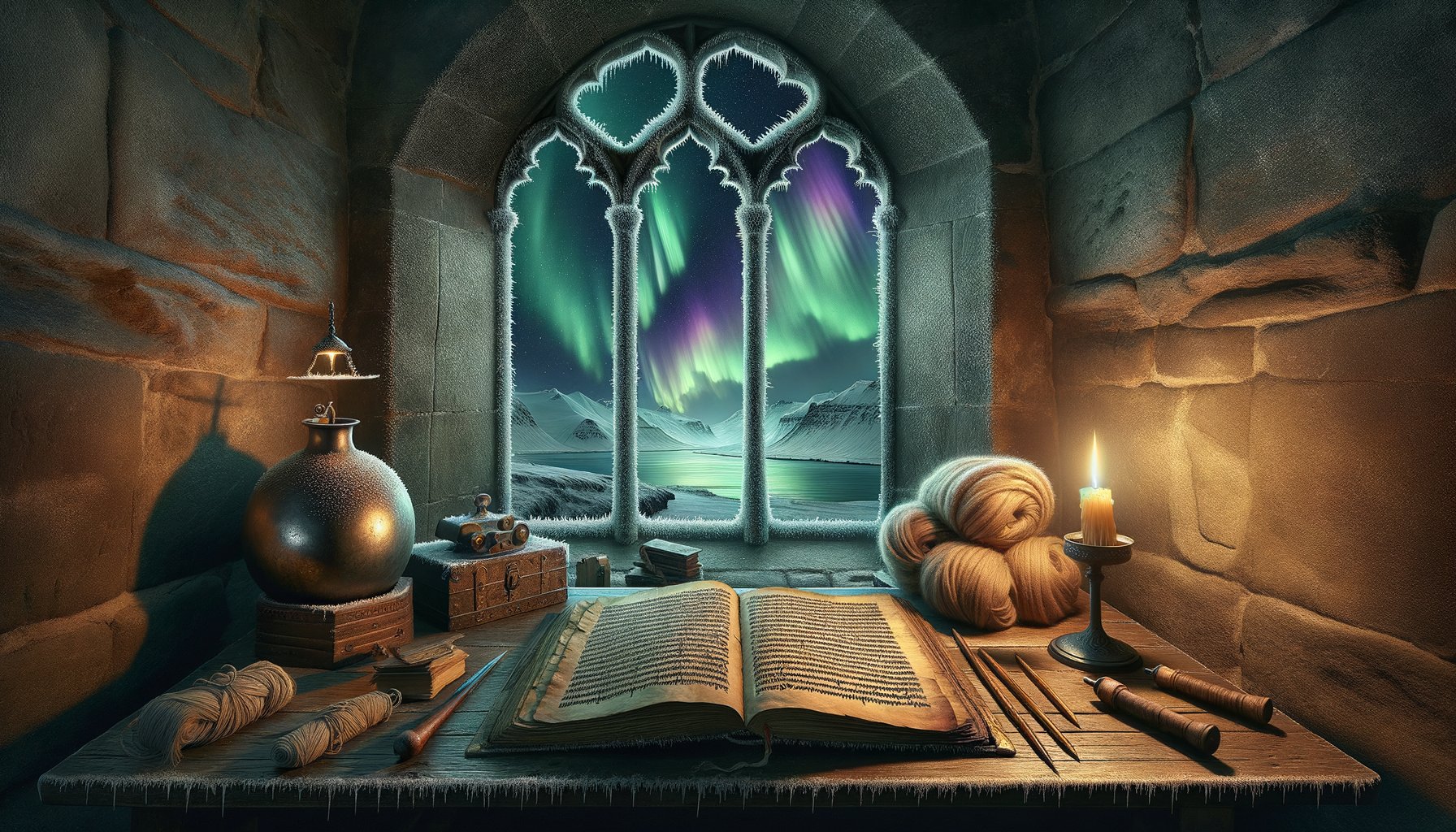
Anyone who has stood in northern Iceland on a still January night has watched the same green ribbon Snorri Sturluson (1179-1241) might have seen from his farm at Reykholt. Whether he saw it as a veil between worlds, as he wrote of so many other thresholds, is a separate question. The medieval record on auroras is thinner than most popular guides admit. Reading it carefully reveals a culture that thought intensely about the boundary between the living and the otherworld, but that referred to the lights themselves only obliquely. The patient reader is rewarded with something more interesting than a tidy myth: a tradition where the meaning was made over centuries, on both sides of the divide between Old Norse and modern.
This essay moves from what the sources actually say, to the cosmology in which auroras might have lived, to the figures (Bifröst, the Valkyries, Heimdall) most often pulled into aurora interpretation, to the Sami neighbors whose myths shaped the region, and finally to how the modern “northern lights as Valkyrie armor” image was constructed. The aim is to honor the gap between what survived and what was added later within the broader landscape of mystical and occult practices.
What the Old Norse Sources Actually Record
Direct medieval Norse references to the aurora are surprisingly few. The earliest unambiguous Old Norse description appears in the Konungs skuggsjá, the “King’s Mirror,” written in Norway around 1250. Its anonymous author, addressing a young prince, lists three theories about the lights of the far north and admits that Norwegians of his time had not personally seen them, since they live south of where the lights are most visible (Encyclopaedia Britannica). That single passage is the cornerstone of any honest discussion of medieval Norse aurora lore.
The King’s Mirror Passage
The Konungs skuggsjá proposes three explanations: that the lights are fires surrounding the outer ocean, that they are reflections of the sun shining upward from below the horizon at night, or that ice and glaciers radiate stored brightness. The author is cautious. He gives reasons for and against each theory and lets the reader weigh them. There is no Valkyrie, no Bifröst, no journey of the dead. The text reads as a piece of medieval natural philosophy, and that is exactly what it was.
Silence in the Eddas
Snorri’s Prose Edda (c. 1220) and the older Poetic Edda, compiled in thirteenth-century Iceland from earlier oral tradition, contain no plain reference to auroras as a phenomenon. Modern translators including Carolyne Larrington and Anthony Faulkes confirm the absence in their indices. What the Eddas do supply is the cosmological scaffold (a multi-realm universe with shimmering bridges, traveling armored women, and a watchman who sees and hears across worlds) into which later readers slid the lights they saw. The myth was already structured for the lights; the lights themselves arrived in the text by inference.
The Cosmological Frame: Worlds, Bridges, Veils
To understand why auroras and Norse myth attract one another, the underlying cosmology has to come first. The Eddic universe is not a single place. It is nine realms organized around the world-tree Yggdrasil, with thresholds and crossings everywhere. Light that moves across the sky in patterns invites being read as one of those crossings.
The Nine Worlds and Yggdrasil
Snorri lists nine worlds linked by the ash Yggdrasil, including Asgard (the home of the Aesir), Vanaheim, Midgard (the human world), Jotunheim, Niflheim (the icy north), Muspelheim (the fiery south), Alfheim, Svartalfheim, and Hel. The boundaries between these realms are porous. Gods walk into the land of giants. Dead heroes ride to Odin’s hall. Cosmic phenomena are read as movements across these thresholds, rather than as fixed events in a single sealed sky.
Bifröst, the Trembling Bridge
The most famous threshold is Bifröst, the bridge linking Midgard and Asgard. Snorri calls it three-colored, vibrating, made by the gods with great care and guarded by Heimdall (Encyclopaedia Britannica). Most modern editions translate Bifröst as “rainbow bridge,” following Snorri’s phrase. The original word is closer to “trembling road” or “shimmering path.” Some twentieth-century scholars, including Hilda Roderick Ellis Davidson (1914-2006), proposed that the original referent might have included the Milky Way or even the aurora, with the rainbow being a later domestication of a more uncanny image. The argument cannot be settled from the manuscript evidence alone, but it remains live in the field.
Heimdall, the Watchman Who Hears Grass Grow
Heimdall guards Bifröst from his hall Himinbjorg, “Heaven’s Cliffs,” at the bridge’s end. He needs less sleep than a bird, sees a hundred miles by night or day, and hears wool growing on a sheep. If anyone in the Norse pantheon witnesses what crosses the threshold of the sky, it is Heimdall. The poetic image of him at his post, watching the bridge for any movement, is the closest the Eddic literature comes to staging a guardian of the boundary the auroras imply.
Valkyries and the Sky-Crossing Dead
No connection between auroras and Norse myth is more popular than the image of the Valkyries riding the sky in flashing armor. It is also the most heavily reconstructed. The medieval texts are silent on the link. The romantic-era idea, taken up by Wagner and by nineteenth-century painters, fills a real cosmological niche, but it does so by stretching the sources.
What the Eddas Say About Valkyries
Snorri’s Prose Edda and several Eddic poems describe Valkyries (Old Norse valkyrjur, literally “choosers of the slain”) as Odin’s sky-faring women who select half the warriors who die in battle and lead them to Valhalla. They ride horses across the sky and over the sea. Their armor and helmets are bright. The poem Helgakviða Hundingsbana I describes them riding through the air with helms gleaming and “their byrnies all blood-stained, with rays standing forth from their spears.” That last image, sometimes translated as “lights from the sea” or “from their points,” is the textual seed from which the later aurora connection grew.
The Reflections-on-Armor Theory
By the nineteenth century, Romantic scholars and artists, working from a freer reading, proposed that the northern lights were the reflections from Valkyrie armor as the riders passed overhead. The image is genuinely beautiful and fits Eddic imagery. It does not, however, appear in any surviving Old Norse source. The most influential modern Norse mythologist to scrutinize the claim is John Lindow, whose Norse Mythology: A Guide to the Gods, Heroes, Rituals, and Beliefs (Oxford, 2001) treats the aurora-Valkyrie association as a modern reception rather than a medieval datum.
Sami Aurora Beliefs and Their Northern Norse Neighbors
North of the Norse heartland, the Sami people of Sápmi (modern northern Norway, Sweden, Finland, and Russia) developed a distinct and far richer aurora tradition. Norse and Sami communities lived alongside each other for centuries. Trade, intermarriage, and shared shamanic exchange make it almost impossible to discuss Norse aurora reception without a parallel chapter on Sami belief.
Guovssahasat and Respect for the Lights
In northern Sami the aurora is guovssahasat. Traditional ethnographic accounts, including those collected by the folklorist Just Knud Qvigstad (1853-1957) in his multi-volume work on Sami folktales, record taboos around the lights: do not whistle at them, do not wave a white cloth, do not call attention to oneself when they appear, lest the lights notice and descend. The lights are a presence with intention. Some communities understood them as the dancing souls of the dead. Others saw them as a bridge or veil to a parallel world (Encyclopaedia Britannica).
The Norse Borrowing Question
Norwegians and Icelanders living near Sami territory likely absorbed elements of this lore. The thirteenth-century Historia Norwegiae describes Sami shamanic practice in some detail and treats it as a real, if alien, phenomenon. The cultural permeability is well documented in Neil Price’s The Viking Way: Magic and Mind in Late Iron Age Scandinavia (2002). What this means for aurora interpretation is that any northern Norse reading of the lights almost certainly carried Sami fingerprints, even when the medieval text does not name them.
How the Modern “Veils to the Other World” Image Was Made
The popular contemporary picture of Norse auroras (Valkyries flashing across the sky, Bifröst as a green ribbon, the dead riding to Asgard along a corridor of light) is largely a nineteenth- and early twentieth-century synthesis. Tracking its construction is part of reading the tradition honestly.
Romantic-Era Compilers and Wagner
Jacob Grimm (1785-1863), in Deutsche Mythologie (1835), gathered scattered references to the heavens, the dead, and divine processions into a single cosmological canvas. Richard Wagner (1813-1883) built on this in Die Walküre (1856), staging armored women on horseback in storm-light. Visual artists from Peter Nicolai Arbo to Arthur Rackham fixed the iconography. None of them claimed to be reporting medieval evidence; all of them ended up shaping how readers later imagined the medieval evidence.
Twentieth-Century Popular Folklore
Popular books from the 1920s onward, written for general audiences, presented the Valkyrie-armor reading as if it were a recovered medieval belief. The pattern persists in tourism marketing in Iceland, Norway, and Finland, where the Valkyrie reading is now a fixture of aurora-watching tours. Folklore is a living thing, and the “veils to the other world” reading is now a genuine modern tradition. It is just not a medieval one.
What Survives as Evidence: A Working Inventory
Pulling the threads together produces a small but specific evidence base. Anyone wanting to study Norse aurora myth seriously can begin with the items below.
- Konungs skuggsjá: The King’s Mirror (c. 1250), the earliest unambiguous Old Norse aurora passage. Discusses three natural-philosophical theories without mythic content.
- Snorra Edda (Prose Edda): Snorri Sturluson’s c. 1220 handbook of Norse cosmology, source of Bifröst, Heimdall, and the nine worlds.
- Poetic Edda: Compiled in thirteenth-century Iceland; includes Voluspa, Grímnismál, and the Helgi poems with Valkyrie imagery.
- Historia Norwegiae: A late twelfth-century Latin chronicle that records observed Sami shamanism and contextualizes the cultural environment.
- Sami folktale collections: Especially Just Knud Qvigstad’s compilations, preserving aurora taboos and belief structures from oral tradition.
- Modern syntheses: John Lindow (2001), Neil Price (2002), Carolyne Larrington’s Poetic Edda translation (revised 2014), and Hilda Davidson’s Gods and Myths of Northern Europe (1964).
Reading the Sky Today as a Medieval Norse Reader Might
Honest engagement with the sources changes the experience of standing under the lights. The Norse imagination did not need a fixed dogma about the aurora to give it meaning. It needed a cosmology in which a shifting, colored sky was already a plausible place for crossings to occur. That cosmology survives in the Eddas. Anyone reading Voluspa by candlelight before going outdoors can carry it with them.
Three Things to Notice
First, the trembling. Bifröst is not a calm bridge. The Eddas describe it as bifa, to tremble. Auroras do the same. Second, the sound. Heimdall hears wool grow. Many modern observers in the high north report a faint hiss or crackle from intense displays, an effect that has been studied at the University of Oulu in Finland. Whether the medieval listener heard it is unrecorded, but the cosmological figure is already wired for it. Third, the threshold quality. The lights mark above and below, near and far, dead and living. They do not perform the boundary. They are it.
Holding the Open Question
What did a medieval Icelandic farmer think when an aurora crossed her sky? The honest answer is that we do not know. The texts are mostly silent. The cosmology is suggestive. The Sami neighbors had elaborate beliefs that surely seeped across the cultural boundary. The romantic synthesis that fills modern guidebooks is real folklore now, but it is younger than its packaging admits. Standing under the green ribbon today, the most accurate frame is the one Snorri’s contemporaries left us: a sky already known to be a threshold, with the lights as one more question that the records did not finish answering.
From the wider mystical and occult practices archive: Modern Shamanism and Urban Spirituality and Integrating AI into Occult Studies.