By Emilia Wellesley · Published May 5, 2026 · Updated September 10, 2026
Last updated: September 10, 2026.
What Is the Florentine Diamond?
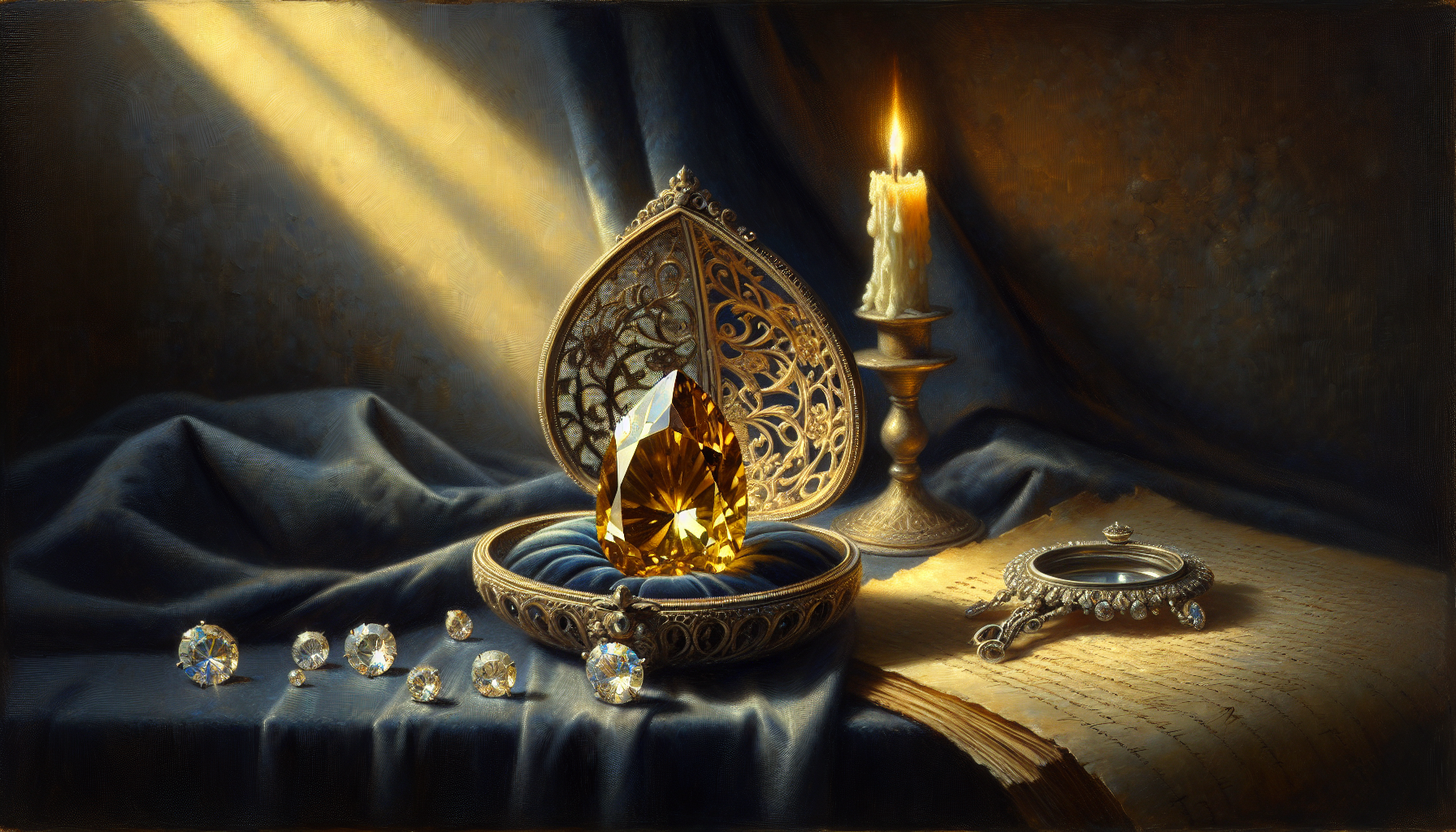
The Florentine Diamond is a roughly 137-carat yellow diamond, briolette-cut with around 126 facets, that passed from Burgundian to Medici to Habsburg hands between the late fifteenth and early twentieth centuries. After the abdication of Emperor Karl I of Austria in 1918, the stone vanished from the public record. No verified resurfacing has ever been confirmed.
Few jewels carry a paper trail as long as the Florentine, and fewer still drop out of that paper trail so completely. The stone shows up in inventories, ambassadorial dispatches, court portraits, and gem treatises across four centuries. Then, sometime between the Habsburg flight from Vienna in November 1918 and the family’s exile in Switzerland the following year, the references stop. What remains is a sequence of plausible fates and a small group of historians and gemologists who continue to weigh them against the surviving record.
This account follows the diamond from its earliest secure attestation through its long career as a Medici and Habsburg crown jewel, and then into the conjectures that have grown around its disappearance. The aim is to keep the evidentiary ladder visible at every step within the broader landscape of historical and archaeological mysteries, so that the reader can hold the open questions with the same care a working scholar would.
The Stone Itself: Cut, Color, and Carat
The Florentine was a fancy yellow diamond, often described in nineteenth-century literature as having a faint greenish tint when viewed in daylight. Most surviving descriptions place its weight at about 137.27 metric carats, though earlier sources sometimes round to 137 or 139.5 old French carats depending on the period’s standard. The cut was a double-rose or briolette form with roughly 126 to 128 triangular facets, an unusual shape that allowed light to enter from many directions at once.
The Gemological Institute of America’s historical records, summarized in its archive of famous historic diamonds, classify the Florentine among the great Indian-origin yellows of the early modern period, alongside the Sancy and the Hope. Tavernier’s measurements, taken before standardized scales, complicate any modern reconstruction of the exact weight. What survives instead is an unusually consistent visual description across three centuries of court inventories and engraved plates.
Earliest Attested History: Charles the Bold and the Battle of Nancy
The most repeated origin story sends the diamond into European history with Charles the Bold, Duke of Burgundy (1433-1477). According to a tradition recorded in the seventeenth century by the French gem merchant Jean-Baptiste Tavernier (1605-1689), the duke wore the stone at the Battle of Nancy on 5 January 1477, where he was killed and his body stripped on the frozen field. A Swiss foot-soldier reportedly took the diamond, mistook it for glass, and sold it for a florin or two to a passing priest.
Tavernier’s Six Voyages
Tavernier’s account appears in his Les Six Voyages, first published in Paris in 1676 and digitized through JSTOR’s partner-library collections.[1] He describes a stone he saw in the Medici treasury in Florence that matches the Florentine in shape and weight, and he attributes its earlier history to the Burgundian wars. Tavernier was a working merchant, not a court historian, and modern scholars treat his early-history claims as plausible but not independently corroborated by Burgundian inventories.
Alternative Burgundian-to-Medici Routes
Other reconstructions skip the battlefield episode. In these accounts, the stone passes through Portuguese hands, possibly via the diamond traffic out of Vijayanagara and Goa, before reaching the Medici through a sixteenth-century banking transaction. The Medici archives, partially digitized by the Medici Archive Project at Villa I Tatti, contain ledger entries that historians read as compatible with this slower route, though no single entry names the diamond unambiguously. Both reconstructions remain in play.
The Medici Years: From Ferdinando I to the End of the Dynasty
By the late sixteenth century the Florentine sat among the central jewels of the Medici grand-ducal collection. Ferdinando I de’ Medici (1549-1609) is most often named as the figure who acquired or formalized the stone’s place in the Florentine treasury. Its presence is documented in inventories of the Palazzo Pitti and in painted records made for visiting ambassadors. The stone traveled with the dynasty for roughly a century and a half.
Inventories and Court Display
Encyclopaedia Britannica’s overview of the diamond, drawing on the Medici inventories preserved in the Archivio di Stato di Firenze, places the stone among the most-described jewels of the late Renaissance.[2] It was set, unset, and reset across reigns. Court goldsmiths matched it to ornamental bases for state occasions and removed it for safekeeping during interregnums, a pattern Marian H. Winter traced in her studies of European court jewelry held in JSTOR’s art-history collections.[3]
Inheritance Through Anna Maria Luisa
When the Medici male line ended with Gian Gastone in 1737, the dynasty’s movable wealth passed in a complicated settlement. Anna Maria Luisa de’ Medici (1667-1743), the last legitimate Medici heir, secured the family’s art and antiquities for Florence through her famous Patto di Famiglia of 1737. The Florentine Diamond, however, fell under the dynastic-marriage settlement and traveled north with the new Habsburg-Lorraine grand dukes. From this moment its political life became Austrian rather than Tuscan.
The Habsburg Centuries
In 1743 the Florentine entered the Habsburg crown jewels through Francis Stephen of Lorraine, husband of Empress Maria Theresa. For the next 175 years it was reset several times for imperial use, most prominently as the centerpiece of a hat ornament known in Vienna as the Florentine Brilliant or, in some German-language inventories, the Florentiner. It was photographed, painted, and exhibited under glass at the Imperial Treasury in the Hofburg.
Settings and Public Display
Nineteenth-century photographs of the stone, including the much-reproduced plate in Edwin Streeter’s The Great Diamonds of the World (London, 1882), show the Florentine mounted as a clasp or aigrette with surrounding white brilliants. The Smithsonian Institution’s mineralogical reference materials reproduce period engravings of the same setting in their overview of famous diamonds for comparative study against the Hope and the Tiffany. The stone’s silhouette was widely known to nineteenth-century European readers.
The Imperial Treasury Catalog
Habsburg archive references, gathered in the modern catalog of the Kaiserliche Schatzkammer in Vienna, treat the Florentine as one of the eight or nine signature objects of the dynasty’s portable wealth. The catalog notes its repeated appraisal and the unusual care taken to retain it in original cut, despite the nineteenth-century fashion for recutting historic stones into modern brilliants. That preservation impulse may matter for the disappearance question.
1918: The Stone Vanishes
On 11 November 1918, Emperor Karl I (1887-1922) renounced participation in state affairs. Within days the imperial family, including Empress Zita and their children, were preparing to leave Schönbrunn. Among the items carried from Vienna into exile was a small group of Habsburg crown jewels, the Florentine reportedly among them. The family settled first in Switzerland, at Castle Wartegg and later at Villa Prangins on Lake Geneva, before being exiled to Madeira in 1921, where Karl died the following spring.
The Last Documented Sighting
The last well-documented appearance of the Florentine in Habsburg hands dates to the period between November 1918 and roughly 1921. After that, the stone falls out of the verifiable record. A 1921 Austrian government investigation into the missing crown jewels produced a report cited in subsequent diplomatic correspondence, but the report’s conclusions about the Florentine specifically remain disputed. The Habsburg family’s own statements, made by various heirs across the twentieth century, do not converge on a single account.
Why the Trail Goes Cold
Several factors compounded the gap. The new Austrian Republic claimed the imperial regalia as state property; the Habsburgs treated the portable jewels as personal inheritance. Political pressure, multiple exiles, and the family’s straitened finances created strong incentives to move the stone discreetly, whether for sale, recutting, or safekeeping. By the time scholars looked seriously for the diamond in the 1930s and again after 1945, the chain of custody had been broken for at least a decade.
The Three Leading Conjectures
Modern accounts converge on three plausible fates for the Florentine. None has been definitively confirmed. Each fits a different reading of the political and personal pressures on the Habsburg family in the 1920s. Holding all three open is the honest position; the evidence does not yet rule any one out.
Recut into Smaller Stones
The first conjecture holds that the Florentine was recut, probably in the 1920s or 1930s, into several smaller brilliants that were sold privately to liquidate Habsburg debts. Gemological analyses of large yellow diamonds that surfaced in the interwar Antwerp and New York markets have been compared against the Florentine’s known weight and color. Several candidates have been examined, but none has been matched to the original stone with the certainty modern gemology requires. The recutting hypothesis remains compatible with the silence in family correspondence after 1925.
Smuggled to Quebec or South America
A second tradition, traced to a Habsburg retainer’s letter referenced in mid-twentieth-century journalism, suggests the stone was carried to Quebec by a courier serving the exiled family. A variant places it in Brazil or Argentina, where Habsburg sympathizers kept contact with Empress Zita through the 1920s. No physical artifact has surfaced to confirm either route.
Sold Privately and Held Anonymously
A third reading, perhaps the most parsimonious, holds that the diamond was sold intact to a private collector who has kept it out of public view ever since. Large fancy-yellow diamonds occasionally appear in private estate sales without provenance documentation, and the Florentine’s distinctive cut would survive even a discreet ownership transfer. The buyer, or the buyer’s heirs, would have strong reasons to keep the stone unseen given the unresolved Austrian claim.
Why the Mystery Persists
The Florentine’s disappearance sits at an awkward intersection of dynastic politics, gemological technicality, and twentieth-century recordkeeping. Each of the three conjectures requires different evidence to confirm and different evidence to falsify. The historian’s task is to keep the categories distinct rather than collapse them into a single preferred narrative.
Competing Legal Claims
Austrian republican law from 1919 onward treated the Habsburg crown jewels as state property; the family’s own legal position treated dynastic objects as personal inheritance. Any modern resurfacing of the stone would trigger a claim from the Republic of Austria and likely a counterclaim from Habsburg descendants. The legal cloud itself encourages anonymity in any current ownership.
The Limits of Provenance Research
Provenance research on yellow diamonds of comparable size is hampered by the absence of a centralized historical register. Modern Gemological Institute of America grading reports do not retroactively cover stones examined before the 1950s. Period inventories use weights that do not always translate cleanly into modern gemological vocabulary, leaving a forensic gap the documentary record cannot close.
Frequently Asked Questions
How big is the Florentine Diamond?
The Florentine is most often cited at approximately 137.27 metric carats, with a briolette or double-rose cut bearing roughly 126 to 128 facets. Earlier sources, written before the standardization of the metric carat in 1907, sometimes give slightly different weights depending on whether old French or Florentine carats were used.
What color is the Florentine Diamond?
It is a fancy yellow diamond, with several nineteenth-century accounts describing a faint greenish overtone in daylight. Modern gemological vocabulary would likely class it as fancy yellow with possible green secondary hue, although no current Gemological Institute of America report exists for the stone itself.
Did Charles the Bold really wear the Florentine at Nancy?
The story comes from Tavernier’s 1676 account and was widely repeated in nineteenth-century gem literature. Burgundian inventories from the 1470s do not name the stone unambiguously, so the battlefield tradition is plausible but not independently confirmed by primary archival evidence.
Who owned the diamond after the Medici?
The Habsburg-Lorraine dynasty acquired the stone in 1743, when Francis Stephen of Lorraine, husband of Maria Theresa, inherited the Tuscan grand-ducal jewels. It remained with the Habsburg crown jewels until the imperial family’s exile in 1918-1921.
When was the diamond last seen in public?
The last secure public display was at the Imperial Treasury in Vienna before November 1918. After Karl I’s renunciation and the family’s flight, the stone enters a private and largely undocumented phase from which it has not re-emerged.
What is the Quebec theory?
The Quebec theory holds that a Habsburg retainer carried the diamond to Canada in the 1920s for safekeeping, possibly through Habsburg-friendly clergy or expatriate networks. It rests on circumstantial testimony rather than physical evidence and remains unverified.
Could the Florentine have been recut?
Yes, this is one of the leading hypotheses. The 1920s and 1930s diamond markets absorbed many large historic stones that were divided into modern brilliants. If the Florentine was recut, the original 137-carat stone no longer exists as a single object, and identification of its fragments would require detailed inclusion mapping no longer available.
Is the Florentine the same as the Tuscany Diamond?
Yes, the stone is sometimes called the Tuscany Diamond, the Grand Duke of Tuscany Diamond, or the Austrian Yellow in different sources. All four names refer to the same gem. The variation reflects which owner-dynasty a given author chose to emphasize.
For deeper context across the historical and archaeological mysteries archive, consider Machu Picchu: The Lost City of the Incas and The Tartaria Tablets: Europe’s Oldest Writing?.