
By EsoVitae Editorial · Published
Drafted with AI assistance from the sources listed; images are AI-generated illustrations. How EsoVitae is made
What Are the Imperial Regalia of Japan?
The Imperial Regalia of Japan, known in Japanese as Sanshu no Jingi, are three sacred objects: the sword Kusanagi-no-Tsurugi, the mirror Yata no Kagami, and the jewel Yasakani no Magatama. They are first attested in the Kojiki of 712 CE and the Nihon Shoki of 720 CE, and they remain central to imperial enthronement, although the originals have not been publicly viewed in modern memory.
Few sets of objects are at once so famous and so unseen. The regalia have anchored Japanese imperial legitimacy for at least thirteen centuries, and yet no published photograph, no scientific examination, and no independent inspection has ever been permitted. The Imperial Household Agency holds the originals out of public view as a matter of ritual policy, and the priests who attend them speak of them only obliquely. What we know is therefore textual, ceremonial, and inferential, layered across mythological chronicles, medieval war epics, Tokugawa-era custodianship records, and the careful descriptions of scholars who have asked, and been told no.
This account follows the regalia through three frames: as Shinto theological objects descending from the sun goddess Amaterasu; as instruments of imperial legitimacy; and as a comparative case in the anthropology of divine kingship. The sober position is to hold all three within the broader landscape of historical and archaeological mysteries rather than collapse them into a single story.
The Three Objects: Sword, Mirror, Jewel
The three regalia are conventionally translated as a sword, a mirror, and a jewel, and each carries a virtue in standard exegesis: valor for the sword, wisdom for the mirror, benevolence for the jewel. The vocabulary itself is older than any photograph could be, and the objects are described in classical sources by name long before they are described in any verifiable physical detail.
Kusanagi-no-Tsurugi (Grass-Cutter Sword)
Kusanagi-no-Tsurugi is the sword. According to the Kojiki, the storm god Susanoo recovered it from the tail of the eight-headed serpent Yamata no Orochi in Izumo Province and named it Ame-no-Murakumo-no-Tsurugi, the Sword of Heavenly Gathering Clouds. The hero Yamato Takeru later used the blade to cut a path through burning grass set against him by an enemy, then used it to control the wind that drove the fire back, and renamed it Kusanagi, the Grass-Cutter. The Kokugakuin University encyclopedia of Shinto traditions, at Kokugakuin’s English portal, treats this as the canonical origin narrative for the sword’s name.[1] The original is held to reside at Atsuta Shrine in Nagoya.
Yata no Kagami (Eight-Span Mirror)
Yata no Kagami is the mirror. The Kojiki places its forging in a primordial scene: when Amaterasu withdrew into a cave in grief and the world fell dark, the kami forged a bronze mirror, hung it from a sakaki tree alongside a strand of magatama jewels, and used the reflection to coax her out. Its enshrinement at the Inner Shrine of the Ise Grand Shrine in Mie Prefecture is treated as continuous, with the object kept inside layered boxes that have been re-cased rather than opened across centuries. Among the three, the mirror is often described by Shinto theologians as the most precious, because it is held to embody Amaterasu herself rather than to symbolize her.
Yasakani no Magatama (Eight-Foot Curved Jewel)
Yasakani no Magatama is the jewel, more precisely a strand of comma-shaped beads in the magatama form known archaeologically from the Yayoi and Kofun periods. The prefix yasakani translates roughly as eight-shaku, an archaic measure, suggesting either a single large bead or a long beaded string; classical commentaries disagree. Magatama from Kofun-period burials are typically jadeite or jasper. The sacred jewel is held at the Three Palace Sanctuaries inside the Imperial Palace in Tokyo, in the precinct known as the Kashikodokoro.
Earliest Textual Layer: Kojiki and Nihon Shoki
The earliest surviving accounts of the regalia belong not to the objects but to the eighth-century imperial project to consolidate dynastic mythology in writing. The Kojiki, completed in 712 CE under O no Yasumaro, and the Nihon Shoki, completed in 720 CE under Prince Toneri, both narrate the descent of Ninigi-no-Mikoto from heaven bearing the three sacred objects entrusted to him by his grandmother Amaterasu. The American scholar Donald Keene (1922-2019), in his Columbia University Press study Seeds in the Heart, treats the Kojiki as both religious text and political document of the Yamato court, drafted to anchor the imperial line in cosmogonic time.[2]
The Function of the Eighth-Century Compilations
The two chronicles diverge in style. The Kojiki is older and more lyrical, in a hybrid of Chinese characters used phonetically for Old Japanese; the Nihon Shoki is more historicized, written in classical Chinese on the model of mainland dynastic histories. Both establish that the emperor holds the three regalia by divine devolution. Britannica’s entry on the Kojiki summarizes the consensus that the text was compiled to legitimize the Tenmu line, with the regalia narrative as its load-bearing element.[3]
The 1185 Crisis: Dan-no-ura and the Sword in the Sea
The most documented historical disruption comes from the closing battle of the Genpei War, fought in the Kanmon Strait between the Taira and Minamoto clans on 25 April 1185. The Taira held the boy emperor Antoku, then six years old by the East Asian count, along with the regalia. When the Minamoto fleet under Minamoto no Yoshitsune broke the Taira line, Antoku’s grandmother, Taira no Tokiko, gathered the child into her arms and stepped from the ship into the strait. The chronicle Heike Monogatari, set down between the late twelfth and early thirteenth centuries, places the regalia on board at the moment of the rout.
What Was Lost, What Was Recovered
The Heike account, summarized in Britannica’s entry on the battle, holds that the mirror and the jewel were retrieved from the water but that the sword sank.[4] Medieval and early-modern Japanese historiography divides on what this means. One reading takes the loss literally and treats the sword now venerated at Atsuta as a late-twelfth-century replacement supplied after recovery failed. A second reading argues that the sword present at Dan-no-ura was already a ceremonial duplicate kept with the traveling court, and that the genuine Kusanagi remained at Atsuta throughout. The Heike text is ambiguous, and the debate is still alive.
Why the Question Cannot Be Closed
No physical inspection of the Atsuta sword has been permitted by the shrine or by the Imperial Household Agency, and no metallurgical analysis exists in the open record. The English ethnographer Carmen Blacker (1924-2009), in her Cambridge study The Catalpa Bow, suggested the question may itself be misframed: in the ritual logic of Shinto, an object that has received the same successive consecrations as the original may be understood as continuous with it rather than as a substitute, a position that does not map cleanly onto Western reliquary categories.[5]
Tokugawa-Era Custodianship
Through the medieval and early-modern periods, the three regalia were held at three locations that have remained stable since: Atsuta in Nagoya for the sword, Ise in Mie for the mirror, and the imperial residence in Kyoto, later Tokyo, for the jewel. During the Tokugawa shogunate, established in 1603, the regalia became part of the symbolic compact between the bakufu in Edo and the imperial court in Kyoto.
Patronage Without Inspection
Successive Tokugawa shoguns financed the maintenance of Atsuta and Ise without seeking access to the objects themselves. The pattern, documented in the shrine records preserved at Atsuta, is one of patronage at a respectful distance: Oda Nobunaga, Toyotomi Hideyoshi, and Tokugawa Ieyasu all funded shrine reconstruction while custodial authority remained with the priestly lineages.[1] The bakufu thereby reinforced the religious aura of objects it was content not to see.
The Meiji Reorganization
The Meiji Restoration of 1868 transformed the regalia’s political role. Under State Shinto, the objects were drawn into a centralized national-religious apparatus that placed the emperor at the head of a Shinto state. The British scholar of Shinto John Breen, of the International Research Center for Japanese Studies in Kyoto, has described the reorganization as the moment at which the regalia were reframed from local sacred objects under shrine custody into national symbols of an imperial-religious polity, even as the objects themselves remained physically untouched.[6]
Modern Custodianship and the Imperial Household Agency
Since 1947, the regalia have been under the practical custody of the Imperial Household Agency, the Kunaicho. The Agency administers shrine logistics, ritual schedule, and ceremonial access, and it has consistently refused requests for scholarly inspection. Its position, articulated through statements summarized at the Imperial Household Agency’s English portal, is that the objects are sacred ritual property whose efficacy depends on their non-inspection.[7] No emperor since Meiji is publicly attested to have looked directly at the originals; ritual handling is mediated by senior priests and by the layered boxes in which the objects rest.
Akihito 1990 and Naruhito 2019
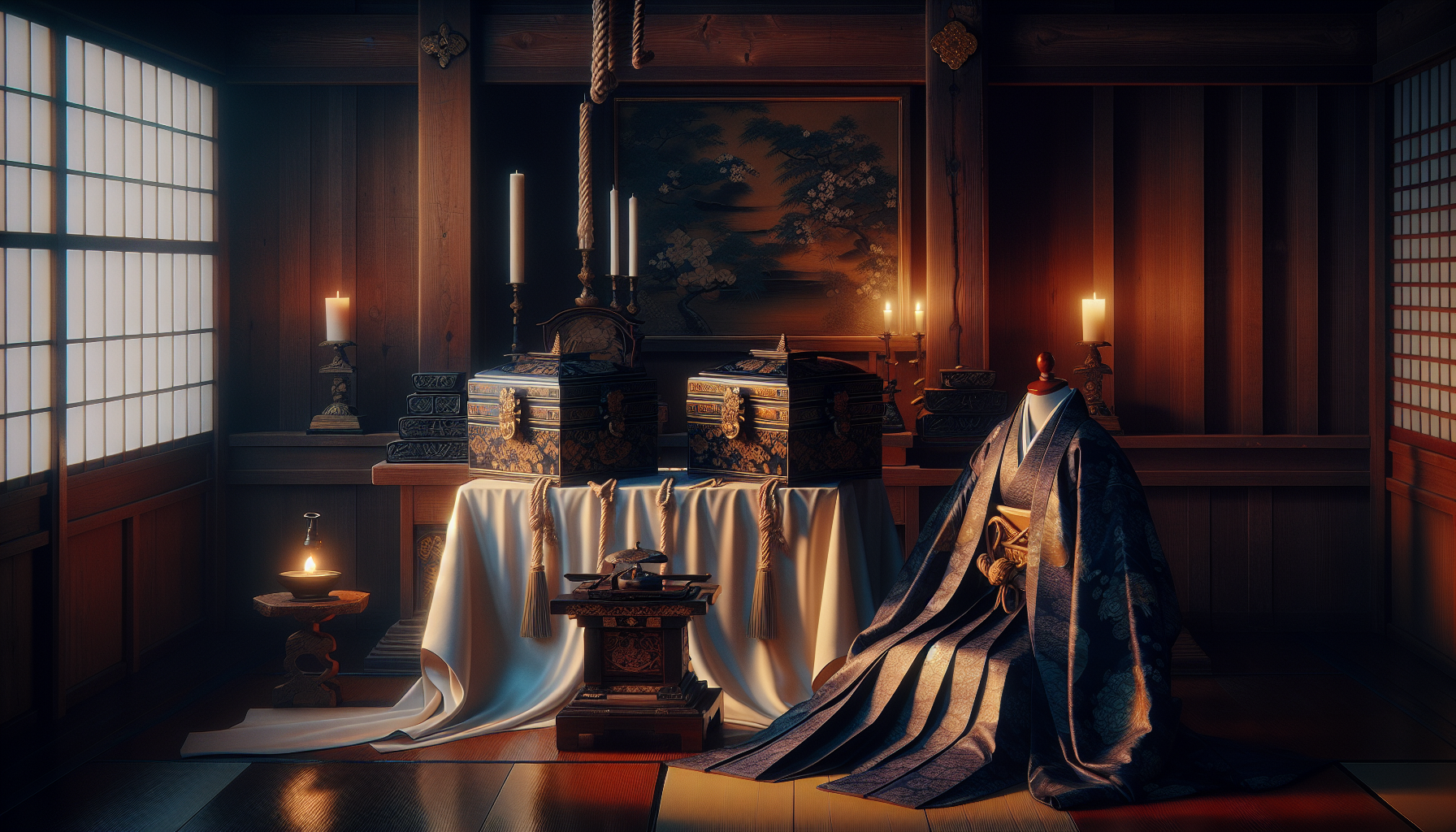
At the Sokuirei-Seiden-no-Gi for Emperor Akihito on 12 November 1990, and again for Emperor Naruhito on 22 October 2019 before representatives of roughly 174 states, the sword and the jewel were placed in their boxes on stands beside the new emperor while the mirror remained at Ise. The 2019 succession was preceded on 1 May by the Kenji-to-Shokei-no-Gi, a brief ritual at which the boxed sword and jewel were transferred to the new emperor in the presence of senior officials. No participant or observer saw the contents of the boxes.
Three Interpretive Frames
The regalia sit at a junction of three scholarly approaches, each producing a different conclusion from the same record. The careful reader is best served by seeing how they intersect.
The Shinto Theological Frame
In Shinto theological reading, the three objects are not symbols of the kami but sites at which kami are present. The mirror at Ise is treated as the residence, not the representation, of Amaterasu; the sword at Atsuta is similarly treated as a kami in its own right. The question of whether the Atsuta sword is original or replacement becomes a category mistake, since ritual continuity, not material continuity, is what matters. Carmen Blacker’s The Catalpa Bow remains the clearest English-language exposition of this view.[5]
The Imperial-Legitimacy Frame
In the political-historical reading, the regalia function as instruments of legitimacy. Possession of the three objects, or their boxed proxies, has been the operative test of imperial succession since the late seventh century. Donald Keene’s work on the Meiji Emperor traces how the regalia were marshaled in the nineteenth-century reconstruction of imperial authority after the long Tokugawa eclipse.[2] In this frame, the secrecy is itself political: an object that cannot be seen cannot be challenged.
The Comparative Divine-Kingship Frame
A third reading places the regalia within the comparative anthropology of divine kingship, alongside the British coronation regalia and the Holy Roman Reichsinsignien. The triadic structure of sword, mirror, and jewel finds analogues across Eurasia, although the specific theological grounding is distinctively Japanese. John Breen’s work, with Mark Teeuwen, argues that the Japanese case is unusual chiefly in the durability of its non-inspection norm rather than in the symbolic logic of the objects themselves.[6]
Why the Mystery Endures
The Imperial Regalia have endured as a mystery less because they are hidden than because the choice to keep them hidden has itself been ritually maintained for many centuries. There is no scandal of disappearance here, no theft or rumored sale; the objects’ opacity is constitutive of their function. The Imperial Household Agency has refused inspection of the originals, and that refusal is the modern continuation of a posture stretching back through Tokugawa patronage, medieval war, and the eighth-century chronicles. Some sacred objects are most powerful when they are not described, and respecting that condition is part of taking the tradition seriously.
Frequently Asked Questions
What are the three Imperial Regalia of Japan?
They are the sword Kusanagi-no-Tsurugi, the mirror Yata no Kagami, and the jewel Yasakani no Magatama. Together they are called Sanshu no Jingi, the Three Sacred Treasures, and they are conventionally associated with the virtues of valor, wisdom, and benevolence respectively.
Where are the regalia kept today?
The sword is held at Atsuta Shrine in Nagoya, the mirror at the Inner Shrine of the Ise Grand Shrine in Mie Prefecture, and the jewel at the Three Palace Sanctuaries inside the Imperial Palace in Tokyo. The locations have been continuous in tradition for many centuries, although no public inspection of the originals takes place.
Has anyone seen the originals?
No public inspection has been permitted in modern memory. The objects rest inside layered boxes, and ritual handling is carried out by a small number of senior priests. No emperor since the Meiji period is publicly attested to have looked directly at the originals, and the Imperial Household Agency has consistently refused requests for scholarly examination.
Was the sword really lost at Dan-no-ura in 1185?
The Heike Monogatari narrates that the sword sank during the battle on 25 April 1185, when Emperor Antoku and his grandmother Taira no Tokiko drowned and the Taira fleet was destroyed. Whether the sword now at Atsuta is the recovered original, a late-twelfth-century replacement, or always a separate object kept ashore is a matter of unresolved scholarly debate.
What is the role of the regalia in modern enthronements?
During the Sokuirei-Seiden-no-Gi, the formal enthronement ceremony, the boxed sword and the boxed jewel are placed on stands beside the new emperor. The mirror remains at Ise. The transfer of the boxed regalia is the operative ritual of imperial succession and has been performed for Akihito in 1990 and Naruhito in 2019.
What is the Imperial Household Agency’s role?
The Imperial Household Agency, in Japanese the Kunaicho, is a government body that administers the imperial family’s affairs, including the ritual schedule and physical custody of the regalia. Its longstanding policy has been to decline external inspection, on the grounds that the objects are sacred ritual property.
How old are the texts that describe the regalia?
The two earliest surviving sources are the Kojiki, completed in 712 CE under O no Yasumaro, and the Nihon Shoki, completed in 720 CE under Prince Toneri. Both narrate the descent of the regalia from the sun goddess Amaterasu to her grandson Ninigi-no-Mikoto and on to the imperial line.
Why is the mirror considered the most important?
In Shinto theology, the mirror at Ise is treated as the actual residence of Amaterasu rather than as a symbol of her, which gives it a different ontological status from the other two regalia. Several Japanese commentators, including the Institute of Moralogy researcher Shinsuke Takenaka, identify the mirror as the most precious of the three.
Did Yamato Takeru really wield Kusanagi?
The Kojiki and Nihon Shoki narrate that Yamato Takeru received the sword from Princess Yamatohime-no-Mikoto, used it to cut grass and turn back a fire set against him, and renamed it from Ame-no-Murakumo to Kusanagi, the Grass-Cutter. The story is a foundational Yamato-court legend, and Yamato Takeru himself sits between historical and mythological registers.
Are there scientific examinations of the regalia?
No published scientific examination of the originals exists. No metallurgical, gemological, or radiographic analysis has been carried out in the open record. The only inferences possible are textual, ceremonial, and comparative, drawing on classical chronicles, shrine records, and the broader archaeology of Yayoi and Kofun-period swords, mirrors, and magatama.
For deeper context across the historical and archaeological mysteries archive, consider The Burke and Wills Expedition and The Hollow Earth Theory.