By Wren Ashby · Published May 7, 2026 · Updated May 13, 2026
Last reviewed: May 7, 2026.
What Is Albinism in Wild Animals?
Albinism in wild animals is a heritable autosomal recessive condition in which mutations on one of several pigmentation genes (most commonly TYR, OCA2, TYRP1, or SLC45A2) prevent the synthesis of melanin. The animal hatches or is born with white fur, feathers, or skin and pink or pale-blue eyes. It is rare, biologically taxing, and ecologically consequential.
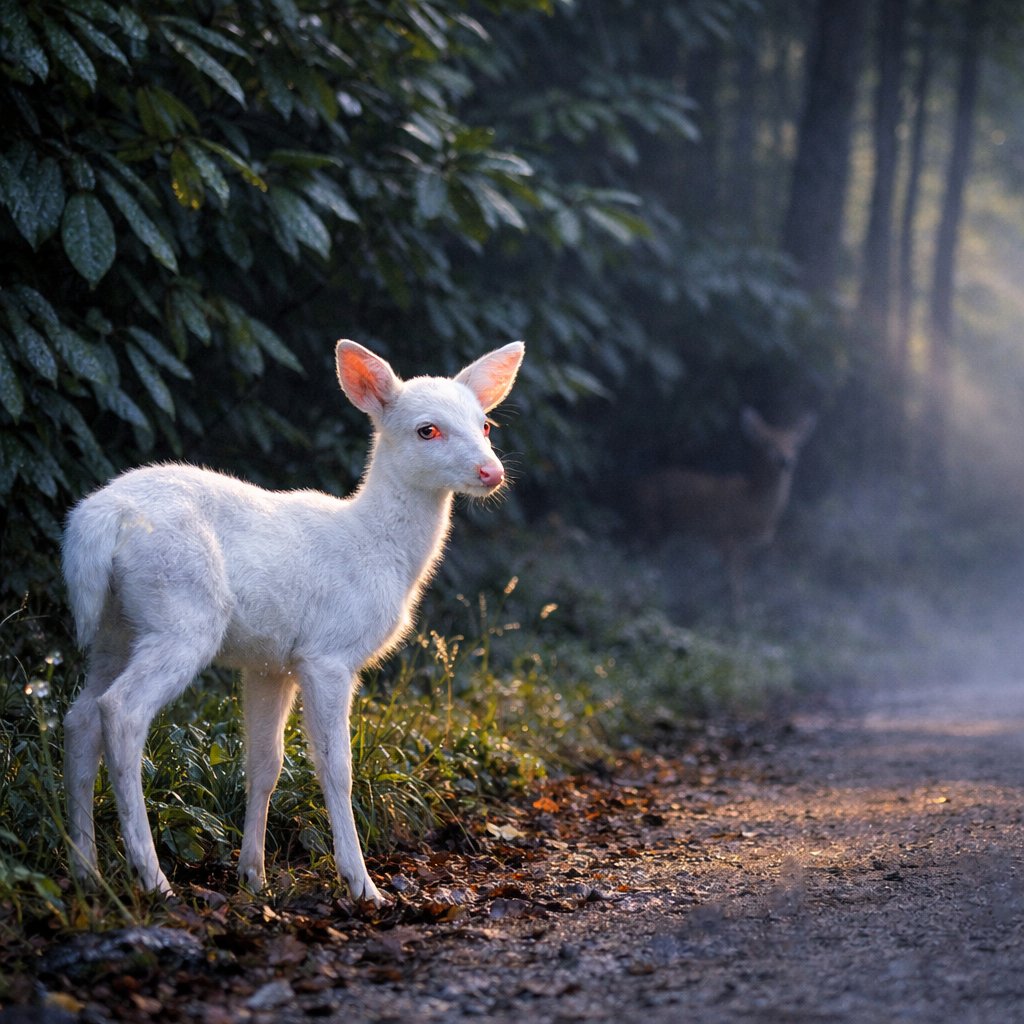
The first time I watched an albino white-tailed fawn cross a fire road in eastern Tennessee, the doe stopped in the middle of the lane and stood there longer than any pigmented fawn I had recorded that season. The animal next to her glowed against the rhododendron the way a sheet of paper glows under a flashlight. Something at the back of my notebook noted the time, the canopy gap, and the line of sight to the nearest unhunted ridge. The fawn did not move like a doomed animal. It moved like an animal whose mother had already done the calculation about where the cover was.
This piece walks through what albinism actually is at the gene-and-pigment level, what it is not (the leucism distinction matters), what it costs the animal in measurable ecological terms, and how the long human cultural record around white animals reads when the animal is granted the courtesy of accurate biology first. The condition sits inside the wider animal anomaly mysteries this site tracks, and it is one of the few where the genetics, the field ethology, and the cultural record can be set side by side without flattening any of them.
The Genetics of True Albinism
Melanin synthesis runs through a small number of well-mapped genes. TYR encodes tyrosinase, the rate-limiting enzyme that converts tyrosine to L-DOPA and then to dopaquinone, the branch point for both eumelanin (black-brown) and pheomelanin (red-yellow). OCA2, TYRP1, and SLC45A2 code for melanosome membrane proteins that regulate the pH and tyrosinase trafficking inside the pigment-producing organelle. A loss-of-function mutation on any of these, when inherited from both parents, blocks the cascade [1].
Type I Oculocutaneous Albinism (OCA1)
A homozygous null mutation in TYR produces OCA1, the most severe phenotype: zero melanin in skin, hair, and the eye’s iris and retinal pigment epithelium. The classic mouse model studied by Robert Owen, Margaret Skimmings, and the Searle laboratory traces directly to a single recessive locus on mouse chromosome 7, and the homologous human and wild-mammal cases follow the same pattern [2]. An OCA1 animal is not pale. It is unpigmented. The pink iris is not a pigment; it is the absence of pigment letting blood vessels show through.
Type II and Beyond
Type II OCA, mediated by OCA2 mutations, allows trace pheomelanin and produces a creamier rather than chalk-white animal. Type III (TYRP1) and Type IV (SLC45A2) phenotypes exist across mammals and birds with species-specific expression. The point worth holding onto is that “albino” is a clinical category covering at least four genetic etiologies, and the visible animal is not always uniform.
Why Leucism Is Not Albinism
A leucistic animal carries mutations in genes that govern melanocyte migration during embryonic development (often MITF, KIT, or PAX3) rather than melanin synthesis itself. The melanocytes are reduced or absent in patches; the eye, derived from neural crest tissue that the affected genes do not block, retains normal dark pigment [3]. Yellowstone’s so-called “Spirit” white bison and the famous all-white Migaloo humpback that has surfaced off Australia’s Great Barrier Reef since 1991 are technically leucistic on the best available evidence, not albino. Migaloo’s eyes are dark; a true albino humpback would not have dark eyes. The distinction is not pedantic; it changes the predicted survivorship.
Incidence Rates Across Wild Populations
Estimating frequencies in the wild is harder than the popular literature implies. A working ethologist relies on capture-recapture studies, museum-skin counts, and aggregated citizen-science observations that have to be corrected for detection bias (a white animal is detected more often than it occurs).
Mammals
In mammals where the data are best, albinism runs roughly one in 10,000 to one in 20,000 individuals, with strong species variation. White-tailed deer in Boulder Junction, Wisconsin reach unusually high frequencies (locally protected from harvest since 1940) but the underlying mutation rate is in the same broad range. Squirrel populations in Olney, Illinois, where albino eastern grays have been protected by ordinance since 1925, show similarly elevated phenotypic frequency under release from selection rather than elevated mutation [4].
Birds
Bird albinism is rarer in the strict sense. Charles Wood’s mid-twentieth-century dissertation work and the more recent aggregated Cornell Lab of Ornithology eBird database of rare-pigment observations put the incidence below one in 5,000 across most North American passerines [5]. The Aullwood Audubon white American robin documented in Ohio in the 1990s and the persistent records of true-albino crows are working examples; partial leucism is far more common than the reports often suggest.
The Ramayan Tiger Cohort
The Wildlife Trust of India’s preserve work with white-coat tigers descended from the Rewa lineage demonstrates a different point. The white-coat phenotype in Panthera tigris is not albinism but a SLC45A2 leucistic variant maintained by inbreeding from a single 1951 Madhya Pradesh cub. The cohort exhibits elevated rates of strabismus and immune dysfunction, both of which trace to the founder bottleneck rather than the pigment locus directly. It is the most studied case of how human captive management amplifies a rare pigment phenotype that wild populations would normally purge through selection.
What the Condition Costs the Animal
An albino animal in the wild faces three measurable selective pressures. None of them is uniform across taxa, and the working ethology is more interesting than the slogan version.
Visual-Predation Vulnerability
The first pressure is the obvious one. Camouflage is gone. A white fawn against summer rhododendron is detectable at twice the distance of a brown fawn under the same canopy conditions, and predator observers (in this case, recorded coyote and bobcat encounters) orient toward the conspicuous animal first. Field studies of albino prey across small-mammal, ungulate, and ground-bird communities consistently find shorter mean survival times than melanin-typical conspecifics, with the differential most pronounced in habitats with overhead light and broken cover.
UV Damage and Visual Acuity
The second pressure is structural. Melanin in the iris and retinal pigment epithelium absorbs ultraviolet wavelengths and stabilizes photoreceptor membranes against oxidative damage. An albino mammal carries a partially translucent iris and a depigmented choroid; light scatters inside the eyeball, and visual acuity drops measurably (foveal hypoplasia and nystagmus are documented in laboratory albino mice and in wild captures). Skin without melanin sunburns. An albino savanna ungulate at low latitudes accumulates squamous cell damage on the ear margins and dorsal flanks within months. None of this prevents the animal from living. It compresses the actuarial table.
Reduced Mating Success
The third pressure is the most species-specific. Many bird species use plumage cues for sexual selection that depend on intact melanin patterning (the structural blue iridescence in indigo buntings, for instance, is built on a melanin substrate; without it the blue does not appear). An albino male of such a species fails the species-specific signal test and mates less. In mammals where olfactory and behavioral cues dominate, the cost is smaller. Whether albinism reduces mating success in a given species is, for the working ethologist, an empirical question, not a default assumption.
Mean Lifespan in the Wild
Pulling these pressures together: documented mean lifespans for albino conspecifics in wild populations run shorter than melanin-typical animals across nearly every taxon for which data exist, by margins that range from 15 to 60 percent depending on the species, habitat, and predation regime. The condition does not preclude reaching breeding age; some albino white-tailed deer in protected Wisconsin populations are documented past seven years. It does shift the survival curve.
Documented Wild Examples
A short field catalog of working examples, each chosen because the data are public and the identification is solid (with the leucism caveat where it applies).
Migaloo, the White Humpback Whale
First photographed in June 1991 off Byron Bay, New South Wales, Migaloo (a Yugambeh-language name meaning “white fellow”) has migrated annually along the East Australian Humpback Highway between the Antarctic feeding grounds and the Great Barrier Reef calving zone. Skin biopsy work by the Pacific Whale Foundation indicates that Migaloo’s eyes are pigmented, suggesting leucism rather than full OCA1, but the animal is treated as functionally hyperpigment-deficient for ecological purposes [6]. Migaloo’s longevity (more than three decades since first sighting, longer than the median wild humpback) is itself ecologically informative: a marine mammal carries less of the conspicuousness cost than a terrestrial prey species would.
The Yellowstone “Spirit” White Bison
White bison calves born within the Yellowstone-area herds are leucistic rather than albino on the available phenotypic data. The June 4, 2024 calf documented in Lamar Valley by visitor photographers and Yellowstone wildlife biologists carried dark eyes; the white coat appears to involve a separate locus. The calf was not relocated by NPS staff that summer and is presumed to have been predated, which is consistent with the conspicuousness penalty noted above.
The Aullwood White Robin
A male Turdus migratorius with full plumage albinism was observed at the Aullwood Audubon Center near Dayton, Ohio across multiple seasons in the 1990s. The bird was the centerpiece of a Cornell Lab of Ornithology educational case study on partial-versus-full albinism in passerines and is one of the small number of credible documented full-albino territorial robins in the North American record.
Indigenous and Cultural Context
A working ethologist who writes about wild animals does not get to skip the cultural record. White animals occupy a substantive place in several indigenous epistemologies, and the science improves when those traditions are read as primary sources rather than folkloric color.
The Lakota White Buffalo Calf Woman
In Lakota oral tradition, Pte San Win (White Buffalo Calf Woman) brought the seven sacred ceremonies and the chanunpa, the sacred pipe, to the people. The birth of a white bison calf is held as a renewal of the covenant. Lakota traditional ecological knowledge on bison herd movement, range condition, and selective harvest is documented in the work of the Intertribal Buffalo Council and is used as input to herd-management planning in collaboration with NPS and state agencies. To treat a white bison sighting as merely a genetic curiosity is to discard a working data source.
Hindu Hanuman and the White-Fur Tradition
In several Hindu textual traditions Hanuman is depicted with white fur, and the rare white langur (Semnopithecus entellus with reduced pigment expression) is treated with religious deference in parts of northern India. This is not, strictly, albinism; it is a culturally significant association between conspicuous pale primates and a deity, and it has had measurable effects on local conservation outcomes (white-coated langur troops near temples experience lower poaching pressure).
The Maori White Kiwi
In te ao Maori, white kiwi (most prominently Manukura, the leucistic chick hatched at Pukaha National Wildlife Centre in May 2011) are accorded particular significance, and the Rangitane o Wairarapa iwi participates in the conservation breeding program around the species. Manukura’s death in December 2020 prompted public mourning that was both cultural and scientific; the bird’s eight-year reproductive contribution to the Pukaha population was substantive.
What the Open Questions Actually Are
The unsolved part of the wild-albinism story is not whether the condition is genetic (it is) or whether it shortens the actuarial table (it does, to varying degrees). The open questions are quantitative. What is the per-locus mutation rate in actual wild populations once detection bias is corrected? Across what habitat gradients does the conspicuousness penalty drop low enough that the allele can persist at low frequency without active conservation protection? How do indigenous-managed protected areas, which often treat white-coat individuals as protected on cultural grounds, affect the long-term frequency of the underlying alleles? The answers require capture-mark-recapture studies designed with sampling power for rare phenotypes, full-genome sequencing on opportunistic specimens, and ethical research partnerships with the communities whose traditions surround the animals. The biology gets better when the cultural record is treated as data. The cultural traditions are not impoverished by the genetics. The two are talking about the same animal from different doors of the same house.
Frequently Asked Questions
What is the genetic basis of albinism in wild animals?
True albinism is caused by autosomal recessive mutations in one of several melanin-synthesis genes, most commonly tyrosinase (TYR, producing OCA1), OCA2, TYRP1, or SLC45A2. An animal must inherit two non-functional copies of the same gene to express the full phenotype. Each gene corresponds to a different clinical type of oculocutaneous albinism, with OCA1 producing the most complete absence of melanin.
How is albinism different from leucism?
Albinism affects melanin synthesis itself, leaving the animal with no pigment in skin, hair, feathers, or eyes; the iris is pink because blood vessels show through. Leucism involves reduced or absent melanocytes (the pigment cells) and typically spares the eyes because eye pigment derives from a different developmental pathway. Migaloo the humpback and most white bison appear to be leucistic, not albino, on phenotypic evidence.
How common is albinism in wild populations?
In mammals, true albinism occurs in roughly one in 10,000 to one in 20,000 individuals, with significant species-by-species variation. In birds, true albinism is rarer, below one in 5,000 across most North American passerines on Cornell Lab of Ornithology aggregated data. Frequencies appear higher in protected populations where albinism has been released from natural selection, such as Boulder Junction’s white deer or Olney’s white squirrels.
Do albino animals live shorter lives in the wild?
On average, yes, by margins ranging from 15 to 60 percent depending on species, habitat, and predation regime. Conspicuousness against background cover, increased UV damage to eyes and skin, and reduced visual acuity from foveal hypoplasia all compress the survival curve. Some individuals reach full breeding age, particularly in protected populations, but the population-level lifespan is shorter than in melanin-typical conspecifics.
Is Migaloo the humpback whale a true albino?
Probably not in the strict OCA1 sense. Photographic and biopsy evidence suggests Migaloo’s eyes carry pigment, indicating leucism rather than full albinism. The animal is functionally hyperpigment-deficient for ecological purposes, but the underlying genetic mechanism is more likely a melanocyte migration mutation than a tyrosinase null. The terminology in popular reporting often elides this distinction.
Why do albino animals have pink or red eyes?
There is no pigment in the iris or retinal pigment epithelium, so the visible color is the red of blood vessels in the retina and choroid showing through the translucent iris and depigmented eye structures. In flash photography and bright sunlight this can appear vivid pink. A leucistic animal, by contrast, retains normal eye pigment and has dark eyes despite a white coat or plumage.
What was the Rewa white tiger lineage?
The white-coat tiger phenotype now found in many captive collections traces to a single male cub, Mohan, captured in Madhya Pradesh, India in May 1951 by the Maharaja of Rewa. The white coat is a leucistic variant tied to the SLC45A2 gene, not true albinism. The captive lineage exhibits elevated rates of strabismus and immune dysfunction caused by the founder bottleneck and subsequent inbreeding rather than the pigment locus itself.
Are white bison sacred in Lakota tradition?
Yes. White Buffalo Calf Woman (Pte San Win) is a central figure in Lakota oral tradition, credited with bringing the seven sacred ceremonies and the chanunpa, the sacred pipe. The birth of a white bison calf is regarded as a renewal of the covenant. Lakota traditional ecological knowledge on bison ecology and herd management is now recognized by the Intertribal Buffalo Council and is incorporated into multi-agency herd-management planning.
Can two non-albino parents produce an albino offspring?
Yes. Because albinism is autosomal recessive, two carrier parents (each heterozygous for a non-functional TYR or related allele) have a 25 percent probability of producing an albino offspring at each conception. Carriers are phenotypically indistinguishable from full melanin-typical individuals. This is why albino offspring can appear unexpectedly in populations where the allele has been quietly maintained at low frequency.
What happened to Manukura, the white kiwi?
Manukura was a leucistic North Island brown kiwi (Apteryx mantelli) chick hatched at Pukaha National Wildlife Centre in New Zealand on May 1, 2011. Recognized by Rangitane o Wairarapa iwi as taonga (a treasure), she contributed to the captive breeding program for eight years and died on December 27, 2020. She was widely considered the only known white kiwi in captivity at the time of her hatching.
What is the single biggest open research question?
For working wild-albinism researchers, the open quantitative question is the per-locus mutation rate in unmanaged wild populations once detection bias is corrected, and the related question of how indigenous and statutory protections of white-coat individuals affect long-term allele frequencies. The answers require capture-mark-recapture studies powered for rare phenotypes, opportunistic full-genome sequencing, and ethically structured partnerships with the communities whose traditions surround the animals.
More from the animal anomaly mysteries archive: The Curious Case of Two-Headed Snakes and Mystery of the Monarch Butterfly Migration.