
By EsoVitae Editorial · Published
Drafted with AI assistance from the sources listed; images are AI-generated illustrations. How EsoVitae is made
What Are the Massive Stone Blocks at Baalbek?
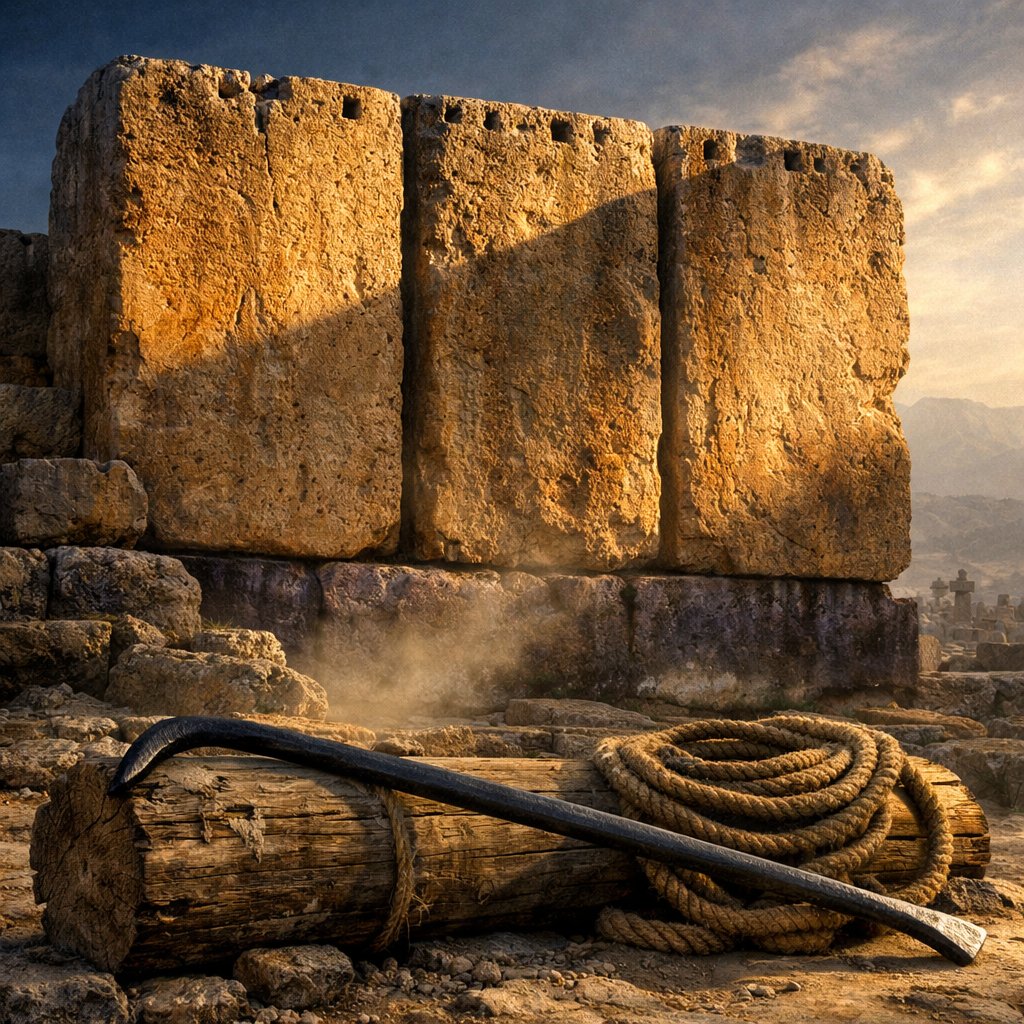
Baalbek‘s so-called megaliths are three colossal limestone blocks set into the western retaining wall of the Temple of Jupiter podium, in the Beqaa Valley of modern Lebanon, together with at least two unfinished blocks still lying in the local quarry. The three wall blocks, known collectively as the Trilithon, weigh on the order of 800 tonnes each. The largest quarry block, recorded since the Renaissance and called Hajar al Hibla, the “Stone of the Pregnant Woman,” weighs roughly 1000 tonnes. A second, larger quarry block, found by a Lebanese-German team in 2014 and lying just below it, has been weighed at about 1650 tonnes, the heaviest worked stone yet documented from antiquity.
These are Roman blocks. They are not lost-civilization debris, and they are not unexplained. The podium of the Temple of Jupiter at Baalbek, ancient Heliopolis, was built between roughly 27 BCE and the early second century CE, with the cult precinct continuing under the Severan dynasty and partial reuse into the Umayyad and later periods. The interpretive puzzle is not who lifted the stones. The puzzle is exactly how a particular Roman building yard, working at the edge of imperial possibility, organized labor, timber, capstans, and ramped earth to seat dressed limestone blocks of two thirds of a million kilograms onto a wall already six meters high.
This guide walks the site as the archaeologists have walked it, beginning with the strata beneath the Roman temenos, moving through the engineering reconstruction of the lift, and closing on the place Baalbek holds within the broader landscape of historical and archaeological mysteries. The aim is to give Roman engineering its proper credit and to put the perennial “ancient aliens” reading where the field has long placed it, which is outside the evidence.
The Site Beneath the Site: Phoenician, Roman, Umayyad Strata
Baalbek sits on a low natural mound at the northern edge of the Beqaa Valley, between the Mount Lebanon and Anti-Lebanon ranges. The mound is artificial in part. Beneath the Roman platform lies a deep stratigraphy that begins, on present evidence, in the third millennium BCE, with continuous occupation through the Bronze Age and the Phoenician and Hellenistic periods.
Phoenician and Pre-Roman Layers
Soundings led by Margarete van Ess of the German Archaeological Institute (DAI) in collaboration with the Lebanese Directorate General of Antiquities, beginning in the 2000s, located Bronze Age and Iron Age levels beneath the courtyards of the Roman sanctuary. The pre-Roman shrine was probably dedicated to a Semitic storm and weather god, Baal of the Beqaa, whose cult name gave the site its modern toponym. By the late Hellenistic period, the local deity had been syncretized with Zeus, and the Romans inherited a functioning cult center, not an empty hilltop.
The Roman Sanctuary
Construction of the Temple of Jupiter Heliopolitanus began under Augustus, around 27 BCE, with the podium and its retaining walls completed in stages through the reigns of Claudius and Nero, and the cella and surrounding structures finished under the Antonines and Severans. The sanctuary was the largest in the Roman Near East. Klaus Stefan Freyberger’s analytical study of the temenos placed the Trilithon courses within the Augustan to early Julio-Claudian phase of the podium, with the surrounding peristyle and altar courts added during the first and early second centuries CE [1].
Late Antique and Umayyad Reuse
After the official suppression of the cult under Theodosius in the late fourth century, the great court was converted into a Christian basilica. The Umayyads in turn fortified the temenos in the seventh and eighth centuries, weaving Roman fabric into a citadel whose later medieval walls preserve much of the original podium intact. The blocks the modern visitor sees inside Umayyad and Mamluk rebuilds are still, in many cases, Roman blocks in their original beds.
The Trilithon: Three Roman Blocks of About 800 Tonnes Each
The Trilithon proper consists of three dressed limestone blocks set in the sixth course of the western retaining wall of the Temple of Jupiter podium, roughly six meters above the surrounding pavement. Each block measures around 19 meters long, 4.3 meters high, and 3.6 meters deep. Density measurements on the local hard limestone (a recrystallized calcareous member of the Cenomanian sequence) yield masses on the order of 800 tonnes per block, with individual estimates ranging in the modern literature from 750 to 970 tonnes depending on the assumed density and the precise dimensions used.
Why a Course of Such Size?
The architectural reason is straightforward and quietly revealing. The podium had to span a slight irregularity in the underlying ground, and the engineers chose to even the foundation course with extreme-format orthostats rather than build up multiple smaller courses. Friedrich Ragette’s 1980 monograph Baalbek, still the standard published synthesis on the architecture, argued that the Trilithon was a structural decision dressed up in spectacle, where engineering necessity and imperial display reinforced one another in a single course of stone [2]. The wall above is built up in conventional courses of three to four metric tonnes per block. The Trilithon is the foundation theatre.
Where the Stones Came From
The quarry is roughly 800 meters southwest of the temenos, on a slight downslope toward the modern town. The quarry face is still exposed, the bedding planes still legible. Three unfinished megaliths remain in situ. The Stone of the Pregnant Woman sits at the surface, three sides dressed, the fourth still attached to the parent rock. Below it lie two further blocks, the second of which was first measured fully by Jeanine Abdul Massih’s Lebanese University team during her 2014 season at the quarry, and confirmed by subsequent DAI study as the largest worked stone yet known from antiquity.
Hajar al Hibla and the 2014 Block
Hajar al Hibla, the Stone of the Pregnant Woman, has been visible at the surface of the Baalbek quarry since the early modern period. Travelers in the seventeenth and eighteenth centuries sketched it. Its name in popular Lebanese tradition gives it the affectionate quality of a thing too large to ignore, the way a village pictures a curious neighbor. The block measures about 20.3 by 4 by 4.5 meters and weighs approximately 1000 tonnes. It was abandoned in antiquity for reasons that probably involve hairline cracks at one corner, visible in raking morning light, and the rising difficulty of moving stones at that scale across an awkward slope.
The 2014 Discovery
During a 2014 season directed by Jeanine Abdul Massih of the Lebanese University, with technical collaboration from the DAI, a partner block lying directly beneath Hajar al Hibla was fully cleared and measured for the first time. The dimensions, roughly 19.6 by 6 by 5.5 meters, give a mass of about 1650 tonnes [3]. The block sits at a depth that suggests the Romans were preparing it for extraction by undercutting the bedding plane, and that work was halted before the channel was completed. A third partner block, smaller but still in the 1100-tonne range, was identified nearby in the same season.
Why the Quarry Stopped
The simplest reading is the structural one. The Roman wall above the Trilithon was already finished. There was no further course at this scale to fill. The quarrymen had cut the blocks for a planned extension that the project’s architects ultimately replaced with conventionally sized courses, possibly under the Severans, when monumental ambition gave way to the slower realities of provincial finance. Daniel Lohmann of the Technical University of Berlin, in a sequence of papers published between 2008 and 2014, argued that the abandoned megaliths represent a building program that was scaled back rather than a technology that failed [4]. The Romans could move the stones. They simply chose not to.
How the Romans Lifted Them: Lohmann’s Reconstruction
The most complete modern reconstruction of the Baalbek lifting and transport methodology is Daniel Lohmann’s, developed during his TU Berlin doctoral and postdoctoral work on the temenos and the quarry. Lohmann combined autopsy of the building courses, tool-mark mapping at the quarry, and comparative reading of Vitruvius (De Architectura, Book X) and surviving capstan and pulley remains across the empire, into a step-by-step account that does not require any technology unknown to the Roman Mediterranean.
Quarry Extraction by Cantilever Wedge
The blocks were detached along bedding planes by a sequence of channeled cuts, each about 60 centimeters wide, opened with iron picks and chisels. Once three sides were free, the underside was undercut by driving wooden wedges into a horizontal channel, swelling them with water until the parent rock fractured along the bedding line. The cantilever wedge was a known Roman quarrying technique applied here at maximum scale.
Transport on Rolled Sleds
The 800-meter haul from quarry to building site followed a graded ramp prepared in advance, with the slope of the descent kept as gentle as the ground allowed. The block sat on a heavy timber sled riding on rollers of cedar and oak, harvested from the Mount Lebanon forests within a hundred kilometers of the site. Lohmann estimated, on the basis of comparative Roman accounts and modern engineering analogues, that a team of several hundred men with capstans and dragging cables could move a block of this scale across the prepared track at the order of tens of meters per day [4].
Lifting onto the Sixth Course
The lift onto the sixth course, six meters above the surrounding ground, was the hardest step. Lohmann’s reconstruction proposes a built-up earth ramp behind the wall during construction, with the block dragged up the ramp on rollers using capstans anchored at the top, then levered into final position with iron crowbars (vectes) and timber spacers, the courses below packed with sand and dunnage to absorb the placement load. The ramp would have been removed after the wall above was completed, leaving no trace except for the slight pitting on the upper edges of the blocks, which Lohmann interpreted as anchor points for the timber cradle.
Why the “Ancient Aliens” Reading Fails the Evidence
The Baalbek megaliths recur in popular pseudoarchaeology as proof that ancient builders had access to lost technology, antigravity, or extraterrestrial assistance. The reading rests on three sleights of hand, each of which falls apart under the actual stratigraphy and tool-mark evidence at the site.
The Stones Are Securely Roman
The Trilithon and the unfinished quarry blocks lie within Roman strata. The masonry style, the tool marks, the bedding-plane cuts, the lewis-hole patterns at the corners of dressed blocks, and the architectural integration with the surrounding podium all date the blocks to the Augustan to Severan range. There is no Phoenician or Bronze Age horizon at the Trilithon. The pre-Roman cult lay below ground level, in a shrine that Roman engineers buried, paved over, and built upon. As Klaus Freyberger and Margarete van Ess have repeatedly emphasized in DAI publications, the chronology is not in dispute among archaeologists working at the site [1].
The Methodology Is Documented
Roman engineering at this scale is not hypothetical. Trajan’s column was raised using comparable capstan and ramp methods. The 327-tonne obelisk of Constantine, transported from Karnak to Rome in the fourth century CE, is documented in textual and archaeological sources. The Vatican obelisk, weighing roughly 330 tonnes, was moved across Rome by Domenico Fontana in 1586 using essentially the same Roman techniques, refined for sixteenth-century logistics. The lifts at Baalbek are larger by a factor of two and a half, but the principle scales with timber, capstans, men, and time.
Absence of Evidence Is Not Evidence of Aliens
The pseudoarchaeological reading converts the gap between Roman texts (which describe everyday capstans, not the Baalbek extraordinary case) and the surviving stones into a mystery requiring an extraordinary cause. The historian’s discipline is to fill that gap with parsimony, not with sensation. The blocks are within Roman engineering capacity if we accept the costs in labor, time, and timber. The blocks are outside non-Roman explanation only if we discard the stratigraphy, the tool marks, and the architectural integration. The choice is between a Roman building yard working at imperial scale, or a thesis that needs to ignore the actual archaeology to remain coherent.
What Baalbek Tells Us About Roman Engineering
The proper relief into which Baalbek throws Roman engineering is not the relief of magic. It is the relief of a particular building yard, in a particular Augustan provincial program, choosing to spend extraordinary effort on a foundation course because the imperial cult of Jupiter Heliopolitanus required a podium that registered as more than provincial. The Trilithon was a calculated act of monumental rhetoric, and the unfinished quarry blocks are the trace of a program that ran out of will or money before it ran out of capability.
Margarete van Ess and the DAI Baalbek project have, since 1998, treated the site as a continuous laboratory rather than a static monument. Excavation in the great court, geophysical survey of the temenos approaches, and the publication of the quarry stratigraphy by Abdul Massih have together made Baalbek one of the best-documented Roman provincial sanctuaries in the eastern Mediterranean, alongside the Britannica entry on the wider Baalbek complex and its Roman context [5]. The picture that has emerged is of Roman engineering pushed, deliberately and confidently, to the edge of what timber, rope, iron, and organized labor could deliver, with the limit visible in the unmoved 1650-tonne block still in the quarry. The frontier was real. The Romans found it. They stopped.
Frequently Asked Questions
How heavy are the Trilithon blocks at Baalbek?
The three Trilithon blocks weigh approximately 800 tonnes each, with published estimates ranging from 750 to 970 tonnes depending on assumed limestone density and exact dimensions. Each block is about 19 meters long, 4.3 meters high, and 3.6 meters deep, set in the sixth course of the western retaining wall of the Temple of Jupiter podium.
What is the Stone of the Pregnant Woman?
Hajar al Hibla, the Stone of the Pregnant Woman, is an unfinished Roman quarry block weighing approximately 1000 tonnes. It lies at the surface of the Baalbek quarry, three sides dressed, the fourth still attached to the parent rock. It was abandoned in antiquity, probably because of hairline cracks at one corner and the rising cost of moving the planned course at this scale.
What was discovered at Baalbek in 2014?
In 2014, a Lebanese-German team led by Jeanine Abdul Massih of the Lebanese University fully cleared and measured a partner block lying directly beneath Hajar al Hibla. The block, roughly 19.6 by 6 by 5.5 meters, weighs about 1650 tonnes, making it the heaviest worked stone yet documented from antiquity. A third nearby block was measured at around 1100 tonnes.
Who built the Temple of Jupiter at Baalbek?
The Temple of Jupiter Heliopolitanus was built by the Romans, beginning under Augustus around 27 BCE. The podium and retaining walls were completed in stages through the reigns of Claudius and Nero, with the cella and surrounding structures finished under the Antonines and Severans. The site syncretized an older Phoenician cult of Baal with the Roman Jupiter.
How did the Romans move 800-tonne blocks?
Daniel Lohmann’s reconstruction at the Technical University of Berlin proposes a sequence of cantilever-wedge quarrying, transport on timber sleds riding on cedar rollers, and a built-up earth ramp behind the wall, with the final lift onto the sixth course performed by capstans and iron crowbars. No technology unknown to the Roman Mediterranean is required.
Did aliens build Baalbek?
No. The Trilithon and the quarry blocks lie within securely dated Roman strata, with masonry, tool marks, and architectural integration all consistent with the Augustan-to-Severan construction sequence. The pseudoarchaeological reading requires ignoring the stratigraphy, the tool-mark evidence, and the architectural context, and is not supported by any archaeologist working at the site.
What is the Trilithon?
The Trilithon is the name given to the three colossal limestone blocks set in the sixth course of the western retaining wall of the Temple of Jupiter podium at Baalbek. Each weighs approximately 800 tonnes. The course evens the foundation across a slight irregularity in the underlying ground while serving as a piece of imperial-scale architectural display.
Where is Baalbek located?
Baalbek lies in the Beqaa Valley of modern Lebanon, between the Mount Lebanon and Anti-Lebanon ranges, about 85 kilometers northeast of Beirut. In Roman times the city was called Heliopolis and served as one of the most important cult centers of the Roman Near East. The site has been a UNESCO World Heritage Site since 1984.
Why didn’t the Romans use the largest quarry blocks?
The wall above the Trilithon was already finished by the time the larger blocks were being prepared. Daniel Lohmann interprets the abandoned megaliths as a scaled-back building program rather than a failed technology. The Romans could have moved the 1650-tonne block. They simply chose, probably for reasons of cost and shifting imperial priorities under the Severans, not to.
What older layers lie beneath the Roman temple?
German Archaeological Institute soundings led by Margarete van Ess from the late 1990s onward have located Bronze Age, Iron Age, and Phoenician occupation levels beneath the Roman courtyards. The pre-Roman cult was dedicated to a Semitic storm god, Baal of the Beqaa, syncretized in the Hellenistic and Roman periods with Zeus and then with Jupiter Heliopolitanus.