By Dr. Sloane Reeve · Published May 7, 2026 · Updated May 13, 2026
Last reviewed: May 7, 2026.
What Bigfoot Actually Is, in Plain Zoological Terms
Bigfoot, also called Sasquatch, is a hypothesized large bipedal hominid reported across the temperate forests of North America. The modern public case rests on the 1967 Patterson-Gimlin film, the footprint record analyzed by anthropologist Jeff Meldrum, sighting databases such as the Bigfoot Field Researchers Organization, and a deep, much older record of Indigenous oral tradition. As a working biologist, my notebook reads: cultural reality, yes; primatological evidence sufficient to name a species, not yet.
I think with my boots on. A cast in the mud is a vertebrate or it isn’t. A gait pattern is consistent with bear or it isn’t. The Pacific Northwest is full of real animals that get misidentified, and full of real testimony that has been dismissed for the wrong reasons. The discipline of cryptids and mythical creatures works best when it honors both ledgers without conflating them.
What follows is a field naturalist’s tour of the Bigfoot case. Indigenous knowledge gets respect on its own terms. Films, footprints, and DNA each get the same evidence ladder I would apply to any candidate large vertebrate.
Indigenous Sasquatch Traditions: Primary, Not Folkloric Garnish
A common error in popular Bigfoot writing is to open with 1958 footprint hoaxes and treat Indigenous traditions as a flavor note. The chronology is the other way around. The Sts’ailes Nation of the Harrison River in British Columbia gives the figure its anglicized name, sasq’ets, and recognizes the being as a real, ancestral inhabitant of the land. The Yurok of the Klamath River call a similar figure Oh-mah. Coast Salish peoples, including the Lummi, Squamish, and Snoqualmie, carry related accounts of forest people who live apart from human settlements and are encountered, occasionally, by hunters and travelers.
In the cultural-historical ledger, these traditions predate European contact, predate every footprint cast, and predate the word “cryptozoology.” They are not evidence for a particular biological model. They are evidence that something has long been worth naming. A field zoologist who treats Indigenous testimony as a “myth column” misreads the data twice: once as ethnography and once as biogeographic prior.
Robert Michael Pyle, the lepidopterist whose 1995 book Where Bigfoot Walks walked the Dark Divide of Washington State on foot, makes the ecological-credibility version of this point. The forests in question are vast, undersurveyed, and contain plenty of mammals that science has cataloged late or poorly. Pyle’s argument is not that Bigfoot must exist; it is that ridicule has done more to retard the question than evidence has done to settle it.
The Patterson-Gimlin Film of October 20, 1967
The single most analyzed piece of cryptid footage was shot at Bluff Creek in Six Rivers National Forest, northern California, on the afternoon of October 20, 1967. Roger Patterson, a former rodeo rider and amateur Bigfoot researcher, and his companion Bob Gimlin had ridden in on horseback specifically to look for tracks. Their account of the encounter is consistent across decades of retelling: a tall, dark, hair-covered figure walking upright across a sandbar, turning at one point to look at the camera, then continuing into the trees. The film runs roughly 59.5 seconds at 16 frames per second, on a borrowed Cine-Kodak K-100 camera.
Two readings have competed since the day the film cleared the lab. The first is the costume hypothesis: the subject is a human in a tailored ape suit. Costume effects designer Philip Morris claimed in 2002 to have sold Patterson the suit, and stuntman Bob Heironimus said he wore it. Neither account has been corroborated with materials, fittings, or a successful reconstruction that reproduces the film’s specific shoulder-to-hip ratio, gluteal mass, mid-stride compression of the calf, or smooth uninterrupted gait at the documented frame rate.
The second reading is the unknown-primate reading. Anthropologist Jeff Meldrum of Idaho State University, in his 2006 monograph Sasquatch: Legend Meets Science, argues from gait kinematics that the subject’s stride length, ankle flexion, and lack of the classic plantigrade human heel-strike are difficult to fake under a 1967 latex-and-fur costume. The wildlife biologist John Bindernagel reached a similar conclusion in his 2010 book The Discovery of the Sasquatch: Reconciling Culture, History, and Science in the Discovery Process, which catalogs the species as if it were any other large mammal awaiting type-specimen confirmation.
A working naturalist’s reading is narrower. The film does not prove a species; no film does. It does establish that a high-quality costume hypothesis carries its own evidentiary burden, one its proponents have not fully met. The honest verdict is suspended, not closed.
Footprints and the Meldrum Cast Collection
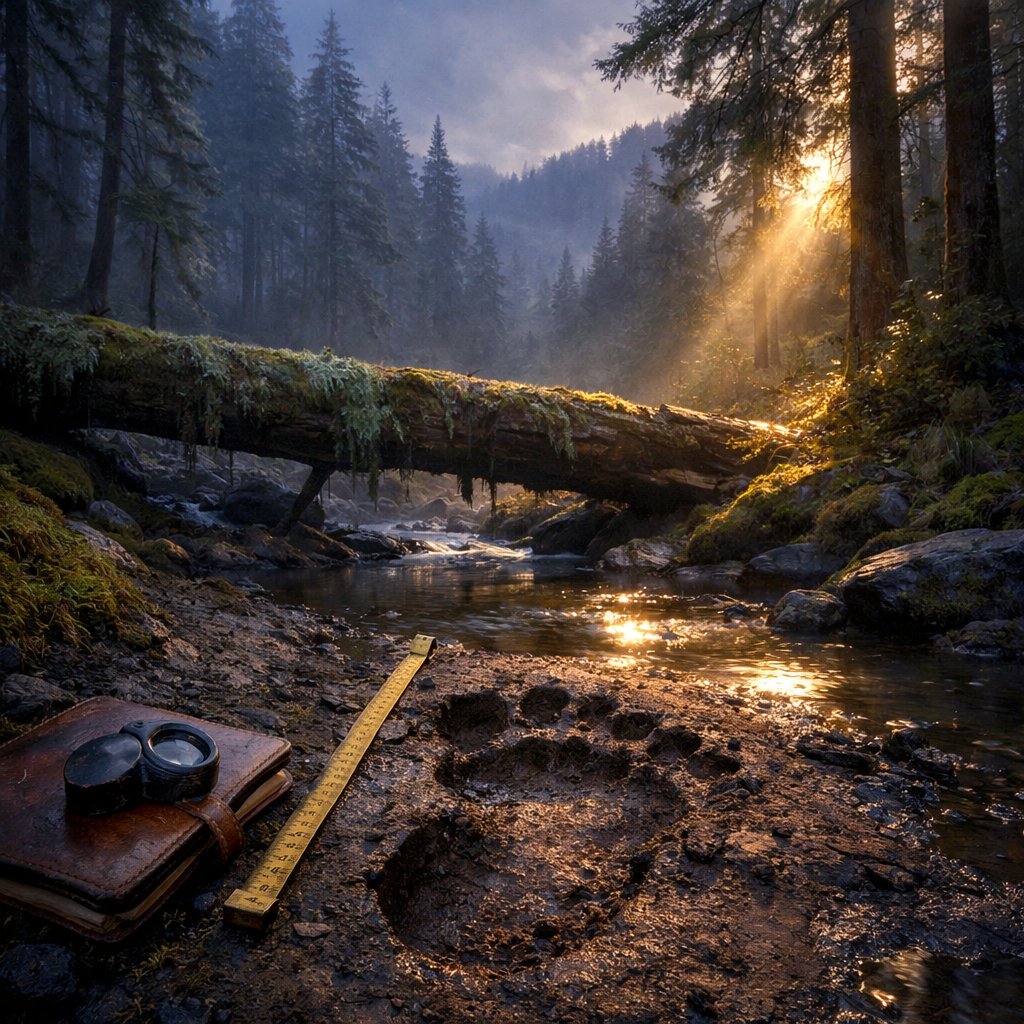
If the Patterson-Gimlin film is the visual signature of Bigfoot, footprint casts are the morphological one. Meldrum’s working collection at Idaho State exceeds 300 cast specimens drawn from across the Pacific Northwest, the Sierra Nevada, and the southern Appalachians. He has argued that a subset of these casts shows midtarsal flexibility, dermal ridge patterns, and consistent biomechanical features that are difficult to reproduce by simple stamping or carving.
Skeptics counter, fairly, that hoaxing is documented and easy. Ray Wallace’s 1958 Bluff Creek prints, the founding event of the modern Bigfoot phenomenon, were posthumously revealed in 2002 by his family to have been carved wooden stompers. Any honest analyst has to assume hoaxing accounts for a meaningful fraction of casts. Meldrum’s defense is not that all casts are real but that a tighter subset shows internal anatomical features no known hoaxer has produced. The evidence is morphological, not statistical.
A field zoologist’s question is what predictions follow. A real population of large bipedal hominids should leave more than footprints. It should leave hair with intact follicular cells, scat with identifiable plant fragments and parasites, and, eventually, a carcass. None has yet been produced and verified.
The 2014 Sykes mtDNA Study and the End of the Paranormal-Class Hypothesis
The most rigorous DNA test the case has yet faced was led by Bryan Sykes, the Oxford geneticist who established the use of mitochondrial DNA in human population studies. Between 2012 and 2013, Sykes solicited samples worldwide that submitters believed came from Bigfoot, Yeti, Almasty, or related figures. Of 57 samples judged suitable for sequencing, the team published results in 2014 in Proceedings of the Royal Society B.
Every Sasquatch sample matched a known mammal. The list included American black bear, brown bear, raccoon, deer, horse, sheep, cow, dog, and human. Not one sample produced a sequence outside the known mammalian reference set, and not one matched any unknown primate. The two Himalayan samples that initially attracted attention as a possible Ursus maritimus hybrid were later reanalyzed and reattributed to Himalayan brown bear (Ursus arctos isabellinus).
The Sykes paper is sometimes overstated and sometimes understated. It does not prove Bigfoot does not exist. It does definitively rule out the paranormal-class hypothesis: a population of supernatural, ghost-like, or interdimensional beings that nonetheless leaves hair samples submitters believed in. Every “Bigfoot hair” handed to Sykes came from a known mammal. That is the strongest negative result in the case so far.
Sighting Databases and Their Limits
The Bigfoot Field Researchers Organization (BFRO) maintains the largest public sighting database in North America, with reports indexed by state and county. Patterned sighting clusters in the Pacific Northwest, the southern Appalachians, and the Ohio Valley track real ecological gradients of forest cover and lower human density. They also track interstate highways, popular hiking trails, and cell-phone coverage, which is the same problem that plagues the Loch Ness sighting record.
A useful database for cryptozoology should be filtered, weighted, and tested against control habitat where no creature is reported. BFRO has improved its vetting since the 1990s but does not run controlled comparisons. The honest naturalist’s use of the database is descriptive: where do reports cluster relative to forest type and population density? It is not a substitute for a specimen.
What Biology Would Actually Require
Cryptozoology disappoints when it skips the boring parts of biology. I love the boring parts. They are where real cases either dissolve or hold up. Set the films and folklore aside and ask what a viable Bigfoot population would need.
Population, Not Individual
A persistent breeding population of large bipedal hominids in temperate North America would require, at minimum, a few hundred individuals to avoid inbreeding collapse over centuries. That implies dozens of carcasses produced per generation, distributed across hundreds of thousands of square kilometers, with predation, scavenging, and erosion eventually exposing bones. None has been recovered and verified.
Caloric Budget and Habitat
A 250-kilogram omnivorous primate has a substantial daily caloric demand, plausibly six to eight thousand kilocalories. Pacific Northwest forests can support such an animal in principle, given salmon runs, ungulate populations, and abundant plant matter. The biogeographic question is whether they do, undetected, alongside well-monitored bear populations that occupy similar forage. Bear-density data are good. A second large omnivore in the same habitat would draw on the same resources without leaving a parallel scat or kill record.
Falsifiability
A useful Sasquatch hypothesis must specify what evidence would falsify it. The relict-Gigantopithecus model predicts skeletal remains, dermal-ridge-bearing footprint casts at known biomechanical resolution, and identifiable nuclear DNA in shed hair. Sykes 2014 is a strong null on the third prediction. The first two remain open.
The Naturalist’s Verdict, and Why the Question Stays Open
My field notebook reads as follows. Indigenous traditions establish a deep cultural reality that no scientific finding will undo, nor should it try. The Patterson-Gimlin film remains the single most analyzed piece of cryptid footage and is not closed by either side’s strongest argument. The footprint record contains hoaxes, ambiguous casts, and a smaller set with biomechanical features that deserve continued study. The Sykes mtDNA work has retired the paranormal-class hypothesis and shifted any remaining unknown-primate model into a narrower, harder-to-defend window.
Cryptozoology has a graveyard chapter and a rediscovery chapter. The Bigfoot file belongs in neither yet. It is, as Pyle wrote, a working question in a forest that has not been completely surveyed, asked of a continent that confirmed the okapi only in 1901 and the saola only in 1992. The question stays open because the evidence ladder is incomplete in both directions: no skeleton, no clean DNA, but no falsification of the broader cultural-historical record either. Honest practice keeps the file open and applies the same standards to every new submission. The forest is not done with us yet.
Frequently Asked Questions
Is Bigfoot real?
No verified physical specimen, skeleton, or unambiguous DNA sequence supports a living large bipedal primate in North America. Indigenous oral traditions describe such a being as a real cultural-historical presence. The biological case remains open but unconfirmed; the paranormal-class hypothesis was effectively ruled out by the 2014 Sykes mitochondrial DNA study.
What is the Patterson-Gimlin film?
A 16mm film shot by Roger Patterson and Bob Gimlin at Bluff Creek, California, on October 20, 1967. It shows a tall, dark, hair-covered figure walking upright across a sandbar. Two readings persist: the costume-hypothesis reading and the unknown-primate reading. Neither has been definitively closed by independent reconstruction or biomechanical analysis.
Did the Sykes DNA study prove Bigfoot does not exist?
No. Bryan Sykes’s 2014 paper in Proceedings of the Royal Society B showed that every submitted “Sasquatch” hair sample matched a known mammal. That rules out a paranormal-class hypothesis and narrows any remaining unknown-primate model. It does not prove a creature does not exist; it shows none of the submitted material came from one.
Why are Indigenous Sasquatch traditions important?
Sts’ailes, Yurok, Lummi, Squamish, and other Coast Salish peoples carry pre-contact traditions of a forest-dwelling being. The anglicized “Sasquatch” comes from the Sts’ailes word sasq’ets. These traditions are primary cultural-historical evidence in their own right and an important biogeographic prior; they are not folklore in the dismissive sense.
What did Jeff Meldrum contribute?
Meldrum, an anatomist at Idaho State University, has assembled a working collection of more than 300 footprint casts and analyzed them for biomechanical features such as midtarsal flexibility and dermal ridges. His 2006 book Sasquatch: Legend Meets Science argues that a subset of casts shows anatomy difficult to hoax and merits continued zoological investigation.
What did John Bindernagel contribute?
Bindernagel was a Canadian wildlife biologist whose 2010 book The Discovery of the Sasquatch approached the species as a candidate large mammal awaiting type-specimen confirmation. He cataloged behavioral, vocal, and ecological reports in the manner of a wildlife monograph, arguing the discipline should treat the question as primatological rather than paranormal.
What is the BFRO?
The Bigfoot Field Researchers Organization is a US-based group that maintains the largest public sighting database, indexed by state and county. The data describe where reports cluster but cannot substitute for a specimen. Sighting clusters track forest cover and lower human density, but also road access and cell-phone coverage, which limits inferential weight.
Could Bigfoot be a misidentified bear?
In a meaningful fraction of cases, yes. American black bears occasionally walk on their hind legs, and observers in poor light can mistake a bipedal bear for a hominid silhouette. Sykes’s 2014 results identified several “Sasquatch” samples as bear. Bear misidentification accounts for some, but not all, sightings, and it does not address the footprint or film evidence.
What would actually convince a field zoologist?
A type specimen: a carcass, partial skeleton, or fresh tissue that yields a sequenceable nuclear genome distinct from known great apes and humans. A repeatable population-level study, with hair, scat, and camera-trap data triangulating to the same individuals over time, would close most remaining doubt. None has yet been produced.
Related reading from the cryptids and mythical creatures archive: Dragons: A Global Phenomenon and Loch Ness Monster: The Legend Continues.