By Emilia Wellesley · Published May 5, 2026 · Updated May 13, 2026
Last reviewed: May 5, 2026.
What Are the Secrets of Freemasonry, and Which Symbolisms Have Been Lost?
Freemasonry‘s secrets are not hidden doctrines but modes of recognition: the grips, words, and signs that identify a brother across lodges. Its symbolisms come from medieval stonemasons’ tools, refashioned in the eighteenth century into a moral and philosophical language. Some original meanings, anchored in operative craft and trade lore, have weathered into metaphor.
Few subjects attract more rumor than the Masonic lodge. The image is familiar: candlelit chambers, aproned figures, oaths sworn on a Volume of Sacred Law. Yet the actual record, traceable through manuscripts, lodge minutes, and printed exposures from the 1720s onward, tells a quieter story than the conspiracy literature suggests. Operative masons in late-medieval England guarded trade signs that proved a man had been trained in the craft. Their inheritors, the speculative Masons of the eighteenth century, kept those signs and read them as moral allegory. The “secrets” survived. The original work that produced them did not.
This guide traces the line from cathedral construction sites to gentlemen’s lodges, names the symbols that became load-bearing for the modern Craft, and identifies the meanings scholars believe were lost in transit. The aim is to make Freemasonry legible without flattening either its strangeness or the gaps in its early record. Readers exploring the wider terrain of mystical and occult practices will recognize the pattern: a working tradition becomes a literary one, and what gets remembered is rarely what was originally meant.
From Stonemasons to Speculative Masons: The Hinge of the Tradition
Modern Freemasonry stands on a hinge moment between two crafts. On one side, the operative masons of the European Middle Ages, who built cathedrals and guarded the technical knowledge that made the work possible. On the other, the speculative Masons of the late seventeenth and eighteenth centuries, who took the operative vocabulary and applied it to ethics, philosophy, and self-cultivation. The hinge is the point where the trade became a brotherhood.
The Operative Lodges of the Middle Ages
Stonemasons in late-medieval England, Scotland, and France worked under master craftsmen at long-running cathedral sites. They organized into lodges, the wooden huts adjoining the worksite where tools were stored, drawings drafted on tracing-floors, and apprentices instructed. The earliest surviving Masonic document, the Regius Manuscript of about 1390, is a 794-line Middle English poem that lays out the legendary history of the craft and fifteen articles of conduct, according to the Old Charges manuscript tradition. The document was donated to the British Museum‘s Royal Library in 1757, which gave it the name Regius.
The Acceptance of Non-Operative Members
By the late sixteenth century, large stone construction in Britain had slowed. Lodges admitted gentlemen and antiquarians as “accepted” members, men who had no plans to dress a block of limestone but valued the lodge’s ceremonial frame. Elias Ashmole, the founder of the Ashmolean Museum, recorded his own acceptance into a Warrington lodge in 1646. By the early eighteenth century, many lodges contained no working stonemasons at all.
The Premier Grand Lodge of 1717
On 24 June 1717, four London lodges meeting at taverns named the Goose and Gridiron, the Crown, the Apple Tree, and the Rummer and Grapes formed what became the Premier Grand Lodge of England. The minister James Anderson (c.1690 to 1739) was commissioned to draft a constitution. The result, the 1723 Constitutions of the Free-Masons, set the legal and moral charter for what the modern Craft would become. Benjamin Franklin reprinted it in Philadelphia in 1734, the first Masonic book printed in North America.
The Secrets That Are Not Really Secret
Freemasons are fond of saying they belong to a society with secrets, not a secret society. The phrase is more than a deflection. The actual content of Masonic confidentiality is narrow: specific grips that identify a brother, particular words associated with each degree, and a small set of physical signs. Everything else, including the structure of ritual, the symbolic vocabulary, and the philosophical commitments, has been published openly since at least the 1720s.
Grips, Words, and Signs
A grip is a handshake recognized only between Masons of the same degree. A word is a password, often biblical in origin. A sign is a gesture, sometimes drawn from the obligations of the lodge, sometimes from the legendary trade. According to Encyclopaedia Britannica, these recognition tokens are the genuine secrets of the Craft, and their function is practical rather than esoteric: they let a traveling brother visit a lodge in another jurisdiction without producing paperwork.
Why the Confidentiality Endured
The trade root explains the persistence. A medieval mason without a recognized sign could not prove his training and could not be paid as a fellow of the craft. The eighteenth-century inheritors kept the form even after the function changed. The ceremony that once protected wages now protects fraternal trust. Critics of Freemasonry have always pointed to the gap between the gravity of the oaths and the modesty of the content. Defenders argue the gravity is the content: how a person handles a small confidence reveals how they handle a large one.
The Core Symbolism and What It Once Meant
When speculative Masons reorganized the lodge in the eighteenth century, they retained the operative tools as their primary symbolic alphabet. Each emblem began as a working object on a building site. Each was reinterpreted as an ethical instruction. The drift between the two layers is where the lost symbolism sits.
The Square and Compasses
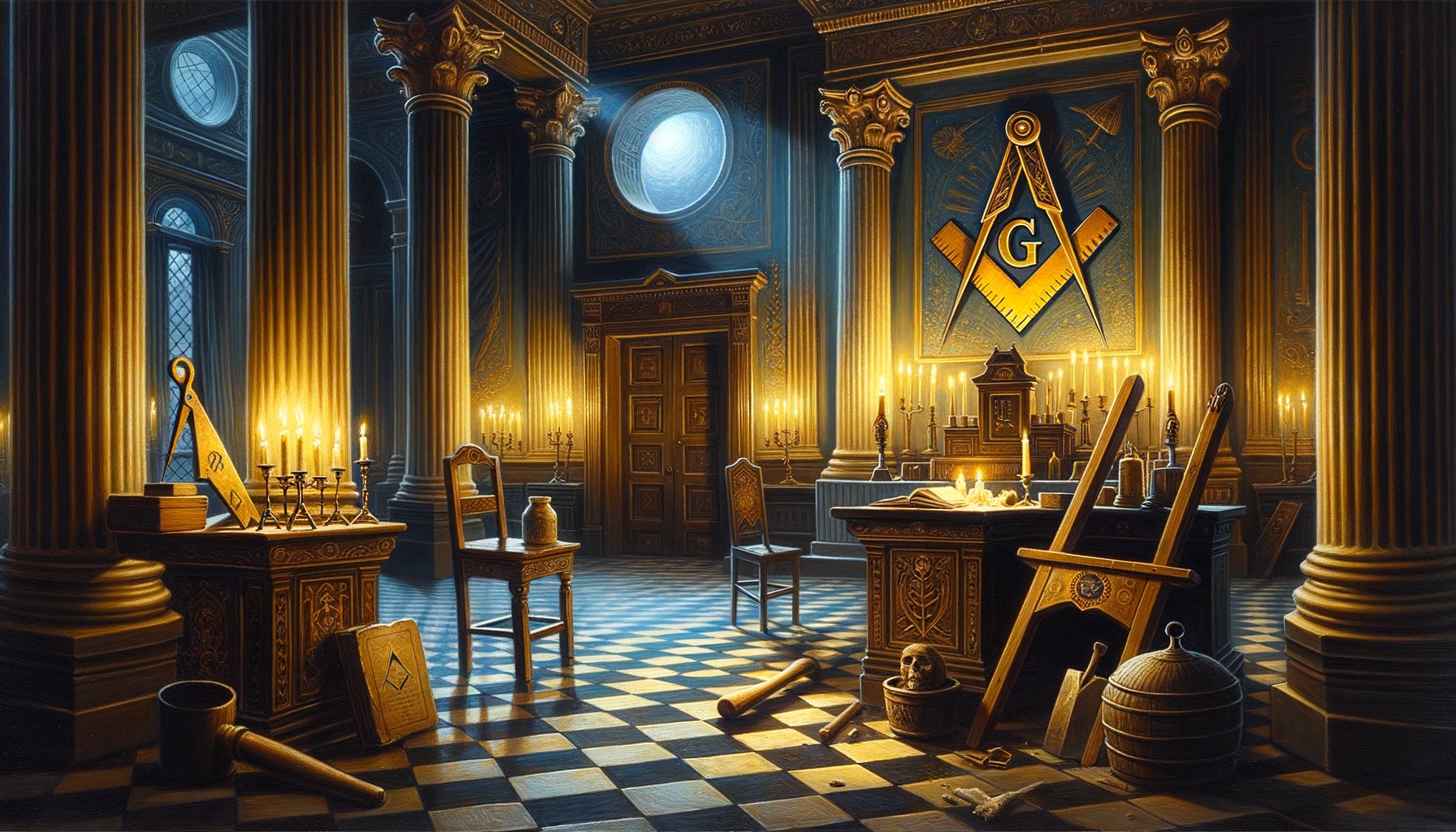
The most recognized Masonic emblem is the conjoined square and compasses, often with the letter G in the center. Operatively, the square ensures that two stones meet at a true right angle; the compasses set the radius of an arch or a circle. Speculatively, the square teaches the Mason to act with integrity and the compasses teach him to circumscribe his desires within fit boundaries. The G is widely read as standing for both Geometry, the queen of medieval crafts, and God, the Great Architect of the Universe.
The All-Seeing Eye
The All-Seeing Eye was not a Masonic symbol at all in the medieval lodge. It first appears in the Craft in 1797, in Thomas Smith Webb’s Freemason’s Monitor or Illustrations of Masonry. Webb adapted it from earlier Christian and Egyptian iconography. In a Masonic context, it represents divine attentiveness, the principle that no human action is hidden from the Great Architect. Conspiracy literature later borrowed the eye and grafted it onto unrelated political imagery, including the Great Seal of the United States, where its function is independent of the Craft.
The Blazing Star and the Letter G
A five-pointed Blazing Star, sometimes containing the Hebrew letter Yod, often hangs above the Mosaic Pavement on the lodge floor. Eighteenth-century writers like William Preston (1742 to 1818) read it as the divine providence that guides the candidate, an emblem closer to the Christmas star than to anything occult. The letter G, central to many lodge interiors, doubles in meaning as already noted. Both items entered the symbolic vocabulary at the speculative stage and have no direct operative ancestor.
The Mosaic Pavement and the Two Pillars
The black-and-white checkered floor, called the Mosaic Pavement, recalls the Temple of Solomon and stages a moral lesson on the mingling of light and dark in human life. The Two Pillars at the door of the lodge are named Boaz and Jachin after the bronze pillars of the Temple described in 1 Kings 7. They serve as a doorway through which the candidate symbolically enters the Craft.
The Three Degrees and the Hiram Abiff Legend
A Mason advances through three degrees in what is called the Blue Lodge or Craft Lodge: Entered Apprentice, Fellowcraft, and Master Mason. Each degree has its own ceremony, obligations, and lecture. The third degree is the symbolic heart of the system because it carries the legend of Hiram Abiff, the chief architect of Solomon’s Temple.
The Three Degrees in Brief
- Entered Apprentice: The candidate is initiated. The degree teaches purification, the limits of the candidate’s knowledge, and the foundation of moral conduct.
- Fellowcraft: The candidate is passed. The degree introduces the seven liberal arts and the symbolic ascent of the winding stair, an emblem of intellectual growth.
- Master Mason: The candidate is raised. The degree dramatizes the death and recovery of Hiram Abiff and presents fidelity and fortitude as the highest Masonic virtues.
The Legend of Hiram Abiff
In the third-degree drama, three workmen ambush Hiram and demand the Master’s Word, the secret that would let them claim a wage they have not earned. Hiram refuses each demand and is killed. The lost word is then symbolically replaced by a substitute. The legend first appears in print in the early 1720s, which means it almost certainly entered Craft ritual through speculative inventiveness rather than from the operative lodges. According to scholarly accounts of the Hiramic legend, the figure has no continuous trace in operative manuscripts and may be an early eighteenth-century literary composition.
What Was Actually Lost: Operative Knowledge and Its Speculative Echo
When the lodge stopped admitting working stonemasons, much of the technical content of the operative tradition slipped out of memory. The geometric drafting techniques used to lay out a Gothic vault, the trade signs that distinguished a regional master’s hand, the architectural jargon that filled a lodge’s tracing-floor: these were the original “secrets” of operative masonry, and most of them now survive only in scattered manuscripts and the work of architectural historians.
The Vanished Trade Knowledge
Few modern Freemasons can read a thirteenth-century template for a tracery window. The technical literacy that justified the medieval lodge has been replaced by ethical literacy. This is not a flaw of the modern Craft, but it is a real loss to the historical record. Scholars associated with the Quatuor Coronati Lodge No. 2076, the premier Masonic research lodge founded in London in 1884, have spent more than a century reconstructing what operative practice once contained.
The Marginalized Symbols
Some emblems faded as Freemasonry evolved. The Forty-Seventh Problem of Euclid, central to early degree work, now appears in many Master Mason aprons but is rarely explained beyond a single line about the Pythagorean theorem. The trowel, once a working tool, became an emblem of fraternal cement and lost its grit. The pot of incense, the beehive, and the hourglass remain in some American lecture systems but are seldom worked through in detail.
The Rise of Spurious Antiquity
As genuine operative knowledge thinned, speculative writers filled the gap with imagined antiquity. James Anderson’s 1723 history traces the Craft to Adam in Eden. Eighteenth-century enthusiasts asserted descent from the Knights Templar, from ancient Egyptian mysteries, and from the schools of Pythagoras. Modern scholarship treats these claims as part of Masonic folklore rather than as history. The historian David Stevenson’s The Origins of Freemasonry: Scotland’s Century, 1590 to 1710 (Cambridge University Press, 1988) reset the academic baseline by anchoring the speculative shift in late Renaissance Scotland rather than in Egypt or Solomonic Israel.
Modern Misreadings of the Symbolism
Once the symbols left the lodge, they were claimed by readers with their own agendas. The All-Seeing Eye now appears in pop conspiracy material that has nothing to do with Masonic ritual. The pyramid on the dollar bill is regularly attributed to the Craft, though most of the seal’s designers were not Masons. The Bavarian Illuminati, suppressed in 1785, is repeatedly conflated with mainstream Freemasonry by writers who have read neither set of records.
The Conspiracy Tradition
Anti-Masonic feeling has appeared in waves: the abduction of William Morgan in 1826, the European Catholic suppressions of the nineteenth century, the forgery of the Protocols of the Elders of Zion in 1903, and the contemporary online ecosystem. Most of this material rests on the assumption that the secrets must be larger than they are. According to National Geographic’s reporting on Masonic history, the documentary record consistently disappoints conspiracy expectations: lodge minutes describe charity, dinner, and ritual rehearsal, not coordinated political control.
The Pop Culture Inheritance
Dan Brown’s The Lost Symbol (2009), Nicolas Cage’s National Treasure films, and dozens of streaming documentaries have given Freemasonry a cinematic vocabulary that grand lodges generally find uncomfortable. The cultural footprint is real. The historical content beneath it is thinner than the footprint suggests.
Why the Lost Symbolisms Still Matter
The slow forgetting of operative content is part of how traditions survive. A living craft narrows its toolkit to the items that still earn their place. Freemasonry kept the square and compasses because the metaphor still teaches; it lost the tracery template because no one in the lodge needed to lay out a Gothic window anymore. The pattern is recognizable across other initiatic traditions, from Sufi orders that retained the dhikr but lost the original master-disciple lineages, to Pythagorean schools whose mathematics outlived their dietary rules.
What Modern Lodges Preserve
Contemporary Freemasonry, with roughly two million members in the United States and many more worldwide, still teaches geometry as a moral discipline. The lodge’s small ritual economy of obligation, charity, and fraternal recognition has outlasted its medieval source. The symbols carry a lineage even when their original referents are gone.
Where Recovery Is Underway
Research lodges, university scholars, and grand lodge libraries have made the early modern record steadily more accessible since the late twentieth century. Quatuor Coronati’s Ars Quatuor Coronatorum, published since 1886, remains the best place to find the slow archaeological work of recovery. Recent monographs by historians such as Margaret Jacob and Jessica Harland-Jacobs have placed Freemasonry inside the Enlightenment public sphere, where its real influence sits. The lost symbolisms are, at least in part, retrievable. They simply require the discipline of reading the trade record before the legend.