By Marcus Halloway · Published May 13, 2026 · Updated May 13, 2026
Last reviewed: May 13, 2026.
On May 8, 2026, the Department of War opened a public archive at war.gov/UFO and posted 162 records under a program it now calls PURSUE: the Presidential Unsealing and Reporting System for UAP Encounters. The drop included 120 PDFs, 28 sensor videos, and 14 image files, drawn from the Department of War, the FBI, NASA, and the State Department. Officials called it the first tranche. They promised more on a rolling cadence. They did not claim the records confirm non-human intelligence, and they did not need to. The framing did the work.
The Pentagon statement, attributed to Secretary of War Pete Hegseth’s office, said the administration was “focused on providing maximum transparency to the public, who can ultimately make up their own minds about the information contained in these files” [1]. That clause has two halves. The first half is a press-release verb. The second half is a transfer of analytical burden from the institution to the reader. This article works that second half. It treats the PURSUE archive as a documentary record and asks what the record actually says.
What’s Actually in Release 01
The PURSUE landing page presents the 162 records in three buckets: documents, videos, and images. The documents bucket leans heavily on a single legacy FBI case file, serial 62-HQ-83894, an OCR’d run of more than 1,200 pages covering flying-disc reports from 1947 through 1968 [2]. Inside that file sit several artifacts long familiar to FOIA researchers: the Guy Hottel “Three Saucers” memo of March 22, 1950, Hoover’s October 13, 1950 URGENT teletype on Frank Scully, and the Kenneth Arnold counter-intelligence summary indexed at 62-83894-95. Most of these have been on the FBI Vault for years.
The NASA materials are the highest-profile additions. They include lunar imagery from Apollo 12 and Apollo 17 missions, an Apollo 17 frame catalogued internally as VM6 that shows three lights in a triangular formation above the lunar surface, and audio from the 1965 Gemini VII flight in which astronaut Frank Borman radios that he has a “bogey at 10 o’clock high” [3]. Apollo 17 commander Eugene Cernan’s transcript describes a flashing object rotating in a rhythmic pattern several miles from his capsule. The audio is short. The visual record is small. The bar to clear, evidentiarily, is whether the imagery resolves a structured craft or whether it resolves a lens reflection. The released frames do not resolve the question on their own.
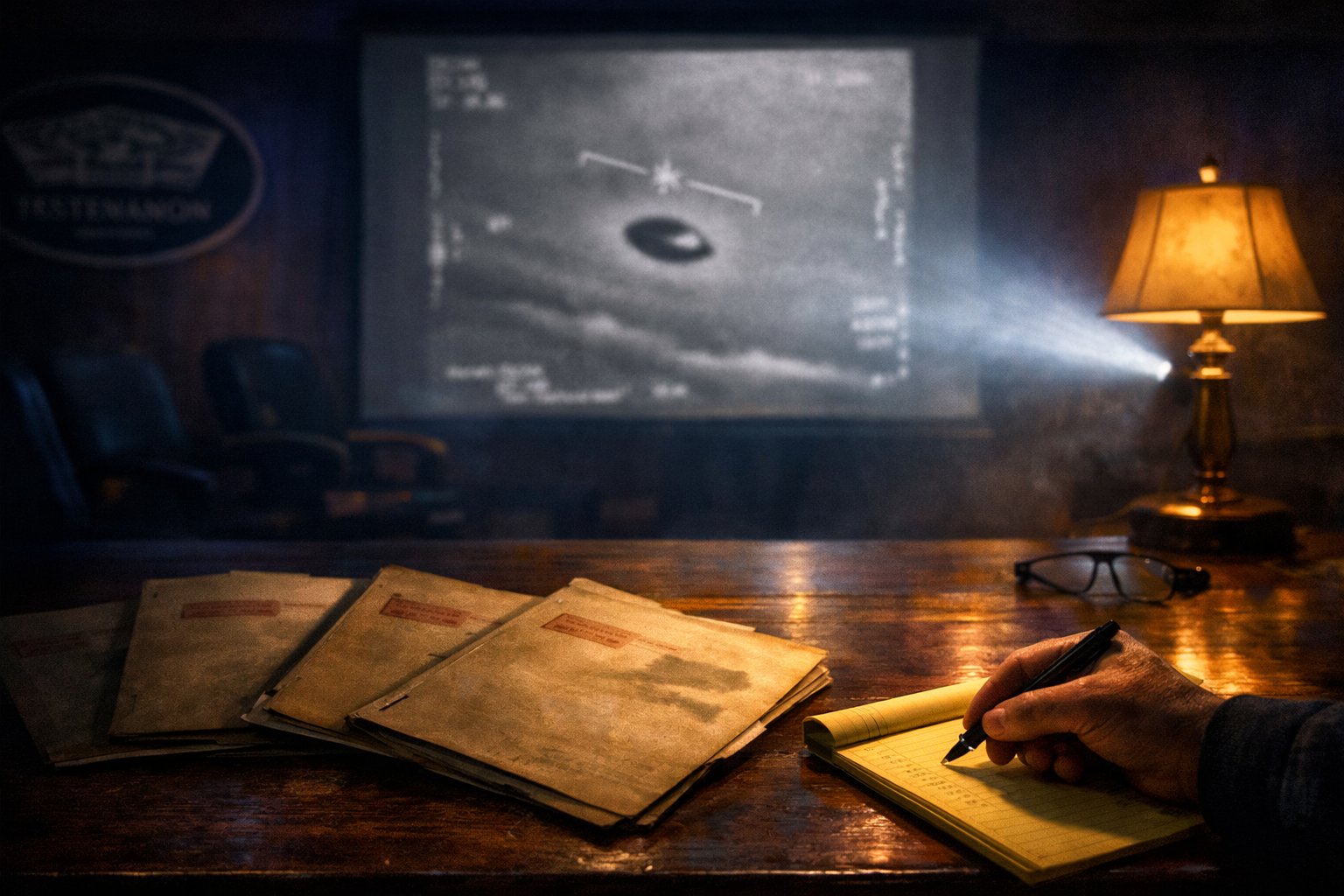
The video bucket is where the new material lives. Of the 28 sensor clips, the marquee item is a one-minute, thirty-nine-second infrared track submitted by U.S. Indo-Pacific Command in 2024, showing a football-shaped body in level flight [4]. A separate 2023 clip from Greece records an object executing a ninety-degree turn at roughly eighty miles per hour. Others capture a semi-transparent shape over Syria and a misshapen white sphere near Japan. The Pentagon labels each clip an “area of contrast,” which is the cautious AARO term for a thermal hot spot the sensor cannot resolve into a known platform. Inside the documents, AARO singles out one open-field case as exceptional: the Western U.S. “orbs launching orbs” encounter, in which six federal officers across three two-person teams reported orange orbs that emitted smaller red orbs before vanishing. AARO writes the multi-team corroboration and witness credibility “combine to make this report among the most compelling within AARO’s current holdings” [5].
Pedigree Triage: New, Old, and Heavy
An archive is not a single thing. Each record carries its own provenance, and a journalist’s first job is to triage what is net-new from what is reissue. Three categories track usefully against the PURSUE drop.
Already public via FOIA
The bulk of the 1947 to 1968 FBI material falls here. The 62-HQ-83894 case file has lived on the FBI Vault since 2011. Researchers including John Greenewald Jr. of The Black Vault have indexed the major sub-serials for over a decade. Releasing them under a new portal heading does not change their evidentiary content. It changes their visibility.
Net-new to the public record
The 2023 to 2024 sensor videos are the strongest claim to novelty in this batch. The Indo-Pacific Command infrared clip, the Greece ninety-degree-turn footage, and several other military-collected segments were filed into AARO’s intake pipeline under the FY2023 NDAA reporting authority and had not previously appeared in open coverage. The Bronze Ellipsoid case, a multi-witness 2023 daylight sighting of a 130-to-195-foot object with consistent shape descriptions across observers, is also net-new in the public archive sense.
Carries the most evidentiary weight
The “orbs launching orbs” case has the highest internal pedigree because it satisfies three of the conditions a defense analyst looks for: multiple independent observers, no shared optical channel, and credible witness positions. The Indo-Pacific clip carries weight because the sensor platform is calibrated and the kinematic data accompany the video, though the Pentagon redacted the velocity and range fields on initial release. The legacy lunar imagery and the Gemini VII audio carry historical weight but not analytical weight on their own. Neither is a closed case. Neither is a confirmation of anything beyond a recorded observation.
The Pentagon’s Framing Language, Read Carefully
Two phrases recur across the May 8 official communications and are worth quoting precisely. The first is the “make up their own minds” clause already cited. The second comes from the landing page’s own framing: “The materials archived here are unresolved cases, meaning the government is unable to make a definitive determination on the nature of the observed phenomena” [1]. Read together, these statements do not announce a finding. They announce a release of records about which the government has explicitly declined to make a finding.
Hegseth framed the launch as historic. “The Department of War is in lockstep with President Trump to bring unprecedented transparency regarding our government’s understanding of Unidentified Anomalous Phenomena,” he said in the press rollout [1]. Director of National Intelligence Tulsi Gabbard echoed the line. AARO Director Jon Kosloski, who briefed reporters separately, kept his comments inside the office’s standing analytic posture: no record in this batch establishes non-human intelligence, several remain open, and the absence of resolution is itself the reason for release. The press-release vocabulary is “transparency.” The analytic vocabulary is “unresolved.” Both are accurate. They are not the same word.
For the political-coalition angle on how this disclosure got pushed onto the calendar, see Augustus Kane’s companion piece on the political mechanism behind PURSUE. For how the Pentagon framed this as a productized UX experience, see Riley Tanaka’s analysis of PURSUE as a product launch.
Loeb and the Serious-Academic Counterpoint
Avi Loeb, the Harvard astrophysicist who chairs the Galileo Project, posted his own read of the release to Medium on May 11 [6]. His verdict was narrow and deliberate. “None of the objects is sufficiently extraordinary to require an exotic origin,” he wrote, after itemizing the source-agency split: 82 documents from the Department of War, 56 from the FBI, 12 from NASA, and 8 from the State Department. He noted that “interesting details regarding the videos are unfortunately redacted, and all images could be explained as either reflections in the camera optics or human-made objects.”
Loeb’s caveat is the part advocates have largely skipped. To certify an object as exceeding human technology, he wrote, requires “high-quality evidence” that includes resolved distance, velocity, and acceleration data. The PURSUE videos do not currently meet that bar because the kinematic fields are redacted. He also flagged the 46 sensor videos Congresswoman Anna Paulina Luna formally requested from the Pentagon, which were not in this batch and which Loeb expects to surface in a later tranche. His framing of the release’s significance was not evidentiary. It was psychological: the topic is now inside the mainstream of public and scientific discourse, and that, he argues, is the immediate yield.
What’s Coming Next, and What the Law Now Requires
The Pentagon described PURSUE as a rolling program with additional tranches “every few weeks.” A specific date for Release 02 has not been announced as of May 13. Internally, the planning calendar suggests a June 2026 target window if the review queue holds; the Luna-requested 46 videos, the remainder of the Indo-Pacific Command 2024 collection, and additional FBI material from the post-1968 holdings are the obvious candidates.
The legal floor underneath PURSUE is the FY2026 National Defense Authorization Act, which extended and expanded AARO’s reporting authorities. The act requires the All-domain Anomaly Resolution Office to brief Congress on UAP intercepts conducted by U.S. Northern Command and the North American Aerospace Defense Command, including the number, location, and nature of the encounters [7]. It eliminates duplicative reporting paths and requires the Director of National Intelligence and the Secretary of Defense to push UAP-relevant data into AARO immediately, while protecting sources and methods. It also requires AARO to produce a consolidated classification matrix for UAP-related programs, and to report on classification guides in its 2026 annual report. PURSUE is the publicly visible face of those statutory obligations. The portal is not the program. The program is the reporting architecture behind the portal.
What the Record Says, and What It Doesn’t
The released material does not, by itself, confirm extraterrestrial intelligence. It does not refute it. The Pentagon explicitly declined to make either claim. What the record shows is a federal government that, after seventy-nine years of stop-start engagement with the subject, has stood up a statutorily-anchored release pipeline and posted its first 162 items. Most of those items have been in FOIA hands for years. A meaningful minority, concentrated in the 2023 to 2024 sensor data, are new to the public archive. One open-field case, the “orbs launching orbs” encounter, carries the kind of multi-witness corroboration AARO itself flags as compelling. The marquee infrared clips lack the kinematic context that would let an analyst certify them as exceeding known platform performance.
The work going forward is not interpretation in advance of the data. It is patience with the queue. PURSUE will issue Release 02. The Luna videos will surface or they will not. The kinematic fields on the Indo-Pacific clip will be unredacted in a later pass, or they will be the subject of a Congressional sustainment letter requesting that they be. The documentary discipline does not change. Read what the record says. Note what it doesn’t. Quote the case by number. Wait for the next tranche.
For the broader context on government engagement with this topic, see the Alien & Extraterrestrial Mysteries pillar, which tracks the full disclosure timeline.
Frequently Asked Questions
What is PURSUE?
PURSUE is the Presidential Unsealing and Reporting System for UAP Encounters, the Department of War’s portal at war.gov/UFO launched on May 8, 2026, to publish declassified UAP records on a rolling basis. The first release contained 162 files from the Department of War, FBI, NASA, and State Department.
How many records were in Release 01?
One hundred sixty-two records: 120 PDFs, 28 sensor videos, and 14 image files. Of the 162, the Pentagon stated 108 contain redactions, with no redactions applied to the nature or existence of any reported UAP encounter.
What is the “orbs launching orbs” case?
A 2023 Western U.S. incident in which six federal officers across three independent two-person teams reported large orange orbs at dusk releasing two-to-four smaller red orbs before disappearing. AARO calls it among the most compelling reports in its current holdings.
Does Release 01 prove non-human intelligence?
No. The Pentagon and AARO both stated the released records are unresolved cases on which the government has not made a definitive determination. Avi Loeb’s May 11 commentary concluded none of the objects in the batch is sufficiently extraordinary to require an exotic origin.
What is the Gemini VII audio?
A 1965 cockpit recording in which astronaut Frank Borman reports a “bogey at 10 o’clock high” from the Gemini VII capsule. The clip is short and the visual context is limited; it is included as a historical record, not as a corroborated sighting.
What FBI documents are included?
Most of the document bucket draws from FBI case file 62-HQ-83894, an OCR’d flying-disc collection spanning 1947 to 1968. Notable sub-serials include 62-83894-209 (the Guy Hottel “Three Saucers” memo of March 22, 1950) and 62-83894-95 (the Kenneth Arnold counter-intelligence summary).
When will Release 02 happen?
The Department of War committed to tranches “every few weeks” but has not announced a specific Release 02 date. Internal indicators suggest a June 2026 target window. Likely candidates include the 46 sensor videos requested by Representative Anna Paulina Luna and additional AARO casework from 2024.
What is the legal authority behind PURSUE?
The FY2026 National Defense Authorization Act, which expanded AARO’s reporting authority, mandated congressional briefings on military UAP intercepts, eliminated duplicative reporting paths, and required a consolidated classification matrix. PURSUE is the public-facing release pipeline that operationalizes those statutory obligations.
Who runs AARO?
Jon T. Kosloski has served as director of the All-domain Anomaly Resolution Office since August 2024, replacing acting director Timothy Phillips. Kosloski briefed reporters on the May 8 release and maintained AARO’s standing position that no record in the tranche establishes non-human intelligence.
What did Avi Loeb say about the release?
In a May 11 Medium post, Loeb wrote that “none of the objects is sufficiently extraordinary to require an exotic origin,” flagged that key kinematic data on the videos remain redacted, and argued the release’s primary significance is the legitimization of UAP as a mainstream scientific and public topic.