By Emilia Wellesley · Published May 5, 2026 · Updated May 13, 2026
Last reviewed: May 5, 2026.
What Is Shamanic Journeying?
Shamanic journeying is a controlled trance practice in which a practitioner sends consciousness, often described as the soul, to non-ordinary worlds in search of healing, knowledge, or contact with helping spirits. The technique relies on rhythmic drumming or rattling near a steady tempo and is documented across Siberia, the Americas, and circumpolar Eurasia.
Few religious practices have been studied so carefully and translated so loosely as the shamanic journey. Anthropologists who lived for years among Tungus, Sami, and Mapuche communities returned with field notes that read more like ethnography than mysticism: the shaman drums, the shaman lies down, the shaman returns and reports. The journey itself is a craft handed down through apprenticeship, rooted in particular landscapes, and bound to obligations the wider community can verify. What follows separates what the historical and ethnographic record actually says from the looser modern adaptations layered on top, locating the journey within the broader landscape of mystical and occult practices.
The Geography of the Other Worlds
Across most documented shamanic cultures, the cosmos is described as having three layers connected by a central axis. The journey is not random wandering. It is a directed movement to a specific layer for a specific purpose, and the geography is taught explicitly during apprenticeship. The historian of religion Mircea Eliade (1907-1986) collated hundreds of such accounts in his comparative study Shamanism: Archaic Techniques of Ecstasy, first published in French in 1951 [1].
The Lower World
The Lower World is most often entered through a tunnel, a hollow tree, a spring, or a cave. It is associated with animal helpers, ancestral spirits, and the recovery of lost vitality. Despite the European Christian instinct to read “lower” as infernal, the term is geographic in shamanic cosmology, not moral. According to the comparative survey of shamanism by the Encyclopaedia Britannica, downward movement in indigenous Siberian accounts typically signals a passage to ancestral realms rather than punishment.
The Upper World
The Upper World is reached by climbing: a smoke hole, a sacred tree, a rope of light. It is the home of teachers, sky deities, and the wisdom required for community-scale problems. Tungus and Yakut shamans described nine, sometimes twelve ascending heavens, each guarded and each requiring different songs to enter. The detail in these maps argued, for Eliade and later scholars, that we are dealing with practiced experience rather than improvisation.
The Middle World
The Middle World is the everyday landscape seen with non-ordinary vision. Shamans use it to track lost objects, locate game, or read the spirit of a place. It is the most spatially literal of the three, and many ethnographers note that journeying practitioners describe terrain that matches their physical surroundings, only thickened with intention and presence.
The Drum, the Rattle, and the Mechanics of Trance
A shamanic journey is not a daydream. It is induced, sustained, and concluded by deliberate sensory means. The most consistent across cultures is monotonous percussion, usually a frame drum or a skin-bound rattle, struck at roughly four to seven beats per second. This range overlaps with the theta brainwave band associated with deep meditation and lucid imagery, a correlation that drew interest from neuroscientists in the late twentieth century [2].
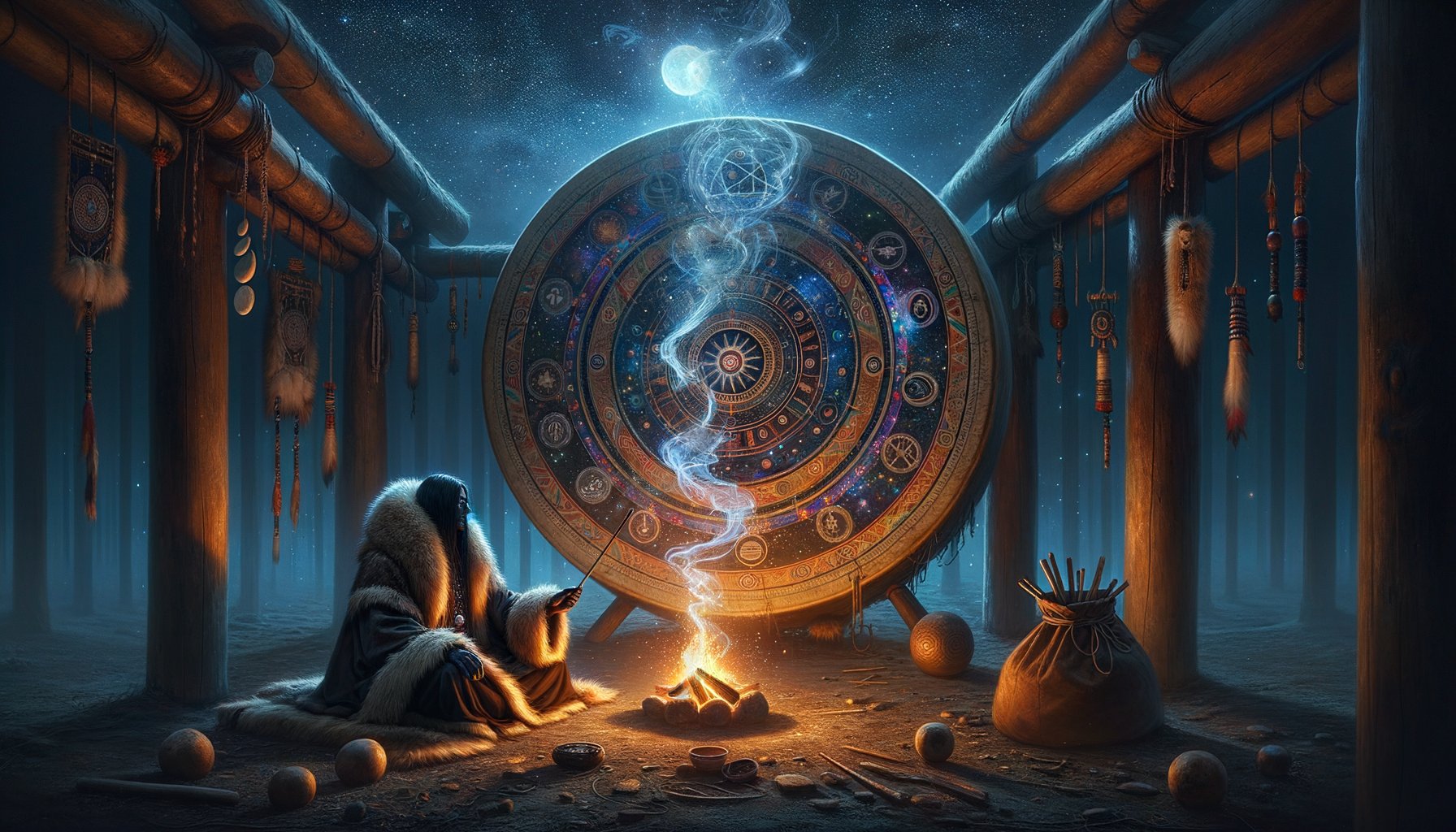
The drum is not symbolic furniture. In Sami tradition, the runebomme carries painted figures arranged into a working map of the three worlds, and the noaidi reads the journey through it as one might read an instrument panel. Among Evenki and Buryat shamans, the drum is itself called a horse, the steed on which the soul travels. The materials matter: certain woods, certain hides, certain blessings. A drum is consecrated through specific rituals before it can carry a journeyer anywhere.
Rattles, bone whistles, jaw harps, and breath songs serve as alternatives or accompaniments. In some Amazonian traditions, the same trance is reached through plant medicines such as ayahuasca, and the journey runs along a different sensory channel while keeping a recognizably similar three-world architecture, as anthropologist Michael Taussig has documented in Shamanism, Colonialism, and the Wild Man [3].
Cross-Cultural Lineages of the Practice
The word shaman entered European languages through seventeenth-century Russian travelers reporting on the Tungus peoples of Siberia. The Tungusic root šamán denoted a specific religious specialist, not a generic spiritual practitioner. Eliade’s later comparative use widened the term to cover analogous figures across continents, a move that some contemporary anthropologists, notably Roberte Hamayon, have criticized as too broad [4]. The historical record, even read carefully, still reveals striking parallels.
Siberia and the Circumpolar North
Among the Tungus, Yakut, Buryat, Chukchi, and Sami, shamans were initiated through illness, dream, or lineage. The ethnographer Sergei Shirokogoroff, whose 1935 study Psychomental Complex of the Tungus remains a primary reference, documented apprenticeships lasting years and journeys undertaken to recover stolen souls, retrieve information about future weather, or escort the dead. The Sami runebomme drums, many of which were confiscated during eighteenth-century Christianization campaigns, survive in Scandinavian museum collections and remain physical evidence of a sophisticated cosmology.
The Americas
In the Americas, comparable practices appear among the Ojibwe, Lakota, Mapuche, Shipibo-Conibo, and many others. Practices vary widely, but the journey-for-healing pattern recurs: the practitioner enters trance, locates the cause of suffering, and either retrieves what was lost or extracts what was intrusive. The Smithsonian National Museum of the American Indian publishes interviews with contemporary practitioners that emphasize the community-bound and locally specific character of these traditions, in deliberate contrast to globalized adaptations.
Korea, Mongolia, and Beyond
Korean mudang shamanism, predominantly female-led, persists in modern South Korea alongside Buddhism and Christianity. Mongolian böö shamanism saw a sharp revival after the Soviet era ended in 1990. Each carries its own three-world architecture, its own initiation pattern, and its own specialist vocabulary. The structural similarity across continents is what allowed Eliade to argue, controversially, for shamanism as a single archaic complex rather than a chain of unrelated local cults.
How Eliade Framed the Journey for Western Readers
Mircea Eliade’s Shamanism: Archaic Techniques of Ecstasy remains the most influential single book in the field, even where its conclusions are now contested. The 1964 English translation, prepared by Willard R. Trask and published by Princeton’s Bollingen Series, reached generations of religion scholars and popularized the phrase “techniques of ecstasy” as the defining feature of the practice [5].
The Phenomenological Reading
Eliade treated the journey as a recurring religious type rather than a culturally local rite. He emphasized the axis mundi, the world tree, the sacred mountain, and the soul flight as universal elements. This framing made shamanism legible to comparative religionists and to a curious lay public. It also flattened, his critics argued, the political and economic specificity of individual traditions.
Where Later Scholars Diverged
By the 1990s, anthropologists such as Roberte Hamayon and Alice Kehoe pushed back. They documented how the role of a Buryat shaman in 1900 was not identical to that of a Mapuche machi, and that treating the two as variants of one type erased internal difference. The current scholarly consensus accepts the comparative usefulness of the term while insisting on careful local description before any cross-cultural claim.
Modern Core Shamanism and Its Critiques
In the 1980s, the American anthropologist Michael Harner (1929-2018) extracted what he saw as the operational core of journeying, stripped it of culture-specific elements, and taught it as a portable practice. His Foundation for Shamanic Studies has since trained tens of thousands of participants in the basic journey method. The work made shamanic technique accessible to an audience without lineage access, and it made it controversial.
Indigenous critics argue that the cultural decontextualization risks misrepresentation and appropriation, particularly when individual teachers claim authority drawn from communities they have not lived among. Defenders point to the reproducibility of the technique itself: with a steady drumbeat and a clear intention, a substantial percentage of first-time participants report vivid imagery and a sense of guided contact, a finding documented in studies such as those gathered by the Journal of Consciousness Exploration and Research. The empirical and the ethical questions are not the same question, and current practitioners increasingly distinguish them.
What Survives, and Why It Still Holds
Three observations endure across the record. First, the technique is teachable and reasonably reproducible: drum, intention, posture, return. Second, the cosmology of three connected worlds with a central axis appears in unrelated cultures with enough consistency to demand explanation. Third, the function is consistently relational. A shaman journeys for someone, in service of a community problem, and returns accountable. None of these observations settles the metaphysical question of where the practitioner has actually traveled, and the careful student does not require it to. The practice has been studied for four hundred years, partially translated, periodically suppressed, and steadily revived. It is older than most of the religions that tried to absorb or replace it, and the ethnographic record continues to grow.
Frequently Asked Questions
Is shamanic journeying the same as meditation?
No. Both involve attention work, but meditation typically aims at present-moment awareness or non-attachment, while shamanic journeying is goal-directed travel to non-ordinary terrain in search of specific information or help. The drum and the imaginal landscape distinguish the journey from most meditative traditions.
Can shamanic journeying be self-taught?
The basic technique can be learned from books and audio drum tracks, and many people experience first journeys that way. Indigenous teachers and serious practitioners caution that interpretation, integration, and ethical practice generally require a teacher and a community of accountability. The technique without context can produce intense imagery without a framework for handling it.
What does the drum actually do?
A steady drumbeat at roughly four to seven beats per second entrains attention and is associated with theta-band brainwave activity, which correlates with deep imaginal states. The drum also marks the journey’s beginning, middle, and return. Practitioners report that the drum carries them outward and brings them back.
Are the three worlds literal or metaphorical?
Different traditions answer differently. Most indigenous practitioners describe the worlds as real but not physical in the ordinary sense. Eliade and later phenomenologists treated them as religious geography. Skeptical neuroscience reads them as structured imagery generated under altered states. The practice does not require resolving the question to function.
What is core shamanism?
Core shamanism is Michael Harner’s distillation of journeying technique stripped of culture-specific elements. It teaches the basic three-world journey method through drumming and intention. It is widely taught in workshops worldwide and is also widely critiqued for separating technique from cultural lineage.
Did Mircea Eliade ever practice shamanism?
No. Eliade was a historian of religion, not a practitioner. He read primary ethnographic accounts in French, German, Russian, and English, then synthesized them into a comparative theory. His work is influential precisely because it is scholarly, but later anthropologists have tested and sometimes corrected his readings.
Is shamanic journeying dangerous?
For most participants, the basic drum journey is psychologically safe, though it can surface unprocessed material. Plant-medicine traditions carry physiological risks and require trained guidance. People with certain mental health conditions, particularly active psychosis or dissociative disorders, are generally advised to avoid intensive trance work without clinical support.
How is a shaman different from a medium or a priest?
A shaman is generally distinguished by active soul travel undertaken on behalf of a community for healing or knowledge, by training through illness or initiation, and by accountability to specific lineage spirits. Mediums typically receive spirits passively, and priests administer ritual on behalf of an institution. The categories overlap and historical practitioners often crossed them.
Where does the word shaman come from?
The word comes from Tungusic languages of eastern Siberia, where it referred to a specific religious specialist. Russian travelers carried it into European languages in the seventeenth century. The broader use of the term to describe analogous practitioners worldwide is a twentieth-century scholarly choice, not an indigenous self-designation.