By Sloane Reeve · Published May 7, 2026 · Updated September 10, 2026
Last updated: September 10, 2026.
What Are the Acámbaro Figures?
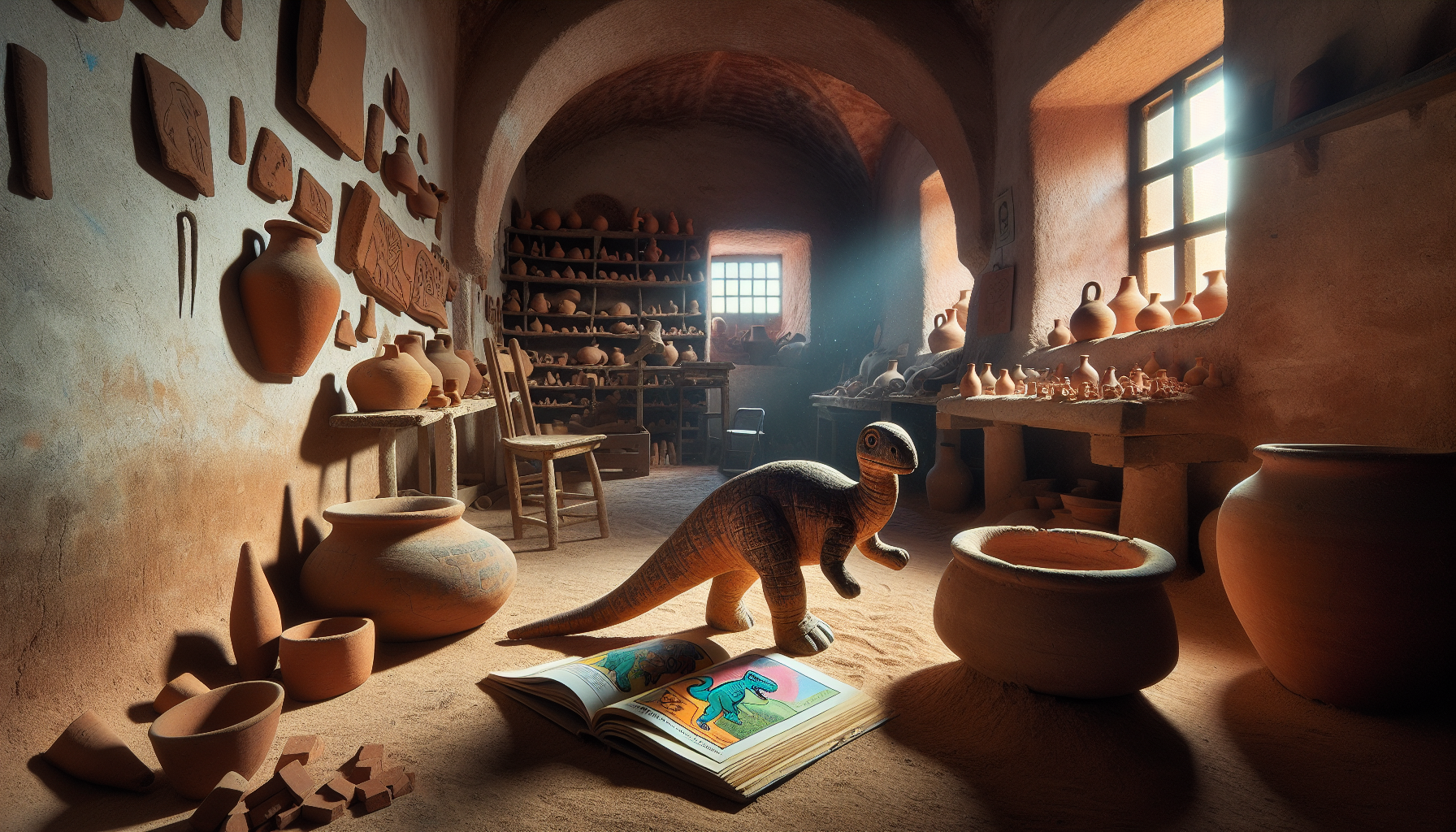
The Acámbaro Figures are a collection of roughly thirty-three thousand small ceramic figurines accumulated from July 1944 onward by the German hardware merchant and amateur antiquarian Waldemar Julsrud (1875-1964) in the town of Acámbaro, Guanajuato, in central Mexico. The collection is best known for the subset of figurines that read, at first glance, as men interacting with non-avian dinosaurs: a sauropod with a human rider, a theropod with prey in its jaws, a horned animal looking very much like a styracosaur. That subset is the part that travels. It is the part used in popular and creationist literature as evidence that humans and dinosaurs lived in the same Holocene horizon.
The professional archaeological position is that the dinosaur-rich subset is a modern fabrication, made by a local Acámbaro family on a piece-rate contract paid by Julsrud, and that the wider Julsrud collection is best understood as a fabrication chain layered over a small genuine seed of pre-Hispanic Chupícuaro pottery from the surrounding El Toro hill. The first formal investigation, by the American Southwest archaeologist Charles C. DiPeso (1920-1982) of the Amerind Foundation in 1952, identified the surfaces as freshly broken, the patina as missing, and the supplier chain as a piece-rate contract with the local Tinajero household [1]. Mainstream Mexican and U.S. archaeology has held that verdict steadily for seventy years.
A field zoologist learns to read a track for what it is. A cast in the mud is a vertebrate or it isn’t. A clay sauropod with no muscle attachments where a sauropod’s muscle attachments would be, with a tail held high in the 1970s heroic-dinosaur pose that was iconographically wrong before Robert Bakker’s reconstruction of dinosaur posture, is not a vertebrate. It is folk art. Holding the discipline matters here, because the case has remained alive in young-earth-creationist publishing as if the question were still open. It is not. What is open, and worth paying attention to, is the cultural-historical phenomenon of why a settled forgery keeps walking. That belongs in the wider landscape of historical and archaeological mysteries, alongside the Ica Stones and the other twentieth-century OOPArt fabrications that share its shape.
Julsrud, El Toro Hill, and the 1944 Discovery
Julsrud was born in Bremen in 1875, emigrated to Mexico late in the nineteenth century, and settled in Acámbaro, where he ran a hardware store and built a private regional library [1][2]. He had collected pre-Columbian sherds and figurines from the surrounding fields for decades before 1944. His own published account, in the self-issued Spanish-language pamphlet Enigmas del Pasado (1947), describes his attention being caught in July 1944 by a fragment of unfamiliar fired clay protruding from the dust on the lower slope of the small hill called El Toro, on the south-eastern margin of Acámbaro, while he was out riding [2]. The fragment, on his telling, was unlike the Chupícuaro material he already knew.
The Piece-Rate Contract with the Tinajero Household
What followed shaped the rest of the case. Julsrud retained a local farmer in his employ, Odilón Tinajero, on a piece-rate contract: one peso for each complete figurine, or each figurine reconstructable from its sherds, brought up from the lower flank of El Toro [1]. Tinajero recruited his two sons. The supply was steady. By the late 1940s Julsrud had filled the lower rooms of his Calle Hidalgo house with crates; by the time of his death in 1964 the holding had reached the figure of approximately thirty-three thousand pieces that is repeated in every secondary source [1][2]. The piece-rate is the central economic fact of the collection. A piece-rate paid to one family creates exactly the labour-supply incentive that produces a thirty-thousand-piece haul.
What the El Toro Hill Genuinely Yielded
El Toro is a real archaeological site. The Chupícuaro horizon, which extends across the western Bajío and includes the hill and the plain south of Acámbaro, ran from roughly 600 BCE to 250 CE and produced a documented ceramic tradition of small modelled figurines, jars, and effigy bowls. INAH excavators in 1953 recovered Chupícuaro material in their own controlled test pits a kilometre or so from Julsrud’s source, including a few figurines superficially similar to a small fraction of the Julsrud holding [3]. The genuine Chupícuaro material is the small honest seed underneath the larger fabricated bloom. The fabrication did not invent the site. It seeded itself onto a real one, which is the harder kind of forgery to dismantle and the kind that lasts longest.
Charles DiPeso’s 1952 Field Visit and the 1953 Verdict
DiPeso travelled to Acámbaro in late 1952 at the request of the New World Archaeological Foundation. He was thirty-two, recently published on Hohokam ceramics, and trained in the close-look ceramic analysis that the case required. He spent several days in Julsrud’s house, examined the collection at length, and observed two of Tinajero’s diggers at work on the El Toro slope [1]. His verdict, published in two short, careful papers in 1953, is the foundation document of the sceptical case [1][4].
What DiPeso Saw on the Surfaces
A working zoologist looking at fresh-killed bone learns to recognise a clean break versus a weathered one within seconds. DiPeso applied the same close attention to the figurines and found, on his account, three things that did not fit. First, the surfaces lacked the mineral discolouration and rootlet pitting that fired clay accumulates over a thousand years in damp central-Mexican soil. Second, the broken edges were sharp, recently fractured, with no soil packed into the breaks; reconstructed pieces were uniformly missing no fragments, which is statistically inconsistent with archaeological recovery, where a percentage of every broken artefact is always lost in the depositional history. Third, the dirt clinging to the figurines was loose surface dust, not the cemented matrix that long burial produces [1].
What DiPeso Saw in the Trench
The decisive observation was stratigraphic. DiPeso watched Tinajero’s diggers clear a freshly cut hole on the El Toro slope, drop a pre-prepared figurine into it, mix in topsoil, and present the result for collection [1]. The stratigraphy of the trench, on his account, showed a recent disturbance cutting through the older Chupícuaro horizon. He described the wider field as scored with similar pits where reconstructed figurines had been seeded back into the soil and then re-excavated for Julsrud’s payment.
The Suppliers, on DiPeso’s Account
DiPeso identified the Tinajero household as the principal supplier. He recorded that the figurines were almost certainly being fired in one or another of the small panaderías, the household-scale bread ovens, that operate in every Mexican town of the period and that reach the four-hundred to six-hundred-degree-Celsius range characteristic of the Acámbaro pieces [1][4]. He named Hispano-Mexican comic books, the cinema in Acámbaro, and day trips to the Museo Nacional in Mexico City as the most plausible iconographic sources for the dinosaur, Egyptian, Sumerian, and bearded-Caucasian motifs in the collection [1]. The published verdict was unambiguous: a modern hoax with a small genuine Chupícuaro seed at the bottom.
The 1953 INAH Investigation
In 1953 the Mexican government sent a four-archaeologist team from the Instituto Nacional de Antropología e Historia (INAH) to investigate. The team excavated test pits roughly a kilometre from Julsrud’s source on the El Toro slope and recovered authentic Chupícuaro material at the expected stratigraphic depth [3]. The INAH report distinguished the genuine Chupícuaro figurines from the dinosaur-rich Julsrud material and noted that no dinosaur figurines appeared in the controlled in-situ recovery. The professional Mexican archaeological position has held that distinction since: a real Chupícuaro horizon underneath, a fabricated Julsrud-and-Tinajero supply chain on top, with the dinosaur subset isolated to the fabricated layer [3].
Hapgood, Gardner, and the Thermoluminescence Episode
The case would have died in the regional press were it not for a second wave of amplification by writers outside the discipline. Charles Hapgood (1904-1982), a college history professor best known for his crustal-displacement theory of pole shift, took up the figurines in the late 1960s and self-published Mystery in Acámbaro in 1972, framing the collection as evidence of a lost central-Mexican civilisation [5]. He was joined by Erle Stanley Gardner (1889-1970), the prolific creator of the Perry Mason novels and an enthusiastic amateur antiquarian, whose The Host with the Big Hat (1969) gave the figurines their largest English-language audience to date. Both men accepted Julsrud’s authentication argument and pressed for laboratory dating.
The 1969-1972 MASCA Tests
Between 1969 and 1972 the Museum Applied Science Center for Archaeology (MASCA) at the University of Pennsylvania, then a leading thermoluminescence laboratory, ran TL dating on a small sample of Julsrud figurines submitted by Hapgood. The technique measures the dose of ionising radiation a fired ceramic has accumulated since its last firing. The MASCA reading produced an apparent date of roughly 2500 BCE [5][6]. Hapgood treated the result as vindication. The result travelled fast through the popular-mystery press and underwrote a generation of subsequent Acámbaro defences.
The 1976 Carriveau-Han Re-Test
In 1976 Gary W. Carriveau and Mark C. Han, working at the same MASCA laboratory, re-examined the Julsrud samples with a published plateau-test protocol that detects whether the luminescence signal being read is a genuine archaeological dose or a non-archaeological signal that mimics one [6]. They reported in American Antiquity that the samples failed the plateau test. The original 2500 BCE date was not reading the figurines’ true thermoluminescence; it was reading a chemiluminescence artefact, which is not a dating signal. Their corrected estimate placed the firings at approximately thirty years before the 1969 sampling, which is to say the late 1930s and 1940s, which is to say the period covered by Julsrud’s piece-rate contract with the Tinajeros [6]. The 1976 paper is the technical retraction of the 1972 result. It is not a contested document inside the discipline; it has stood for half a century.
Why the Imagery Reads Wrong, On a Closer Look
The case can be made on the artefacts alone. A field-trained eye accustomed to vertebrate anatomy will find the dinosaur figurines disqualifying on three grounds. First, the proportions reproduce mid-twentieth-century dinosaur-popular-art conventions, including the heavy upright stance, the dragging tail, and the hunched theropod silhouette, that were standard in textbook illustration before the 1970s reassessment of dinosaur posture and that have been corrected away in every subsequent reconstruction [7]. Second, the dinosaurs are recognisable as specific recent reconstructions of specific named taxa rather than as creatures observed from life; a culture that genuinely shared the landscape with dinosaurs would not converge independently on the same set of named species that twentieth-century palaeoart had selected for textbook illustration. Third, several of the dinosaur figurines depict horned ceratopsians and armoured ankylosaurs whose ranges, on the actual fossil record, were exclusively in the Late Cretaceous of Laurasia, not central Mexico in any horizon at all.
The Problem with Faces and Iconography
The same close-look discipline applies to the human figurines. The Egyptian, Sumerian, and African motifs in the Julsrud collection do not correspond to any documented contact horizon between Mesoamerica and the Old World. They correspond, very closely, to the visual vocabulary of mid-twentieth-century Mexican comic books and illustrated pulp magazines, which is the source DiPeso flagged in 1953 and which subsequent visual-history work has confirmed in detail [1][8]. The collection looks like the magazine rack of a 1940s small-town Mexican shopkeeper because that is the iconographic well it was drawn from.
The Creationist Repurposing
From the 1990s onward the Julsrud dinosaur figurines have been a recurring exhibit in young-earth-creationist publishing. Don Patton, the geologist-creationist, and Dennis Swift, the apologist-traveller, have presented the dinosaur subset as evidence that humans and non-avian dinosaurs coexisted within the past several thousand years, in support of the Genesis-flood chronology that compresses the geological column into a Bronze Age event [8]. The argument requires the dinosaur figurines to be authentically pre-Columbian, a position the documentary record has refused to support since DiPeso’s 1953 paper [1][6].
The Internal Creationist Critique
A separate strand of creationist scholarship, including work published on Creation Ministries International’s site, has urged its own readership to set the Acámbaro figures aside on evidentiary grounds. The internal critique reads the DiPeso identification, the absence of stratigraphic provenance, and the 1976 plateau-test failure, and recommends that responsible young-earth argumentation rest on stronger evidence [8]. When the proponents of a non-mainstream chronology divide on whether to use a particular piece of evidence, the methodological gap is usually visible from inside the camp as well as outside. The discipline of cryptozoology has the same internal divide on the lake-monster cases. Holding it well is part of the work.
The Museo Waldemar Julsrud and the Persistence of the Story
Julsrud died in 1964. The collection passed to his family, drifted, and was reorganised in the 1990s by a partnership of young-earth-creationist enthusiasts and local cultural-tourism interests into the Museo Waldemar Julsrud, which today displays a substantial subset of the figurines in a converted residential building on Calle Hidalgo in central Acámbaro [2]. The museum’s curatorial framing reads the figurines as authentic, names DiPeso’s investigation only briefly, and presents the collection as evidence of a lost civilisation. It is open to visitors as a regional tourist site and is one of the small economic anchors of central Acámbaro’s tourism economy. The persistence of the framing is itself the historical-cultural fact that survives the collection’s professional refutation.
What Would Move the Needle
A reader who is genuinely curious rather than committed to a verdict can name in advance what would constitute strong evidence. A single Julsrud-style dinosaur figurine recovered in situ from a sealed Chupícuaro-period horizon, under the supervision of an independent recording archaeologist, with documented stratigraphy and an instrumentally dated firing-temperature signal that passes the plateau test and places the firing in the first millennium BCE, would change the conversation. None of the recoveries in eighty years has met that standard. The continued absence is itself information, and the discipline of holding the open questions accurately requires registering it as such. A working zoologist tracking a candidate species would phrase it the same way: hold the witness as data, hold the verdict for the evidence, and keep the graveyard chapter honest.
Where to Read More and What to Read Critically
For readers who want the case in the primary sources, DiPeso’s 1953 paper in American Antiquity is the foundational document; Carriveau and Han’s 1976 paper in the same journal is the technical retraction of the 2500 BCE date; the Penn Museum’s Expedition magazine essay by Alessandro Pezzati (2005) supplies the institutional history of the MASCA episode; Kenneth Feder’s Frauds, Myths, and Mysteries places the case in the standard university curriculum on pseudoarchaeology. The Acámbaro literature itself, including Julsrud’s Enigmas del Pasado (1947) and Hapgood’s Mystery in Acámbaro (1972), is best read critically as a primary document of the popular-believer tradition rather than as evidentiary support for the claims it advances.
Frequently Asked Questions
What are the Acámbaro figures?
The Acámbaro figures are roughly thirty-three thousand small ceramic figurines accumulated from July 1944 onward by the German hardware merchant Waldemar Julsrud (1875-1964) at the foot of El Toro hill in Acámbaro, Guanajuato, Mexico. The collection includes a controversial subset of figurines that depict humans interacting with non-avian dinosaurs.
Who was Waldemar Julsrud?
Julsrud was a Bremen-born hardware merchant who emigrated to Mexico in the late nineteenth century and settled in Acámbaro. He had collected pre-Columbian Chupícuaro material from the surrounding fields for years before 1944. He self-published Enigmas del Pasado in 1947 to defend the figurines as authentic pre-Columbian artefacts. He died in 1964.
How were the figurines actually produced?
On Charles DiPeso’s 1952 field investigation, the figurines were being made by a local family, the Tinajero household, on a piece-rate contract with Julsrud at one peso per complete or reconstructable piece, fired in small household bread ovens (panaderías), and seeded into freshly cut pits on the El Toro slope for re-excavation. Iconographic sources were comic books, films, and Museo Nacional visits.
Who was Charles DiPeso?
Charles C. DiPeso (1920-1982) was an American Southwest archaeologist of the Amerind Foundation in Dragoon, Arizona, best known for his Casas Grandes excavations. He travelled to Acámbaro in 1952 and published the foundational sceptical account in two papers in 1953, in American Antiquity 18(4) and Archaeology 6(2).
What did the 1953 INAH investigation find?
The Instituto Nacional de Antropología e Historia sent a four-archaeologist team to Acámbaro in 1953. The team recovered authentic pre-Hispanic Chupícuaro material at controlled test pits roughly a kilometre from Julsrud’s source on El Toro hill, but recovered no dinosaur figurines in the controlled in-situ stratigraphy. INAH’s published position distinguished the genuine Chupícuaro horizon from the Julsrud-Tinajero fabrication chain.
What was the 1972 thermoluminescence date and why was it retracted?
Charles Hapgood submitted Julsrud samples to the Museum Applied Science Center for Archaeology (MASCA) at the University of Pennsylvania between 1969 and 1972. The first MASCA reading produced an apparent date of roughly 2500 BCE. In 1976 Gary W. Carriveau and Mark C. Han, working at the same laboratory, applied a published plateau-test protocol and reported in American Antiquity that the samples failed the test, that the original signal was a chemiluminescence artefact rather than a true archaeological dose, and that the firings dated to approximately the 1930s-1940s.
Are the figurines all fakes, or is part of the collection genuine?
The lower flank of El Toro hill genuinely overlies a Chupícuaro-period horizon (~600 BCE-250 CE), and a small number of the Julsrud figurines may be reused or recopied genuine Chupícuaro pieces. The dinosaur-rich subset that gives the collection its popular reputation is fabricated. The case is best understood as a piece-rate fabrication chain seeded onto a real archaeological site.
Why do creationists cite the figurines?
Young-earth-creationist writers including Don Patton and Dennis Swift have presented the dinosaur subset as evidence of human-dinosaur coexistence within the past several thousand years, in support of the Genesis-flood chronology. The argument requires the dinosaur figurines to be authentically pre-Columbian, which the documentary record does not support. Other creationist publishers, including Creation Ministries International, have urged their own readership to set the figurines aside on evidentiary grounds.
What about Charles Hapgood and Erle Stanley Gardner?
Charles Hapgood (1904-1982) was a college history professor known for crustal-displacement and pole-shift speculation; his 1972 self-published Mystery in Acámbaro framed the figurines as evidence of a lost civilisation. Erle Stanley Gardner (1889-1970), the Perry Mason author and amateur antiquarian, gave the figurines their largest English-language audience to date in The Host with the Big Hat (1969). Both supported Julsrud’s authentication argument and predate the 1976 plateau-test retraction.
Where is the collection today?
A substantial subset is on display at the Museo Waldemar Julsrud, a private museum reorganised in the 1990s in Julsrud’s former residence on Calle Hidalgo in central Acámbaro. The museum’s curatorial framing reads the figurines as authentic and is one of the small economic anchors of central Acámbaro’s tourism economy.
What is the responsible way to discuss the case?
As a settled forgery case in the bibliography of mid-twentieth-century pseudoarchaeology, with the persistence of the popular framing treated as the live historical-cultural phenomenon. The methodologically sound treatment names DiPeso’s 1953 identification, registers the 1953 INAH investigation, registers the 1976 Carriveau-Han plateau-test retraction, distinguishes the fabricated subset from the genuine Chupícuaro seed, and reads the imagery for what it is: folk art, not vertebrate evidence.
What would change the verdict?
A single dinosaur-imagery figurine recovered in situ from a sealed Chupícuaro-period horizon, under the supervision of an independent recording archaeologist, with documented stratigraphy and an instrumentally dated firing-temperature signal that passes the plateau test and places the firing in the first millennium BCE. None of the recoveries in eighty years has met that standard, and the continued absence is itself part of the evidentiary record.