By Emilia Wellesley · Published May 5, 2026 · Updated September 10, 2026
Last updated: September 10, 2026.
The people once called the Anasazi did not vanish. They moved. The cliff dwellings of Mesa Verde, the great houses of Chaco Canyon, and the masonry villages of the San Juan basin stand empty because the families who built them walked south and east into the Rio Grande pueblos, the Hopi mesas, and Zuni — and their descendants, the modern Pueblo nations, have said so for generations. The puzzle archaeologists confront is not a disappearance but a depopulation, and the more the record is read carefully, the more the older “lost civilization” framing falls away.
Direct Answer: Why the Anasazi Did Not Vanish
The Anasazi, more accurately called the Ancestral Puebloans, were a Native American agricultural society that built the cliff dwellings and great houses of the American Southwest between roughly 100 CE and 1300 CE. They did not disappear. Between about 1275 and 1300 they abandoned the Four Corners region and migrated south to become the ancestors of today’s Pueblo peoples [1].
Names, Periods, and a Disputed Word
“Anasazi” is a Navajo term, often translated as “ancient enemies” or “enemy ancestors,” recorded in the late nineteenth century and applied to the prehistoric ruins of the Four Corners by archaeologist Alfred V. Kidder (1885-1963) at the first Pecos Conference in 1927 [1]. Modern Pueblo communities — Hopi, Zuni, Acoma, and the nineteen Rio Grande pueblos — find the loan word inaccurate and at times offensive, since the people in question were their ancestors, not anyone’s enemies. The National Park Service and the Crow Canyon Archaeological Center now use “Ancestral Puebloans” in most public-facing material, with “Anasazi” retained where the older literature requires it [2].
The internal chronology, in the Pecos Classification refined by Kidder and the conferences that followed, runs from Basketmaker II (around 100 BCE to 500 CE), through Basketmaker III, Pueblo I, Pueblo II, and into the cultural high water of Pueblo III (roughly 1150 to 1300 CE), when Mesa Verde, Hovenweep, and the cliff alcoves of the San Juan reached their final form [3]. By Pueblo IV the Four Corners stood vacant.
The Built World: Chaco, Mesa Verde, and the Outliers
Chaco Canyon, in what is now northwestern New Mexico, is the conceptual center of the high Ancestral Puebloan world. Between roughly 850 and 1150 CE, builders raised at least a dozen “great houses” — multi-story masonry compounds with hundreds of rooms — connected by a road network that stretched across more than 60,000 square kilometers. Pueblo Bonito alone contained around 650 rooms and dozens of kivas, the round, semi-subterranean ceremonial chambers that remain the architectural signature of the tradition [4].
The historian Stephen H. Lekson has argued, in The Chaco Meridian and his later synthesis A Study of Southwestern Archaeology, that Chaco was a regional polity of unusual scale — perhaps even an early state-like center — and that the Chacoan elite shifted their seat northward to Aztec Ruins around 1100 CE and later south, on a remarkably persistent meridian, to Paquime in northern Mexico [5]. Other archaeologists read Chaco less hierarchically, as a pilgrimage and ceremonial hub rather than a kingdom. Both readings remain alive in the literature, and the ground truth between them is exactly the kind of question Pueblo oral history is now being invited to help answer.
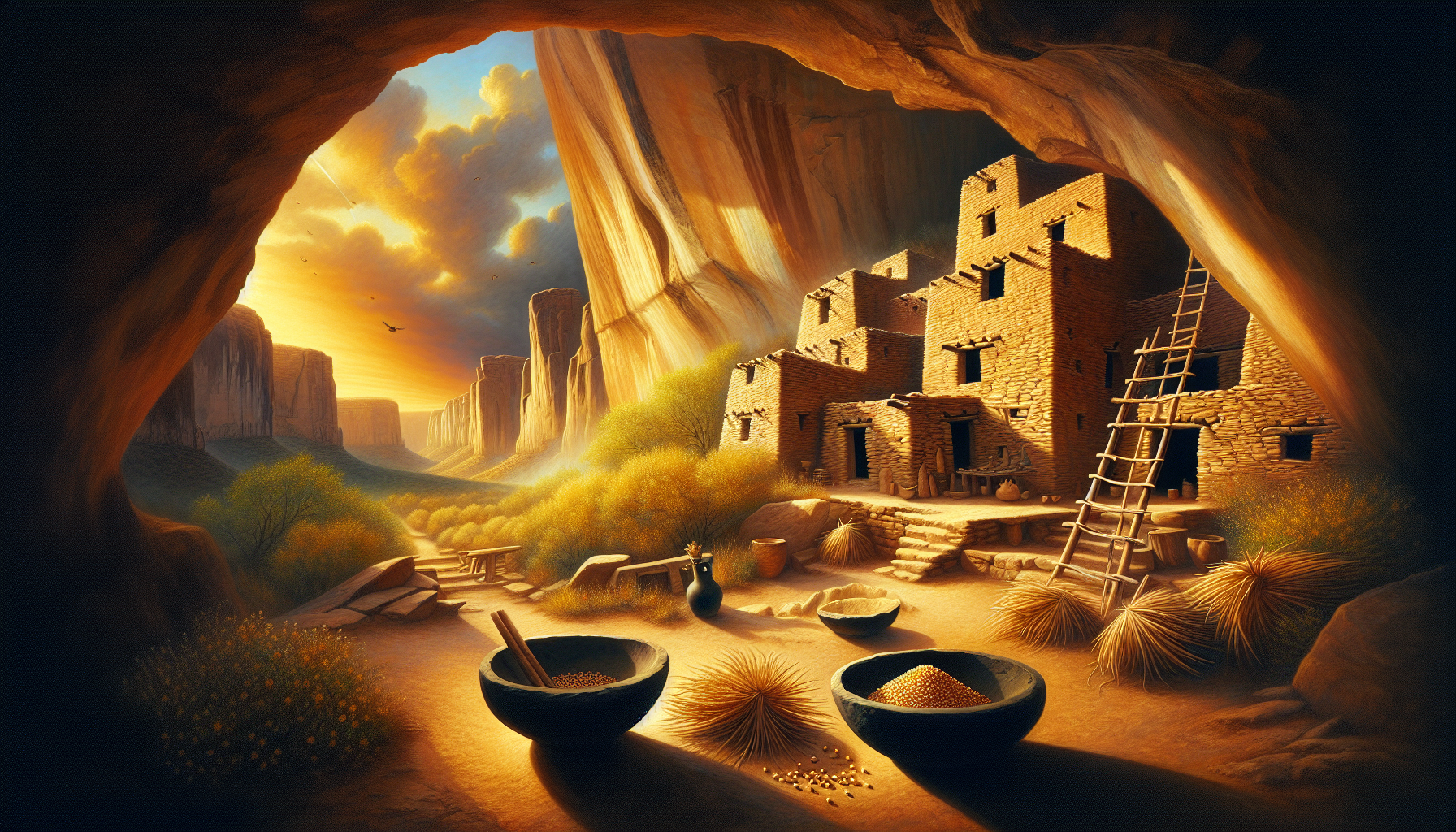
A century after Chaco’s high noon, the population center shifted to the cliffs above Mesa Verde, where between roughly 1190 and 1280 CE Ancestral Puebloan masons fitted apartment-block villages into south-facing alcoves. Cliff Palace, the largest, holds about 150 rooms and 23 kivas. Spruce Tree House, Long House, and Square Tower House preserve the same logic in smaller form. The construction is precise; the mortar is fingerprinted; the doorways are deliberately small and T-shaped, a form that recurs in modern Pueblo ceremonial architecture and in oral tradition [6].
The Departure: What the Evidence Shows
By about 1300 CE the entire Four Corners region — tens of thousands of people across thousands of sites — had emptied. The departure is not a slow decline. Tree-ring dates from beams left in situ show that the last major construction at Mesa Verde occurs in the 1270s and ends abruptly. Ceramic assemblages on the south side of the Rio Grande and the Hopi mesas grow correspondingly in the same decades. The arithmetic is consistent: those who left the San Juan arrived elsewhere [7].
The leading candidates for what made the region untenable are now well constrained. The Great Drought of 1276-1299 is documented to the year in the Douglass tree-ring chronologies developed at the University of Arizona and continuously refined since. Rainfall fell well below the threshold for reliable maize agriculture in marginal upland fields. A second, older drought in the mid-1100s had already stressed Chacoan provisioning and may have triggered the northern migration to Mesa Verde itself [8].
Drought is not the whole story. Soil exhaustion from intensive maize, deforestation around the great houses (more than 200,000 timbers were cut for Chaco alone, sourced by strontium-isotope analysis to mountains 50 to 100 kilometers away), and a worsening growing-season frost regime all narrowed the window for farming. The archaeologist David E. Stuart, in Anasazi America, frames the collapse as a structural failure of a high-investment, high-yield agrarian system that could not be maintained when the climate turned [9].
A grimmer line of evidence has emerged in the last twenty-five years. Excavations at Castle Rock Pueblo, Sand Canyon, and Cowboy Wash, published by Crow Canyon archaeologists and others, document instances of severe interpersonal violence in the late thirteenth century — in some cases including processed human remains — alongside defensive site placement on cliff ledges that are difficult to reach without a ladder being pulled up. Whether these represent organized warfare, factional retribution, or extreme localized stress at the margin of failure is debated, but the pattern is no longer dismissed [10].
The picture that emerges from cross-referencing these strands is one of compounding pressure rather than a single catastrophe. Marginal upland fields fail first; lower fields hold a few more seasons; storage caches are drawn down; ritual obligations to the great-house centers grow harder to meet; smaller villages aggregate defensively into larger cliff-protected pueblos; the aggregation itself stresses sanitation, social cohesion, and food systems already at their limit. By the time the worst drought years hit in the late 1280s, the social architecture is fragile enough that a moderate shock becomes a terminal one. This is the structural reading most contemporary Southwest archaeologists now favor [9].
Migration, Not Disappearance: The Descendant Communities Speak
The single most important correction to the older “lost civilization” framing is the testimony of the Pueblo nations themselves. Hopi clan migration accounts trace named clans from specific Four Corners sites — Wupatki, Mesa Verde, Aztec — to the modern Hopi mesas. Acoma and Zuni preserve parallel histories. The Tewa-, Tiwa-, Towa-, and Keresan-speaking pueblos along the Rio Grande each carry comparable migration narratives [11].
Twenty-first-century work has confirmed the broad pattern in the dirt. Ceramic seriations track the movement of San Juan styles into the Rio Grande basin. Architectural conventions — kiva form, plaza orientation, T-shaped doorways — carry south. Recent studies of mitochondrial DNA from individuals at Pueblo Bonito and from modern Pueblo communities show clear maternal continuity over the past thousand years [12]. Material, oral, and biological lines of evidence agree.
The receiving regions matched the demographic load. The Rio Grande pueblos grew rapidly between 1280 and 1325; new settlements were founded along the Rio Chama, the Pajarito Plateau (later the seat of Bandelier’s Frijoles Canyon ancestral sites), and the Galisteo Basin. The Hopi mesas absorbed clans from the Kayenta and Tusayan branches further west. Zuni’s classic-period ancestors built sites such as Hawikuh and Kechiba:wa. Acoma’s mesa-top continuous occupation, often cited as among the oldest in North America, belongs to the same horizon of southward consolidation [11].
This is why the term “Ancestral Puebloan” matters. It encodes the relationship the evidence supports. It is also why a serious account of Chaco or Mesa Verde now begins by naming the descendant communities — Hopi, Zuni, Acoma, Laguna, San Ildefonso, Santa Clara, Taos, and the rest — rather than treating them as a coda to a story about ruins.
What Is Still Open
Several questions remain genuinely open. The political nature of Chaco — whether kingdom, theocracy, ceremonial confederation, or something for which the existing comparative vocabulary fails — is unresolved, and the Lekson reading is one position among several. The relative weight of drought, internal social stress, and conflict in driving the late-thirteenth-century departure is similarly debated; most archaeologists now reach for a multi-causal model, but the proportions vary by site. Why specific clans went to Hopi rather than the Rio Grande, or vice versa, is being traced ceramic by ceramic [13].
The honest reader leaves these questions where they are. The departure was real. The migration was south. The descendants are present. Within that frame, which is firm, the finer-grained reconstruction continues — and increasingly, with Pueblo collaborators rather than around them.
Why the “Vanished” Story Persisted Anyway
A short historiographic note is in order. The “vanished race” framing is a nineteenth-century inheritance. Early Anglo-American observers, working before tree-ring dating and before serious dialogue with Pueblo nations, found cliff dwellings emptied of their inhabitants and reached for romantic explanation. The mystery sold books and tourists; the reality required more patience. By the 1970s American archaeology had the tree-ring evidence; by the 1990s it had the migration evidence; by the 2010s it had the genetic continuity. The popular vocabulary lagged the field, and “lost civilization” outlived its accuracy [14].
The current consensus, summarized by the Smithsonian’s National Museum of the American Indian and the National Park Service across Mesa Verde, Chaco Culture, Bandelier, and Aztec Ruins, is that the Ancestral Puebloans never disappeared. Their settlements moved. Their lifeways adapted. Their grandchildren today farm beans and corn on the same calendar their thirteenth-century forebears would have recognized [15]. That is the story. The cliff houses are not a tomb. They are a chapter.
A Note on Reading the Material
For the lay reader who wants to go further, three doors are open. Stephen Lekson’s work for the political history. David Stuart’s Anasazi America for the agrarian and demographic argument. The publications of the Crow Canyon Archaeological Center for the close-grained site evidence in the central Mesa Verde region. Read them alongside the writings of Pueblo authors — Leigh Kuwanwisiwma at Hopi, Joseph Suina at Cochiti, and others — for the inside view that academic prose tends to recover only slowly. Hold the open questions accurately. Trust the descendants when they say their ancestors did not vanish.
For deeper context across the historical and archaeological mysteries archive, consider Machu Picchu: The Lost City of the Incas and The Tartaria Tablets: Europe’s Oldest Writing?.