By Emilia Wellesley · Published May 8, 2026 · Updated September 10, 2026
Last updated: September 10, 2026.
A Petrified Man That Was Never a Man
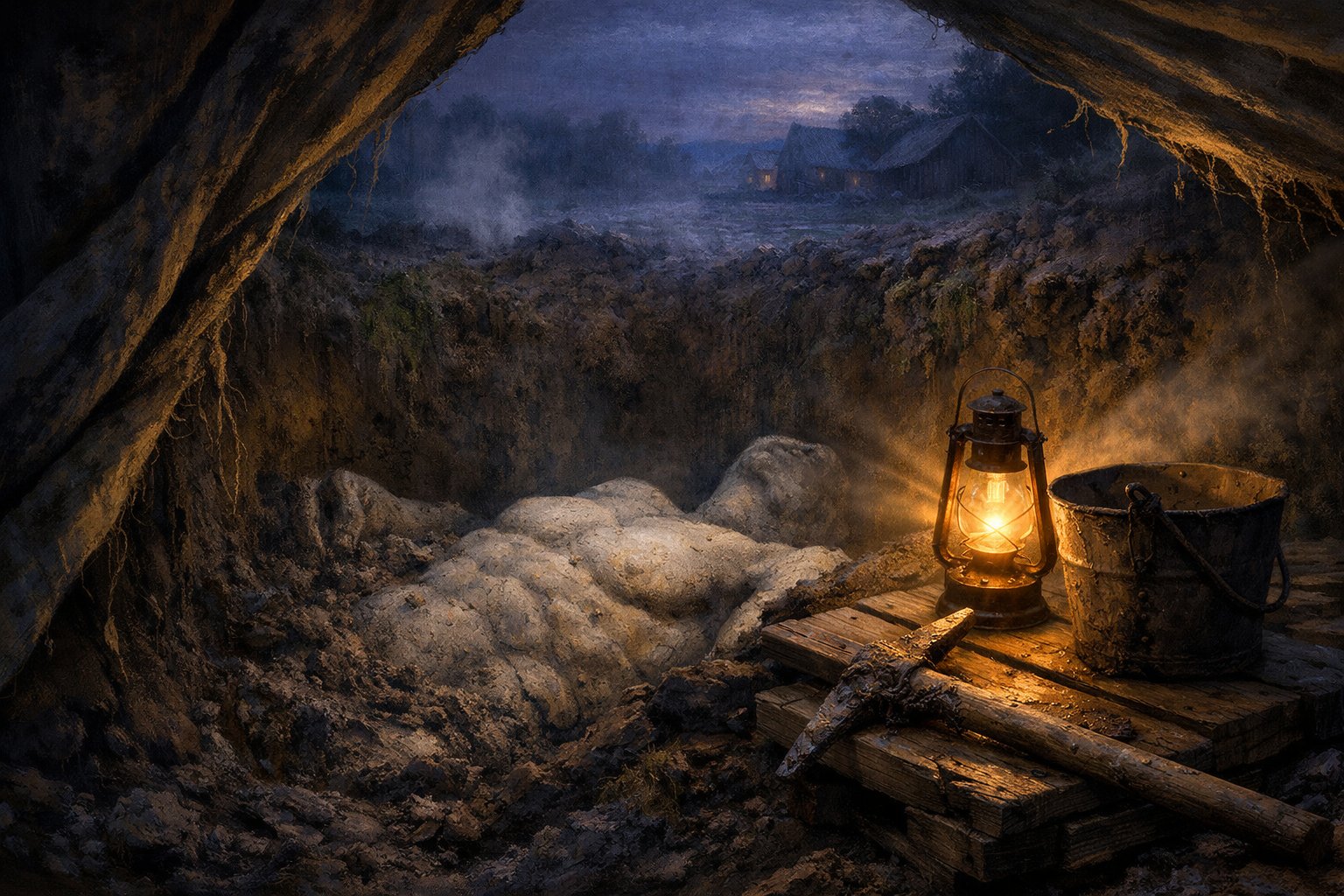
On October 16, 1869, two well-diggers struck stone three feet down behind a barn in Cardiff, New York, and pulled a ten-foot human figure out of the soil. Within a week the figure was earning $500 a day under a tent, drawing pilgrims, theologians, and at least one Yale paleontologist who needed only a glance to call it a “decided humbug” [1][2]. The Cardiff Giant was a sculpted block of Iowa gypsum, planted on a relative’s farm by a New York tobacconist with a grudge against a Methodist preacher. It is, by most counts, the most successful hoax in 19th-century American natural history, and the cleanest case study a working naturalist could ask for in how credulity, faith, and a dull autumn news cycle assemble themselves into a “discovery.” [1][3]
Why the Cardiff Giant Still Matters to Cryptozoology
Cryptozoology, in its working form, is the discipline of zoology paying attention to what non-academics have been telling it. The Cardiff Giant is the inverse case: a fabricated specimen that the public wanted to be real, that several minor newspapers wanted to be real, and that a small Syracuse banking syndicate paid $30,000 for the privilege of believing was real [1][2]. It belongs in the field naturalist’s graveyard chapter not because it dissolved on contact with biology but because biology did not initially get a turn at the microphone. The lesson sits inside that delay.
There is a tidy through-line from Cardiff to the Piltdown Man (1912) to the Patterson-Gimlin film debates of the 1960s: each case shows what happens when an artifact reaches the public before it reaches the lab. The artifact is not the problem. The interval is the problem. Cardiff’s interval was about six weeks of paid admissions before Othniel Charles Marsh, the Yale Peabody paleontologist, walked the tent in late November 1869 and produced one of the more economical pieces of forensic geology on record [1][4].
The Sculpture: Fort Dodge Gypsum, Burkhardt’s Workshop, and a Cousin’s Farm
George Hull, a cigar-maker from Binghamton, conceived the giant in 1868 after losing an argument over Genesis 6:4 (“there were giants in the earth in those days”) at a Methodist revival in Ackley, Iowa [1][3]. He returned to Fort Dodge the following June with a hired man named H. B. Martin, telling local quarrymen they needed a five-ton block of gypsum for a Lincoln monument bound for New York. The block was 10 feet 4.5 inches long and roughly two feet thick, hauled by oxcart to the rail depot, then shipped to Chicago [1][5]. A German stonecutter named Edward Burkhardt accepted the commission and assigned two sculptors, Henry Salle and Fred Mohrmann, to carve a recumbent male figure. Hull added age artificially: ink stains, sulfuric-acid pitting, and darning needles driven into the surface to mimic skin pores [1][3].
In November 1868 the finished figure was crated and freighted east to the farm of Hull’s cousin, William “Stub” Newell, in Cardiff, an unremarkable hamlet about twelve miles south of Syracuse. Newell buried it three feet down behind the barn one moonless night and walked away from the project for almost a year. The wait was tactical. Hull wanted the soil to settle, the disturbance to grass over, and the field-hand memory of the burial to thin. On October 16, 1869, Newell hired two locals, Gideon Emmons and Henry Nichols, to dig a well in that exact spot [1][6].
Field-Notebook Note: What a Genuine Subfossil Would Have Looked Like
A vertebrate buried for centuries in moist, acidic upstate New York soil would not survive as a coherent ten-foot figure. The Onondaga Limestone region’s groundwater chemistry would dissolve gypsum (calcium sulfate dihydrate) within decades, not millennia. A genuine human petrifaction is also a category error: human bone mineralizes in narrow circumstances (silica-rich groundwater, anoxic burial, mineral replacement), and the result is not a sculpted figure but a fossil of the discrete bone elements. The Cardiff Giant was, anatomically, a single mass of stone shaped like a man. That alone was the diagnostic. Marsh and the geologist John F. Boynton noticed it inside a single afternoon [4][7].
A second diagnostic the Cardiff figure failed: proportions. The carved torso was disproportioned in ways no human skeleton, fossilized or otherwise, would produce. Rib cages, pelvic articulation, femoral length-to-stature ratios, and the cranial-to-postcranial mass distribution all conform to species-specific constraints in the genus Homo. Even allowing for theoretical gigantism, a 10-foot figure would show distinctive endocrine pathology in the long-bone epiphyses; the Cardiff figure shows nothing of the kind because it was carved from a fenced design, not grown from a hypothalamus [4]. None of this was occult knowledge in 1869. It was first-year comparative anatomy. The hoax succeeded because the people in the tent were not anatomists.
The Six-Week Window: How the Public Believed
Within forty-eight hours of the find, Newell had pitched a tent over the pit and was charging twenty-five cents a head, soon raised to fifty [1][3]. Wagons from Syracuse arrived in lines that stretched out of the village. Local clergy declared the figure a Genesis-6 antediluvian giant; some early newspaper coverage hedged toward the “petrified man” hypothesis instead, which was also wrong but at least had a 19th-century scientific veneer. Both readings are visible in the local press of late October 1869, and both are honest reflections of how a Methodist-revivalist culture and a popular-science culture were sharing the same evidence and reaching opposite conclusions [3][6].
On October 23, 1869 (one week after the discovery), a five-man syndicate fronted by Syracuse banker David Hannum bought a three-quarter stake for $30,000 [1][2]. They moved the giant into Syracuse for exhibition. By early November, foot traffic justified the move; by mid-November, the figure was a national news object; by late November, the academic skeptics were writing letters. Andrew Dickson White, the first president of Cornell University, visited the tent, watched the visitors weep, and wrote in his autobiography that the episode was the moment the conflict between unexamined faith and disciplined science became, for him, urgently real [3][8].
The Forensic Verdict: Marsh, Boynton, and the Tool-Mark Diagnostic
John F. Boynton, a geologist working out of Pennsylvania, reached the site on October 17 and wrote a survey letter the following day identifying the material as Onondaga gypsum and arguing that the surrounding soil’s erosion rate could not accommodate more than about a year of burial [4]. That letter alone should have ended the matter; it did not. The decisive intervention came from Othniel Charles Marsh on November 30, 1869, in the form of a Syracuse Daily Journal letter declaring the figure “of very recent origin and a most decided humbug” [4][7]. His reasoning was elementary and load-bearing: gypsum is water-soluble, fresh tool marks are still visible on the surface, and the two facts together require that the figure cannot have been buried for any geologically meaningful interval. Skin-pore dimples were also too regular for biology and too uniform for taphonomy. He read it as a sculpture in roughly the time it takes to walk a tent [4].
P.T. Barnum, denied a purchase by the Hannum syndicate, commissioned his own plaster replica and exhibited it in Manhattan as the “real” Cardiff Giant [1][2]. Hannum sued for an injunction. The judge denied it on a technicality that became the project’s punchline: he would issue an injunction only if the original giant would swear under oath to its own authenticity. On February 2, 1870, Hull confessed publicly; both giants were now in the public record as fakes. The famous line “There’s a sucker born every minute” is often credited to Barnum but, by most accounts, was actually said by Hannum about the customers paying to see Barnum’s copy of Hannum’s fake [1][3].
What the Cardiff Giant Was Really Made Of: Credulity, a Slow News Cycle, and a Disciplinary Vacuum
The artifact itself is forensically dull: gypsum, sulfuric acid, ink, six months of carving in a Chicago workshop. The interesting object is the hoax’s reception. Three conditions enabled it. First, a Methodist-revival culture that read scripture as zoology and welcomed any physical specimen that could be shoehorned into Genesis 6:4 [1][3]. Second, a popular-press economy in which a 25-cent ticket and a tent could outpace academic review by a clean six weeks [3]. Third, a working scientific community that, in 1869, was still constructing the institutional habits — peer review, museum cataloguing, professionalized paleontology — that would make Marsh’s verdict feel obvious twenty years later [4][8]. The Cardiff Giant did not deceive science. It deceived the part of the public that did not yet have science as a stabilizing reflex.
For a working naturalist, the case is a useful inoculation. When a remarkable specimen surfaces — a footcast, a carcass photo, a viral clip — the right discipline is the boring one. Date the substrate. Check the tool marks. Ask what the local geology will and will not preserve. Ask who profits from the find being real before the laboratory has weighed in. The Cardiff Giant offers all four diagnostic prompts in a single, clean, ten-foot-long lesson [1][4].
Where the Giant Lives Now
After Hull’s confession, the giant changed hands several times, toured carnivals and side-shows under various owners, and eventually came to rest at the Farmers’ Museum in Cooperstown, New York, where it has been on display since May 19, 1948 [9]. P.T. Barnum’s plaster copy is housed at Marvin’s Marvelous Mechanical Museum in Farmington Hills, Michigan, and at Coney Island USA [10]. Both are now exhibited as what they always were: products of 19th-century stagecraft, useful as a unit of measurement for how far a culture’s appetite for wonder can run ahead of its appetite for verification.
For the parent niche, the broader landscape of cryptids and mythical creatures includes a long roster of artifacts and sightings that have either dissolved under examination or, occasionally, survived it. The Cardiff Giant sits firmly in the first category. The discipline is in noticing the difference quickly.
Related reading from the cryptids and mythical creatures archive: North American Sasquatch: Tribal Tales and The Lizard Man of Scape Ore Swamp.