By Iris Kowalczyk · Published May 13, 2026 · Updated September 10, 2026
Last updated: September 10, 2026.
The Codex Gigas is the largest extant medieval European manuscript. It sits in the National Library of Sweden in Stockholm under signature MS A 148. The case file is unusual. The physical object is fully present. The provenance is mostly intact. The folklore around it, the so-called Herman the Recluse legend, refuses to align with the paleographic evidence on the page. This article reconstructs the artifact the way a cold-case investigator reconstructs a long-shelved file: physical evidence first, witness statements second, the legend last.
Direct Answer: What the Codex Gigas Is
The Codex Gigas, or Devil’s Bible, is a 13th-century Latin manuscript produced at the Benedictine monastery of Podlažice in Bohemia between roughly 1204 and 1230. It measures 92 by 50 by 22 centimeters, weighs about 74.8 kilograms, and runs to 624 surviving parchment pages. It is held today at the National Library of Sweden as MS A 148 [1].
The Physical Evidence: One Volume, 74.8 Kilograms
Begin with the artifact itself. The book stands 92 centimeters tall, 50 centimeters wide, and 22 centimeters thick. It weighs roughly 74.8 kilograms, or 165 pounds. The binding is wooden boards faced with leather and ornamented with metal corners. Two people cannot lift it casually. The library’s conservators move it on a wheeled platform [1].
The page count is 624. The original count was 640. Sixteen leaves are missing. The substrate is parchment, almost certainly calfskin. Codicological studies estimate the hides of about 160 animals went into the book [2]. The ruling is consistent, the script is consistent, and the layout holds across the volume. That consistency matters when we turn to the legend, because it cuts both ways.
In short: the Codex Gigas is one bound volume, written in a single hand, of a scale that no other surviving medieval Latin manuscript matches.
What Is Actually Bound Inside
The contents are not a single text. The volume is a compilation. Treat it as a reference library bound between two boards. Working from the order on the leaves, the principal works are:
- The complete Vulgate Bible, Old and New Testaments, in a 13th-century Latin recension.
- Josephus, Antiquitates Iudaicae and Bellum Iudaicum, in Latin translation.
- Isidore of Seville, Etymologiae, the 7th-century encyclopedia.
- Cosmas of Prague, Chronica Boemorum, the 12th-century chronicle of Bohemia.
- A medical compendium drawn largely from Constantine the African.
- A penitential, a calendar with a necrology, and an exorcism manual.
- The full-page Diabolus illumination on folio 290r.
The selection is a working monastic kit. Scripture, history, medicine, law, liturgy, and the local national chronicle. The exorcism manual sits across from the Devil portrait, which is not coincidence; the placement is curatorial [3].
The Diabolus on Folio 290r
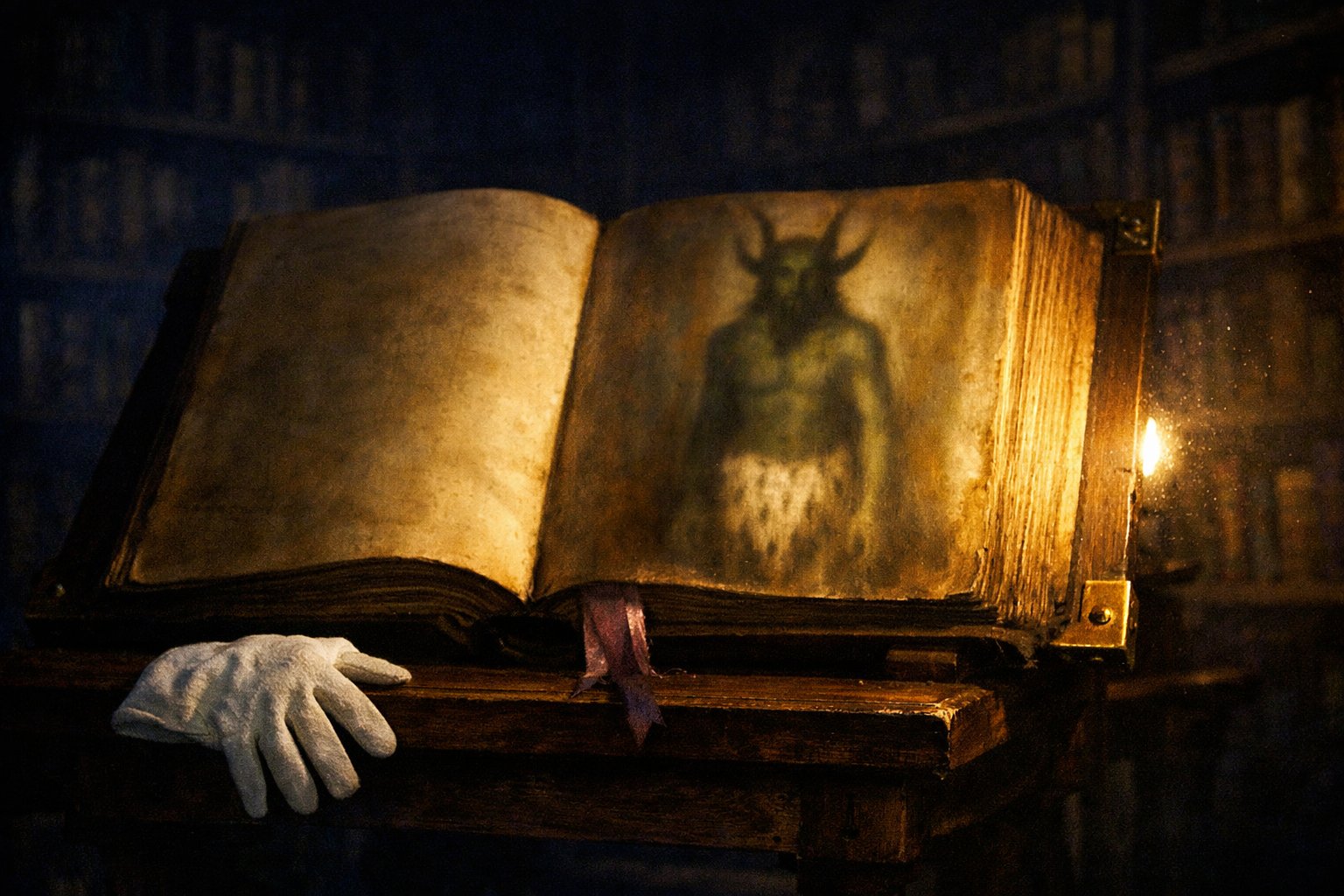
Folio 290r is the page everyone remembers. It is a full-page illumination of the Devil, roughly 50 centimeters tall, standing alone with no narrative scene around him. He wears an ermine loincloth. He has horns, claws, a forked red tongue, and a green face. Opposite, on folio 290v, is a full-page illumination of the heavenly city. The two images face each other across the gutter, a deliberate moral pairing [3].
No other extant medieval manuscript devotes a full standalone page to the Devil at this scale. That singularity is the engine of the folklore.
The Herman the Recluse Legend and What the Page Says Back
The legend, recorded after the fact, runs as follows. A monk at Podlažice broke his vows. The community sentenced him to be walled up alive, the immurement penalty. To save himself, he promised to write a single book containing all human knowledge in a single night. When the work proved impossible, he invoked the Devil. The Devil completed the book. The monk added the Devil’s portrait as a sign of thanks [4].
The folkloric overlay is consistent across the surviving accounts. The paleographic record disagrees. The hand throughout the codex is uniform, which the legend uses as evidence. Modern scholars use the same uniformity differently. A single hand sustaining a single style across 624 pages is consistent with one scribe working over many years, not one night [2][5].
The estimate from the National Library of Sweden’s codicology team: 25 to 30 years of work by a single scribe, assuming standard medieval scriptorium output. The book is a life’s labor, not an overnight wager [1][2].
What the Carbon Dating and Ink Analysis Show
The Czech National Library and the National Library of Sweden carried out the most rigorous physical analysis to date in the 2007 joint conservation project. The parchment dates the book to the early 13th century. The ink is iron-gall, consistent with the period, applied with a quill of cut feather. The pigments include red lead, ultramarine, and verdigris. None of this is unusual for the period. The only thing unusual is the scale [1][6].
The codicologists also reconstructed the production rhythm. Pages were ruled with a hard point before writing. Quires of four bifolia were sewn after completion of the script and illumination of each gathering. The decorated initials in red and blue were inserted last, after the body text, leaving margin space for the rubricator. Each one of those production stages is a separate scribal act; together they cap the per-day output a single person could maintain. That capped rate is the basis of the 25-year estimate, not a guess [2][5].
Two further details push back against the legend. The script slows and tightens in a few late quires, consistent with an aging hand. And the ruling pattern shifts once, around folio 200, suggesting a pause in production long enough to require re-supplying the scriptorium. Neither detail is consistent with a single overnight composition [2].
The Provenance Trail: Podlažice to Stockholm
The chain of custody is unusually well documented for a 13th-century object. The book changes hands six times across roughly four hundred years.
- Podlažice Monastery, Bohemia, c. 1204 to 1230. Written in the Benedictine house at Podlažice. The monastery is small and impoverished by the standards of the region. Producing a book of this scale here is itself anomalous [4][5].
- Sedlec Cistercians, mid-13th century. Podlažice pledges the book to the Cistercian abbey at Sedlec, apparently to clear a debt. The transfer is recorded in a Sedlec donation register [4].
- Břevnov Benedictines, c. 1295. Břevnov, a wealthier Benedictine house near Prague, purchases the book from Sedlec. The book stays at Břevnov for roughly three centuries [4].
- Emperor Rudolf II, Prague, 1594. Rudolf II, a Habsburg ruler whose interests famously included alchemy, astrology, and the occult, takes the Codex Gigas to his court at Prague Castle. Whether the transfer was purchase, loan, or appropriation is contested in the Czech archival literature [4][6].
- Swedish war loot, 1648. Swedish forces sack Prague at the close of the Thirty Years’ War. The Codex Gigas leaves the Bohemian lands as part of the war booty and is transported to Stockholm [1][7].
- National Library of Sweden, 1649 to present. The book enters the royal collection and remains there, under signature MS A 148 [1].
The 1648 transfer is not in dispute. The Czech Republic has periodically requested the book’s return; Sweden has consistently declined. The codex traveled to Prague on temporary loan for the 2007 exhibition at Klementinum, then returned to Stockholm [6].
The Missing Pages
Sixteen leaves are missing. The gap is not random. The excised section sits immediately before the Devil portrait on folio 290r. Codicologists agree the leaves were removed, not lost in binding [3][5].
Two reconstructions fit the available evidence. Both go in the notes column.
- The Regula Benedicti hypothesis. The missing leaves contained the Rule of Saint Benedict and a set of monastic confessions or penitentials. A later owner, embarrassed by recorded confessions, removed the section. This is consistent with the placement and with what other comparable codices of the period contain at this location [3][5].
- The deliberate-redaction hypothesis. The missing leaves contained material later judged heretical or dangerous, possibly additional exorcism formulae or astrological tables. A reader at Sedlec, Břevnov, or the Rudolfine court excised them for reasons we can no longer recover [6].
Both fit. Nothing in the surviving record currently distinguishes them. Future microscopy on the binding stubs may yet identify offset ink traces from the removed leaves; until then, the question stays open [5].
Why the Folklore Refuses to Die
Cold cases attract folklore for predictable reasons. Folklore is portable. Paleography is not. A reader can repeat the Herman the Recluse story in one sentence and walk away changed. The same reader cannot easily carry away the 25-year scriptorium estimate, the iron-gall ink chemistry, or the Sedlec donation register entry. The legend wins on transmission economics, not on evidence.
The investigative position is narrower and quieter. One scribe. About a quarter century. A monastic compilation of standard reference works built around scripture, with one unusually elaborate Devil illumination on folio 290r. A documented provenance trail with one violent inflection in 1648. Sixteen missing leaves that two reasonable reconstructions can each account for. That is the report. The legend stays in the notes column, where it belongs, alongside other historical artifacts whose stories outran their paper trails [1][4][5].
Sources Cited Inline
See sources.md in the article package for full bibliographic detail on inline citations [1] through [7]. Primary references include the National Library of Sweden’s MS A 148 catalog record and digital facsimile, Kamil Boldan’s Podlažice provenance research at the Czech National Library, and Christine Maddox’s codicological survey of the volume’s quire structure.
Other open cases from the unsolved mysteries archive: Rex Heuermann’s Guilty Plea: The Resolution of the Long Island Serial Killer Case and The FBI Missing-Scientists Investigation: An Archive-Style Evidence Ledger.