By Emilia Wellesley · Published May 6, 2026 · Updated May 13, 2026
The disappearance of Richard John Bingham, 7th Earl of Lucan (18 December 1934 to last seen 8 November 1974), is, on its surface, the story of an English peer who vanished after a murder in his own house. Read closely, it is something stranger: a single overnight gap in a life that had otherwise been documented down to the gambling chip, followed by half a century of theory built on top of an absence. The case file is unusual for what it contains, and unusual again for what it never closed.
The murder happened first. The vanishing came second. The British state has, over five decades, settled the legal questions one at a time and left the central historical question untouched.
What Happened, in 40 Seconds
On the evening of 7 November 1974, Sandra Eleanor Rivett (16 September 1945 to 7 November 1974), the 29-year-old nanny to the Lucan children, was bludgeoned to death in the basement kitchen of 46 Lower Belgrave Street in Belgravia, London. Her employer’s estranged wife, Veronica Bingham, Countess of Lucan (née Duncan, 1937 to 2017), was attacked moments later on the same staircase, escaped, and stumbled bleeding into a nearby pub called The Plumbers Arms. Lord Lucan telephoned his mother, drove to a friend’s house in Sussex, wrote two letters, and then drove off into the dawn of 8 November. He has not been verifiably seen since. A coroner’s jury at Westminster named him as Rivett’s murderer in June 1975. A High Court judge declared him legally dead in February 2016. Like other historical and archaeological mysteries of the modern era, the surviving record is rich enough to argue from and thin enough to argue over.
The House on Lower Belgrave Street
By the autumn of 1974 the Lucans were living separately. Veronica and the three children remained at number 46. Lucan had moved out following a custody battle the year before; he kept a flat at 72a Elizabeth Street, a few minutes’ walk away. He visited the children regularly, watched the house, and, by his own bank statements, was deep in gambling debts that ran to roughly £14,000 (worth several hundred thousand pounds today). Rivett had taken the post of nanny in late August. According to the Metropolitan Police timeline reconstructed during Operation Lucan, her usual evening off was a Thursday, and 7 November was a Thursday.
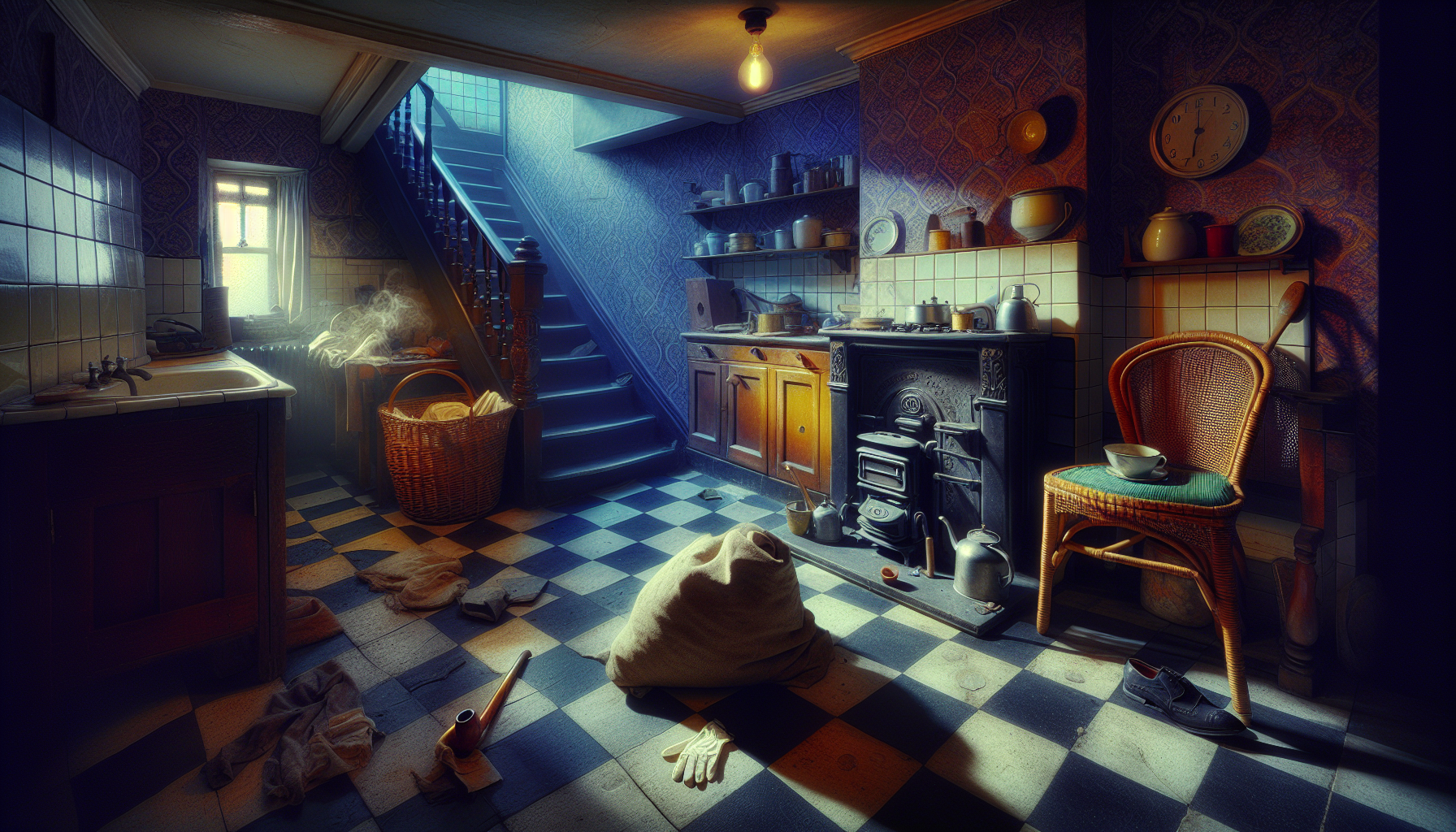
Rivett broke her routine that night. She had asked Lady Lucan if they might have a cup of tea around nine in the evening and went down the basement stairs to the kitchen to make it. She did not return. At about 9:45 p.m. Lady Lucan, having gone down to look for her, was attacked on the basement stairs by a man whose voice, she said, she recognised as her husband’s. She bit his finger, broke free, and fled barefoot up Lower Belgrave Street to the Plumbers Arms public house, where she arrived at the door drenched in blood. Police were called. They found Rivett’s body folded into a canvas United States mail sack in the basement; near her lay a length of bandaged lead pipe. The basement light bulb had been removed from its socket, suggesting whoever waited there meant to wait in the dark.
The Overnight: Phone Call, Letters, Sussex
Between roughly 10 p.m. and midnight on 7 November, Lucan’s movements are documented through three separate channels. He telephoned his mother, Kaitilin Dowager Countess of Lucan, at her flat in St Leonards Terrace, Chelsea, and asked her to collect the children. He drove a borrowed Ford Corsair (his own Mercedes was in the garage) roughly 42 miles south to the home of his old friends Ian and Susan Maxwell-Scott in Uckfield, East Sussex. Susan Maxwell-Scott was the only adult who saw him after the murder. By her later police statements, he arrived shortly after 11:30 p.m. with mud on his trousers, drank a vodka and tonic, and described what he called a “terrible catastrophe” at Lower Belgrave Street.
At Uckfield he wrote two letters to his brother-in-law William Shand Kydd. The first letter, marked with a small bloodstain, alleged that he had been passing the house, seen a man attacking his wife in the basement, and intervened, only to be wrongly suspected. The letters survive in the police file. He left Uckfield in the small hours of 8 November and was never seen again.
The Ford Corsair at Newhaven
The car was discovered on Sunday 10 November in Norman Road, Newhaven, on the East Sussex coast about sixteen miles from Uckfield and a short walk from the cross-Channel ferry terminal. Forensic examination found bloodstains on the front seat and door of types matching both Sandra Rivett (group A) and Lady Lucan (group B), as well as a length of bandaged lead pipe in the boot, similar in construction to the weapon used at Lower Belgrave Street. The car had, by witness statements, been parked in Norman Road sometime between five and eight in the morning of Friday 8 November. From that morning the historical record falls silent.
Newhaven is a working ferry port. The Dieppe boat sailed at 12:30 p.m. on 8 November and again that evening. Lucan’s passport was later found in his Elizabeth Street flat. He had cash, a chequebook, and a small overnight bag, but no luggage that suggested an extended journey. Whether he boarded a boat, walked the chalk cliffs to the sea, or was driven elsewhere by a friend remain three competing reconstructions and no more.
The 1975 Inquest: A Verdict Without a Trial
The inquest into Sandra Rivett’s death opened at Westminster Coroner’s Court on 16 June 1975 under the Coroner Dr Gavin Thurston. The hearing ran for eight days. On 19 June 1975 the jury returned, after thirty-one minutes of deliberation, a verdict that Rivett had been murdered by Richard John Bingham, Earl of Lucan. Thurston issued a warrant committing the named man for trial at the Central Criminal Court. No trial ever followed because the defendant was unavailable.
The verdict was procedurally rare and historically the last of its kind. The Criminal Law Act 1977 amended the Coroner’s Act to remove the power of an inquest jury to name a person as a murderer; the Lucan inquest is therefore the last occasion on which a coroner’s jury in England and Wales did so. The verdict identifies Lucan in the historical record. It does not, in the language of English criminal law, convict him: a coroner’s inquest does not hear cross-examination by the named party’s defence, and its standard of proof is the civil one, the balance of probabilities. The distinction matters when later writers speak of guilt.
The Theories of His Fate
Four reconstructions have repeated themselves through the secondary literature, and they should be named clearly because none has been ruled out by evidence.
1. Suicide at Sea
The earliest theory, and the one his closest friend John Aspinall (zoo owner and proprietor of the Clermont Club, 1926 to 2000) preferred publicly, is that Lucan walked or motored to Newhaven, took out a small boat, and scuttled himself in the English Channel. Aspinall stated this view in interviews from the late 1970s onward. The theory accepts the inquest verdict (Lucan as the killer) and proposes the cleanest exit. It explains the abandoned car. It explains the silence. It does not explain the missing passport remaining in his flat or the absence of any boat reported missing from Newhaven harbour that weekend.
2. Africa, Helped by the Clermont Set
Detective Chief Superintendent Roy Ranson (lead investigator on Operation Lucan; co-author of Looking for Lucan: The Final Verdict, 1994) became persuaded that Lucan had been spirited out of England by his wealthy gambling circle, almost certainly Aspinall and Sir James Goldsmith (financier, 1933 to 1997), and lived in southern Africa. Ranson reportedly carried Lucan’s photograph in his breast pocket from November 1974 until his retirement and pursued sightings in Botswana, Mozambique, and Namibia. The theory is best argued in John Pearson’s The Gamblers: John Aspinall, James Goldsmith and the Murder of Lord Lucan (Century, 2005), which assembles the social anthropology of the Clermont Set and its capacity to manage a fugitive. Pearson’s case is circumstantial. It rests on what such friends could have done rather than evidence that they did.
3. Goa, India
In 2003 a former Scotland Yard detective named Duncan MacLaughlin published a photograph and a book identifying a long-haired hippy living in Goa as the missing earl. The man was traced and identified, conclusively, as Barry Halpin, a folk singer from Lancashire. The episode is sometimes cited as evidence that Lucan-sightings have a half-life of their own, independent of any new evidence about Lucan himself.
4. The Wrong Man (Sally Moore’s Reading)
A separate thread of writing argues that the inquest got the wrong person. Sally Falk Moore’s Lucan: Not Guilty (Sidgwick & Jackson, 1987) reads the case as a procedural failure: she finds inconsistencies in Lady Lucan’s statements at different stages, points to forensic ambiguities the jury did not weigh, and proposes that the murderer was a hired intruder, possibly an off-duty police officer with criminal sidelines, whose errand went wrong. The case in this telling is closer in spirit to a Ricardian defence of Richard III: a careful evidentiary brief on behalf of a man not present to defend himself. Moore’s book sold less widely than Ruddick’s or Pearson’s. James Ruddick’s Lord Lucan: What Really Happened (Headline, 1994; updated 2016) sits on the opposite end of the spectrum, accepting the inquest verdict and reconstructing the night around the assumption that Lucan, mistaking Rivett for his wife in the dark basement, killed the wrong woman.
The 2016 Ruling and What It Did Not Settle
Lucan was first declared dead by the High Court for probate purposes on 27 October 1999, which permitted his estate to be wound up. That ruling did not, however, allow his eldest son George Charles Bingham (born 21 September 1967) to inherit the title or take a seat in the House of Lords, because the Crown Office required a death certificate before issuing a writ of summons. The Presumption of Death Act 2013 created a clearer pathway. On 3 February 2016 Mrs Justice Sarah Asplin granted a presumption-of-death order in the High Court, and a death certificate was issued. George Bingham succeeded as 8th Earl of Lucan.
The ruling closed one legal question, the succession, and one civil question, the legal personhood of the absent man. It did not close the disappearance. The judge made no finding on whether Lucan was, in fact, dead, on what date he died, or by what means. Presumption of death is a legal device, not a historical conclusion. The two are often confused.
Sandra Rivett, Restored to the Centre
It is the structural injustice of unsolved murder cases that the missing perpetrator can crowd out the named victim. Sandra Eleanor Rivett was born in Basingstoke on 16 September 1945, the third child of Albert and Eunice Hensby. Her family emigrated to Australia when she was two and returned to Surrey in 1955. As a teenager she gave up a son for adoption; her biological son, the building contractor Neil Berriman, learned of the connection thirty years later and has spent more than two decades campaigning for the case to be reopened. Rivett trained briefly as a hairdresser, worked as a secretary in Croydon, and took the Lucan post in late August 1974. She had been in the household roughly ten weeks when she was killed.
She is a person, not a footnote. The Metropolitan Police Operation Lucan file, partially released under Freedom of Information requests in 2024, lists her by name on every continuation sheet. Her son’s campaign has done a part of what the disappearance of the named suspect made structurally hard: it has kept the victim’s name attached to her own death, and not to the title of the man accused of causing it.
What the Record Will and Will Not Say
Two questions sit inside the Lucan case, and they should not be merged. The first is whether Lord Lucan murdered Sandra Rivett and attempted to murder his wife. A coroner’s inquest answered that question in the affirmative in 1975, by a procedure that no longer exists. Police, biographers, and most historians have followed the inquest. A minority has not.
The second is what happened to him after he drove away from Uckfield in the small hours of 8 November 1974. No archive answers this. The car was found, the passport was not used, the body has not been produced, and the people who might have known have died: Aspinall in 2000, Goldsmith in 1997, Susan Maxwell-Scott in 2004, Lady Lucan in 2017. The disappearance has outlived its witnesses. What survives is a procedural record sufficient to settle a peerage and insufficient to settle a death.
A historian holds the gap open and resists the temptation to fill it. The honest sentence at the end of the file remains the same one it began with on the morning of 8 November 1974: he was at Uckfield, he drove to Newhaven, and after that the record stops.