By Emilia Wellesley · Published May 8, 2026 · Updated September 10, 2026
Last updated: September 10, 2026.
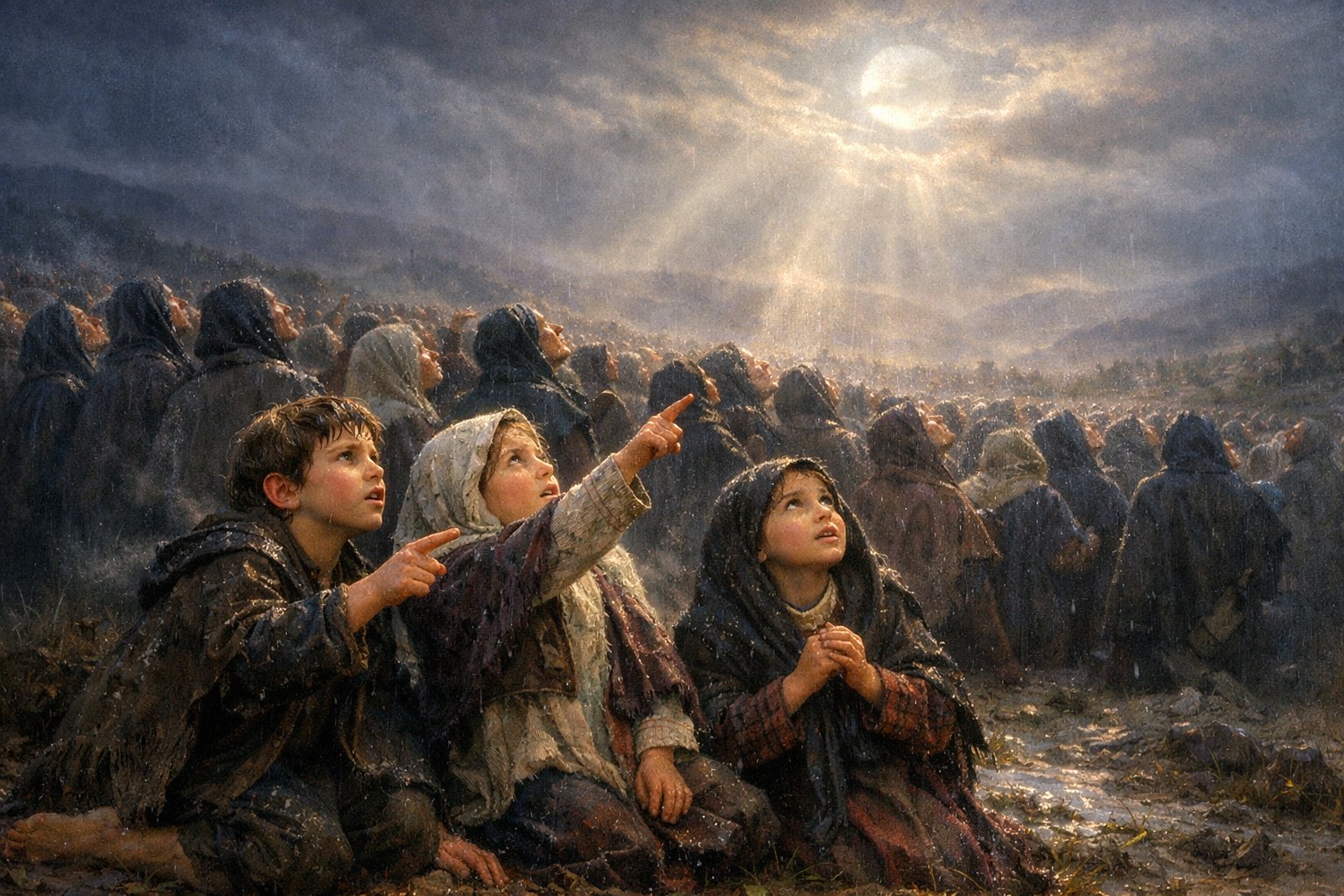
On the rainy afternoon of October 13, 1917, a crowd estimated by contemporary reporters at thirty thousand to fifty thousand people stood in the muddy basin called the Cova da Iria, on a Portuguese hillside outside the village of Fátima. Three shepherd children — Lúcia dos Santos, ten, and her cousins Francisco and Jacinta Marto, nine and seven — had said the lady they had been seeing each month since May would, on this day, give them a sign. What followed has been argued over for more than a century: many in the crowd reported that the sun, after the rain stopped, did things suns are not supposed to do. Others nearby said they saw nothing unusual at all.
The folklorist’s task here is not to settle the question. It is to render the testimony — its variants, its silences, its institutional careers — with the same care a witness deserves at her own kitchen table. What people at Fátima reported, and how those reports were received, is itself the lasting record. For a wider survey of the wonders that gather around devotional life and shared visionary experience, see our pillar on paranormal and supernatural phenomena.
What the witnesses said happened at the Cova da Iria
The basic shape of the testimony is consistent across hundreds of statements gathered in the weeks and decades that followed. Rain had been falling heavily through the morning. Around midday, the children pointed; the clouds parted; people turned to look. Then, in many accounts, the sun appeared as a pale silver disc that could be looked at directly without pain. It seemed to spin. It threw colors across faces, hands, and the ground. To some, it appeared to leave its place in the sky and plunge toward the earth. The crowd cried out. Some prayed. Some fled. Then it was over, and the witnesses found that their sodden clothes — many described being soaked to the skin — had dried.
The clearest contemporary report came from Avelino de Almeida, chief editor of the Lisbon daily O Século, a paper with a famously anticlerical and republican posture. Almeida had attended the morning expecting to write a satire of credulous peasantry. He stayed and wrote something else. In his October 15 report, he described “the immense crowd turn toward the sun, which appeared at its zenith, clear of the clouds. It looked like a plate of dull silver, and it was possible to stare at it without the least discomfort. It did not burn the eyes. It did not blind. One might say that an eclipse had occurred.” [1] He estimated the crowd at thirty to forty thousand on October 15; in a follow-up on October 29 he revised that to roughly fifty thousand. [1]
Variants in the witness pool
Researcher Stanley Jaki, working through the corpus of first-person accounts a half-century later, observed that the popular shorthand of “the sun danced” flattens what witnesses actually said. The earliest and most carefully recorded testimonies frequently describe thin clouds across the disc as it moved — a meteorological detail that often drops out in retellings. [2] Some witnesses inside Fátima saw nothing. Some witnesses several kilometers away reported the same phenomena. The variation is itself a data point, and it is the data point most arguments about Fátima, in either direction, contend with.
The three shepherd children and the apparitions of 1917
The October crowd had not arrived spontaneously. It had been gathering, month by month, since May 13, 1917, when the three children first reported a “lady” at the Cova da Iria who returned on the thirteenth of each month and asked for prayer for the world and for Russia. Lúcia did most of the speaking; Jacinta spoke less; Francisco, who said he could see the lady but not hear her, said even less. As the months went on, the visits drew larger crowds drawn by word of mouth and by sympathetic regional newspapers, and eventually by the children’s promise that on October 13 the lady would do something the crowd could see. [3]
Francisco and Jacinta did not live long after the apparitions. Both died in the influenza pandemic — Francisco in April 1919, Jacinta in February 1920. Lúcia survived to ninety-seven, entered religious life, took the name Sister Lúcia of Jesus and the Immaculate Heart, and produced a series of memoirs over decades. The memoirs are themselves a folkloric document: they preserve, as Lúcia remembered them, the words the children attributed to the lady, including what came to be called the three secrets of Fátima. [3][4]
How the Church received the reports
Institutional acceptance was neither automatic nor fast. The Bishop of Leiria, Dom José Alves Correia da Silva, opened a canonical inquiry in 1922. Eight years later, on October 13, 1930 — the thirteenth anniversary of the sun event — he issued a pastoral letter declaring the visions of the Cova da Iria “worthy of belief” and authorizing public devotion to Our Lady of Fátima. [5] That formula is precise. The Church does not, in cases like this, declare apparitions to be true; it declares them not to contradict the faith and to be permissible objects of devotion. The distinction matters to anyone parsing what was actually said.
Beatification of the two children who had died young came on May 13, 2000, by Pope John Paul II, who attributed his own survival of a 1981 assassination attempt to Our Lady of Fátima. Canonization of Francisco and Jacinta followed on May 13, 2017, on the centenary of the first apparition, by Pope Francis, at the Cova da Iria itself. [3][4] Sister Lúcia, who died in 2005, was declared Venerable in 2023; her cause continues.
The third secret
The first two of the three secrets — a vision Lúcia described of hell and a request for the consecration of Russia to the Immaculate Heart of Mary — were committed to writing in her third memoir in 1941. The third was sealed and forwarded to Rome in 1957. It became, over the next four decades, a fixed object of speculation, with rumors that it foretold a coming chastisement or the loss of the faith inside the Church. The Vatican released the four-page, handwritten text on June 26, 2000. The released text describes a vision of a “bishop dressed in white” climbing a mountain past corpses and being shot by soldiers; the official commentary tied it to the persecution of the twentieth-century Church and to the 1981 attempt on John Paul II’s life. Critics inside and outside the Church have argued that the released document is incomplete; the Vatican has consistently said it is not. The folkloric career of the third secret — the way it has continued to generate variant readings — is itself worth recording. [3][4]
What skeptics and physicists have said
Among nonreligious commentators, the dominant readings are meteorological, optical, and psychological. Joe Nickell, longtime investigator for the Committee for Skeptical Inquiry, has argued that the consistent core of the testimony — a silver disc that could be stared at, dancing motion, plunging toward earth — is consistent with the visual artifacts produced by staring directly at a sun partly obscured by thin altostratus clouds. Brief, fixed gazing at a bright source produces afterimages and apparent motion when the eyes saccade; a partly veiled sun reads as a disc rather than as the painful point of normal sunlight. Sun “miracles” of the same type, Nickell notes, have been reported elsewhere — at Medjugorje, at Knock, at numerous Marian sites — by people staring at the sun in expectant crowds. [6]
The skeptical reading does not fully dispatch the case. The dried-clothes detail, the synchronicity of the cry across the crowd, the reports from villages several kilometers away, and the fact that the sun was visible to thousands while the Earth’s astronomy registered nothing unusual — these are the points around which argument continues. Stanley Jaki, a Benedictine physicist and historian of science, took the meteorological angle in a different direction in his 1999 book God and the Sun at Fátima. Jaki argued for what he called a meteorological miracle: a localized atmospheric event of the kind that does not occur on demand but is not, in his view, made less remarkable by being natural. The position is unusual; it concedes most of the physics to the skeptic and locates the wonder in the timing. [2]
The local context: Portugal in 1917
Any honest reading of Fátima begins with the Portugal the children lived in. The First Republic had been declared in 1910, and the new state had moved quickly against the public role of the Catholic Church: religious orders dissolved, religious education stripped from public schools, public processions restricted, parish priests pressed by local administrators. The mayor of Vila Nova de Ourém — the district administrator under whose authority the parish of Fátima fell — had detained the three children on August 13, 1917, the date of what would have been the fourth apparition, and held them for two days, attempting to extract a confession that the visions were a fraud. None of the three retracted. The eldest, Lúcia, was ten. [3] That this happened a fortnight before the published prediction of the October sign is part of the local atmosphere a folklorist has to register; the crowd that gathered on October 13 had been formed not only by piety but by reaction to a state that had treated the children as suspects.
It is also worth noting that the regional press, particularly the smaller Catholic and conservative papers, had carried sympathetic coverage of the earlier apparitions. By October the case had become a national news story, and the question of who would be present at the Cova on the thirteenth was not just a matter of devout neighbors. Almeida’s appearance for O Século was symptomatic: the Lisbon press came expecting the children to be exposed. The reporters’ presence is part of the reason the testimony pool from October 13 is as rich as it is. They wrote down what they saw because they had been sent to write something down.
Reading the event as a folklorist
A folklorist looking at the Fátima record sees several patterns at once. The first is the careful preservation of detail in early accounts that later retellings smooth over — the rain, the thin cloud, the silence, the cry. The second is the pattern of variation in what individual witnesses reported, which is the signature of authentic crowd testimony rather than a rehearsed account. The third is the long institutional after-life of the event, in which a single afternoon’s testimony gets stretched, re-read, and re-deployed by every generation that inherits it.
What stays in present tense
When fieldworkers later returned to the village to interview people who had been at the Cova as children — work done across the 1930s, 1940s, and after — a recurring feature emerged. Witnesses asked to describe what they saw at the Cova on October 13, 1917, often slipped from past tense into present tense partway through the answer. “And the sun, it spins, it comes down, it stops.” That cadence is familiar to ethnographers who collect traumatic, ecstatic, or numinous testimony elsewhere; the present tense is how the body remembers a moment the mind never quite finished. The folklorist’s discipline is to keep that detail in the transcript without flattening it into past-tense narrative summary, because the present tense is itself part of what the witness reported.
There is also the simple fact that something happened at the Cova da Iria that day for which a great many sober people, including a famously anticlerical journalist, found themselves reaching for descriptions they had not expected to use. Whether what happened was a localized atmospheric event, a shared visual artifact, a genuine sign, or some combination, the record shows a crowd that arrived expecting and a crowd that left changed. The folklorist’s contribution is to preserve both — the expectation and the change — without forcing the testimony into either a credulous or a debunking shape. The witnesses kept their accounts in present tense for the rest of their lives. That detail, more than any of the explanations layered over it, is the thing the record actually contains.
More from the paranormal and supernatural phenomena archive: The Hermetic Tradition: Rediscovering Ancient Wisdom and Journeys Beyond the Veil: Documenting NDEs.