By Augustus Kane · Published May 8, 2026 · Updated September 10, 2026
Last updated: September 10, 2026.
The Roswell Incident, Read From the Paper Trail
The Roswell incident is a 1947 New Mexico debris recovery, an Army Air Forces press release issued and retracted within twenty-four hours, and an evidentiary controversy now bracketed by two Air Force reports — the 1994 Roswell Report: Fact vs. Fiction in the New Mexico Desert, which identified Project Mogul Flight No. 4 as the source, and the 1997 Roswell Report: Case Closed, which traced the alleged “alien bodies” to anthropomorphic dummies dropped during Projects High Dive and Excelsior between 1954 and 1959 [1][2].
What Happened on the Foster Ranch in July 1947
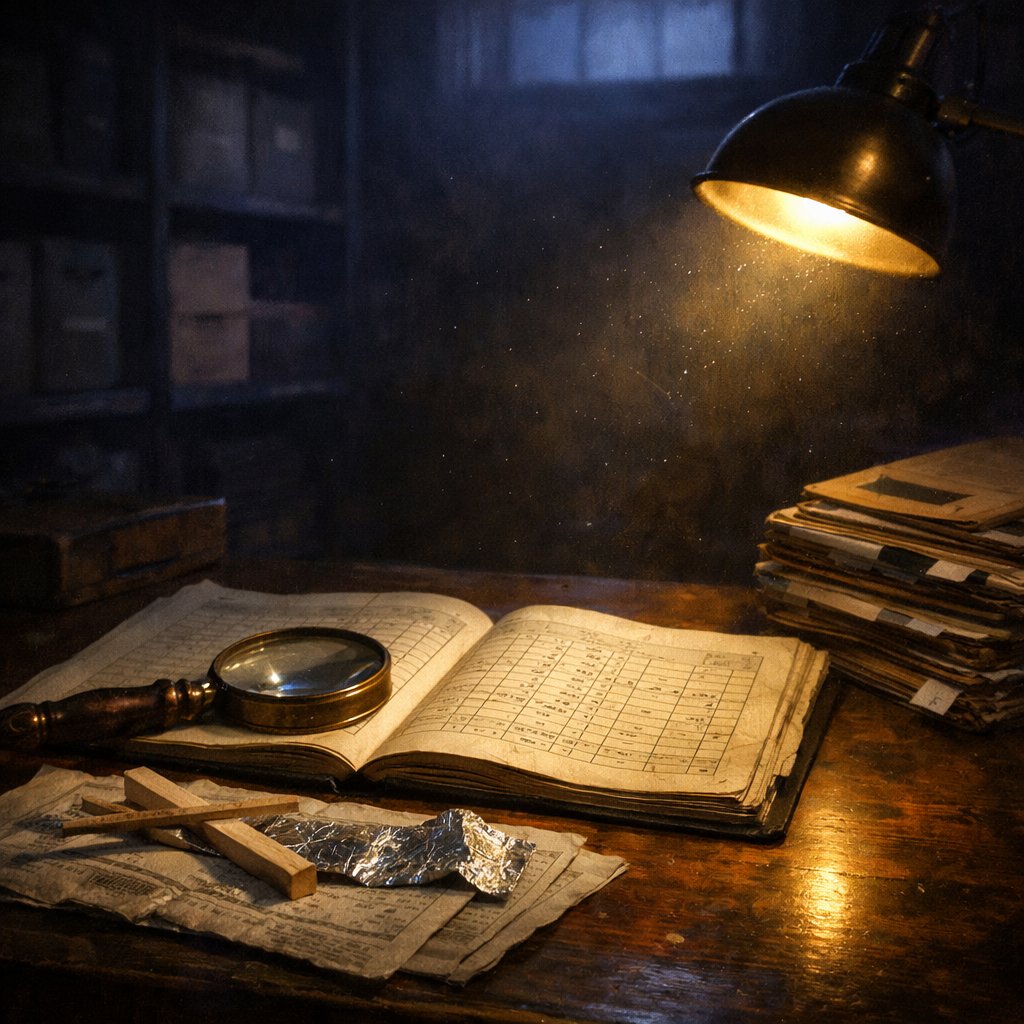
The basic chronology has been corroborated by multiple independent witnesses, by the 1947 wire-service record, and by the National Archives copy of the Roswell Daily Record front page of 8 July 1947. On or about 14 June 1947, William Ware “Mac” Brazel, foreman of the Foster Ranch in Lincoln County, New Mexico, encountered a debris field of foil-like material, paper-backed tape, balsa-grade sticks, and rubber strips scattered across roughly three-quarters of a mile of pasture [1]. Brazel reported the find to Sheriff George Wilcox in Chaves County on 7 July, after he had read newspaper accounts of Kenneth Arnold’s 24 June 1947 sighting near Mt. Rainier and the ensuing “flying disc” coverage [1]. Wilcox notified Roswell Army Air Field, then home to the 509th Bomb Group, the only nuclear-capable bomb wing in the world.
Major Jesse A. Marcel, the 509th’s intelligence officer, drove to the ranch with Captain Sheridan Cavitt of the Counter Intelligence Corps. They returned with the material on 8 July, the same morning that Public Information Officer Walter G. Haut released, on Colonel William H. Blanchard’s authorization, the now-infamous statement that the field had recovered “the disk” [1]. Within hours the debris had been flown to the Eighth Air Force at Fort Worth, where Brigadier General Roger M. Ramey, his chief of staff Colonel Thomas J. DuBose, and weather officer Warrant Officer Irving Newton identified the recovered material as a downed weather balloon and radar target [1]. The retraction landed in evening editions; the file was effectively closed at the public level.
The Two Air Force Reports That Reopened the Documentary Record
The conspiracy is in the footnote, not the headline — and in this case, the footnote turned out to be a 1,000-page government report that took forty-seven years to surface. In 1993 Congressman Steven Schiff (R-NM) requested a General Accounting Office audit of Roswell-related records after the Air Force declined to provide them on demand. The GAO’s 1995 report (B-262046) revealed that the Roswell base outgoing-message file for the relevant period had been improperly destroyed without retention authorization, and that two contemporaneous administrative-action records had been preserved by accident [3].
1994: Fact vs. Fiction in the New Mexico Desert
The first Air Force study, released in July 1994 under signature of Colonel Richard L. Weaver and Captain James McAndrew, concluded that the Roswell debris was the wreckage of NYU Constant Level Balloon Flight No. 4, a Project Mogul train launched on 4 June 1947 from Alamogordo Army Air Field [2][4]. Project Mogul, classified Top Secret at the time, used 600-foot-long balloon strings carrying low-frequency acoustic microphones intended to detect long-range pressure waves from Soviet atomic tests; the program ran 1947–1949 under the direction of Columbia University geophysicist Maurice Ewing and NYU’s Charles B. Moore [2]. The unclassified cover for Mogul was “weather balloon” — which is precisely the line Ramey delivered at Fort Worth and which has since been mistaken for the original lie when, on the documentary record, it was the second cover story laid over a first.
1997: Case Closed and the Anthropomorphic Dummies
The follow-up volume by Captain James McAndrew, published 24 June 1997, addressed the secondary folklore of “alien bodies” recovered from a second crash site. McAndrew’s analysis traced the body-recovery testimony to the high-altitude balloon-drop programs Project High Dive (1954–1959) and Project Excelsior (1959–1960), which deployed life-sized anthropomorphic test dummies dressed in Air Force flight suits across northern and central New Mexico to study parachute deployment from altitudes above 70,000 feet [5][6]. Witnesses, McAndrew argued, had compressed events from a roughly twelve-year window into a single July 1947 narrative — a phenomenon that source-criticism scholars call “memory consolidation” or “time-collapse” [5].
Where the Civilian Investigation Pushed Back
The official explanations did not arise in a vacuum. Civilian research had been operating on the case since 1978, when nuclear physicist Stanton T. Friedman, then on the lecture circuit, conducted the first recorded interview with the retired Major Jesse Marcel for the National Enquirer and APRO [7]. Friedman, working with aviation journalist Don Berliner, would publish Crash at Corona in 1992, drawing on more than one hundred witness interviews to argue that two distinct crash sites — Foster Ranch and a second location on the San Agustin Plains — had been collapsed in the public memory into one [7]. Earlier, Charles Berlitz and William Moore’s The Roswell Incident (1980) had introduced the case to the trade-paperback market; subsequent works by Kevin D. Randle and Donald R. Schmitt expanded the witness pool through the 1990s [8].
The civilian researchers’ methodological weaknesses were real. Many witnesses gave their first formal accounts thirty or more years after the events, against an intervening cultural backdrop saturated with UFO imagery; several key informants, on cross-corroboration, proved to be hoaxers (notably Frank Kaufmann and Glenn Dennis, both later disavowed by the principal Roswell research community) [8]. The 1995 release of the so-called “Alien Autopsy” film, later admitted by producer Ray Santilli to be a reconstruction, did the field further reputational damage. None of which, however, dispenses with the underlying chronological core: a press release was issued, then retracted, and the documentary record from the period is incomplete by the GAO’s own admission.
What the Subsequent Disclosures Have and Have Not Established
The Roswell case sits at the head of a longer documentary thread that, since 2017, has acquired a new bibliography. In December of that year, The New York Times, Politico, and The Washington Post simultaneously reported on the Advanced Aerospace Threat Identification Program (AATIP), a Defense Intelligence Agency line item that had operated 2007–2012 with $22 million in funding, sponsored by Senators Harry Reid, Daniel Inouye, and Ted Stevens [9]. The DIA released a partial bibliography of AATIP technical reports under FOIA in 2018; AATIP itself was succeeded by the UAP Task Force (2020) and the All-domain Anomaly Resolution Office (AARO, 2022) [10].
On 26 July 2023, former intelligence officer David Grusch testified before the House Oversight Subcommittee on National Security that the United States operates a covert UAP retrieval and reverse-engineering program; Grusch acknowledged on the record that he had not personally seen recovered vehicles or biological remains, and that his testimony rested on interviews with approximately forty named and unnamed witnesses [11]. The Department of Defense issued a categorical denial through AARO Director Sean Kirkpatrick. A second House Oversight hearing on 13 November 2024 introduced an alleged whistleblower report concerning a program codenamed “Immaculate Constellation,” presented by journalist Michael Shellenberger; the Pentagon has not confirmed the program’s existence [12].
None of the post-2017 disclosures has produced documentary evidence — chain-of-custody manifests, recovery logs, autopsy reports, materials-analysis files — tied to Roswell specifically. What they have done is reframe the case as the historiographical headwater of a continuing institutional secrecy problem, one in which the 1994 and 1997 reports represent the most thorough governmental engagement with a single UFO incident in the historical record. That is not a conclusion conspiracy advocates welcome, but it is what the columns add up to when the ledger is balanced.
The Historian’s Verdict
The defensible reading of the present record is this: Mac Brazel found debris from a classified, balloon-borne acoustic-surveillance experiment whose existence the Air Force did not declassify until 1972 and did not formally name as the Roswell source until 1994. The original “weather balloon” press conference was a cover story; the second cover story — Project Mogul — became the official position fifty-seven years later. The “alien bodies” testimony aligns chronologically and geographically with the High Dive and Excelsior programs, with the qualification that some witness statements remain unaccounted for in the McAndrew analysis. Civilian researchers were correct to disbelieve the 1947 retraction; they have not yet produced documentary proof that the underlying object was extraterrestrial. The reasonable historian does not yet know.
Frequently Asked Questions
What was the Roswell incident?
The Roswell incident refers to the July 1947 recovery of debris from the Foster Ranch in Lincoln County, New Mexico, by personnel of the Roswell Army Air Field, followed by an Army Air Forces press release announcing capture of a “flying disc” and a same-day retraction reclassifying the material as a weather balloon. The 1994 USAF report identified the actual source as Project Mogul Flight No. 4 [1][2].
Who was Mac Brazel?
William Ware “Mac” Brazel (1899–1963) was the foreman of the J.B. Foster sheep ranch in Lincoln County, New Mexico. He discovered the debris field on or about 14 June 1947 and reported the find to Chaves County Sheriff George Wilcox on 7 July, who forwarded the report to Roswell Army Air Field [1].
Who was Major Jesse Marcel?
Major Jesse A. Marcel (1907–1986) was the 509th Bomb Group’s intelligence officer, the first military officer to recover material from the Foster Ranch debris field, and the first key 1947 witness to recant the weather-balloon explanation, in a 1978 interview with civilian investigators Stanton Friedman and Leonard Stringfield [7].
What was Project Mogul?
Project Mogul was a Top Secret 1947–1949 Army Air Forces program using 600-foot balloon trains carrying low-frequency acoustic microphones to detect long-range pressure waves from Soviet atomic tests. The program operated under Columbia geophysicist Maurice Ewing and NYU’s Charles B. Moore. The 1994 USAF report identified Mogul Flight No. 4 (launched 4 June 1947 from Alamogordo) as the source of the Roswell debris [2][4].
What did the 1994 USAF report conclude?
The 1994 report, The Roswell Report: Fact vs. Fiction in the New Mexico Desert by Colonel Richard Weaver and Captain James McAndrew, concluded that the recovered debris was consistent with NYU Constant Level Balloon Flight No. 4, part of Project Mogul, and that the original “weather balloon” press conference had been a deliberate cover story for the classified program [2][4].
What did the 1997 USAF report conclude?
The 1997 follow-up, The Roswell Report: Case Closed by Captain James McAndrew, addressed the “alien bodies” claims by attributing them to anthropomorphic test dummies deployed during Projects High Dive (1954–1959) and Excelsior (1959–1960) for high-altitude parachute research, with witnesses having compressed multi-year memories into the 1947 timeframe [5][6].
Did Stanton Friedman believe the Roswell debris was extraterrestrial?
Yes. Stanton T. Friedman (1934–2019), nuclear physicist and the original civilian investigator of the Roswell case, concluded after thirty-plus years of witness interviewing that the debris originated from a non-terrestrial craft. His position is most fully articulated in Crash at Corona (1992, with Don Berliner) and Top Secret/Majic (1996) [7].
What did the 1995 GAO report find about Roswell records?
The General Accounting Office’s 1995 report (B-262046), commissioned by Congressman Steven Schiff, found that the outgoing-message file from Roswell Army Air Field for the period covering July 1947 had been destroyed without proper retention authorization. The GAO did not endorse either the conspiracy or counter-conspiracy narrative but documented the records gap as fact [3].
How does the Roswell case relate to AATIP and the post-2017 UAP disclosures?
The Roswell case is the historiographical reference point for the UAP-secrecy thesis but is not directly addressed in the AATIP, UAP Task Force, or AARO public output. None of the 2017–2024 disclosures has produced documentary evidence specific to Roswell. The cases share an institutional thread: classified programs whose existence was denied until external pressure forced acknowledgment [9][10][11].
Did David Grusch’s 2023 testimony confirm Roswell?
No. David Grusch’s 26 July 2023 testimony before the House Oversight Subcommittee made general claims about a covert U.S. retrieval program but did not reference the Roswell case specifically and acknowledged that Grusch had not personally observed recovered vehicles or biological remains [11].
Why does the Roswell debate persist?
The debate persists because three conditions hold simultaneously: the 1947 press release was issued and retracted within twenty-four hours; the contemporary records were partially destroyed; and the official explanation (Project Mogul) was itself classified for forty-seven years. These are the source-critical conditions under which historiographical disputes do not close — and the historian’s discipline is to say so without choosing sides prematurely.
Sources
[1] “Roswell incident,” Encyclopedia Britannica, accessed via britannica.com/event/Roswell-incident.
[2] Weaver, Richard L., and James McAndrew. The Roswell Report: Fact vs. Fiction in the New Mexico Desert. Headquarters United States Air Force, 1995 (covering 1994 study). Defense Technical Information Center ADA326148.
[3] U.S. General Accounting Office. Government Records: Results of a Search for Records Concerning the 1947 Crash Near Roswell, New Mexico. Report GAO/NSIAD-95-187 (B-262046), July 1995.
[4] “Project Mogul,” NSA Declassified Documents Archive, document report_af_roswell.pdf.
[5] McAndrew, James. The Roswell Report: Case Closed. United States Air Force, 1997. Project Gutenberg eBook 63659.
[6] “Air Force report says Roswell aliens were just dummies,” Deseret News, 24 June 1997.
[7] Friedman, Stanton T., and Don Berliner. Crash at Corona: The U.S. Military Retrieval and Cover-Up of a UFO. Marlowe & Company, 1992 (rev. 1997).
[8] Berlitz, Charles, and William L. Moore. The Roswell Incident. Grosset & Dunlap, 1980.
[9] Cooper, Helene, Ralph Blumenthal, and Leslie Kean. “Glowing Auras and ‘Black Money’: The Pentagon’s Mysterious U.F.O. Program.” The New York Times, 16 December 2017.
[10] “Advanced Aerospace Threat Identification Program,” Wikipedia, with primary sources from the Defense Intelligence Agency FOIA release, 2018.
[11] House Oversight Subcommittee on National Security, the Border, and Foreign Affairs. Hearing on Unidentified Anomalous Phenomena, 26 July 2023. Transcript via Rev.com.
[12] House Committee on Oversight and Accountability. Unidentified Anomalous Phenomena: Exposing the Truth, 13 November 2024.
For broader context on related institutional and conspiratorial cases, see the parent pillar Conspiracy Theories & Secret Societies.
Continuing the conspiracy theories and secret societies thread: The MK-Ultra Project: Mind Control Experiments and The Psychology Behind War Propaganda.