By Felix Chen · Published May 13, 2026 · Updated May 13, 2026
Last reviewed: May 13, 2026.
On 24 April 2026, Nature Astronomy published the first direct chemical measurement of water from another planetary system. The paper, led by graduate student Luis E. Salazar Manzano and principal investigator Teresa Paneque-Carreño at the University of Michigan, reports that the interstellar comet 3I/ATLAS contains at least thirty times more deuterated water than any comet ever measured in our own solar system [1]. The Atacama Compact Array detected the heavy-water isotopologue HDO in the comet’s coma; the result implies a birth environment below roughly 30 kelvin. That number, and what it does and does not say, is what this article is about.
Direct Answer: What the Deuterium Paper Actually Reports
The Nature Astronomy paper measures the ratio of deuterated to ordinary water in 3I/ATLAS at no less than thirty times the typical solar-system cometary value, and more than forty times the ratio in Earth’s oceans. The signature implies formation below 30 K in a cold outer protoplanetary disk. The result constrains chemistry and temperature only; it does not address origin hypotheses about alien hardware [1][2].
What the D/H Ratio Actually Measures
Deuterium is hydrogen with an extra neutron. In water, when one of the two hydrogen atoms is swapped for deuterium, the molecule becomes HDO instead of H2O. The ratio of HDO to H2O in a frozen body is set by the temperature of the gas-grain chemistry that produced its ice. The Big Bang fixed the cosmic deuterium budget at roughly one deuterium atom per 100,000 hydrogen atoms. Anything substantially higher in a water reservoir reflects later, low-temperature processing, mostly on the surfaces of interstellar dust grains, where ion-molecule reactions enrich deuterium in the cold [3].
For reference, Earth’s oceans sit at a D/H of about 1.56 × 10⁻⁴, the value chemists call Vienna Standard Mean Ocean Water, or VSMOW [3]. Run that reaction network at 20 to 30 kelvin and the D/H in the resulting water ice climbs by an order of magnitude or more. Run it at 100 kelvin and the chemistry barely fractionates at all. So the D/H ratio is, in effect, a frozen thermometer that records the temperature of the cloud where the ice condensed, sometimes billions of years before the comet’s parent body was assembled.
Why Comets Are the Useful Probe
Comets are leftover ice from the cold outer regions of a planetary system. They have not been cooked by stellar radiation in any sustained way. Their volatiles preserve formation chemistry the way a deep ice core preserves ancient air. For 3I/ATLAS, that preservation is doubly useful: the comet did not form in our solar system at all. Its chemistry is a chemistry sample from somewhere else.
The Number: Roughly Six Deuterium Atoms per Thousand Hydrogen
The Salazar Manzano team report a D/H ratio in 3I/ATLAS water of approximately 5 to 7 deuterium atoms for every 1,000 hydrogen atoms, or about 5 to 7 × 10⁻³ [1][2]. That is roughly thirty to forty times the solar-system mean for comet water and forty times the VSMOW value. The team did not detect H2O directly with ALMA. The water production rate fell below the array’s sensitivity at the geometry available. Instead, they detected the HDO isotopologue and inferred the H2O column by modeling excitation of methanol lines (CH3OH) observed in the same dataset. The ratio is therefore a lower limit on D/H, since H2O is inferred rather than measured directly.
That methodological detail matters. The headline number, “at least thirty times,” is honest about being a floor rather than a central value, because the denominator carries model dependence. The deuterium enrichment is real and large; the precise multiplier is a constraint, not a point estimate.
How the Measurement Was Made
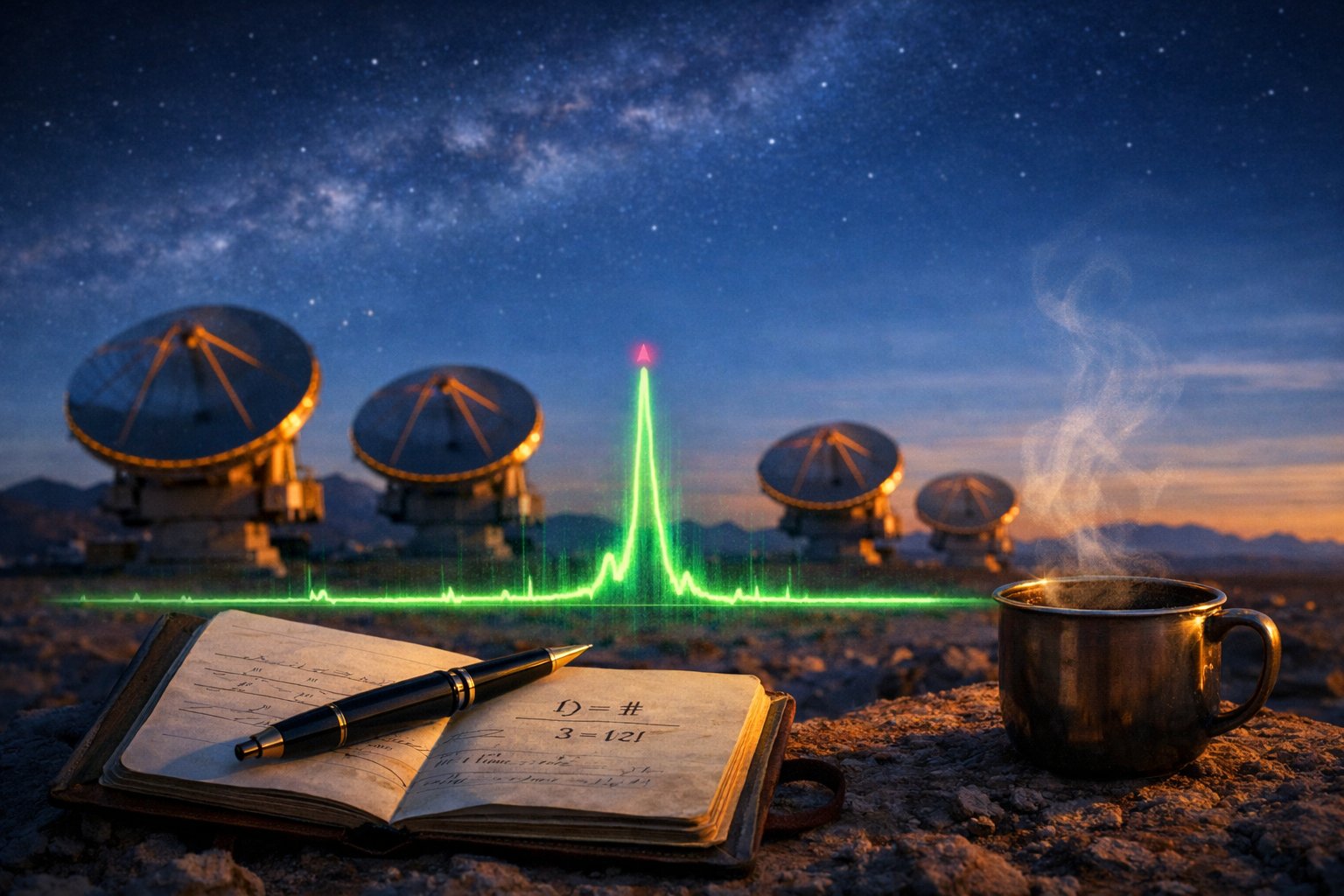
The observations used the Atacama Compact Array, a subset of ALMA optimized for compact-source emission [1]. The team observed during the comet’s pre-perihelion approach in late 2025, when 3I/ATLAS was within roughly 335 million kilometers of Earth. HDO has a rotational transition in the submillimeter that ALMA can resolve, and the comet’s coma was bright enough in that line to permit a detection. The methanol lines, also rotational transitions, served as the secondary probe.
This is the first time deuterium has been measured in an interstellar object. The previous interstellar visitor, 2I/Borisov, outgassed water but never grew bright enough to support an HDO measurement [4]. The first, 1I/’Oumuamua, did not show detectable outgassing at all and was already on its way out by the time anyone could try.
Comparison: 3I/ATLAS Against the Solar-System Cometary Archive
A D/H of 5 to 7 × 10⁻³ for 3I/ATLAS sits well above every comet we have measured at home. Worth listing the comparison set, because the gap is the story:
- 103P/Hartley 2: D/H = (1.61 ± 0.24) × 10-4, measured by Paul Hartogh and collaborators using the Herschel Space Observatory in 2011. Statistically indistinguishable from VSMOW [5].
- 1P/Halley: D/H roughly 3.1 × 10⁻⁴ in water, about twice VSMOW [3].
- C/1995 O1 Hale-Bopp: D/H about 3.3 × 10⁻⁴, again roughly twice VSMOW [3].
- 67P/Churyumov-Gerasimenko: initially reported by the Rosetta mission at about 5.3 × 10⁻⁴, three times VSMOW. A 2024 reanalysis of the full mission dataset, separating coma gas from dust contamination, brought the well-mixed value back near terrestrial [6].
The pattern in the solar system is a factor of one to three above VSMOW, with one Jupiter-family comet sitting essentially at VSMOW. 3I/ATLAS lies between thirty and forty times above that mean. The gap is not subtle.
2I/Borisov: A Different Kind of Strange
Before 3I/ATLAS, the other interstellar comet whose chemistry was characterized was 2I/Borisov in 2019-2020. Two independent ALMA teams reported that 2I/Borisov was extraordinarily rich in carbon monoxide. The CO-to-water ratio in its coma reached at least 173 percent, with one analysis citing CO between 9 and 26 times the average solar-system cometary level [7][8]. That, too, indicated a cold birth environment, because CO ice is volatile and only survives at temperatures below roughly 25 K.
So both interstellar comets we have characterized chemically tell a “cold formation” story, but along different molecular axes. Borisov flagged it with elevated CO. 3I/ATLAS flags it with elevated HDO. They are not necessarily the same kind of object; they are two independent pieces of evidence that the chemistry of comets formed around other stars is genuinely different from the chemistry of comets formed around the Sun.
What the Chemistry Rules Out and What It Suggests
A D/H this high cannot be produced in a warm protoplanetary disk. The deuteration-enhancement reactions in the gas phase shut down above about 30 K because the inverse reactions begin to undo the enrichment. The grain-surface pathways also fall off sharply once volatile mantles desorb. The implication is straightforward: 3I/ATLAS formed in the cold outer reaches of a planetary system around another star, somewhere far from its host’s snow line, where temperatures sat in the 20-to-30 K range or lower [1][2].
In our own system, that temperature regime exists today in the outer Kuiper Belt and Oort Cloud. The deuteration story for 3I/ATLAS is consistent with a comet ejected from the outermost reservoir of some other star’s planetary architecture, perhaps after a close pass with a giant planet that flung it onto an interstellar trajectory. The comet has been traveling between stars for an unknown duration since then, possibly billions of years.
The Methane Wrinkle (a Different Paper, a Related Story)
A separate JWST observing campaign, using NIRSpec in August 2025 and MIRI in December 2025, characterized the volatile inventory of 3I/ATLAS more broadly. Pre-perihelion, NIRSpec found the coma dominated by carbon dioxide, with a CO2-to-water ratio of about 7.6, among the highest ever observed in any comet [9]. Post-perihelion, MIRI detected methane at production rates of 13.7 percent of water on 15-16 December 2025 and 27 percent on 27 December 2025 [10].
The methane timing is itself a small puzzle. Methane is more volatile than CO2, so by simple sublimation logic it should have appeared first, not last. The leading explanation is that the comet’s outer crust was already depleted in methane by long galactic-cosmic-ray exposure, and the freshly excavated subsurface ice only became accessible after perihelion stripped away the surface layer. That is a chemistry story, not a hardware story.
Where the Chemistry Lands in the Bigger Argument
For the broader anomaly catalogue and the interpretive divide between Avi Loeb’s tech-origin hypothesis and the natural-comet camp, the companion piece by Marcus Halloway is the right place to look. This article only handles one well-instrumented chemistry result, and the chemistry result is orthogonal to the larger origin debate. The D/H paper measures one thing: how cold the ice was when it formed. That tells us a real fact about an extrasolar protoplanetary environment. It does not tell us whether the parent body was natural or otherwise, because exotic-hardware hypotheses do not predict water D/H one way or the other.
What the deuterium paper does do is anchor the natural-comet model in a defensible, testable measurement. If 3I/ATLAS were a piece of fabricated technology disguised as an icy body, it would presumably not need to carry HDO at the exact ratio that cold-disk grain-surface chemistry predicts. The fact that it does is a parsimonious data point for the natural-formation reading. It is not a refutation of anything, and the authors do not claim it is.
Reading the Paper Carefully
The Salazar Manzano paper is a careful piece of submillimeter spectroscopy. The authors are explicit about model dependence. They flag the lower-limit nature of the D/H value. They contextualize against the existing solar-system D/H dataset. They report a formation temperature constraint with a stated chemical basis. They do not overclaim on origin.
That is, in the small print, the unsung achievement: a chemistry result on an object that visits the inner solar system once and then leaves forever, done within a discovery window of less than a year, returning a number whose physical interpretation is clean. We don’t yet know how representative 3I/ATLAS is of comets around other stars in general. We have a sample size of two, with chemistries that disagree about which molecule flags the cold most loudly. A third interstellar comet, if it brings its own surprises, will start telling us whether what we are seeing is a universal cold-outer-disk signature or the contingent history of two unrelated planetary systems.
FAQ
What does deuterium-to-hydrogen ratio actually mean?
It is the count of deuterium atoms relative to ordinary hydrogen atoms in a sample of water. Higher D/H signals colder formation, because deuterium-enrichment reactions are most efficient at temperatures below about 30 kelvin.
How much higher is 3I/ATLAS’s D/H ratio than Earth’s?
At least forty times the Vienna Standard Mean Ocean Water value, and at least thirty times the average for comets measured in our solar system [1].
What instrument made the measurement?
The Atacama Compact Array, a subset of ALMA, observing the submillimeter rotational transition of HDO in the comet’s coma during late 2025 [1].
Did they measure water directly?
No. Water fell below ALMA’s sensitivity at the observation geometry. The team inferred the water column by modeling methanol excitation, which means the reported D/H is a lower limit rather than a central value [1].
What temperature does the result imply for the comet’s birthplace?
Below roughly 30 kelvin, with formation likely in the 20-30 K range. The deuteration chemistry that produces this signature does not run efficiently in warmer environments [1][2].
Does this prove 3I/ATLAS is natural rather than artificial?
It is consistent with natural formation in a cold extrasolar protoplanetary disk. It does not formally rule out alternative hypotheses, because those hypotheses do not predict water chemistry. The chemistry result is orthogonal to the origin debate; it constrains formation environment.
How does 3I/ATLAS compare to 2I/Borisov?
Borisov was extraordinarily rich in carbon monoxide, with CO at least 173 percent of water [7]. 3I/ATLAS is extraordinarily rich in deuterium. Both signatures point to cold formation, but along different molecular axes.
Is the result peer-reviewed?
Yes. The paper appeared in Nature Astronomy on 24 April 2026 after peer review [1].
What about the methane outgassing that came up later?
A separate JWST/MIRI dataset detected methane post-perihelion at rates of roughly 13.7 to 27 percent of water production. The leading explanation is that surface methane was lost to cosmic-ray exposure during the comet’s interstellar travel and only fresh subsurface ice released it after perihelion warming [10].
Where can readers find the chemistry paper?
Salazar Manzano et al., “Water D/H in 3I/ATLAS as a probe of formation conditions in another planetary system,” Nature Astronomy, 24 April 2026, DOI 10.1038/s41550-026-02850-5 [1].
Sources
[1] Salazar Manzano, L. E., Paneque-Carreño, T., et al. (2026). “Water D/H in 3I/ATLAS as a probe of formation conditions in another planetary system.” Nature Astronomy, 24 April 2026. DOI: 10.1038/s41550-026-02850-5. https://www.nature.com/articles/s41550-026-02850-5
[2] ALMA Observatory press release (2026). “ALMA Reveals Interstellar Comet 3I/ATLAS Formed in a Far Colder World Than Our Own.” https://www.almaobservatory.org/en/press-releases/alma-reveals-interstellar-comet-3i-atlas-formed-in-a-far-colder-world-than-our-own/
[3] ESA Herschel Science Portal. “Deuterium-to-hydrogen ratio in the Solar System.” https://sci.esa.int/web/herschel/-/49378-the-deuterium-to-hydrogen-ratio-in-the-solar-system
[4] Sky & Telescope (2026). “Interstellar Comet 3I/ATLAS Has Cold, Ancient Origins.” https://skyandtelescope.org/astronomy-news/interstellar-comet-3i-atlas-is-ancient/
[5] Hartogh, P., et al. (2011). “Ocean-like water in the Jupiter-family comet 103P/Hartley 2.” Nature 478, 218-220. DOI: 10.1038/nature10519. https://www.nature.com/articles/nature10519
[6] Mueller, D. R., Altwegg, K., et al. (2024). “A nearly terrestrial D/H for comet 67P/Churyumov-Gerasimenko.” Science Advances. https://www.science.org/doi/10.1126/sciadv.adp2191
[7] Cordiner, M. A., et al. (2020). “Unusually high CO abundance of the first active interstellar comet.” Nature Astronomy 4, 861-866. https://www.nature.com/articles/s41550-020-1087-2
[8] Bodewits, D., et al. (2020). “The carbon monoxide-rich interstellar comet 2I/Borisov.” Nature Astronomy 4, 867-871. https://www.nature.com/articles/s41550-020-1095-2
[9] Cordiner, M. A., et al. (2025). “JWST detection of a carbon dioxide dominated gas coma surrounding interstellar object 3I/ATLAS.” arXiv:2508.18209. https://arxiv.org/abs/2508.18209
[10] Universe Today (2026). “Interstellar Comet 3I/ATLAS Left a Trail of Methane in its Wake.” https://www.universetoday.com/articles/interstellar-comet-3iatlas-left-a-trail-of-methane-in-its-wake
For the broader 3I/ATLAS anomaly catalogue and the interpretive divide between Avi Loeb and the natural-comet camp, see Marcus Halloway’s companion piece. The parent pillar at https://esovitae.com/science-and-natural-anomalies/ indexes related coverage of unexplained astronomical observations.
Adjacent reading in science and natural anomalies: The Spring 2026 Earthquake Swarm Cluster: Brawley, NTTR, and Kanosh and Quantum Entanglement: Spooky Action at a Distance.