By Emilia Wellesley · Published May 6, 2026 · Updated May 13, 2026
Last reviewed: May 6, 2026.
What Is the Cascajal Block?
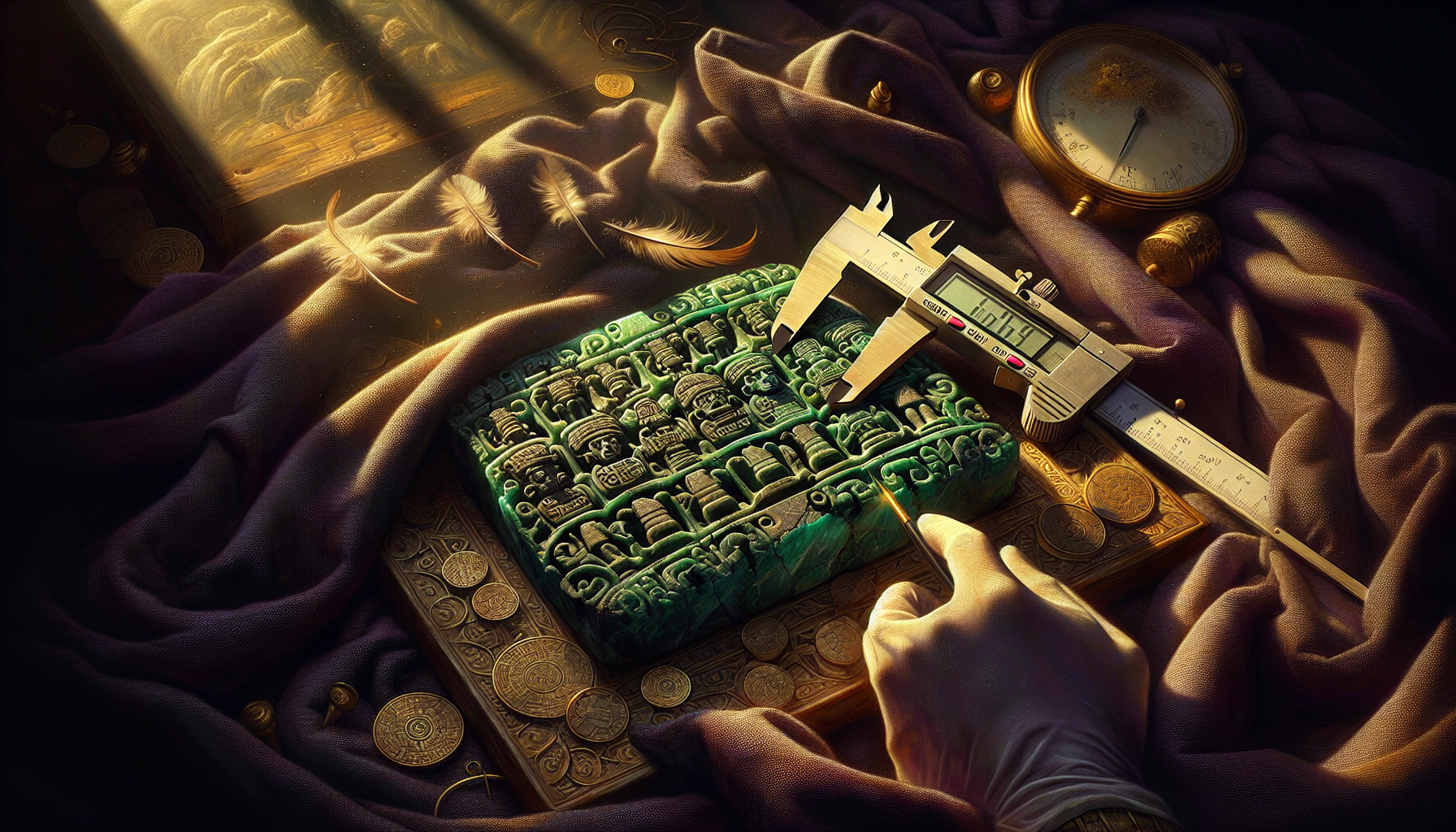
The Cascajal Block is a small slab of greenish serpentinite, roughly the size of a hardcover book, incised on one face with sixty-two carved signs. It is dated to the late San Lorenzo phase of Olmec civilization, around 900 BCE, and was first published in 2006 as the earliest evidence of writing in the New World. Whether those signs constitute writing in the strict linguistic sense remains a live and unresolved scholarly question.
The artifact weighs about 11.5 kilograms and measures 36 by 21 by 13 centimeters, a domestic object rather than a monument. The signs are arranged horizontally rather than in the vertical columns familiar from later Maya stelae, and several recur in patterns that look, depending on the eye reading them, either like a script with grammar or like a ritual catalogue of objects. Both readings remain alive twenty years after the first announcement, which is itself useful information about how the past is reconstructed when the evidence comes to us out of context.
What follows traces how the block was found, what its 2006 publication claimed, why some scholars treat the signs as writing and others as iconography, and where the artifact sits within the larger field of historical and archaeological mysteries.
How the Block Was Found
The Cascajal Block has the kind of discovery story archaeologists wince at and historians keep returning to anyway. In 1999, road builders working a gravel quarry near the village of Lomas de Tacamichapan in the Veracruz lowlands began turning up ceramic shards, clay figurines, and an inscribed slab of green stone. The site, locally called El Cascajal, sits in the Olmec heartland, the same region that produced the colossal stone heads of San Lorenzo Tenochtitlán a few kilometres away.
The block was not lifted from a sealed archaeological context. It was pulled from disturbed road-construction debris, traceable back to a nearby earthen mound that had already been damaged before any specialist arrived. In strict archaeological practice, an object recovered from primary context, in a measurable stratum, with associated finds in their original positions, carries a different kind of evidentiary weight than an object handed up from a gravel pile. The Cascajal Block sits in the second category.
The associated ceramics and figurines, recovered alongside the block by Mexican archaeologists Ma. del Carmen Rodríguez Martínez and Ponciano Ortíz Ceballos of the Instituto Nacional de Antropología e Historia, place the deposit in the late San Lorenzo phase, roughly 1200 to 900 BCE. That assemblage, rather than the block itself, supplies the date cited in the literature.
The 2006 Science Publication
Seven years after the find, on 15 September 2006, the journal Science published “Oldest Writing in the New World,” authored by Rodríguez Martínez, Ortíz Ceballos, Michael D. Coe (1929-2019) of Yale, Richard A. Diehl of the University of Alabama, Stephen D. Houston of Brown University, Karl A. Taube of the University of California, Riverside, and Alfredo Delgado Calderón. The paper made a careful but pointed claim: the block bears a coherent inscription that meets the formal criteria for writing, and it predates the next-earliest Mesoamerican texts, the Zapotec material from Monte Albán, by perhaps four centuries.
Stephen Houston, lead voice for the team in the press coverage, framed the discovery to EurekAlert as “a tantalizing discovery” that could open “a new era of focus on Olmec civilization.” The team reported that the inscription contains sixty-two signs, of which twenty-eight are distinct: three signs repeat four times, six recur three times, twelve appear twice, and seven are unique. That distribution is the kind of structured frequency one expects from a script with a finite repertoire of meaningful units, rather than from random ornamentation.
The team also identified what looked like paired sequences of signs that recurred in the same order, which they cautiously offered as possible poetic couplets or formulaic phrases. Couplet structure is well attested in later Mesoamerican literatures, so the proposal was an attempt to read the Olmec text through patterns that survived into the historic period. According to the Encyclopaedia Britannica, this orthographic regularity is one of the strongest arguments for treating the inscription as a writing system rather than as decoration.
Why Some Scholars Read It as Writing
The case for the Cascajal Block as writing rests on several converging features. The signs sit in linear sequences. They recur with the frequency distribution one finds in script-bearing artifacts, not the flatter distribution typical of iconographic compositions. Some signs are clearly compound, built from elements that appear independently elsewhere on the block. The arrangement reads consistently in one direction. The surface had been smoothed, used, partially erased, and used again, suggesting a reusable working surface rather than a single ritual deposit. Houston, Coe, and Taube argued that the artifact resembles a wax-tablet logic, a surface meant to be carved, read, smoothed, and carved again, which shifts the block from ceremonial display toward administrative or scribal use.
Joel Skidmore’s Mesoweb Commentary
Joel Skidmore of the Pre-Columbian Mesoweb research consortium wrote one of the most cited early accessible commentaries on the block, treating the 2006 publication as a watershed for Olmec studies. Skidmore noted that the script does not link cleanly to any later Mesoamerican system: it is not a direct ancestor of Maya glyphs, Zapotec writing, or the Isthmian script. If the block is a writing system, it appears to be either a regional tradition that left few descendants or a genuine dead end.
Later Archaeometric Support
In 2019, a team led by Joshua D. Englehardt published a digital-imaging and archaeometric analysis in Ancient Mesoamerica. Their scanning electron microscopy showed that the carving traces, fine irregular incisions between 0.6 and 1.3 micrometres wide, match obsidian-tool techniques and sandstone abrasion patterns documented on securely provenanced Formative-period Olmec objects. X-ray fluorescence indicated the serpentinite itself most closely matches outcrops at Tehuitzingo, Puebla, a quarry already linked to other Olmec material. The patina runs uniformly across the carved lines and the surrounding surface, indicating that the inscriptions are not modern additions to an old stone.
Why Other Scholars Read It as Iconography
Not everyone reads the block as writing. The most developed alternative came from David A. Freidel and F. Kent Reilly III in 2010. They argued that the inscribed surface depicts the contents of three sacred bundles, ritual containers used in Mesoamerica to hold and present sets of meaningful objects, arranged in three registers from top to bottom. On their reading, the recurring signs are not phonetic or logographic units of language but pictorial inventories of items: maize cobs, fish, animal hearts, ritual implements.
Freidel and Reilly’s reading rests on the observation that several Cascajal signs resemble objects that show up independently in Olmec iconography. The “maize cob” sign on the block has clear parallels in painted ceramics from the same period. If the surface is a list of bundle contents, the linear arrangement is incidental to a different kind of order, the order in which objects were laid out, not the order of words in a sentence.
A more general source of skepticism is the recovery context. Because the block was not excavated in primary deposit, the dating depends entirely on the surrounding ceramics, which themselves come from disturbed earth. David Stuart of the University of Texas at Austin, a leading epigrapher of Maya and broader Mesoamerican script, reviewed the original 2006 paper for Science and accepted the artifact as a genuine ancient inscription, while several geologists raised early questions about whether the carved lines weathered consistently with the rest of the surface. The 2019 archaeometric work has substantially answered those concerns, but the provenance gap itself cannot be undone.
What Counts as a Writing System
The Cascajal debate is partly an argument about a definition. Linguists generally reserve “writing” for sign systems that encode the units of a specific spoken language: phonemes, syllables, morphemes, or whole words. By that strict standard, a system can only be confirmed as writing when its signs can be matched to the sounds or meanings of a known tongue. The Olmec spoken language is not securely identified, and no bilingual text exists to anchor any reading, which means the block cannot be tested by the strict criterion.
The looser standard, often called proto-writing or glottographic-leaning notation, allows for sign systems that pattern like writing without yet being decipherable. Mesopotamian proto-cuneiform of the late fourth millennium BCE sits in this category for its earliest phases, before scholars could reliably assign signs to Sumerian words. The Cascajal Block, on the proto-writing reading, is a comparable case: an inscription that behaves like a script, by frequency, sequence, and compositional rules, but that has not yielded a language.
Where the Cascajal Block Fits Among Undeciphered Scripts
The block belongs to a small global cohort of inscribed objects whose status as writing remains unsettled. The Indus Valley Script, dating from roughly 2600 to 1900 BCE in present-day Pakistan and northwest India, has many more inscriptions but similar interpretive problems: short texts, no bilingual, no securely identified underlying language. The undeciphered Cretan hieroglyphic and Linear A scripts of Bronze Age Crete share the same basic puzzle, although in their cases the link to a fuller script tradition is clearer.
Within Mesoamerica, the Cascajal Block is the earliest claimed writing, followed by the Zapotec inscriptions at San José Mogote and Monte Albán in the late centuries of the first millennium BCE, and then by the Isthmian script and the early Maya inscriptions of the late Preclassic and Classic periods. None of these later traditions descends visibly from the Cascajal repertoire, which is one reason Skidmore and others describe the block as possibly a tradition that left no surviving children.
What the Block Means for Olmec Civilization
If the inscription is writing, the implications run far beyond a single artifact. The Olmec civilization, centred on the Gulf Coast lowlands from roughly 1500 to 400 BCE, is already credited with foundational contributions to Mesoamerican culture: monumental sculpture, calendrical thinking, the iconography of rulership, and the ritual ballgame. A confirmed Olmec script would add literate administration to that list, and would push the origin of writing in the Americas back by several centuries.
The political consequences inside Mesoamerican studies are real. Some scholars, including Smithsonian Magazine’s reporting on the find, framed the Cascajal Block as evidence that the Olmec functioned as a “mother culture” from which later Mesoamerican literacy descended. Others, working in a “sister cultures” model, are wary of single-source narratives and prefer to keep the Olmec, Zapotec, and early Maya traditions in distinct family trees. The block is at the centre of that debate without resolving it.
The Open Question
Twenty years after the announcement, the most honest answer remains that the Cascajal Block is the strongest single candidate for the earliest writing in the New World, that the case for it as a writing system is supported by orthographic patterns, manufacturing evidence, and material analysis, and that the case is not yet closed. The script has not been deciphered. The provenance is imperfect. The iconographic alternative reading still has serious defenders.
The block sits, for now, in the productive middle space where evidence is real but interpretation is contested. That space is where most of the past actually lives. The Cascajal Block does not need to be a deciphered script to matter. It needs to be looked at carefully, asked the right questions, and held open until either a second inscription emerges to confirm the system or a new framework persuades the field to read the surface differently.
Frequently Asked Questions
Where is the Cascajal Block now?
The block is held in the regional collection of the Centro INAH Veracruz of the Instituto Nacional de Antropología e Historia, the Mexican federal institution responsible for archaeological heritage. It has been studied directly by the original publication team and by later researchers using non-destructive imaging methods.
How old is the Cascajal Block?
The associated ceramic and figurine assemblage dates to the late San Lorenzo phase of Olmec civilization, approximately 1200 to 900 BCE, with most published estimates placing the block itself near the end of that range, around 900 BCE. The 2019 archaeometric study supports a Formative-period date consistent with this range.
Has the Cascajal Block been deciphered?
No. None of the sixty-two signs have been securely matched to a sound or word in any known language. The Olmec spoken tongue is itself not confidently identified, and no bilingual inscription exists to anchor a reading. The script, if it is one, remains undeciphered.
How many distinct signs does it have?
Out of sixty-two carved signs, twenty-eight are distinct. Three signs appear four times each, six appear three times, twelve appear twice, and seven appear only once. That distribution pattern resembles the frequency profile of known scripts more than the profile of typical iconographic compositions.
Why is the provenance considered weak?
The block was not recovered by archaeologists from a sealed stratigraphic deposit. Road builders pulled it from disturbed gravel debris in 1999, and specialists arrived after the original context had already been compromised. The dating depends on associated ceramics and figurines from the same disturbed earth, not on the block itself in undisturbed position.
Is the Cascajal Block authentic?
Material analysis strongly supports authenticity. The 2019 archaeometric study using scanning electron microscopy and X-ray fluorescence found that the carving techniques match Formative-period Olmec lapidary methods and that the serpentinite material derives from a known Olmec quarry source at Tehuitzingo, Puebla. The patina runs continuously across the inscriptions and the surrounding surface.
Why do some scholars dispute that it is writing?
The most developed alternative reading, by David Freidel and F. Kent Reilly in 2010, treats the surface as an iconographic record of three sacred bundles and their contents rather than a linear text. Several recurring signs resemble objects depicted independently elsewhere in Olmec art, which supports the bundle-inventory reading.
Does the Cascajal script have any descendants?
No clear descendants are known. The Cascajal sign repertoire does not match the later Zapotec, Isthmian, or Maya scripts in any sustained way. If it is a writing system, it appears to be either an isolated regional tradition or a script that did not survive into the better-documented periods of Mesoamerican literacy.
Why does the discovery matter for the Olmec mother-culture debate?
A confirmed Olmec script would strengthen the view that the Olmec civilization seeded foundational practices, including literacy, that later Mesoamerican cultures inherited and adapted. Scholars working in a “sister cultures” framework, who treat the early Mesoamerican societies as parallel rather than ancestral, read the block more cautiously and resist any single-origin narrative.