By Emilia Wellesley · Published May 4, 2026 · Updated May 13, 2026
Last reviewed: May 4, 2026.
The Indus Valley Script remains one of the great unsolved enigmas of ancient languages and archaeological studies. While the civilization itself left extensive ruins and artifacts, the script, found on various seals and tablets, continues to baffle linguists and historians. Given its undeciphered status, each symbol, seal impression, and clay tablet offers an intriguing glimpse into the advanced urban culture of the Indus Valley Civilization.
Archaeological Context of the Indus Script
Discovery and Excavation
Tracing the Roots: The initial discovery of the Indus Valley script occurred during the significant excavations at Harappa and Mohenjo-Daro, where archaeologists unearthed numerous seals and tablets inscribed with cryptic symbols. These findings opened a Pandora’s box of historical mysteries waiting to be solved, dating back to the flourishing period of the Indus Valley Civilization from approximately 3300 BCE to 1300 BCE.
Talk about expansion to other sites! Excavations at Dholavira and Rakhigarhi later broadened the geographical and cultural understanding of the Indus script. It’s fascinating how these artifacts peppered across varied sites provide a mosaic of ancient urban life and its complexities. These expeditions have not only enriched the corpus of inscriptions but have also diversified the contexts in which these scripts were used, shedding light on a broader spectrum of ancient communication and record-keeping practices.
Materials and Forms
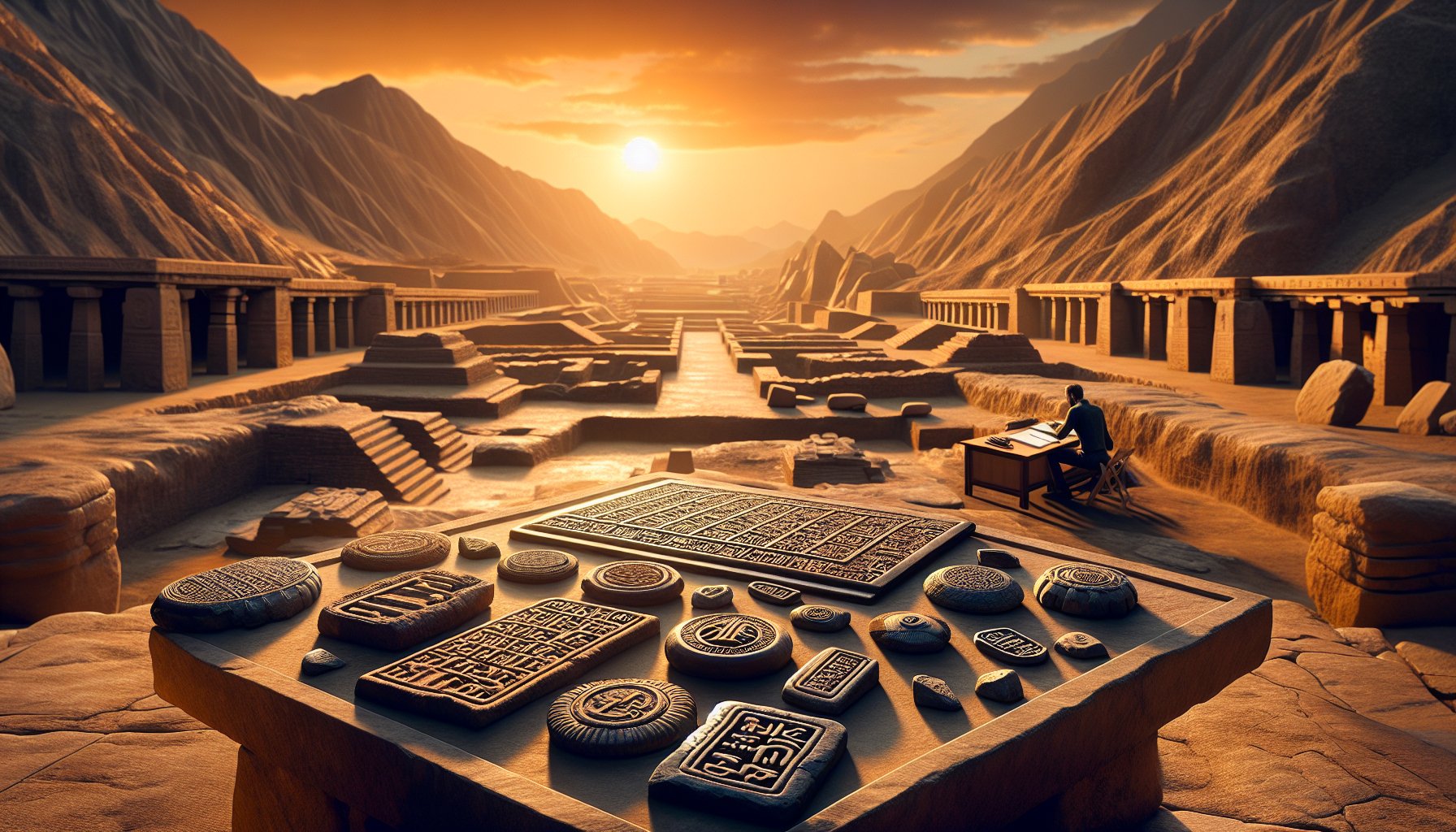
Delving into the variety and versatility of materials — the Indus script was predominantly found on seals made of soapstone, terracotta tablets, and occasionally on metal implements. This suggests a society that was versatile in its use of materials for record-keeping and communication.
And let's not skim over the different forms: the seals, often square or rectangular, embellished with animal motifs and script, hint at a complex system of trade and administration. These seals likely played a crucial role in commercial and bureaucratic activities, acting as markers of authenticity and ownership. Meanwhile, tablets, some inscribed with dense clusters of script, potentially served educational or ceremonial purposes, offering a tantalizing glimpse into the daily and spiritual lives of the Harappans.
These artifacts aren't just archaeological treasures; they're silent narrators telling tales of a civilization steeped in complexity and sophistication, awaiting the key to unlock their secrets. From Mohenjo-Daro to Harappa, and extending out to Lothal and Kalibangan, each piece links together the vast jigsaw of the Harappan way of life, providing pathways that lead us closer to deciphering their lost language and, essentially, their lost world.
Unraveling the Indus Valley Script
In unraveling the complexities of the Indus Valley Script, one of the primary focuses revolves around its cultural and administrative roles. These small but intricately carved seals and delicately inscribed tablets may look unassuming, yet they are potential keys to understanding the day-to-day lives and the societal structures of one of the world's earliest urban civilizations.
Hypothesized Functions of the Script
The Indus script's potential applications are as varied as they are fascinating. Scholars propose that these symbols served multifaceted roles, perhaps as administrative tools to monitor trade, goods, or even labor. Given the strategic locations where these scripts were often found, such as on seals associated with goods and in prominent urban centers like Harappa and Mohenjo-Daro, it's plausible to suggest they played a part in bureaucratic control. This hypothesis aligns with comparative evidence from contemporary cultures in Mesopotamia, where similar systems of script on seals facilitated trade and administrative activities.
Moreover, the script's presence in what appears to be non-commercial contexts suggests that its use extended into realms of ritualistic significance. These could have included:
- Religious ceremonies
- Royal decrees
- Scripts encrypted for elite or priestly classes only
The diverse placements and sizes of these inscriptions suggest their varied applications across different social strata and urban settings.
Comparative Analysis with Contemporary Scripts
Zooming out to the broader Bronze Age landscape provides additional insights.
Artifacts comparisons:
- Egyptian hieroglyphs
- Mesopotamian cuneiform
When comparing the artifacts bearing the Indus script with Egyptian hieroglyphs or Mesopotamian cuneiform, fascinating parallels and divergences emerge. Both the Mesopotamian and Indus cultures utilized seals extensively, indicating a shared concept of administrative control and identity reinforcement.
Cultural exchanges:
- Not just in the physical goods traded but also in technological and ideological transfers
- The complexity and sophistication in urban planning observed in the Indus Valley mirrors those seen in Mesopotamia, hinting at possible influences or parallel developments in writing systems.
Such cross-cultural interactions could provide clues about the script’s genesis and its functional evolution over time.
In peeling back the layers of how the Indus script interacted with its cultural environment and compared with its contemporaries, a rich narrative of ancient urban sophistication and interconnectedness begins to form. These analyses are not just academic—they reshape how we perceive the historical capabilities and complexities of ancient societies.
Methodologies for Decipherment
Delving into the intricate world of the Indus Valley Script, deciphering it stands as a formidable challenge due to its undeciphered nature and the monumental implications such breakthroughs could bring to understanding ancient South Asian cultures. This section scrutinizes various methodologies employed in the painstaking quest to decode this cryptic ancient script.
Linguistic Analysis Approaches
The linguistic analysis of the Indus script is a complex field mingled with fervent debates and ingenious hypotheses. At the forefront are linguists and scholars who apply historical linguistics, seeking patterns and analogies with known languages.
- Key Proponent: Asko Parpola, a significant figure in this domain, spearheads the Proto-Dravidian theory, suggesting a potential linguistic kinship between the script and ancient Dravidian languages.
- Methodology: This approach hinges on comparative linguistics, where:
- Symbol analysis
- Linguistic patterns
- Phonetic components
are meticulously compared against a backdrop of known languages to unearth underlying linguistic structures.
- Challenges: Yet, the absence of a Rosetta Stone-like artifact leaves these theories in a delicate balance of educated conjectures and intense academic scrutiny.
Modern Computational Techniques
In the digital age, computational analysis emerges as a formidable ally. Leveraging algorithms and binary sequences, researchers and technologists attempt to unpack the script's structure and contextual usage.
- Field Development: Computational linguistics, once a fledgeling field, now offers significant promise through machine learning models that simulate various decipherment scenarios.
- Techniques Employed:
- Analysis of the script’s syntax
- Structure proposals for understanding sequences and repetitions within the script
This modern technique intersects with cryptography, where deciphering a script is akin to decoding a complex cipher without a key.
- Advancements: Each computational trial adds a layer of understanding or redefines the perplexities of the script’s syntax.
By forging a path through these diversified analytical approaches, researchers incrementally peel back layers of historical and linguistic mystique that envelop the Indus Valley Script. Each method, be it rooted in traditional linguistics or cutting-edge technology, offers a unique lens to view the tantalizing enigma presented by these ancient inscriptions. As such, the exploration into the Indus script is not just a scholarly pursuit but a multidisciplinary odyssey at the intersection of history, technology, and linguistics.
The Challenges of Deciphering the Indus Script
Deciphering an ancient script is akin to fitting together the pieces of a historical puzzle without having the picture on the box as a guide. This challenge is particularly acute in the case of the Indus Valley Script, a cryptic script from one of the world's earliest urban cultures. The hurdles faced by researchers, from the absence of bilingual texts to the sheer complexity of the script’s symbols, reveal why this ancient language remains undeciphered.
Crucial Absence of Bilingual Texts
Bilingual texts have been the Rosetta Stone for deciphering numerous ancient scripts. For example, the decipherment of Egyptian hieroglyphics was largely due to the discovery of the Rosetta Stone, which coupled the same text in Egyptian and Greek. Unfortunately, such a bilingual counterpart has not been found for the Indus script, plummeting linguists into a quandary. This lack significantly impairs linguistic breakthroughs, as comparative analysis with known languages could offer clues about the syntax, structure, and vocabulary of the script. Without these bilingual texts, the Indus script remains an elusive cache of knowledge, its secrets locked within symbols that refuse to speak the language of modern scholars.
Symbol Complexity and Corpus Limitations
The intricacy of the Indus script further perplexes researchers. With over 400 unique signs, significantly more than typical alphabets, the script suggests a complex system of writing possibly indicative of a rich linguistic tradition. However, most of these symbols are found in very brief inscriptions on seals and tablets, leaving a limited corpus for extensive analysis. This scarcity of long texts hampers efforts to determine if the script represents language per se or a series of ideographic or symbologic representations.
Moreover, the proponents of the "non-linguistic" theory argue that the script might be logographic, representing concepts rather than sounds, which would challenge traditional phonetic decipherment methods. The debate adds another layer of complexity to interpreting the script, as the scholarly community remains divided on whether the script even constitutes a language in the strictest sense.
The Forensic Struggle in Script Analysis
Linguists and archaeologists also face a forensic struggle, piecing together symbol meanings from fragmentary evidence. Each symbol’s context varies widely depending on its archaeological site, the type of artifact it's inscribed upon, and its combination with other symbols. This diversity suggests a multiplicity of uses and meanings, reflective perhaps of different social contexts or administrative purposes. As such, even robust analyses yield interpretations that are speculative at best, requiring further corroboration through additional archaeological discoveries.
Furthermore, the geographical distribution of the script across a range of sites—from Harappa in Pakistan to Lothal in India—introduces different regional variants of the script, complicating standardized interpretation. The variance indicates a widespread use across several city-states, each potentially adapting the script to local needs and dialects, much like the divergent use of cuneiform across ancient Mesopotamia.
Synthesizing New Methodologies
In response to these challenges, researchers have begun synthesizing traditional archaeological methods with advanced technologies like computational linguistics and digital imaging. These modern tools help simulate potential linkages and create digital models of how the script might have evolved. Nevertheless, the synthesis of such diverse methods, while innovative, still primarily offers hypothetical solutions, awaiting confirmation by tangible archaeological evidence.
As we delve deeper into the Indus script, we find ourselves grappling with not just a linguistic mystery but also broader questions about the nature and evolution of early human communication. The journey to unravel the Indus script, therefore, is not merely an academic endeavor but a quest to connect with our ancient human ancestors, understanding their lives through the symbols they left behind. This exploration, while fraught with challenges, continues to be a testament to human curiosity and scholarly determination.
Insights from Symbol and Iconographic Analysis
Detailed Symbol Studies
Diving into the labyrinth of the Indus script, one encounters a plethora of symbols, each possibly a doorway to understanding the daily life, governance, and spiritual beliefs of the Indus Valley Civilization. Scholars have cataloged over 400 distinct signs, ranging from geometric patterns to intricate animal depictions. These symbols are not just artistic expressions but are believed to convey specific meanings, their repetitive patterns across various media suggesting a standardized system of communication.
A notable aspect of these symbols is their appearance on different materials, including seals, pottery, and metal tools, which hints at their utility in diverse contexts from administrative to possibly religious. For instance, the 'unicorn' seal, frequently found in Harappa, shows a single mythical creature that some scholars argue represents a high social or religious symbol within the civilization. Such interpretations, while speculative, encourage a deeper look into the socio-religious fabric of the early Bronze Age urban dwellers.
Comparative Iconography
The comparative study of Indus iconography with contemporaneous civilizations reveals parallels and divergences that are critical for contextual interpretation. Similar to the motifs found in Mesopotamian artifacts, some seals from Mohenjo-Daro depict scenes of ritualistic importance, suggesting a potential cultural exchange or common mythological themes across these ancient urban societies. However, the absence of a deciphered script makes direct comparisons tentative and often conjectural.
By analyzing these symbols alongside other archaeological findings like jewelry, terracotta figurines, and architectural remains, researchers piece together a fragmented but emerging picture of life in the Indus Valley. Such analyses not only help in identifying the possible utility of these symbols but also in understanding the hierarchical structure and economic systems that might have existed.
Theories on Non-verbal Markers
Intriguingly, some academics propose that the Indus script may not represent spoken language but rather a series of non-verbal markers used for specific civil or commercial purposes. This theory aligns with the discovery of numerous seals at administrative or commercial centers like Lothal and Harappa, which might indicate their use in trade or as identity markers for property and goods.
Furthermore, the recurrence of certain symbols in association with specific goods or in specific urban quarters lends credence to the idea that they functioned as part of a complex system of tags or labels within the community, facilitating the management of resources, trade goods, or even labor. Decoding these symbols might therefore not reveal linguistic content but could unlock insights into the economic organization and social stratification of the civilization.
Integrating Technological Methods
Advancements in digital imaging and 3D scanning have revolutionized the way researchers engage with these ancient symbols. High-resolution scans allow for more precise analyses of wear patterns and chisel marks on seals, suggesting the techniques and tools used in their creation. Computational models can simulate various arrangements of symbols, aiding in the identification of patterns that human researchers might overlook.
These technological tools are not just enhancing our understanding of individual symbols but are also crucial in piecing together how these symbols functioned together as a part of larger texts or records. Every scanned seal and every modelled inscription brings scholars a step closer to unraveling the economic and administrative sophistication of the Indus Valley Civilization, providing a clearer image of its inhabitants' interactions and daily transactions.
Through meticulous symbol studies and the application of modern technology, the enigmatic tablets and seals of the Indus Valley continue to offer new insights into an ancient civilization that was as complex as it was advanced. While the full decipherment of their script remains elusive, each study adds a piece to the puzzle, slowly but surely sketching a more comprehensive picture of a society that thrived thousands of years ago.
Interdisciplinary Contributions to Indus Script Research
As researchers peel back the layers of time to understand the Indus Valley Script, contributions from various scholarly fields have proven indispensable. Archaeology and anthropology, alongside technological advances, not only enhance our understanding of this cryptic language but also weave a richer tapestry of the ancient Indus Valley Civilization.
Contributions from Archaeology and Anthropology
Archaeologists and anthropologists have been instrumental in piecing together the environmental and cultural contexts of the Indus Valley Civilization. Major urban centers like Harappa and Mohenjo-Daro, revealed through meticulous excavations, offer critical insights into the daily lives and the administrative sophistication of the civilization. These sites have unearthed numerous artifacts, including seals, tablets, and potsherds, which bear the mysterious script.
The role of seals, often featuring both animal motifs and script, suggests a complex system of goods and maybe even administrative or ritual use. Anthropological insights into these artifacts propose that the Indus script was not merely decorative but served a practical purpose that was integral to the societal framework. This perspective is supported by the distribution of seals, which indicates a wide social application, possibly for identity or ownership.
The Impact of Technological Advances
The recent integration of advanced technological tools has transformed the study of the Indus script. Digital archiving and artifact scanning allow for precise reproductions of inscriptions, which researchers can analyze without risking damage to the original items. These digital replicas provide an invaluable resource for ongoing research and facilitate global collaboration by sharing findings with international experts in real time.
Moreover, computational analysis techniques, such as the use of binary sequences, have introduced a new dimension to the decipherment efforts. These methods enable scholars to identify and categorize patterns within the script, potentially leading to breakthroughs in understanding its structure and content. For instance, algorithmic pattern recognition can compare the Indus script with other ancient languages, offering clues that manual analysis might miss.
By leveraging these modern techniques, researchers can conduct more in-depth and comprehensive studies than ever before. For example, digital models of seal impressions can be analyzed en masse to detect subtle variations and repetitions across a vast dataset, which might indicate grammatical or syntactical rules if the script is indeed linguistic.
Bridging Disciplines to Unravel Ancient Mysteries
The interdisciplinary approach to studying the Indus script underscores the necessity of collaboration across fields. Archaeological and anthropological contexts provide the script's environmental and cultural framework, while technological innovations offer new tools for its analysis. Together, these disciplines are unraveling the complex narrative of the Indus Valley Civilization, demonstrating that the integration of traditional scholarship with modern technology not only broadens our understanding but also preserves this ancient heritage for future generations.
The Script's Cultural and Historical Significance
Exploring the Indus Valley Script illuminates the sophisticated essence of a lost civilization, where each unsolved glyph tantalizes scholars with the possibility of profound revelations. The implications of its potential decipherment reach far beyond mere translation; they promise to reshape our comprehension of the Indus Valley Civilization, offering insights that could revolutionize understanding of ancient economic systems, socio-political hierarchies, and intercultural exchanges.
Hypothetical Impacts of Script Decipherment
Imagine, if you will, a world where the enigmatic symbols of the Indus script are finally interpreted, unveiling the daily lives, governmental structures, and economic strategies of a civilization that thrived over 4,000 years ago:
- Trade Practices: Such a breakthrough could reveal detailed records of trade practices which might suggest a network of bazaars bustling with goods from distant lands, potentially underscoring the Indus Valley as a fulcrum of ancient commerce akin to the commercial hubs we see today.
- Social Structures: A deeper understanding of social structures might emerge, highlighting nuanced class or occupational divisions, hence offering a comparative perspective to modern societal systems.
Script's Significance in South Asian Studies
The script holds a pivotal place in South Asian studies, serving as a keystone in the arch of regional history.
- Advances in Interpretation: Should scholars unlock its secrets or even make significant advances in theoretical approaches, narrative paradigms of prehistoric literacy, communication, and cultural identity in South Asia may undergo comprehensive recalibration.
- Impact on Global Academic Discourse: This would not only enhance regional historic narratives but also enrich global academic discourse on proto-writing systems and early urbanization.
- Collaborative Potential: The script's study could foster enhanced collaboration among linguists, historians, and archaeologists, yielding a multidisciplinary wealth of knowledge and potentially positioning South Asian studies at the vanguard of ancient script decipherment.
The journey towards deciphering the Indus Valley script is peppered with both challenges and opportunities. Although the road may be long and fraught with complexities, the script continues to be a beacon that draws a myriad of scholarly explorations and excites the imagination of all who delve into its mysteries. The potential findings from such studies promise not just academic accolades but a deeper, more connected understanding of human history in the tapestry of time.