By Emilia Wellesley · Published May 1, 2024 · Updated May 13, 2026
Last reviewed: May 1, 2024.
What Is the Baghdad Battery?
The Baghdad Battery is a clay jar, roughly thirteen centimeters tall, holding a copper cylinder and an iron rod, recovered near Baghdad in the late 1930s and dated by most scholars to the Parthian or early Sasanian period (roughly 250 BCE to 650 CE). Its German excavator argued it once produced electric current. The British Museum‘s metallurgists argued it stored sacred scrolls. The artifact still resists a single answer.
A few objects in archaeology refuse to settle into the category their finders chose for them. The jar from Khujut Rabu is one of them. It is a small, ordinary-looking pot with extraordinary insides: a sheet of copper rolled into a tube, an iron rod corroded almost to a stub, and traces of a residue read as either bitumen seal or chemical electrolyte. For nearly a century, archaeologists, museum curators, electrical engineers, and television crews have argued about whether the assemblage represents the world’s oldest galvanic cell or simply a clever piece of religious storage. The dispute is genuinely unresolved, and the reasons it remains unresolved are themselves a useful lesson in how ancient material is read.
This guide walks through the discovery, the competing reconstructions, the experiments that tried to settle the question, and the wider cultural argument the artifact has come to anchor. The aim is to hold both the König hypothesis and the Craddock reading in view without flattening either, situating the jar within the broader landscape of historical and archaeological mysteries.
Discovery at Khujut Rabu
The jar was uncovered at the village of Khujut Rabu, just outside Baghdad, in 1936. Workers from the Iraq State Railway, digging a foundation trench, broke into a tomb that yielded several similar vessels. The objects were transferred to the National Museum of Iraq, then under the supervision of the German archaeologist Wilhelm König (1906-1987), who had recently taken charge of the museum’s antiquities laboratory. König catalogued the pieces alongside other Parthian-era finds and noticed something the workers had missed: each jar contained a small assemblage of metals that looked, to his eye, less like grave goods than like apparatus.
The Object Itself
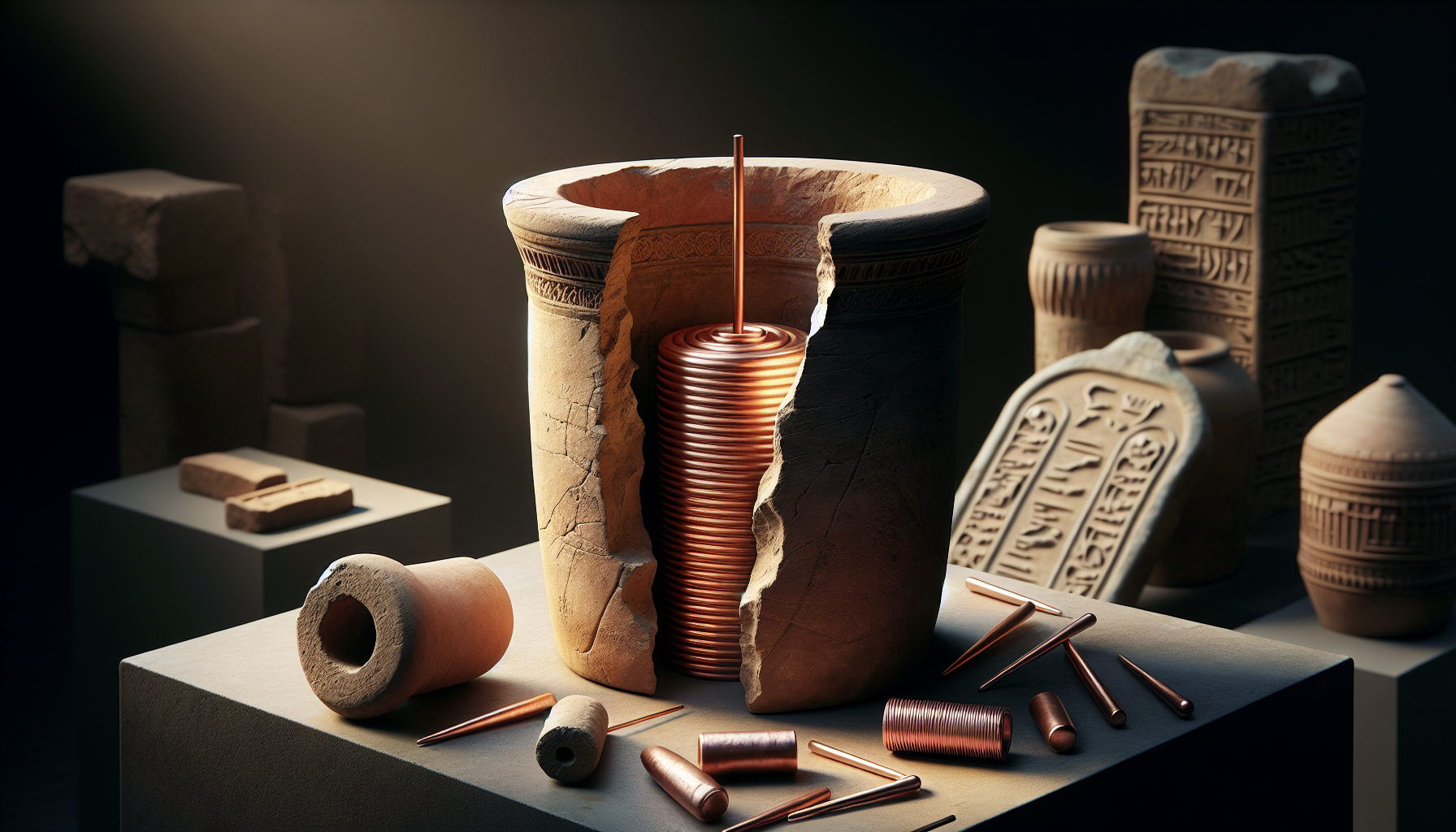
The principal artifact is a buff-yellow ceramic jar approximately 13 to 14 centimeters in height. Inside sits a copper cylinder, formed from a rolled sheet roughly 9 centimeters tall, soldered along its seam with a lead-tin alloy. A heavily corroded iron rod, suspended down the cylinder’s axis, projects slightly from the top. A plug of asphalt or bitumen seals the rod and the cylinder’s mouth, isolating both metals from the surrounding clay. The interior contains traces of a corrosive residue. König read this assembly as electrochemistry. Later analysts read it as preservation.
Dating Disputes
König placed the jars in the Parthian era, roughly the late centuries BCE through the early third century CE [1]. Subsequent reassessment by Iraqi and British scholars suggested several of the recovered vessels are stylistically Sasanian, postdating 224 CE and possibly as late as the seventh century. The asphalt sealant and the iron-rod-in-copper-cylinder construction were both used in late antique scroll storage at Seleucia and Ctesiphon, which complicates any tight Parthian date. The jars have never been radiocarbon-dated; the dating remains stylistic and stratigraphic.
The König Hypothesis: Galvanic Cell
In 1940, Wilhelm König published a short paper in the Austrian journal Forschungen und Fortschritte proposing that the Khujut Rabu jars functioned as primitive galvanic cells [2]. He drew the analogy to the Voltaic pile that Alessandro Volta announced in 1800: two dissimilar metals separated by an electrolyte, generating a small but measurable voltage. The copper cylinder and iron rod fit the geometry, the bitumen plug fit the role of an insulator, and a sour electrolyte such as wine, vinegar, or grape juice would, in principle, complete the circuit. König speculated that Parthian craftsmen used the cells to electroplate gold onto silver, anticipating modern electrochemistry by nearly two millennia.
Why the Idea Took Hold
The hypothesis arrived in print as Europe entered the Second World War, and German-language scholarship was disrupted, but the argument migrated quickly. Willard F.M. Gray, an engineer at the General Electric High Voltage Laboratory, built a working replica in 1940 using copper sulphate and produced about half a volt. Later experimenters, including a 1978 reconstruction by the Egyptologist Arne Eggebrecht at the Roemer-Pelizaeus Museum in Hildesheim, reported similar results: a single jar, charged with grape juice, generated roughly 0.5 to 1 volt and could deposit a thin gilding film on a small object over several hours.
What the Hypothesis Requires
For the galvanic reading to hold, the original jar must have contained an electrolyte at burial or immediately before, and the copper-iron geometry must have been the operator’s deliberate aim rather than a side-effect of another use. Both points are contested. No surviving residue has been chemically identified as wine or vinegar; the corrosion patina is consistent with a range of mildly acidic environments, including soil leachate during burial. The geometry, as the British Museum would later argue, also matches a quite different purpose.
The Craddock Reading: Sacred Scroll Storage
Paul Craddock, longtime head of the British Museum’s Department of Scientific Research, mounted the most thorough counter-argument [3]. Craddock and his colleagues pointed to a class of late Parthian and Sasanian ritual deposits in which papyrus or parchment scrolls were rolled around a metal axis and sealed inside a metal sleeve to protect them from moisture, insects, and grave-robbers. The iron rod served as the scroll’s core. The copper cylinder served as a protective sleeve. The bitumen plug sealed the assembly. The corrosive residue was the decomposition product of organic matter, not battery chemistry.
Comparable Finds
Craddock cited similar objects at Seleucia-on-the-Tigris and at Ctesiphon, where excavators have recovered metal-sleeved scroll containers without copper-iron pairings, suggesting the materials of the Khujut Rabu jars reflect what was locally available rather than a deliberate galvanic design. The Smithsonian Institution, in its public-facing summary of the artifact, accepts the scroll-storage reading as the most parsimonious account of the assembly [4]. The Parthians and Sasanians both produced ritual texts that were entrusted to such containers, and the Khujut Rabu cluster looks like a small consecrated deposit rather than a workshop cache.
Why Galvanic Use Is Hard to Square
If the jars were batteries, one would expect connection points: external terminals, conductive wires, a circuit. None have been recovered. One would also expect them to occur at workshop sites near goldsmiths, not in apparent grave deposits. And the operator would need a body of related practice — texts, training, a guild memory — and no Parthian or Sasanian source describes anything resembling controlled electrochemistry. The galvanic reading must postulate a knowledge tradition that left no other trace.
What the Replicas Showed
A century of replicas has produced a stable result: a single Khujut Rabu-style jar, charged with a mildly acidic electrolyte, generates between roughly 0.5 and 2 volts. That is enough current to gild a small surface, to deliver a faint tingle to a moist hand, or, in series, to power a low-current LED. Whether the ancient operator used any of these effects is a separate question.
MythBusters and the Television Test
In 2005, the Discovery Channel program MythBusters produced ten replica jars, charged them with lemon juice, and wired them in series. The team measured roughly four volts, enough to electroplate a small medallion and to deliver a sharp shock to a participant who held a moistened acupuncture needle [5]. The experiment confirmed feasibility but left intent untouched. Engineers can build a battery from the surviving form. The question is whether ancient craftsmen ever did.
The Eggebrecht Gilding Test
Eggebrecht’s 1978 demonstration produced a gilded silver figurine using a series of replica jars and a grape-juice electrolyte. The film footage was widely rebroadcast in the 1980s and seeded a generation of popular fascination. Modern conservators, however, have argued that the gilding observed on Parthian silver is almost universally consistent with mercury fire-gilding, the standard hot-amalgam technique attested in surviving recipes and ethnographic sources. No Parthian or Sasanian object has been independently identified as electrogilt.
Where the Question Sits Now
The professional consensus among archaeologists and museum scientists currently leans toward Craddock’s reading, primarily because it requires no undocumented knowledge tradition and matches comparable scroll containers from the same period. The galvanic reading retains a smaller community of defenders, including some historians of technology who argue that absence of evidence — for written instructions, for terminals, for related artifacts — is not by itself evidence of absence in a region whose written record is fragmentary [6]. Britannica’s overview of ancient electrical experiments treats the dispute as live but tilting toward the storage interpretation [7].
The Looting of 2003
The original jars were housed in the National Museum of Iraq in Baghdad. During the looting that followed the 2003 invasion, several objects from the museum’s storerooms were stolen or damaged, and the Khujut Rabu jars were briefly listed among the missing. Subsequent inventories recovered most of the collection, but at least one of the jars has not been definitively re-located, and the loss has slowed any modern residue or radiocarbon analysis that might tighten the dating or chemistry [8].
Why It Still Matters
The Baghdad Battery has become a touchstone in arguments about so-called out-of-place artifacts and ancient advanced technologies. Some popular writers treat it as proof of suppressed pre-modern science. The careful position is humbler. The jar is one piece of late antique apparatus whose function is genuinely uncertain, whose context was poorly recorded by mid-twentieth-century standards, and whose primary form does not, on its own, decide between two coherent reconstructions. Both possibilities deserve to be held openly until new evidence arrives.
How to Think About the Jar
A useful rule of thumb in ancient material studies is to ask what the artifact requires from its surrounding world. A galvanic cell requires a knowledge tradition, a workshop context, and a downstream use. A scroll container requires a ritual context, a related class of finds, and a textual culture that produces things worth sealing in metal. The second list is documented. The first list is not. That asymmetry is why most working archaeologists treat the storage reading as the safer default while leaving room for the galvanic possibility to be revived if a workshop find or a chemical residue forces the question open again.
What Would Settle the Question
Three discoveries would tighten the argument materially. A Parthian or Sasanian text describing controlled electrochemical practice would tilt the case toward König. A residue analysis showing organic decomposition products inside an unaltered jar would tilt it toward Craddock. A workshop cache pairing the jars with conductive wires, terminals, or partly gilded objects would settle it almost on its own. None of these has yet appeared. The patient discipline is to wait and to keep both readings legible in the meantime.
Reading the Object Carefully
The Baghdad Battery is sometimes pressed into service as a hero of suppressed history and sometimes dismissed as a museum-shop curiosity. Neither role does the artifact justice. It is, more modestly, a small assembly of clay, copper, iron, and bitumen whose original purpose its makers did not record and whose excavators recorded only partly. What survives is the jar itself, a handful of analogous finds, and a careful argument about how to read late antique apparatus when the surrounding documentation is thin. The honest position is to name the two reconstructions, to describe what each requires from the rest of the world, and to wait for the evidence that would prefer one over the other. The past has been waiting longer than this. It can wait a little more.