
Drafted with AI assistance from the sources listed; images are AI-generated illustrations. How EsoVitae is made
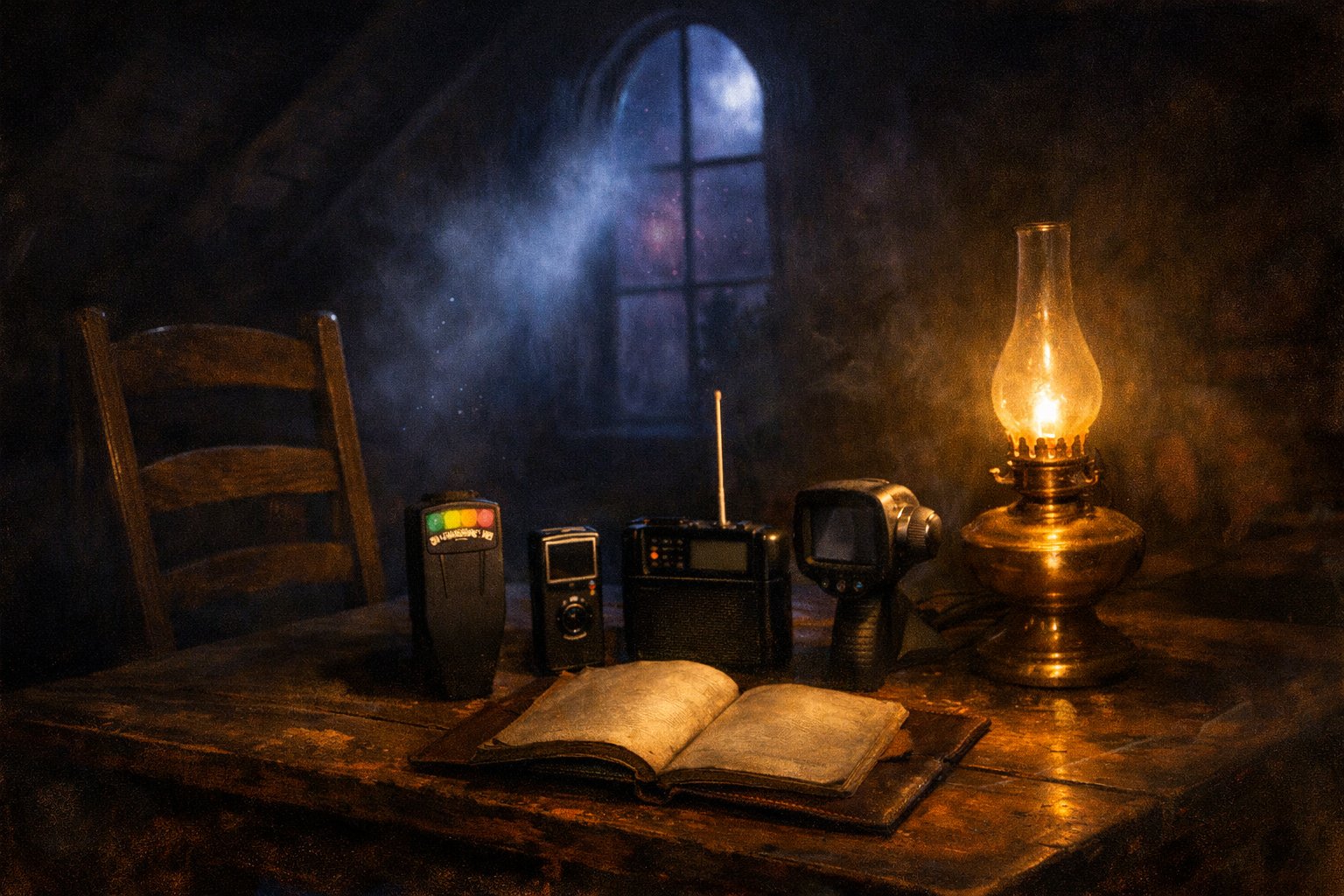
Ghost hunting is the practice of investigating places reported as haunted, using sensors, cameras, and audio recorders alongside witness interviews. Modern investigators rely on EMF meters, digital voice recorders, spirit boxes, thermal cameras, and structured-light sensors, though no device has produced evidence the scientific community accepts as proof of ghosts.
Where ghost hunting came from
The Society for Psychical Research, founded in London in 1882 under the philosopher Henry Sidgwick, was the first body to investigate apparitions by scientific method, and its 1894 Census of Hallucinations canvassed roughly 17,000 people about waking visions [1][2]. Of those, 1,684 reported seeing, hearing, or feeling something with no external cause [2]. The committee did not declare the witnesses right or wrong. It counted them.
That instinct, to record the account before judging it, is older than any gadget. The Ghost Club, revived in London in 1862, traded apparition stories among scholars and clergy decades before electronics existed. When the paranormal researcher Harry Price reached Borley Rectory in 1929 and later leased the house himself from 1937 to 1939, he carried notebooks, cameras, and a remote thermograph, but his richest material was still the testimony of the people who had lived there. The Society for Psychical Research afterward judged much of Price’s evidence unreliable [2]. The interviews outlasted the controversy.
A ghost hunt today, with its meters and screens, descends directly from this archive-and-interview tradition. The persona of this column treats it the way a folklorist would: the recording device is new, but the human at the center, telling you what they saw in the corner of a room, has been the real subject all along. You can read the wider context of this work across paranormal and supernatural phenomena.
Listening for the dead: EVP and the spirit box
Electronic voice phenomena entered paranormal research in 1959, when the Swedish painter Friedrich Jurgenson played back outdoor bird recordings and reported a voice he attributed to his late mother, a claim the Latvian psychologist Konstantin Raudive industrialized into the 1971 book Breakthrough [3]. Raudive said he had logged tens of thousands of these recordings, and the practice of hunting for faint voices in tape hiss has carried his name ever since.
The electronic voice phenomena tradition gained a real-time cousin around 2002, when the hobbyist Frank Sumption built the device now called Frank’s Box, a white-noise generator wired to an AM receiver that sweeps the band and serves up split-second fragments of speech and static [4]. Sumption’s spirit box is the ancestor of every off-the-shelf model sold today. The Estes Method refined the format at the Stanley Hotel in Estes Park, Colorado, where the investigator Karl Pfeiffer wore a blindfold and noise-canceling headphones fed by the box, calling out words while teammates, unheard by him, asked the questions.
What the 1971 book actually establishes: a vocabulary and a method, not a mechanism. Critics of the spirit box note that a swept radio band is a stream of real human speech, and that the human brain, primed to find pattern, will assemble words from noise through pareidolia whether or not anyone is speaking to it [4]. The Estes blindfold is an honest attempt to control for that. It does not settle the question.
Seeing and sensing: EMF meters, thermal, and SLS cameras
The EMF meter, a handheld device that reads electromagnetic field strength in milligauss or microteslas, became the signature ghost-hunting tool after the television series Ghost Hunters premiered on Syfy on October 6, 2004 and put baseline-and-spike readings on screen [8]. The five-light K-II model is the version most people picture. Investigators take a baseline sweep of a room, map the wiring, microwave ovens, and breaker panels that throw fields, then watch for spikes those sources cannot explain.
Cameras add the other senses. A thermal imager, descended from FLIR’s industrial line, paints temperature rather than light, so investigators chase the cold spots that lore ties to a presence. The structured-light sensor camera, or SLS, repurposes the depth-mapping hardware of the Microsoft Kinect; engineer Bill Chapel adapted its skeletal-tracking software so the unit projects an infrared grid and draws stick figures where it thinks a body stands. The REM-pod takes the opposite approach, radiating its own field from an antenna and alarming when something disturbs it. Each device is sensitive, and each is prone to flagging a reflection, a draft, or a coat rack as a figure.
The core toolkit at a glance
The standard kit clusters into six instruments. The table below pairs what each one measures with the ordinary cause that most often mimics a result.
| Device | What it measures | What investigators look for | Common ordinary cause |
|---|---|---|---|
| EMF meter (K-II) | Electromagnetic field strength | Unexplained spikes above baseline | Wiring, appliances, phones, the meter itself |
| Digital recorder (EVP) | Audio, including faint sound | Voices heard only on playback | Radio bleed, stray speech, pareidolia |
| Spirit box | Swept AM/FM radio fragments | Words timed to a question | Broadcast snippets, chance, pareidolia |
| Thermal camera (FLIR) | Surface temperature | Localized cold or warm spots | Drafts, plumbing, body heat, reflective surfaces |
| SLS camera (Kinect) | Infrared depth map | Stick-figure forms in empty space | Misread furniture, reflections, software guesswork |
| REM-pod | Disturbance of its own field | Proximity alarms with no one near | People, pets, drafts, nearby electronics |
What the laboratory record shows
Laboratory parapsychology has tested for psi since the 1930s, when J. B. Rhine ran card-guessing trials at Duke University, and its most-cited modern protocol, the Ganzfeld experiment, reports a pooled hit rate near 32 percent against a 25 percent chance baseline [1][5]. In the Ganzfeld, a receiver sits in mild sensory isolation, halved ping-pong balls over the eyes and red light on the face, while a sender in another room concentrates on one of four images.
A 32 percent hit rate where chance predicts 25 percent is the strongest number parapsychology has to offer, and across thousands of trials the odds against coincidence run very long. Across the replication record, the picture is unsettled: the psychologist Ray Hyman has argued the Ganzfeld result does not reliably reproduce in independent hands and that meta-analysis alone cannot stand in for confirmation [5]. Supporters and critics now agree on tighter controls and still disagree on what the numbers mean. The folklorist’s posture is to report that standoff plainly rather than resolve it by preference. The lab measures a small, slippery effect. It has not measured a ghost.
When the building is the witness
Vic Tandy, an engineer at Coventry University, traced his own 1998 laboratory ghost to infrasound at 19 hertz from an extractor fan, a low-frequency vibration below the floor of human hearing that can induce dread, shivering, and movement at the edge of vision [6]. He had felt watched, glimpsed a gray shape, then found the fan and the resonating frequency that produced it. The figure vanished when the sound did.
Buildings carry other culprits. In 1921 the ophthalmologist William Wilmer published the case of a family, recorded as Mrs. H, who heard footsteps, saw figures, and felt a smothering presence until a faulty furnace was found to be filling the house with carbon monoxide [7]. Infrasound at 19 hertz and a leaking flue are not poetic explanations, but they are real ones, and they fit a striking share of classic hauntings. Two things get conflated here: the experience and its source. The feeling of being watched in a cold corridor is genuine. Its cause can still be a fan, a draft, a gas leak, or the mind completing a pattern through the ideomotor effect, the same unconscious muscle movement that drives a Ouija planchette.
How a careful investigation is run today
A disciplined investigation begins by trying to disprove the haunting, recording baseline sensor levels, interviewing witnesses before touching a single device, and checking every reading against an ordinary cause before anything is called unexplained. The popular telling vs the actual record: televised teams chase dramatic spikes, while the better field groups, including the Atlantic Paranormal Society that Ghost Hunters followed, built their reputation on debunking first [8].
Good practice borrows from ethnography as much as from electronics. The interview comes first and stays trauma-informed, because a grieving or frightened witness deserves care before instruments. Investigators log the time, the place, the weather, and the wiring. They run controls, a recorder left in an empty room, an EMF sweep with the breakers off. They treat a single anomalous reading as a question, not an answer. The gear does not certify a ghost. It documents an environment so that the witness’s account can be set against something measurable.
What the work is really for
Strip away the night-vision footage and the work that remains is old and human: someone describes what happened to them in a particular room, in a particular year, and someone else takes it down with care. The meters and cameras are honest tools for ruling things out, and they are worth carrying. They have never been the point. An account collected gently, dated, placed, and left intact is the durable artifact, and you can follow more of that collecting in these our related coverage. Whether or not the house is haunted, the testimony is real, and recording it faithfully is a craft worth keeping.
Frequently asked questions
What equipment do ghost hunters actually use?
The core kit is six tools: an EMF meter such as the K-II, a digital voice recorder for EVP, a spirit box, a thermal camera, a structured-light sensor camera, and a REM-pod. Most investigators add a notebook, a still camera, and a baseline log, which often matter more than the electronics.
What is an EVP?
EVP, or electronic voice phenomena, are sounds resembling speech captured on a recorder and usually heard only on playback. The Swedish artist Friedrich Jurgenson reported them in 1959, and Konstantin Raudive popularized the term in his 1971 book Breakthrough. Skeptics attribute most EVP to radio bleed, stray speech, and pareidolia [3][4].
Does an EMF meter detect ghosts?
No instrument is known to detect ghosts. An EMF meter detects electromagnetic fields, which are produced by wiring, appliances, and electronics. Investigators treat unexplained spikes as worth noting, but a spike is not proof of a presence, and many trace back to the building or to the meter itself.
How does a spirit box work?
A spirit box rapidly sweeps the AM or FM band, producing a chopped stream of radio fragments and white noise. Investigators listen for words that answer a question. Because the raw audio is real human speech and music, critics argue any meaning comes from chance and pattern recognition rather than a discarnate source [4].
Is ghost hunting scientifically proven?
No. No ghost-hunting device or technique has produced evidence the scientific community accepts as proof of survival after death. Laboratory parapsychology reports small statistical effects in protocols like the Ganzfeld, but those results remain contested and have not reliably replicated [5].
What is the Estes Method?
The Estes Method is a spirit-box technique developed at the Stanley Hotel in Estes Park, Colorado. One investigator is blindfolded and wears noise-canceling headphones fed by the box, then calls out words while teammates ask questions he cannot hear. The isolation is meant to remove the listener’s expectation of the questions.
Can hauntings have ordinary explanations?
Often, yes. Infrasound near 19 hertz can cause dread and peripheral movement, as Vic Tandy showed at Coventry University in 1998. Carbon monoxide poisoning produces hallucinations, documented as early as William Wilmer’s 1921 case. Pareidolia and the ideomotor effect explain many sights, voices, and moving pointers [6][7].
How do I start ghost hunting responsibly?
Begin with the history of the site and a careful interview with the witnesses, treating them gently. Take baseline readings before drawing conclusions, run controls, and look for an ordinary cause first. Get permission to enter any property, and record what people tell you accurately, whatever you decide it means.