By Sloane Reeve · Published June 13, 2026 · Updated June 13, 2026
The Yeti Is a Himalayan Folk Being Older Than Its Famous Photographs
The Yeti is the wild man of Himalayan legend, known across Sherpa, Tibetan, Lepcha, and Bhutanese belief by names such as meh-teh, mi-go, and migoi. The figure shaped indigenous religion and monastery ritual for generations before Western expeditions photographed a footprint and renamed it the Abominable Snowman.
Published: June 5, 2026. Last reviewed: June 5, 2026.
I read folklore the way I read a field notebook: testimony from people who knew their ground before any outsider arrived to test it. The Yeti legend is older than the camera, the English word Yeti, and the bear-DNA papers. Strip the headlines away and you find a named being woven into hunting prayers, creation stories, and monastery relics. The wider field of cryptids and mythical creatures rewards this kind of reading, where the story is data about a place and its people.
The legend has a separate life from the expedition record. The footprints, the photographs, and the genetics belong to the eyewitness and expedition side of the case. What follows is the belief itself, alive in language and ritual long before any ice axe was laid beside a track for scale.
| Name | People or language | Literal sense | What it refers to |
|---|---|---|---|
| Meh-teh / metoh | Sherpa, Tibetan | man-bear | the upright wild man of the high snow |
| Mi-go / migoi | Tibetan, Bhutanese | wild man | the being as a forest power |
| Dzu-teh | Sherpa | cattle-bear | a large bear, the Himalayan brown bear |
| Teh-lma | Sherpa | little one | a small Yeti of warmer valleys |
| Kang-mi | Tibetan | snow-man | the snow-dwelling form |
| Yeti (yeh-teh) | Sherpa | that thing, rocky-place bear | the popular catch-all name |
The Names Came First, and They Describe a Bear as Often as a Man
Himalayan languages carry at least six names for the Yeti, and several of them point plainly at a bear: dzu-teh means cattle-bear, meh-teh means man-bear, and the word Yeti itself traces to a Tibetan compound for a rocky-place bear. The folk vocabulary was sorting animals long before zoology arrived to argue about them.
Swami Pranavananda, an Indian scholar who trekked the Tibetan borderlands, argued in 1957 that the syllables ti, te, and teh derive from a softly pronounced Tibetan word for bear, which is why the names cluster around the idea of a man-shaped bear rather than a separate ape. The Tibetan compound behind Yeti, often written g.ya’ dred, pairs a word for rocky ground with a word for bear, according to the documented etymology. Two things get conflated here, and the languages keep them apart: the literal mountain bear, dzu-teh, and the upright man-bear of story, meh-teh.
The English name arrived through a mistake. Charles Howard-Bury recorded his Sherpa porters using metoh-kangmi during the 1921 Everest reconnaissance, and the columnist Henry Newman of the Calcutta Statesman rendered metoh as filthy or abominable, coining the Abominable Snowman the same year, a sequence traced by the Encyclopaedia Britannica. Tibetan lore is more orderly than the headline suggests, naming three sizes outright: the towering black-furred Nyalmo, the mid-sized Chuti of the tree line, and the small reddish Rang Shim Bombo. A working naturalist reads that as a folk taxonomy, a people sorting their wildlife by size and altitude.
Before Buddhism, a Glacier Being and a Wild Man’s Blood
In the region’s pre-Buddhist religions, the wild man was sacred: the Danish ethnographer Halvor Siiger recorded that the Lepcha of Sikkim worshipped a Glacier Being as a god of the hunt, and that Bon followers used the blood of the mi rgod in ceremony.
That detail reorders the whole picture. To the Lepcha, the high wild man was not a horror to flee but a provider of game, a Glacier Being you petitioned before a hunt the way a fisherman might honor a river. Siiger collected this as living testimony in the mid-twentieth century, not as a curiosity from a dusty archive, which is the kind of informant attribution a field worker trusts most. The Bon connection runs the same direction: a being whose very blood carried ritual power is a being woven into the sacred economy of the mountains, not a beast loitering at its edge.
This is the layer the snowman headlines erased. Before the Yeti was a creature to capture on film, it was a spirit-presence of the snowline, sitting in the same cosmological neighborhood as mountain deities and territorial gods that Himalayan communities still honor. The legend did not begin as a question for biologists. It began as a relationship with a landscape.
How Tibetan Buddhism Absorbed the Wild Man
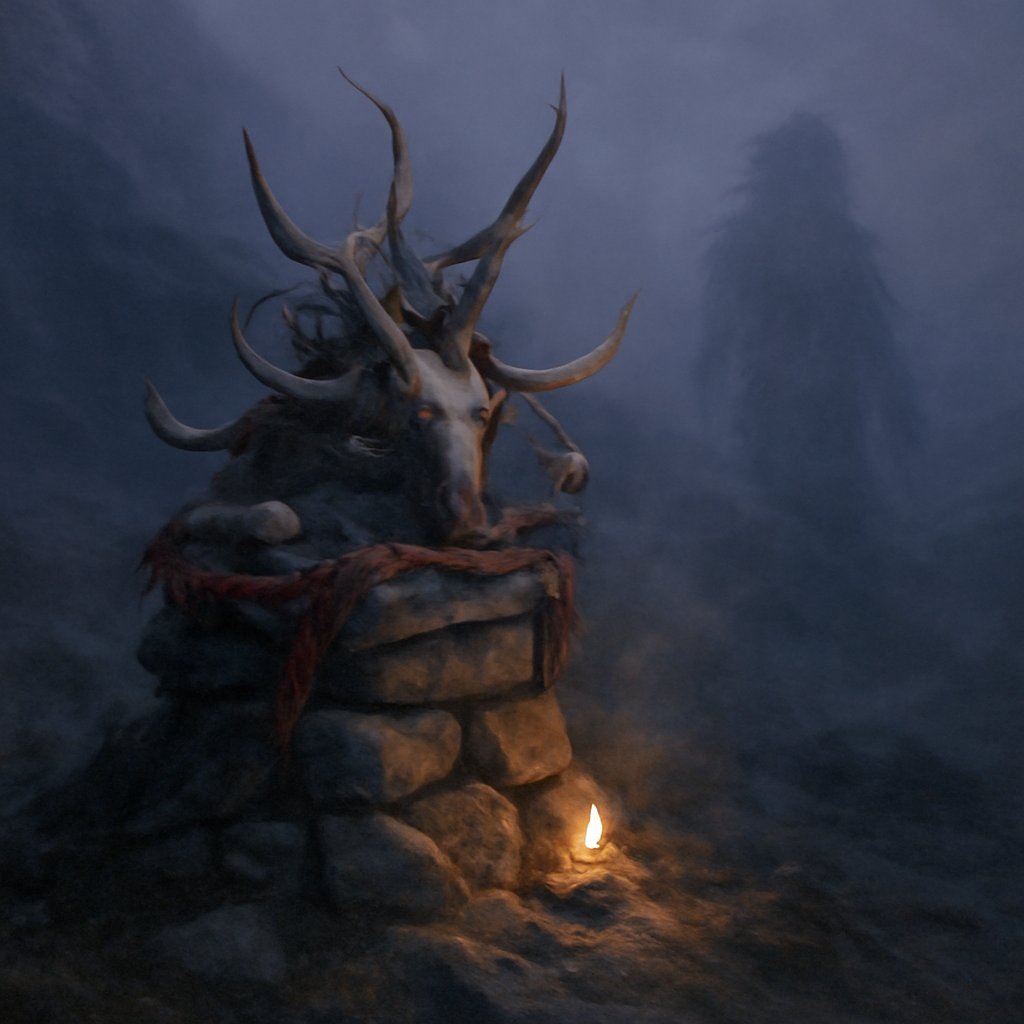
Tibetan Buddhism reclassified the Yeti as tiragyoni, an animal birth still close enough to humanity to follow the Dharma, and folded the wild man into the same origin story that explains the Tibetan people themselves. The being was never simply outside the human circle; it sat at the blurred edge of it.
At the level of primary documents, the Yeti shares an ancestor with the Tibetan people. The Mani Kabum, a Tibetan text compiled in the twelfth and thirteenth centuries, tells of a monkey, an emanation of the bodhisattva Avalokiteshvara, who mated with a rock-ogress understood as an emanation of the goddess Tara. Their six children became the ancestors of the Tibetans, and in the wider telling, the offspring who stayed wild and hairy became the first wild men, the figure later folklore calls the Yeti. The Mani Kabum places the human and the wild man on a single family tree.
Belief shaped behavior. In Tibet, images of the wild man were paraded and sometimes honored as guardians against evil spirits, and during the 1954 Daily Mail expedition the mountaineer John Angelo Jackson photographed Yeti paintings on the walls of Tengboche monastery in the Khumbu. A sighting, by contrast, was widely held to be inauspicious, an omen the witness had to answer by accumulating merit. Belief like that does not need a body to be real. It is already doing work in people’s lives.
The Monastery Relics Were Sacred Charms Long Before They Were Lab Samples
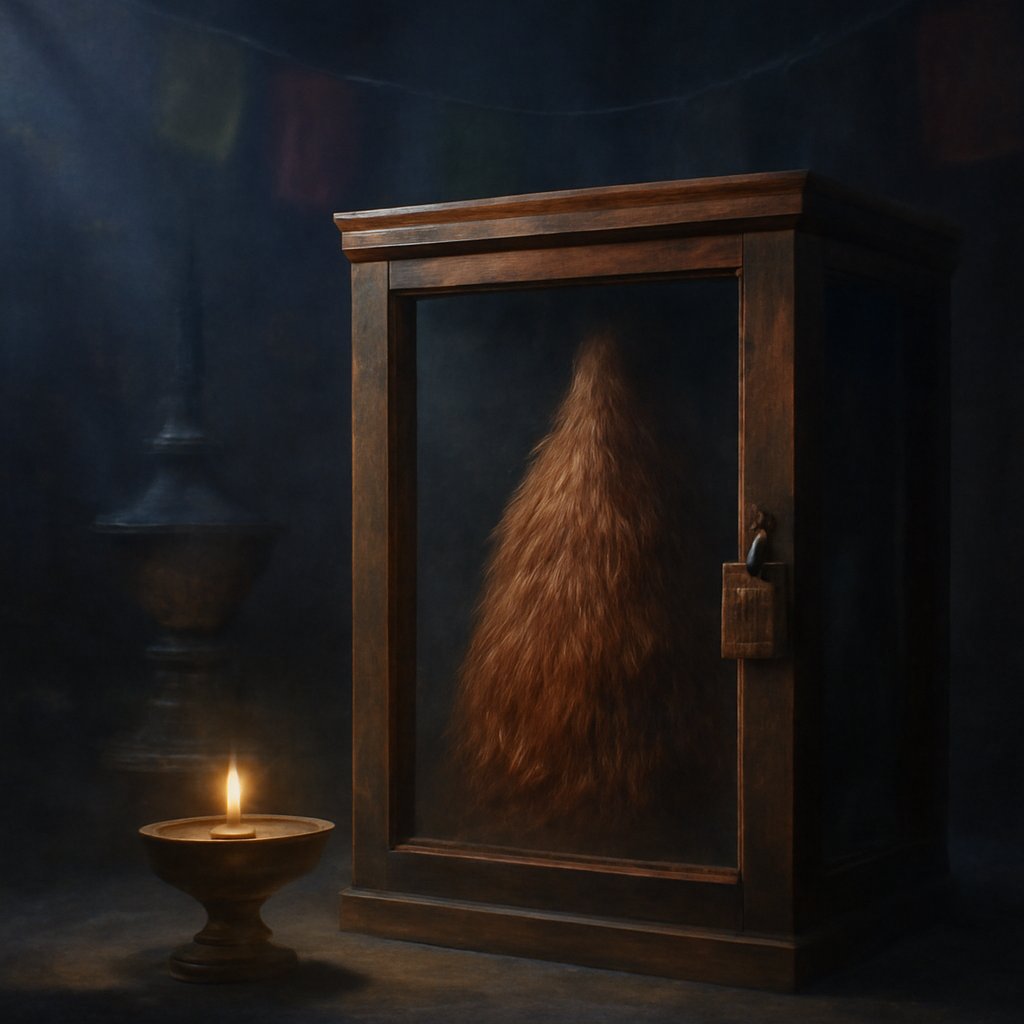
Two Khumbu monasteries, Pangboche and Khumjung, kept conical scalps revered as Yeti relics, and the Khumjung gompa still displays its scalp in a padlocked glass case as a village good-luck charm. The object’s first job was protection, not proof.
In 1960 Edmund Hillary and the journalist Desmond Doig found the Khumjung scalp in the home of an elderly village woman who guarded it as a charm for the community and feared that letting it travel would invite disaster. Hillary struck a careful bargain, recorded by Atlas Obscura: a donation to the monastery and the village school, and a monastery elder sent along as the relic’s guardian on its flight to London. Analysts there concluded the scalp had been molded from the hide of a serow, a Himalayan goat-antelope, and it was returned safely to Khumjung, where it still draws visitors today.
Strip away the spectacle, and the residue is a community’s relationship with its mountains. The relic told the village it was watched over; the lab told the world it was serow skin; both statements are true and they answer different questions. The Pangboche relics, including a famous mummified hand, sat in the same role, sacred objects whose meaning was local and devotional rather than zoological. A scalp can fail as a specimen and still succeed completely as a guardian.
From a Protected Migoi in Bhutan to Bumble, Tintin, and a Theme-Park Animatronic
Bhutan made the Yeti a conservation priority in 2003, gazetting the 742-square-kilometre Sakteng Wildlife Sanctuary in part to protect the migoi, a being the semi-nomadic Brokpa herders of the eastern hills have long believed roams their forests. Few legends get their own protected habitat by law.
The Sakteng Wildlife Sanctuary, in Trashigang and Samdrup Jongkhar districts, is unusual precisely because it treats local belief as a reason for policy, and the sanctuary record names the migoi among the things it was created to shelter. The same forests hold red pandas and snow leopards, so the reserve protects confirmed and unconfirmed animals under one fence, which is a tidy emblem of how the legend and the biology share a single range.
Western culture took the figure in a softer direction. Hammer Film Productions adapted Nigel Kneale’s television play into The Abominable Snowman in 1957, casting Peter Cushing as a scientist who wants to study the creature rather than cage it. Two years later Herge reimagined the Yeti in Tintin in Tibet, serialized from 1958 to 1959 and published as a book in 1960, as a lonely, protective being rather than a beast, a portrait that anticipated the gentle giants to come. The line runs straight to Bumble in the 1964 special Rudolph the Red-Nosed Reindeer, the friendly Abominable Snowman of Monsters, Inc. in 2001, and the animated films Smallfoot in 2018 and Abominable in 2019. Disney even installed a Yeti animatronic on the Matterhorn Bobsleds in 1978 and a twenty-five-foot one at Expedition Everest. Nepal, meanwhile, named an airline after it.
What a Field Zoologist Keeps From the Legend
Read as folklore rather than a wanted poster, the Yeti legend is a consistent record of real things: a high-altitude bear that rears on two legs, deceptive snow that swells a footprint, and a culture already carrying a wild-man story to hang on both. The legend is good data about the Himalaya even where it is poor evidence for an undescribed primate.
I keep a graveyard chapter for cryptids that dissolve into known animals, and the Yeti as an unknown ape belongs there beside the molded scalps. I also keep the folklore chapter, and the Yeti dominates it. Tenzing Norgay said his own father had seen the creature twice, then grew more skeptical in later life, and that arc, from inherited certainty to honest doubt, is the legend in miniature. Belief, evidence, and a careful second look, in that order. You can follow more of a field zoologist’s case files from here, and the same patient reading applied to a cold lake reaches a parallel verdict in the case of the Loch Ness Monster. The wild man of the snow turns out to be one of the best-documented relationships between a people and a mountain we have, which is worth more than a blurry photograph.
Frequently Asked Questions
What is the Yeti in Himalayan folklore?
The Yeti is a wild-man figure of Himalayan folklore, a tall, hairy, upright being of the high snow and forest. Sherpa, Tibetan, Lepcha, and Bhutanese communities have described it for generations under names like meh-teh, mi-go, and migoi, treating it as a real inhabitant of the mountains and, in several traditions, a being with sacred standing.
What does the name Yeti mean?
The name Yeti comes from a Sherpa term, often written yeh-teh, that traces to a Tibetan compound pairing a word for rocky ground with a word for bear. Related names are blunt about the animal: dzu-teh means cattle-bear and meh-teh means man-bear. Swami Pranavananda argued in 1957 that the teh syllable itself derives from a Tibetan word for bear.
Is the Yeti the same as the Abominable Snowman?
They name the same creature, but the Abominable Snowman is a Western label born from a mistranslation. In 1921 the columnist Henry Newman rendered the Sherpa term metoh as filthy or abominable, and the phrase Abominable Snowman stuck in English. The Himalayan names, such as meh-teh and migoi, are older and describe a man-bear rather than anything abominable.
What are the different kinds of Yeti in folklore?
Sherpa tradition distinguishes the meh-teh, the upright man-bear, from the dzu-teh, a large cattle-killing bear, and the teh-lma, a small Yeti of warmer valleys. Tibetan lore names three sizes: the giant black Nyalmo, the mid-sized Chuti, and the small reddish Rang Shim Bombo. These divisions read as a folk taxonomy sorted by size and altitude.
What role does the Yeti play in Tibetan Buddhism?
Tibetan Buddhism classes the Yeti as tiragyoni, an animal birth still capable of following the Dharma. The Mani Kabum, a text compiled in the twelfth and thirteenth centuries, traces the Tibetan people to a monkey emanation of Avalokiteshvara and a rock-ogress, with the wilder offspring becoming the first wild men. Yeti images were also paraded as guardians against evil spirits.
Why did the Lepcha people worship a Glacier Being?
The ethnographer Halvor Siiger recorded that the Lepcha of Sikkim honored a Glacier Being as a god of the hunt, a provider of game rather than a monster. In this pre-Buddhist view, the high wild man held sacred power, and followers of the Bon religion likewise treated the blood of the mi rgod, the wild man, as ritually potent.
What is the Khumjung Yeti scalp?
The Khumjung Yeti scalp is a conical relic kept at Khumjung monastery in Nepal and revered as a village good-luck charm. Edmund Hillary borrowed it in 1960, sending a monastery guardian with it to London, where analysts judged it molded from serow hide. It was returned and still sits in a padlocked glass case, drawing visitors today.
Why did Bhutan create a sanctuary for the Yeti?
Bhutan established the Sakteng Wildlife Sanctuary in 2003, a protected area of about 742 square kilometres in the country’s east, in part to shelter the migoi, the local name for the Yeti. The reserve reflects how strongly Brokpa communities believe in the being, and it protects confirmed species like red pandas and snow leopards in the same forests.
How did the Yeti become a pop-culture character?
Western interest peaked in the 1950s, and storytellers reshaped the wild man into something gentler. Hammer’s 1957 film The Abominable Snowman and Herge’s Tintin in Tibet, published in 1960, both showed a misunderstood creature. That sympathetic version carried into Bumble in 1964, the Abominable Snowman of Monsters, Inc. in 2001, and the films Smallfoot and Abominable.