
Drafted with AI assistance from the sources listed; images are AI-generated illustrations. How EsoVitae is made
Two Centuries of Yeti Encounters, From Porters’ Tracks to a 2019 Army Tweet
Himalayan Yeti encounters are a documented record of footprints, photographs, and expedition artifacts collected since 1921, not confirmed animal sightings. The most-cited cases include Eric Shipton’s 1951 Menlung footprint and N. A. Tombazi’s 1925 Sikkim observation. DNA testing in 2014 and 2017 traced the physical samples to Himalayan and Tibetan bears.
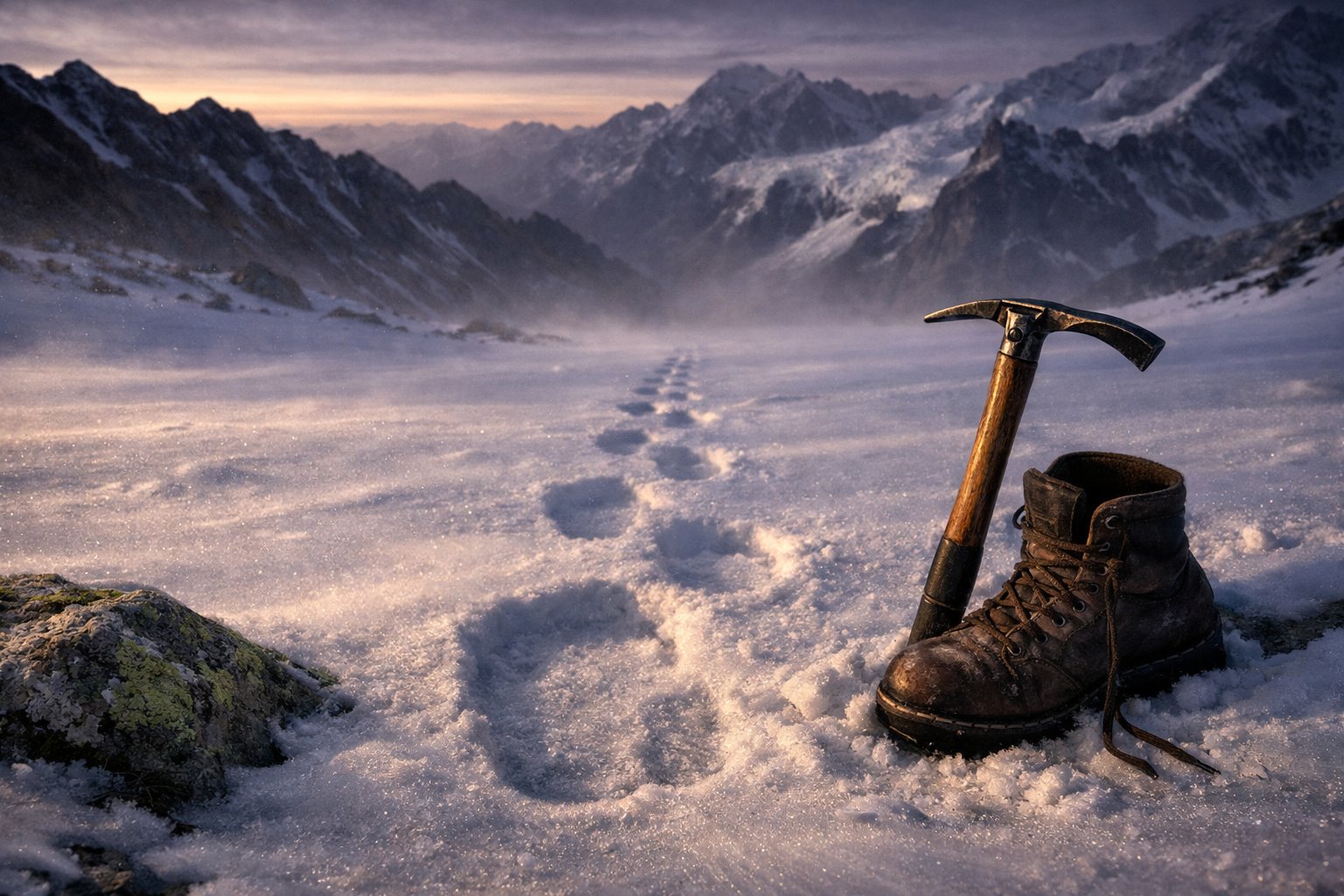
Western records of Yeti encounters begin in 1921, when the Mount Everest reconnaissance expedition photographed large tracks at 21,000 feet, and run through April 2019, when the Indian Army tweeted images of 32-inch prints near Makalu Base Camp. A century of reports sits between, almost all of them encounters with traces rather than animals.
The cast in the snow is a vertebrate or it isn’t; the track is consistent with bear or it isn’t. The Yeti file is mostly footprints, hairs, scalps, and one disputed hand, recorded by climbers and zoologists. Folklore gets respect; the evidence gets the boring biology test. The wider field of cryptids and mythical creatures runs the same ladder across every reported large animal.
| Year | Encounter or expedition | Key figure | Physical evidence | Leading explanation |
|---|---|---|---|---|
| 1921 | Everest reconnaissance | Charles Howard-Bury | Tracks at Lhakpa La | Loping grey wolf |
| 1925 | Zemu Glacier sighting | N. A. Tombazi | Distant upright figure, prints | Wandering ascetic |
| 1951 | Menlung basin | Eric Shipton | Photographed footprint | Bear track, melt-distorted |
| 1954 | Daily Mail expedition | Ralph Izzard | Relic scalps | Molded serow skin |
| 1959 | Slick expedition | Peter Byrne | Pangboche Hand finger | Human bone |
| 2017 | Genetic survey | Charlotte Lindqvist | 9 tissue samples | Asian bears (8 of 9) |
1921 to 1925: The First Western Sightings and a Naming Accident
Charles Howard-Bury, leading the 1921 Everest reconnaissance, recorded a line of dark tracks at the Lhakpa La near 21,000 feet and attributed them to a loping grey wolf, while his Sherpa porters named the maker metoh-kangmi. The porters’ term meant roughly man-bear, snowman. Howard-Bury, a careful observer, noted that soft snow had widened each print until it resembled a bare human foot, an early lesson in how snow lies about size.
The famous English name came from a translation error. Henry Newman, a columnist for the Calcutta Statesman, interviewed the returning porters in Darjeeling and rendered metoh as filthy or abominable, coining the Abominable Snowman in 1921, a sequence traced by the Encyclopaedia Britannica. The creature got a lurid headline before anyone had a body, a hair, or a clear photograph.
The first detailed Western sighting belongs to N. A. Tombazi, a Greek photographer and Royal Geographical Society member who watched a figure near the Zemu Glacier at about 15,000 feet in 1925. He observed it for roughly a minute from 200 to 300 yards as it moved upright and stopped to pull at dwarf rhododendron, then found prints six to seven inches long lower on the slope. Tombazi did not believe he had seen a Yeti; he judged it a wandering ascetic and said so in print. A witness recording his own doubt is the most useful kind of witness, and it is rarer than it should be.
1951: The Shipton Footprint and the Most Examined Track in Cryptozoology
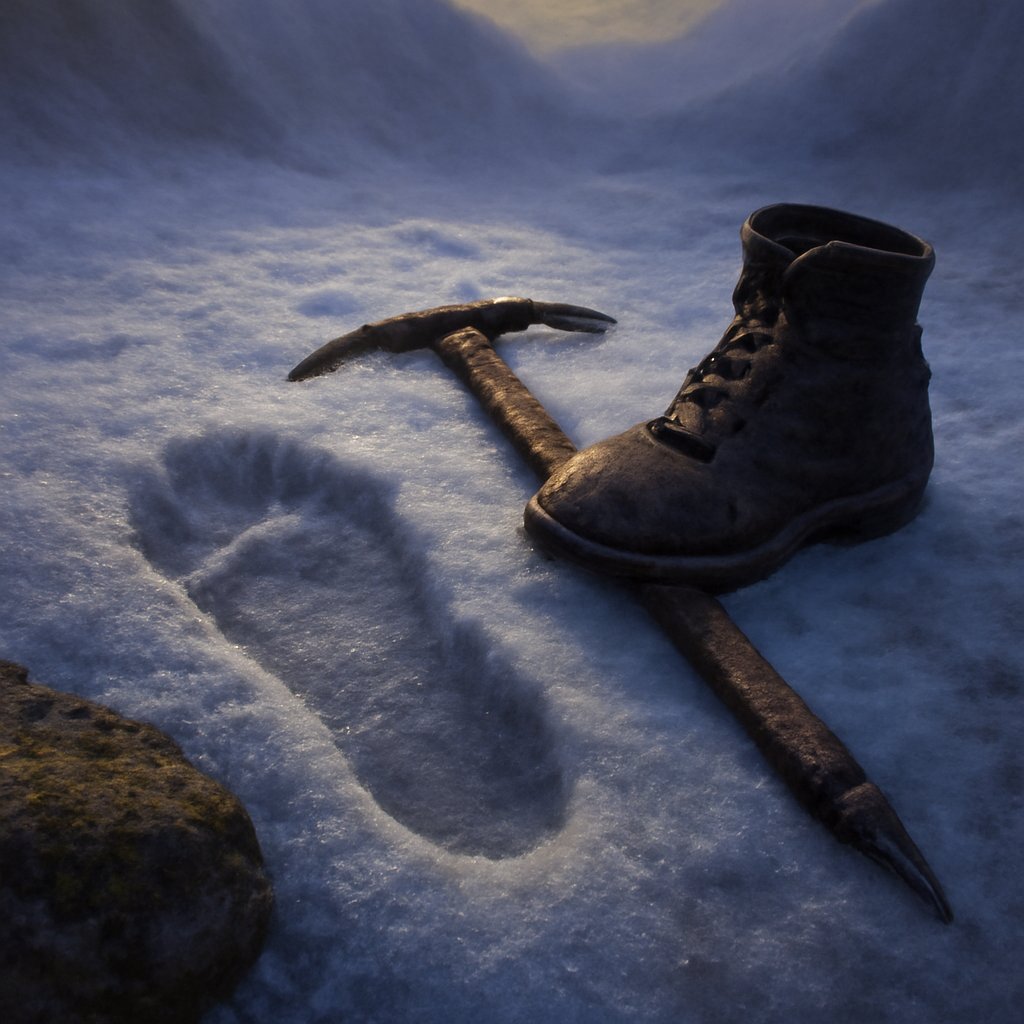
Eric Shipton photographed a single sharp footprint in the Menlung basin on November 8, 1951, laying his ice axe and Michael Ward’s boot beside it for scale, producing the most reproduced track in the Yeti record. Shipton and Ward were scouting an approach west of Everest with the Sherpa Sen Tensing when they crossed the line of prints on firm snow ice. With no ruler at hand, the boot and axe became the measuring tools, and that improvisation is why the image survives at all.
The clearest print runs roughly 13 inches long, with a broad, shortened big toe and a row of smaller toes pressed into crystalline snow. For decades the Shipton footprint stood as the single strongest piece of physical evidence, the photograph every later expedition was measured against.
On the morphology: a print that clean is also a print that should worry a tracker. Zoologist Daniel Loxton and paleontologist Donald Prothero, among others, have argued the celebrated single print is most plausibly two overlapping bear tracks, a hind paw landing partly inside a fore paw, with afternoon sun melting the edges into a deceptively toe-like outline. Michael Ward himself later acknowledged the surrounding trail looked more ambiguous than the one hero frame. A useful track is a long sequence with consistent stride and depth, not one perfect impression. The Shipton case has the perfect impression and not much of the sequence.
The Expedition Decade: Scalps, a Hand, and the Daily Mail Hunt
The Daily Mail funded a months-long Snowman Expedition in 1954, sending reporter Ralph Izzard and zoologist Biswamoy Biswas to examine relic scalps at Pangboche and Khumjung monasteries in the Khumbu region of Nepal. The team collected hair and measured the conical scalps held as monastery treasures. Biswas concluded the Pangboche and Khumjung scalps were not skin from an unknown primate but molded caps, and later analysis identified the source animal as the serow, a Himalayan goat-antelope.
Edmund Hillary tested the same artifact class in 1960 and 1961. His World Book expedition, which included Lincoln Park Zoo director Marlin Perkins, borrowed the Khumjung scalp and flew it to Chicago and London for examination. The verdict matched 1954: the scalp was shaped from serow hide, not grown on a living head. Hillary came home a public skeptic.
The strangest artifact was the Pangboche Hand, a mummified hand kept at Pangboche monastery. Texas oilman Tom Slick funded expeditions in 1957 and 1958, and in 1959 his associate Peter Byrne removed finger bones, substituted human bones, and had the pieces smuggled out of Nepal, reportedly carried through India by the actor James Stewart. When the surviving Pangboche finger was finally DNA-tested at Edinburgh Zoo in 2011, it proved to be human. The hand was a relic, not a specimen.
Modern Encounters: Whillans, Wooldridge, Messner, and the 2019 Prints
Reinhold Messner traced an upright animal across eastern Tibet in 1986 and spent eleven years investigating, concluding in My Quest for the Yeti that the creature behind the reports is the Himalayan brown bear. Messner had the unusual standing to test the claim with his own boots; he watched the animal he calls chemo or dremo rear and move on two legs in low light, and he argued that this bear is the live source of the legend across Tibet, Nepal, and Bhutan.
Not every modern sighting survived a second look. In 1970, climber Don Whillans reported watching an ape-like shape cross a moonlit slope on Annapurna and photographed tracks the next morning. In March 1986, Anthony Wooldridge photographed what he believed was a standing Yeti during a solo run in the Garhwal Himalaya, a case that briefly excited researchers. Wooldridge returned to the site in 1987, re-photographed it in stereo, and accepted that he had recorded a rock outcrop, not an animal. He retracted the sighting himself.
The most recent high-profile encounter is also the weakest. On April 29, 2019, the Indian Army tweeted photographs of a single line of prints measuring 32 by 15 inches, found near Makalu Base Camp on April 9. A solitary biped does not leave one neat single-file trail across deep snow, and the post drew immediate scientific ridicule in international coverage. It did, the Army said, succeed in starting an argument.
What the DNA Says About the Encounter Samples
Charlotte Lindqvist’s team at the University at Buffalo sequenced nine purported Yeti specimens in 2017 and matched eight to Asian bears, publishing the result in Proceedings of the Royal Society B on November 29. The set included bone, tooth, skin, hair, and feces gathered across the Himalaya and Tibetan Plateau.
What the 2017 study actually establishes: of the nine samples, one Yeti skin traced to an Asian black bear, one to a Himalayan brown bear, six to Tibetan brown bears, and the ninth, supposedly Yeti, turned out to be a dog. A femur recovered from a Tibetan cave and labeled Yeti was a Himalayan brown bear relative. Lindqvist framed the finding plainly: the biological root of the legend is local bears.
An earlier study set up the answer. In 2014, geneticist Bryan Sykes reported in the same journal that two Himalayan hair samples, one from Ladakh and one from Bhutan, matched a Palaeolithic polar bear sequence, and he floated an unknown or hybrid bear. Smithsonian biologist Eliécer Gutiérrez and colleagues reanalyzed the data in 2015 and showed the short 12S marker cannot separate brown bears from polar bears; since polar bears do not live in the Himalaya, the hairs were ordinary brown bears. Two independent teams, one journal, the same animal. The folklore behind the name, separate from the samples, is covered in The Yeti: Himalayan Legend.
Reading the Encounter File
Across a century of Yeti encounters, the physical evidence resolves into three categories: footprints consistent with bears and melt distortion, relic artifacts traced to known animals, and sightings later matched to rocks or retracted by the witness. That is not a dismissal; it is what a sorted evidence file looks like when each item is followed to source.
The taxonomic category: every testable Yeti sample so far points to Ursus arctos, the brown bear, in its Himalayan and Tibetan forms, with the high-altitude Himalayan brown bear (Ursus arctos isabellinus) the best single candidate. The brown bear is listed by the IUCN as Least Concern globally, though the Himalayan subspecies is critically endangered in places, so the animal behind the legend may be rarer than the legend. A bear that rears upright to scent the wind, in snow that swells its tracks, among cultures that already hold a wild-man story, generates a century of sincere reports.
Cryptozoology keeps a graveyard chapter and a rediscovery chapter, and honesty means filing each case in the right one. The Yeti, as an unknown upright primate, belongs in the graveyard beside the molded scalps and the human finger. The discipline still has its rediscoveries, the coelacanth and the saola among them. I apply the standard the way a witness like Tombazi once did, reporting the doubt as carefully as the wonder. To see the method run on a cold lake instead of a cold ridge, the same evidence ladder applied to Loch Ness reaches a parallel verdict, and you can follow more of our related coverage from there.
Frequently Asked Questions
Are Himalayan Yeti encounters real events?
The encounters are real in that named people genuinely reported tracks, figures, and artifacts since 1921. What they encountered is the open question. Every physical sample that has been DNA-tested, including the Pangboche Hand finger and nine specimens in the 2017 Lindqvist study, has traced to bears, a dog, or human bone rather than an unknown primate.
What is the Shipton footprint?
The Shipton footprint is a photograph Eric Shipton took on November 8, 1951, in the Menlung basin near Everest, showing a roughly 13-inch print beside an ice axe and Michael Ward’s boot. It became the most famous Yeti track, though many analysts now read the single clean print as two overlapping bear paw prints widened by melting snow.
Who coined the term Abominable Snowman?
Journalist Henry Newman of the Calcutta Statesman coined Abominable Snowman in 1921 after interviewing porters from the Everest reconnaissance. He mistranslated the Sherpa term metoh-kangmi, turning man-bear into filthy or abominable. The vivid mistranslation stuck and shaped a century of Western expectation about the animal.
Was the Pangboche Hand ever tested?
Yes. A surviving finger from the Pangboche Hand, removed by Peter Byrne during Tom Slick’s 1959 expedition, was DNA-tested at Edinburgh Zoo in 2011 and identified as human. The monastery hand was a relic assembled and revered locally, not the preserved limb of an unknown species.
What did the 2017 Royal Society study find?
Charlotte Lindqvist’s University at Buffalo team sequenced nine alleged Yeti samples and reported in Proceedings of the Royal Society B that eight came from bears, one Asian black bear, one Himalayan brown bear, and six Tibetan brown bears, while the ninth was a dog. The study concluded that local bears underpin the Yeti legend.
Did Reinhold Messner solve the Yeti?
Messner reached a strong personal conclusion. After an upright-animal encounter in 1986 and eleven years of fieldwork, he argued in My Quest for the Yeti that the Himalayan brown bear, known regionally as chemo or dremo, is the animal behind the reports. His conclusion matches the later genetic evidence, though it rests on observation rather than lab testing.
Why were the monastery scalps not proof?
The Pangboche and Khumjung scalps examined in 1954 and again by Edmund Hillary in 1960 were conical caps shaped from the hide of the serow, a Himalayan goat-antelope, not skin grown on a living animal’s skull. They were ceremonial objects, so their existence says more about local ritual than about an undescribed species.
What did the Indian Army see in 2019?
On April 9, 2019, an Indian Army team photographed a single line of 32-by-15-inch prints near Makalu Base Camp and tweeted them on April 29. Biologists noted that a lone biped cannot leave one single-file trail in deep snow, and the most likely maker is a bear whose hind and fore tracks overlapped along a path.
What would convince a field zoologist a Yeti exists?
A carcass, fresh tissue with sequenceable non-bear primate DNA, or a long, instrumented track sequence with consistent stride and depth would move the case. A breeding population would also leave bones, scat, and shed hair across its range. After a century of expeditions, every recovered sample has pointed to known animals instead.