
By EsoVitae Editorial · Published · Updated
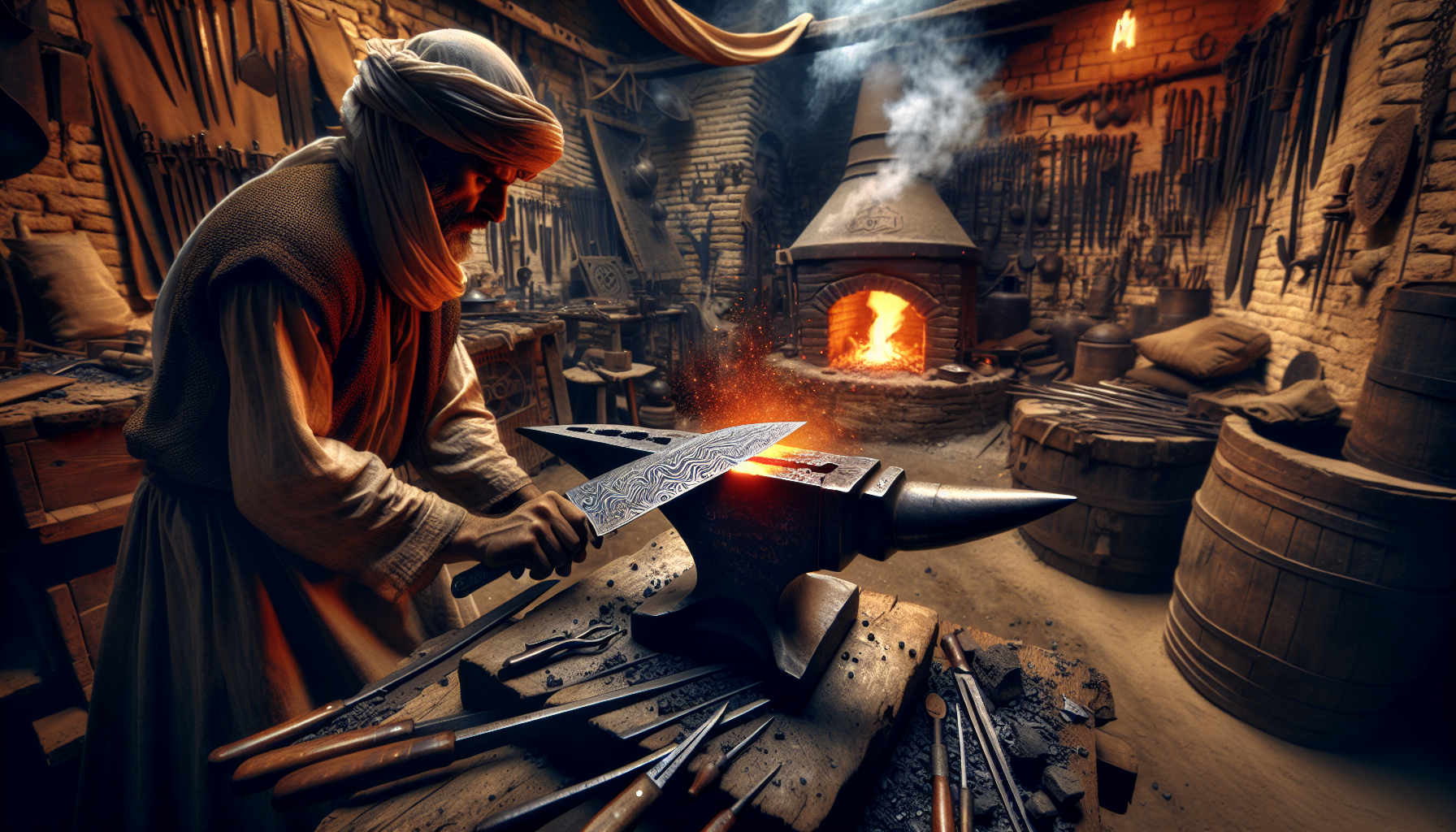
Drafted with AI assistance from the sources listed; images are AI-generated illustrations. How EsoVitae is made
Ancient Damascus steel was a high-carbon crucible steel, cast as small ingots in South Asia and Central Asia and forged into blades whose surfaces carry a pattern like running water. The ingot steel is called wootz. This page sets out where the steel came from, how it was made, why the pattern forms, why the method was lost, and what survives of it.
What Was Ancient Damascus Steel?
Ancient Damascus steel was crucible steel with about 1.5 percent carbon, melted in sealed clay crucibles as small ingots called wootz and forged into blades whose etched surfaces show light, swirling bands on a nearly black ground. The pattern is not applied to the surface. It is the steel’s own structure: sheets of iron-carbide particles, aligned during forging, that etch white against a darker matrix.[1] The Persian name for crucible steel was pulad.[2]
The ingots were made in southern India and Sri Lanka, and a related crucible steel was made in Central Asia. Many of the most admired blades were forged in Persia and Syria, and some of the finest museum pieces come from the Ottoman lands.[2][3] The blades that set the standard date mostly from the sixteenth to the eighteenth century. John D. Verhoeven, a metallurgist at Iowa State University, the bladesmith Alfred H. Pendray and W. E. Dauksch, a retired Nucor Steel executive, put the last blades with the highest-quality patterns at probably around 1750, and judged low-quality patterned blades unlikely to have been made after the early nineteenth century.[1]
The name is used today for two other materials as well, pattern-welded steel and powder-metallurgy steel. A later section separates them from the original.
Wootz and Damascus: Where the Names Come From
Wootz is an English rendering of ukku, the word for steel in Kannada and Telugu, while Damascus names the Syrian city, although the steel itself was made far to the east and the city’s role as a sword-making centre is debated. The word wootz first appeared in print in 1795, when samples of Indian steel were being sent to England for analysis.[2][3]
The archaeometallurgist Ann Feuerbach, reviewing the Arabic sources in her 2002 doctoral thesis, found three likely roots for the Damascus name: the Arabic damas, water, which matches the watered look of the blades; al-Kindi’s use of “Damascene” for swords forged in Damascus; and a crucible-steel swordsmith called Damasqui mentioned by al-Biruni.[2] The Arabic phrase “Damascus steel” appears in the writings of al-Jaubari, who died in 1232.[2]
A popular story holds that Crusaders met the blades at Damascus and carried the name home. Even the 2006 Nature paper on the steel opens by saying the blades were “first encountered by the Crusaders”.[4] Feuerbach found no record of any Crusader using the term. The earliest European use she traces is the French traveller Bertrandon de la Brocquière in 1432, who wrote that “Damascus blades are the handsomest and best of all Syria”.[2]
When and Where Was Damascus Steel Invented?
No single inventor or date exists: crucible steel was being made in southern India and Sri Lanka by the first millennium AD, and probably earlier, and in Central Asia from around the first century AD. Sharada Srinivasan and Srinivasa Ranganathan of the Indian Institute of Science conclude from evidence in Tamil Nadu that the Indian crucible process is likely to have started before the Christian era.[3] Gill Juleff’s excavation at Hattota Amune in central Sri Lanka placed crucible steelmaking there in the second half of the first millennium AD, beginning at least in the seventh century.[5]
Feuerbach’s analysis of a ninth- to tenth-century crucible-steel workshop at Merv, in present-day Turkmenistan, showed that Central Asian smiths used a process of their own rather than a copy of the Indian one. She traces production in at least five Central Asian cities from around the first century AD to the Mongol conquest, and of fifty-seven blades she examined, one may be the earliest known example of Damascus steel.[2] Verhoeven, Pendray and Dauksch state that both crucible and pattern-welded Damascus were apparently first produced before about AD 500.[1]
Early Written References
Written praise of eastern steel is older than the excavated workshops. Mediterranean sources include a report from the time of Alexander that he was presented with 100 talents of Indian steel.[3] In the ninth century the scholar al-Kindi named Khurasan as a steel-making centre and praised steel from Sarandib, the Arabic name for Sri Lanka.[2][5] Pliny the Elder, in the first century AD, gave “the palm of excellence” to iron “made by the Seres, who send it to us with their tissues and skins”, with Parthian iron second.[6] The passage does not mention India, so reading it as an early reference to wootz is conjecture.
How Was Damascus Steel Made?
Damascus steel was made in two stages, often in different countries: crucible smiths in South Asia or Central Asia melted iron with carbon into small steel cakes, and bladesmiths elsewhere forged those cakes slowly, at low heat, into patterned blades. In outline:
- Charge a clay crucible with wrought iron and carbon-rich plant matter, or with cast iron and wrought iron together.
- Seal it and fire it for many hours until the charge melts, at temperatures above about 1,400°C.
- Let the crucible cool so that a small high-carbon cake solidifies inside it.
- Forge the cake in many short heats at a low red heat, roughly 850 to 650°C.
- Grind, polish and etch the finished blade to bring out the pattern.
Making the Wootz Ingot
Two crucible methods are documented in South India. At sites in Tamil Nadu and Karnataka, wrought iron was packed into crucibles with carbonaceous material and carburised; in the Deccan around Hyderabad, cast iron was fused with wrought iron.[3] Francis Buchanan, in an account published in 1807, described conical crucibles holding up to 14 ounces of iron with stems and leaves, set in rows of about fifteen in an ash-filled pit and blown by buffalo-hide bellows.[3]
Crucible fragments show firing to well over 1,300°C in cycles of up to 24 hours, and metal droplets left in South Indian crucibles have the structure of a high-carbon steel of about 1.5 percent carbon, evidence that temperatures above 1,400°C were reached.[3] Ingot sizes varied. Verhoeven’s team gives roughly 2.3 kilograms for a wootz cake, while ten probably eighteenth-century Indian ingots acquired by the Metropolitan Museum of Art in 2023 range from about 3 to 9 centimetres across.[1][7] The ingots were a trade good in their own right: by the late 1600s, shipments of tens of thousands of them went from the Coromandel coast to Persia.[3]
Forging the Blade
The cakes could not be worked like ordinary steel. European smiths forged low-carbon steel at a white heat of about 1,200°C, but wootz had to be forged within a narrow range of about 850 to 650°C; hotter, the carbides dissolve and the steel can crumble under the hammer.[3] In Verhoeven and Pendray’s experiments the carbide bands appear when the steel is cycled again and again to 50 to 100°C below the temperature at which the carbides fully dissolve, and become clear after six to eight cycles.[1]
Many genuine blades are also high in phosphorus, which makes the ingot hot short, liable to crack when hot. Verhoeven’s team argue that smiths had to decarburise the surface to form a ductile rim around the brittle interior, then grind that rim away before the pattern would show.[1] The well-known ladder and rose patterns were made by cutting or forging shallow grooves across a nearly finished blade and then forging it flat.[1]
Why the Watered Pattern Forms
The pattern forms because trace carbide-forming elements, chiefly vanadium, segregate between the dendrites of the solidifying ingot and later make iron-carbide particles cluster into parallel sheets as the blade is repeatedly heated and hammered. In papers published through the 1990s, Verhoeven and Pendray showed that additions of 0.03 percent or less of vanadium, molybdenum, chromium, manganese or niobium produce the bands, and that vanadium as low as 40 parts per million by weight is effective.[1] By the authors’ own account, the exact mechanism that gathers the carbides along those regions is not resolved.[1]
Under the microscope a well-patterned blade shows bands of cementite (iron carbide, Fe3C) particles a few micrometres across, spaced roughly 30 to 70 micrometres apart in a matrix that is generally pearlite. On polishing and etching, the carbide bands appear white and the matrix nearly black, and the smith shaped the visible pattern by changing the angle at which the bands meet the blade surface.[1]
Testing the Idea on Museum Blades
The collector Henri Moser, who assembled some 2,000 such blades, gave four swords and two daggers to B. Zschokke for a study published in 1924. Samples from the swords, whose remains are in the Bern Historical Museum, were analysed again in 1998 with other genuine blades.[1] All but one of the high-carbon blades held vanadium at or above 40 parts per million, and the exception carried enough manganese to band.[1] The vanadium link was found partly by accident, when a high-purity commercial iron used for test ingots, Sorel metal, turned out to contain a few hundred parts per million of vanadium.[1]
Three Steels Called Damascus: Crucible, Pattern-Welded and Powder Metallurgy
Three different materials are sold or described as Damascus steel: historical crucible steel such as wootz, pattern-welded steel made by forge-welding layers of two steels, and modern powder-metallurgy steel that reproduces pattern-welded designs from compacted metal powders. Only the first is the steel of the historical crucible blades; the other two make their pattern from layers rather than from the internal structure of a single steel.[1][8]
How the three kinds of Damascus steel differ:
| Type | How it is made | Where the pattern comes from | Period |
|---|---|---|---|
| Crucible (wootz) Damascus | Iron and carbon melted in a sealed crucible; the ingot forged at low heat | Bands of iron-carbide particles inside one high-carbon steel | Before about AD 500 to the early 1800s; reproduced experimentally since the 1990s |
| Pattern-welded Damascus | Sheets of high- and low-carbon steel forge-welded, folded and re-welded into many layers | Alternating layers of two steels that etch differently | Before about AD 500 to the present |
| Powder-metallurgy Damascus | Gas-atomised steel powders sealed in a capsule, hot isostatically pressed, then forged, rolled, twisted or coined | Layers of two powder steels, revealed by etching | Developed in Sweden from 1992 |
What Powder-Metallurgy Damascus Steel Is
Powder-metallurgy Damascus answers a modern problem: traditional forge welding cannot produce a stainless patterned steel. The Swedish maker Damasteel, at Söderfors, atomises molten steel into fine droplets with inert gas jets, seals the powder in a capsule and compacts it by hot isostatic pressing before forging and rolling; patterns are then twisted or coined and appear on etching.[8] The method grew from a 1992 collaboration between Per Billgren of Erasteel and the knifemaker Kaj Embretsen, and the company holds an international patent on it.[8] The product is stainless after hardening and tempering, and metallurgically unrelated to wootz.
Why Was the Method for Damascus Steel Lost?
The method was probably lost because good patterns depended on trace elements in particular Indian ores that smiths could neither see nor test for, according to a hypothesis set out by Verhoeven, Pendray and Dauksch in 1998. Their argument has three parts: the ingot had to come from an ore carrying enough carbide-forming elements; the high-phosphorus ingots needed a special heat treatment to be forged at all; and the pattern appeared only after the decarburised surface was ground off.[1]
A smith could teach the second and third steps, but nobody could tell a good ingot from a bad one by looking at it. If the right ore source was exhausted or cut off, the technique would stop working, and within a few generations the knowledge would die with smiths who had no reason to pass on a method that no longer worked.[1] The authors noted that the idea could be tested by measuring trace elements in the Indian ore deposits used for wootz.[1] The decline was gradual: wootz swords and daggers were still made at Indian centres such as Lahore, Agra, Jaipur, Tanjore, Mysore and Golconda into the nineteenth century, though none of those workshops survive.[3]
Two Centuries of European Attempts
European scientists chased the secret from the late eighteenth century. The Swedish chemist Torbern Bergman’s finding in 1774 that carbon separates cast iron, steel and wrought iron is linked to that interest.[3] David Mushet concluded in 1804 that wootz held more carbon than English steel. Michael Faraday published an analysis of wootz in 1819 and, working with the cutler Stodart, wrongly concluded that alumina and silica contributed to its properties.[3] In Paris in the 1820s, Bréant of the mint ran some 300 experiments with additions from platinum to uranium before attributing the properties to carbon, and the Russian metallurgist P. Anosov published his work on bulat steel in 1841.[1][3] Cyril Stanley Smith’s A History of Metallography (1960) later showed how much this chase did to found the microscopic study of metals.[3] Verhoeven’s team notes the shared weakness of the claimed reproductions: other bladesmiths could not use them to make the blades.[1]
Does Wootz Steel Still Exist?
Yes: original wootz survives in museum blades and ingots, crucible steel was still made in small Sri Lankan workshops into the twentieth century, and modern smiths can reproduce blades that match museum pieces in pattern and microstructure. The Metropolitan Museum of Art acquired its ten Indian wootz ingots, still in their cloth bag, in 2023, and the remains of the Moser swords are in Bern.[1][7] At Samanalawewa in Sri Lanka, Juleff recorded five family crucible-steel workshops of the nineteenth and twentieth centuries, which used rice-husk-tempered tube crucibles that produced elongated bars.[5]
From the 1990s Pendray, working with Verhoeven, made blades that match the best museum-quality pieces in surface pattern and internal microstructure, and the technique has been published in full and shown to be repeatable.[1] Srinivasan and Ranganathan add a caution: these are laboratory simulations, with fast melting in gas-fired or vacuum furnaces and quick cooling, not reconstructions of the long, slow firing that eyewitnesses described.[3] The metallurgy has been recovered. The traditional workshop practice, as a craft passed between smiths, is documented only in fragments.
The Carbon Nanotube Finding
In 2006 a team in Dresden reported carbon nanotubes and cementite nanowires inside a seventeenth-century Damascus sabre, a finding that remains suggestive rather than settled because other specialists questioned what the electron-microscope images showed. M. Reibold, Peter Paufler and colleagues used high-resolution transmission electron microscopy and wrote that the structure “may offer insight into the beautiful banding pattern” of the steel.[4]
The tubes were seen only after a piece of the sword was dissolved in hydrochloric acid, and Paufler suggested that impurities in the Indian ores could have catalysed their growth.[9] Verhoeven proposed that the rod-like features might be cementite rods rather than nanotubes, and the physicist Alex Zettl of the University of California, Berkeley, warned that electron-microscope equipment sometimes contains nanotubes itself.[9] Paufler answered that he had used a range of equipment and was convinced the tubes came from the sword.[9] Whether nanotubes form in wootz, and whether they affect its properties, remains open.
Legends, Limits and What the Blades Could Do
The blades were high-carbon steels of real quality, but the best-known feats told of them, such as slicing a floating veil, come from travellers’ tales and fiction rather than from documented tests. The most famous version is a scene in Walter Scott’s novel The Talisman, in which Saladin draws his scimitar through a cushion and then through a veil that “hung on the blade entirely loose”.[10] The metallurgist N. T. Belaiew was still reporting in 1918 that such blades could cut a gauze handkerchief in midair.[3]
Measured properties are more modest and more interesting. Research at Stanford University, reported by 1975 and reviewed by J. Wadsworth and O. D. Sherby, found that ultra-high-carbon steels of 1 to 2.1 percent carbon could be superplastic at warm temperatures and strong and ductile at room temperature.[3] How far historical smiths exploited those properties is, in Srinivasan and Ranganathan’s account, not yet known.[3] Patterned blades were also the exception. Verhoeven’s team found it easy to make an ingot that will not pattern, and judged that most surviving wootz blades probably show low-quality patterns.[1] Other cases in which laboratory work has tested an old reputation are collected under historical and archaeological mysteries.
Frequently Asked Questions
Is wootz steel the same as Damascus steel?
Wootz is the crucible steel ingot; Damascus steel, in its historical sense, is a blade forged from wootz or a similar crucible steel so that the watered pattern shows. Not every wootz ingot became a patterned blade, and many blades sold as Damascus today contain no wootz at all.
How was Damascus steel made?
Iron and a carbon source were sealed in clay crucibles and fired above about 1,400°C to make small high-carbon cakes. Bladesmiths then forged the cakes in many low-temperature heats, about 850 to 650°C, and ground and etched the blade to reveal the pattern.
When was Damascus steel invented?
There is no single date. Crucible steel probably began in South India before the Christian era, is attested in Sri Lanka from at least the seventh century AD and in Central Asia from around the first century AD, and patterned blades were apparently made before about AD 500.
Does wootz steel still exist?
Yes. Historical ingots and blades survive in museums, including the Metropolitan Museum of Art and the Bern Historical Museum, and since the 1990s the bladesmith Alfred Pendray, working with Verhoeven, made crucible steel blades that match museum pieces. The historical production centres no longer operate.
What is powder metallurgy Damascus steel?
It is a modern patterned steel made from gas-atomised steel powders compacted by hot isostatic pressing and then forged, rolled, twisted or coined. It imitates pattern-welded Damascus, can be stainless, and has no metallurgical connection to wootz.
Why was Damascus steel lost?
One hypothesis, from Verhoeven, Pendray and Dauksch, is that good patterns needed trace vanadium or similar elements from particular Indian ores. When that ore supply failed, the method stopped working, and smiths stopped teaching it. The hypothesis has not yet been tested against the ore deposits themselves.
Did Damascus steel contain carbon nanotubes?
A 2006 study reported nanotubes in one seventeenth-century sabre. Other researchers suggested the features could be cementite rods or contamination from the microscope, so the claim has not been settled.
Sources
- J. D. Verhoeven, A. H. Pendray and W. E. Dauksch, The Key Role of Impurities in Ancient Damascus Steel Blades, JOM 50(9), 1998, 58–64. tms.org
- A. M. Feuerbach, Crucible Steel in Central Asia: Production, Use and Origins, doctoral thesis, University College London, 2002. discovery.ucl.ac.uk
- S. Srinivasan and S. Ranganathan, Wootz Steel: An Advanced Material of the Ancient World, Indian Institute of Science. illinois.edu
- M. Reibold et al., Carbon Nanotubes in an Ancient Damascus Sabre, Nature 444, 2006, 286. doi.org
- G. Juleff, Crucible Steel at Hattota Amune, Sri Lanka, in the First Millennium AD, in Metals and Civilizations (BUMA VII), NIAS, 2015. pennds.org
- Pliny the Elder, Natural History 34.41, trans. J. Bostock and H. T. Riley. perseus.tufts.edu
- Metropolitan Museum of Art, Ten Wootz Steel Ingots with Bag, India, probably 18th century, 2023.133a–k. metmuseum.org
- Damasteel, Process of Making Damasteel and The Story of Damasteel. damasteel.se
- K. Sanderson, Sharpest Cut from Nanotube Sword, Nature News, 15 November 2006. nature.com
- Walter Scott, The Talisman, Project Gutenberg ebook 1377. gutenberg.org