By Emilia Wellesley · Published May 4, 2026 · Updated September 12, 2026
Last updated: September 12, 2026.
What Was the Amber Room?
The Amber Room was a chamber decoration of Baltic amber panels, backed with gold leaf and set among mirrors, made for the kings of Prussia between 1701 and 1716, given to Peter the Great in 1716, and looted from the Catherine Palace in 1941. Nothing in that sentence is disputed; nearly everything after 1945 is. The room began as a cabinet interior for Frederick I (1657–1713), the first king of Prussia, who commissioned it after his coronation in 1701 for the Charlottenburg Palace in Berlin (Britannica). The court sculptor Andreas Schlüter (1659–1714) drew the design; the Danish amber master Gottfried Wolfram carved the first panels, and when court politics removed both men, the Danzig carvers Ernst Schacht and Gottfried Turau finished the work under the architect Johann Friedrich Eosander. The material was the point: amber, fossilised resin from the Baltic shore, was a Prussian state monopoly, heated, tinted, and glued to boards over bright foil so that light seemed to come from inside the walls. The panels were only ever set up provisionally, in the Berlin City Palace, and in that unfinished state they became a diplomatic instrument.
The Gift of 1716
Frederick William I, who inherited the throne in 1713 and preferred soldiers to sculpture, presented the panels to Tsar Peter I on 17 November 1716 during the negotiations that bound Prussia and Russia against Sweden in the Great Northern War; they left Berlin on 13 January 1717 in eight large crates (Russell Shor, Gems & Gemology, Winter 2018). Peter sent tall grenadiers for the Prussian guard in return. The room was a symbol of peace and shared respect between two rising powers, but it was also a trade, and the ledger survives better than the room. The panels sat in storage until 1743, when Empress Elizabeth had Alexander Martelli mount them, incompletely, in the Winter House, the third Winter Palace.
How Rastrelli Made a Prussian Gift into a Russian Room
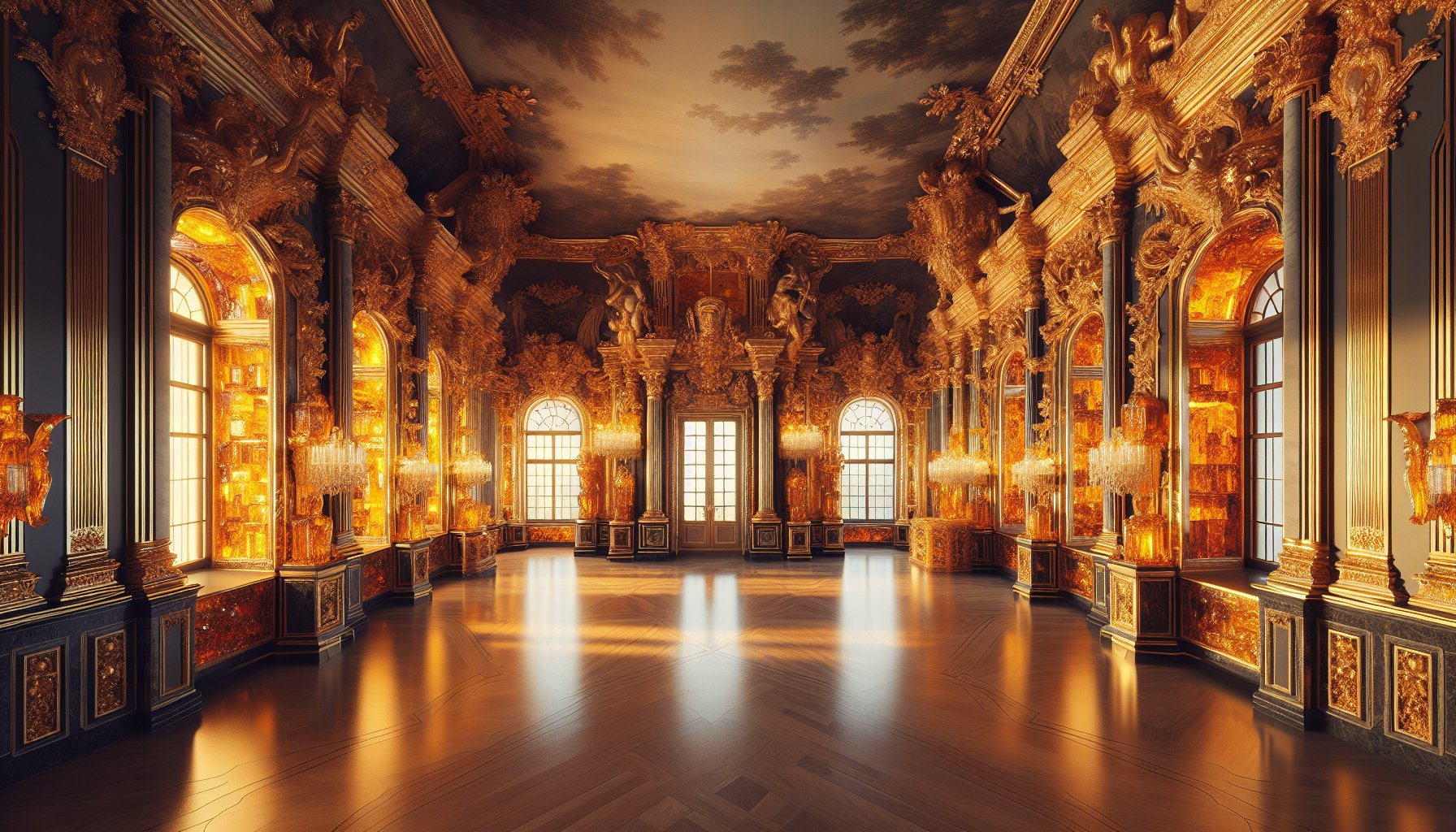
In 1755 Empress Elizabeth moved the amber panels to the Catherine Palace at Tsarskoye Selo, where Bartolomeo Francesco Rastrelli (1700–1771) stretched a Prussian cabinet across a hall nearly three times its size, adding mirrored pilasters, gilded cornices, and painted false amber to fill the walls. He treated the genuine panels as jewels in a larger setting (Britannica). In 1758 Friedrich Roggenbucke became curator, and four Florentine mosaics in coloured hardstone, an allegory of the five senses, were commissioned for the panels’ central frames (Shor). Catherine the Great ordered eight further panels in 1763, and by about 1770 the room held roughly six tonnes of amber, with amber-veneered furniture and a parquet of more than a dozen woods. After 1917 the palace became a state museum, and a single colour photograph from that year is the only colour record of how the room looked; every later judgement of tone rests on it.
How the Nazis Took the Amber Room in 1941
German troops reached the Catherine Palace in September 1941, found the amber panels hidden under wallpaper by the curator Anatoly Kuchumov, and dismantled the room in about 36 hours, packing it into 27 crates for shipment to Königsberg Castle in East Prussia. The curators had tried to evacuate the room and failed: two centuries of drying had made the amber friable, so they papered over the walls and hoped (Britannica). The room already stood on the Kümmel Report, the German art historians’ list of objects deemed German and due for repatriation. Sources disagree on the small numbers: the GIA account gives 36 hours and 27 crates in September; Zita Ballinger Fletcher, writing for HistoryNet in 2021, gives 14 October 1941 and 28 cases. The crates went by rail to Königsberg, where Alfred Rohde, director of the city’s art collections and an amber specialist, had written to Gauleiter Erich Koch asking for the return of “our national pride”. Rohde reassembled the room in the castle by the end of 1941. On the documentary record: his own 1942 article in the journal Pantheon lists what had already gone missing in transit, one Florentine mosaic, 24 bronze candelabra, most of the furniture (Tsarskoselskaya Amber Workshop, amberroom.ru). What hung in Königsberg was already a fragment.
What Happened at Königsberg Castle in 1944 and 1945
The Amber Room was last seen crated in the cellars of Königsberg Castle in January 1945; the castle burned during and after the Soviet assault of April 1945, and no crate, panel, or witness has ever established whether the amber left the building. Rohde took the panels down in March 1944 after an exhibition fire, and in a letter of 2 September 1944, after Royal Air Force raids in late August had gutted the city centre, he reported that the room had “survived, apart from six dado panels” (The Art Newspaper, January 1992). On 12 January 1945 he noted the panels “being crated” (Shor). Then the record stops. Königsberg surrendered on 9 April 1945; a city official named Gerlach described the castle’s south wing as destroyed and its cellar entrances blackened by smoke the following day. Rohde stayed, spoke to the first Soviet investigators, and died of typhus in December 1945 (amberroom.ru; The Art Newspaper). Two things get conflated here: the August 1944 bombing, which the room is documented to have survived, and the April 1945 fire, for which no equivalent document exists. Every later theory lives in the gap between those two dates.
The Search, 1945 to Now: Who Looked and What They Found
Eight decades of searching for the Amber Room have produced exactly two authenticated recoveries, a Florentine mosaic seized in Bremen in 1997 and a chest of drawers surrendered in Berlin the same year, and not one amber panel. Every other lead, Soviet, East German, West German, Polish, has ended in an empty cellar, a sealed mine, or a crate of military hardware.
The Soviet Commissions, 1945 to 1984
Alexander Brusov, an archaeologist attached to the Soviet arts protection service, reached Königsberg on 28 May 1945 and by 10 June had concluded the room no longer existed; his diary, kept secret for 45 years, recorded that the fire “started by our soldiers” had probably destroyed it (The Art Newspaper, January 1992). His team did find things in the cellars: gilded plaster, bronze door panels, and three fire-blackened Florentine mosaics from the room (Tsarskoselskaya Amber Workshop, amberroom.ru). Anatoly Kuchumov rejected the conclusion, arguing that the amber may have been packed separately from the mosaics and moved before the assault, and he found papers signed by Rohde that mentioned evacuation. A new committee re-examined the castle in August 1949 after residents reported crates being packed in the courtyard before the surrender; nothing was found, and in 1950 Brusov could not even relocate the bunker Rohde had described. Geophysical surveys followed in the 1960s, archaeologists joined in 1969, and the official search closed in 1984 without result. The journalists Catherine Scott-Clark and Adrian Levy argued in 2004 that the later KGB searches screened an original Soviet fire; Russian officials rejected the thesis, and on present evidence it is unproven.
The German Searchers: Georg Stein and the Stasi
Georg Stein, a former Wehrmacht engineer turned fruit farmer in Lower Saxony, read about the missing room in 1958 and spent three decades and his own money tracing wartime convoys; he recovered the Pechora monastery treasure in 1973, never found the amber, and died in a Bavarian forest in the summer of 1987 (The Art Newspaper, January 1992). In East Germany the search was state business. Paul Enke of the Ministry for State Security directed a commission that interviewed hundreds, dug palaces, mines and lakes, spent some 2.5 million marks in the Aue district alone, and published his Bernsteinzimmer-Report in 1986; he died the following year, and his theory produced no panel. The same 1992 report noted that Germans were contemplating costly searches of bunker systems in Thuringia. That is the documentary root of the Jonas Valley claims: the Jonastal tunnels between Arnstadt and Crawinkel, a late-war SS construction site, have been examined repeatedly by private groups, including a South Thuringian society devoted to the question, but I can find no published inventory of anything recovered there. The valley remains a theory, not a find.
1997: A Mosaic in Bremen and a Chest in Berlin
In 1997 a Bremen lawyer tried to sell a Florentine hardstone mosaic on behalf of his client Hans Achtermann, the son of a former German soldier, and the police seized it; it proved to be the allegory of Touch and Smell, one of the four Amber Room mosaics, apparently pocketed by an officer during the 1941 removal (Anne Laure Bandle, Alessandro Chechi and Marc-André Renold, Art-Law Centre, University of Geneva). Within weeks a Berlin woman, recognising an object from a television report, came forward with an inlaid chest of drawers she had bought through the East German antiques trade in the 1970s; experts confirmed it had stood in the room (Deseret News, 14 May 2003). The provenance trail runs: Tsarskoye Selo, 1941; a soldier’s household; Bremen and Berlin, 1997; home. On 29 April 2000 the German culture minister Michael Naumann and Bremen’s mayor Henning Scherf handed both objects to Vladimir Putin at Tsarskoye Selo, in exchange for the return to the Kunsthalle Bremen of 101 drawings that a Soviet soldier had carried off from Karnzow Castle in 1945 (Tagesspiegel, 25 April 2000; Art-Law Centre). The reconstruction team, which had already copied the mosaic from photographs, could now set original beside replica.
The Treasure-Hunter Claims, 2008 to 2025
In February 2008 the German parliamentarian Hans-Peter Haustein announced a man-made cavern near Deutschneudorf and soil tests showing gold; Larisa Bardovskaya of the Tsarskoye Selo museum replied that “we hear people saying they found the Amber Room three or four times a year” (NBC News, 21 February 2008). No amber emerged. From 2008 retirees led by Karl-Heinz Kleine searched Wuppertal on the theory that Erich Koch had shipped loot to his home town; by March 2015 their one find was an old well (NBC News, 4 March 2015). In October 2020 the Polish Baltictech team led by Tomasz Stachura announced the wreck of the steamer Karlsruhe, sunk by Soviet aircraft on 13 April 1945, the day after leaving Königsberg, lying at 88 metres off Ustka with sealed crates in her hold (Livia Gershon, Smithsonian, 23 October 2020). A return expedition in September 2021 found military equipment in the crates and passengers’ belongings in the smaller cases (Divernet, September 2021). The latest documented claim I can find is from July 2025, when Jan Delingowski, a former radio officer, was licensed by the Pomeranian heritage conservator to dig at a former SS training ground near Dziemiany in Kashubia, on the strength of prison testimony attributed to Koch (Jerusalem Post, 29 July 2025). As of September 2026 nothing has been reported from that dig.
The amberroom.ru Project
The website amberroom.ru is not a treasure hunt but the public archive of the Tsarskoselskaya Amber Workshop, the enterprise founded in 1979 to rebuild the room, and its English page on “The Search” is the most sober Russian summary of the case. Its verdict: “none” of the theories “has been proved either scientifically, or by documentation”. It lists the hypotheses without endorsing any, burnt in the castle, hidden under Kaliningrad, evacuated to Germany, Austria, Poland or the Czech lands, taken by American troops, sunk aboard the Wilhelm Gustloff or shipped on the cruiser Prinz Eugen, and it records what the searches did yield.
What the 2003 Reconstruction Settles and What It Cannot
The Amber Room that visitors see today is a reconstruction begun in 1979 and inaugurated on 31 May 2003 by Vladimir Putin and Gerhard Schröder, built from six tonnes of Kaliningrad amber over roughly 25 years at a cost near 11.5 million dollars. The 1979 decision shifted the Soviet state’s effort from searching to rebuilding (Britannica). A workshop formed at Tsarskoye Selo that year, led from 1981 by Alexander Zhuravlev and later by Boris Igdalov, worked from 86 black-and-white photographs, one faded colour slide, and 62 surviving amber fragments (Ivan Sautov, Tretyakov Gallery Magazine). The Soviet state owned the Baltic amber mines, so raw material from the Kaliningrad coast, the shore that had supplied Frederick I, was never the problem; money was. Soviet funding of some 8 million dollars ran out with the Union in 1991, and the project stalled until the German gas importer Ruhrgas gave 3.5 million dollars in 1999 (Britannica; Shor). About 100,000 pieces of amber were cut, heated and tinted by a final team of 74 (Jeremy Bransten, RFE/RL, 13 June 2003). The unveiling, on Saint Petersburg’s 300th anniversary, is recorded by the Kremlin press office for 31 May 2003.
What a Copy Can and Cannot Tell Us
The copy settles the question of technique: set beside the 1997 Bremen original, the workshop’s replica made from photographs proved nearly identical, the strongest evidence anyone has that the eighteenth-century methods were recovered. It settles nothing about the original’s fate. Igdalov put the limit precisely: “Amber is a living material, it constantly changes. It changes colour, becomes covered by a network of cracks” (Bransten, RFE/RL). The 1917 slide records one corner after two centuries of darkening; no one alive has seen the original’s colour. The parallel with the Stradivarius violins and their lost methods is exact: a copy can prove a technique recoverable without proving the original’s secret found.
Timeline of the Amber Room, 1701 to 2025
The table below sets out the documented events in the life of the Amber Room, from Frederick I’s commission in 1701 to the most recent permitted excavation in 2025, with the source that anchors each date, so that claims and recoveries can be told apart.
| Year | Event | Source |
|---|---|---|
| 1701 | Frederick I commissions amber cabinet; Schlüter designs, Wolfram carves | Britannica; Shor 2018 |
| 1716 | Frederick William I presents panels to Peter I, 17 November | Shor 2018 |
| 1717 | Eight crates leave Berlin, 13 January | Shor 2018 |
| 1743 | Martelli mounts panels in the Winter Palace | Shor 2018 |
| 1755 | Moved to Catherine Palace; Rastrelli enlarges room | Britannica |
| 1758 | Four Florentine mosaics commissioned | Shor 2018 |
| 1763–70 | Catherine II adds eight panels; six tonnes of amber | Britannica |
| 1917 | Only colour photograph taken | Britannica |
| 1941 | Dismantled in 36 hours, 27 crates; rebuilt in Königsberg | Shor 2018 |
| 1944 | RAF raids, August; Rohde reports room survived, 2 September | Art Newspaper 1992 |
| 1945 | Crated 12 January; city falls 9 April; castle burns; Brusov commission concludes room burned | Shor; Art Newspaper; amberroom.ru |
| 1949–84 | Soviet re-examinations, geophysics, archaeology; search closed | amberroom.ru |
| 1979 | Reconstruction ordered; Amber Workshop founded | Britannica |
| 1986–87 | Enke’s Stasi report published; Enke and Stein die | Art Newspaper 1992 |
| 1997 | Mosaic seized in Bremen; chest surrendered in Berlin | Univ. of Geneva Art-Law |
| 1999 | Ruhrgas grants 3.5 million dollars | Britannica |
| 2000 | Mosaic and chest returned to Russia, 29 April | Univ. of Geneva Art-Law |
| 2003 | Reconstruction inaugurated, 31 May | Kremlin press office |
| 2008–15 | Deutschneudorf cavern claim; Wuppertal dig finds a well | NBC News 2008, 2015 |
| 2020–21 | Karlsruhe wreck found; crates hold military gear | Smithsonian; Divernet |
| 2025 | Dziemiany dig licensed; no result reported | Jerusalem Post 2025 |
Why the Amber Room Still Matters
The Amber Room matters because it is the one great artwork of the Second World War whose loss is documented to the day and whose fate is documented not at all, which makes it a test case for how nations argue about looted culture. Its history maps the Russo-German relationship: a Prussian gift to secure a Russian alliance in 1716, a German seizure in 1941 justified by a list of “German” objects, German money completing the Russian copy in 1999, and German ministers handing back a mosaic in 2000 for Bremen’s drawings. Restitution has run in both directions, and the room has been the currency. The pattern of claim and disappointment has cousins in the wreck hopes attached to the San José galleon and the way the Library of Alexandria is mourned as one catastrophe when the record shows slow attrition. The Amber Room sits in the historical and archaeological mysteries archive because its central question is archaeological: not where is it, but what, in April 1945, was there to be found.
Frequently Asked Questions
What is the Amber Room?
The Amber Room was a chamber in the Catherine Palace at Tsarskoye Selo whose walls were faced with carved Baltic amber panels backed with gold leaf, set among mirrors and Florentine mosaics. Made in Prussia between 1701 and 1716 and enlarged by Rastrelli after 1755, it held about six tonnes of amber. The original vanished in 1945; a reconstruction has stood in the same room since 2003.
Who made the Amber Room and why was it given to Russia?
Frederick I of Prussia commissioned it in 1701; Andreas Schlüter designed it and Gottfried Wolfram, then Ernst Schacht and Gottfried Turau, carved it. His son Frederick William I gave the unfinished panels to Peter the Great on 17 November 1716 to seal an alliance against Sweden, receiving Russian grenadiers in return.
How did Rastrelli change the Amber Room?
After the panels reached the Catherine Palace in 1755, Bartolomeo Francesco Rastrelli fitted a small Prussian cabinet into a hall nearly three times its size with mirrored pilasters, a gilded cornice, painted imitation amber, and four Florentine mosaics of the five senses. Catherine the Great added eight panels in 1763; the room was complete by about 1770.
Where is the Amber Room in Russia?
The reconstructed Amber Room is in the Catherine Palace at Tsarskoye Selo in Pushkin, about 25 kilometres south of Saint Petersburg, in the room the original occupied from 1755 to 1941. The original’s location, if it survives, is unknown; its last documented place was the cellar of Königsberg Castle in January 1945.
How did the Nazis loot the Amber Room?
German troops occupying the Catherine Palace in autumn 1941 found the panels under the wallpaper used to hide them, took the room down in about 36 hours, and packed it into 27 crates, 28 by another account, for Königsberg, where Alfred Rohde reassembled it in the castle. One mosaic and 24 candelabra had already gone missing in transit.
What are the main theories about the Amber Room’s disappearance?
The leading view, held by the 1945 Soviet commission and by Scott-Clark and Levy in 2004, is that the crated panels burned in Königsberg Castle in April 1945. Alternatives place them under Kaliningrad, in a German mine or bunker, in the Jonas Valley, aboard a Baltic wreck such as the Wilhelm Gustloff or the Karlsruhe, or in a private collection abroad. None has produced a panel.
What have the searches for the Amber Room actually found?
Two authenticated objects: the Florentine mosaic Touch and Smell, seized in Bremen in 1997, and an inlaid chest of drawers surrendered in Berlin the same year, both returned to Russia on 29 April 2000. Soviet investigators in 1945 recovered bronze door fittings and three burnt mosaics from the castle cellars. No amber panel has surfaced.
How does the Amber Room affect Russian-German relations?
It has served as a bridge as often as a grievance. Ruhrgas funded the final phase of the reconstruction with 3.5 million dollars in 1999, German ministers returned the mosaic and chest in 2000 in exchange for 101 drawings looted from Bremen, and Chancellor Schröder stood beside President Putin at the 2003 inauguration.
How does the Amber Room appear in books and films?
It is a fixture of thrillers, documentaries and television treasure hunts, usually as the prize at the end of a Nazi-bunker plot. The most substantial non-fiction treatment in English is Catherine Scott-Clark and Adrian Levy’s The Amber Room (2004), which argues for destruction in 1945 and a Soviet cover-up, and which Russian officials denounced.
Why is it sometimes called the Amber Chamber?
“Amber Chamber” is a literal rendering of the German Bernsteinzimmer and the Russian Yantarnaya komnata. Britannica and the Tsarskoye Selo museum prefer Amber Room, while some Polish and German press translations, including reports on the 2020 Karlsruhe wreck, say Amber Chamber. They refer to the same object.
Was the Amber Room found on the Karlsruhe shipwreck?
No. Baltictech divers located the steamer Karlsruhe in 2020 at 88 metres off Ustka; she had left Königsberg on 12 April 1945 and was sunk the next day with sealed crates in her hold. When the team returned in September 2021 the crates held military equipment and the smaller cases passengers’ belongings.