
By EsoVitae Editorial · Published
Drafted with AI assistance from the sources listed; images are AI-generated illustrations. How EsoVitae is made
The 1708 Wreck Off Cartagena and What Lies on the Caribbean Floor
The Spanish sixty-four-gun galleon San José sailed from Portobelo on the Panamanian isthmus on May 28, 1708, riding low under the year’s accumulated New World tribute, and was sunk on the evening of June 8, 1708, in a running fight off the Baru peninsula southwest of Cartagena de Indias by a Royal Navy squadron under Commodore Charles Wager. The hull went down in roughly six hundred meters of water with approximately six hundred crew and passengers aboard and a registered cargo of gold, silver, and emeralds bound for the Spanish treasury during the War of the Spanish Succession. Modern valuations of the cargo, when extrapolated from the manifest and the bullion estimates of historians working from the Archivo General de Indias in Seville, run to seventeen billion United States dollars at present-day metals prices, a figure that places San José among the largest single accumulations of recoverable bullion lying on any seabed in the world.
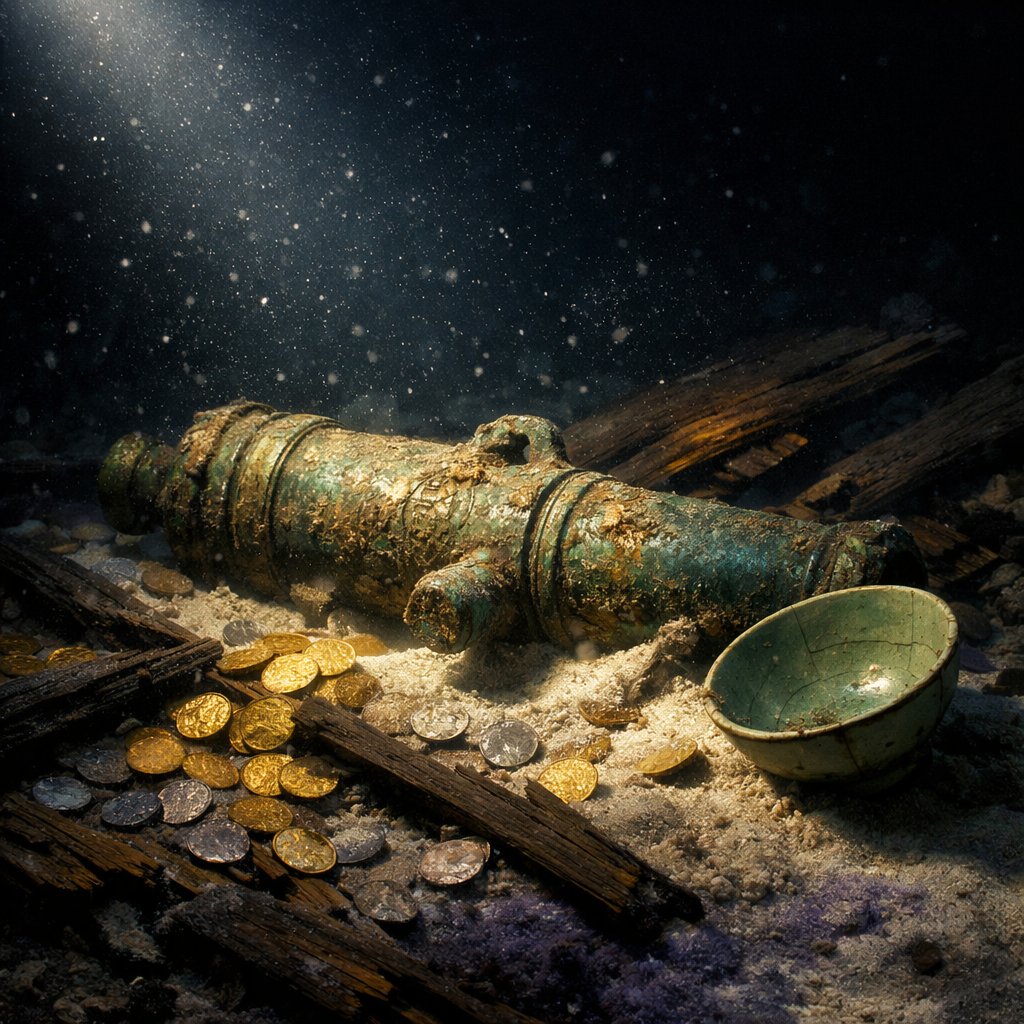
The wreck has not been raised. The Colombian government announced in November 2015 that an international team had located the hull, withheld the precise coordinates as a state secret, and has held the position since. A 2022 high-resolution photographic and bathymetric survey by the Colombian Navy and the Ministry of Culture produced more than three thousand images of the debris field, the cannon array, the porcelain cargo, and the scattered gold doubloons resting where they fell three centuries earlier. The legal status of the recoverable material remains unsettled. Bolivia, Peru, Spain, and the Qhara Qhara indigenous nation of the Bolivian altiplano have each asserted distinct claims grounded in distinct legal and moral frames, and excavation has been paused pending a domestic Colombian framework that the government has indicated will follow the principles of the 2001 UNESCO Convention on the Protection of the Underwater Cultural Heritage. What this article walks through, situating San José in the broader landscape of historical and archaeological mysteries, is the path from the running gun-fight in 1708 to the litigation that has shaped the wreck’s afterlife from 1981 forward.
The Tierra Firme Fleet and the Cargo Aboard
San José was the capitana, or flagship, of the Tierra Firme fleet, the annual Spanish convoy that linked the silver and gold of the Viceroyalty of Peru and the emeralds of the Viceroyalty of New Granada to the royal treasury at Seville. The cargo loaded at Portobelo in the spring of 1708 had reached the isthmus by the long Pacific haul from Lima up the coast to Panama, then by mule train across forty-eight miles of jungle to the Caribbean side. Carla Rahn Phillips, the foremost modern historian of the wreck, working from the manifest registers held at the Archivo General de Indias in Seville, estimates the registered cargo at roughly seven million silver pesos, with substantial unregistered private cargo carried in the holds beyond the king’s account [1]. Two hundred tonnes of gold and silver, with emeralds drawn from the mines at Muzo, ran the standard valuation through the eighteenth-century period.
The cargo was meant for King Philip V of Spain, the Bourbon claimant whose contested accession after Charles II had triggered the War of the Spanish Succession in 1701. The British, allied with the Dutch and the Habsburg claimant, were intercepting Spanish bullion convoys whenever weather and station permitted. By the spring of 1708, the Tierra Firme fleet had been delayed in Portobelo for more than a year, the bullion accumulating at the wharves while the convoy escort was assembled. Commodore Charles Wager, commanding the British Caribbean squadron from Port Royal in Jamaica, knew from his intelligence officers that the fleet would attempt the run from Cartagena to Havana in late spring or early summer.
Wager’s Action of June 8, 1708
Wager intercepted the Spanish convoy off the Rosario Islands at three in the afternoon on June 8, 1708. The Tierra Firme fleet sailed in line ahead under the command of General Don Jose Fernandez de Santillan, the Conde de Casa Alegre, with San José in the lead, the vice-flagship San Joaquín second, the urca Santa Cruz third, and a smaller escort of six gunboats. Wager’s force consisted of his own seventy-gun ship of the line Expedition, the sixty-gun Kingston, the fifty-gun Portland, and the fireship Vulture. The Royal Navy logs of the action, preserved in the Admiralty papers at the National Archives at Kew, record the engagement in conventional ship-time entries [2].
The running fight closed at about five o’clock. Expedition came alongside San José at pistol range as the light began to fail. The exchange of broadsides ran for roughly ninety minutes. Sometime between half past seven and eight, San José’s powder magazine detonated. The galleon broke apart and sank within minutes, taking the Conde de Casa Alegre, his officers, and approximately six hundred souls down with the hull. Eleven men were pulled from the water. Wager, in his dispatch to the Admiralty written in the days after the action, described the loss in measured prose; the magazine had gone, he wrote, before any boarding party could be assembled. He blamed his subordinate captains for failing to engage the vice-flagship San Joaquín, which escaped under cover of darkness with a substantial portion of the fleet’s bullion. The British took the urca Santa Cruz and one of the smaller escorts. San Joaquín reached Cartagena. The action ranks in Royal Navy history as Wager’s Action of 1708.
The 1981 Sea Search Armada Claim
For two hundred and seventy-three years the wreck lay undisturbed. In 1979 a private American salvage consortium called Glocca Morra Company, later reorganized as Sea Search Armada, signed a contract with the Colombian government for permission to search a defined sea area off the Baru peninsula in exchange for a fifty-percent share of any recoveries. In November 1981, working from a survey vessel called Glocca Morra II, the consortium reported to the Colombian Directorate General of Maritime and Port Affairs, known by its Spanish initials DIMAR, that they had located a substantial wreck consistent with San José within the contracted search corridor and supplied a coordinate set in a sealed report.
The Colombian government’s response, over the four decades that followed, has been sustained dispute. Colombia argued that the wreck found by Sea Search was not San José, or alternatively that the contractual share due the consortium had been superseded by a subsequent change in Colombian patrimonial law that limited any private salvor to a finder’s fee. Sea Search Armada sued in Colombian and United States courts. A 2007 ruling by Colombia’s Supreme Court awarded the consortium a fifty-percent share of any treasure recovered from the location they had reported in 1981, narrowly defined. A subsequent United States district court action filed by Sea Search in 2010 was dismissed in 2011 on jurisdictional grounds. The litigation has continued, with the central evidentiary problem that no party can definitively establish whether the 1981 coordinate set and the 2015 announcement-coordinate set name the same wreck, because the latter remains under state-secret seal.
The 2015 Announcement and the 2022 Survey
On December 5, 2015, Colombian President Juan Manuel Santos announced from the Casa de Nariño that an international expedition had located the wreck of San José within Colombian territorial waters. The expedition was conducted by the Colombian Navy with technical support from a private contractor, Maritime Archaeology Consultants Switzerland, working under the direction of Dr. Roger Dooley, a marine archaeologist who had previously surveyed wrecks in the Caribbean for the Florida State University Underwater Archaeology Program. The hull was identified, according to the official statement, by the diagnostic bronze cannon cast at Seville, by the trail of the cannon array consistent with the 1708 broadside disposition, and by the porcelain cargo bearing the marks of the Manila Galleon trade [3].
The location was withheld and remains withheld. In June 2022 the new Colombian government under President Iván Duque, working through the Ministry of Culture and the Colombian Navy’s Caribbean Naval Force (Fuerza Naval del Caribe, ARC), conducted a high-resolution photographic survey of the wreck site using remotely operated vehicles capable of working at six hundred meters. The survey produced more than three thousand digital images, including the now widely circulated photographs of intact gold doubloons and silver pesos lying on the seabed beside the dispersed timbers and the cannon array [4]. The site was confirmed as San José beyond reasonable doubt; the porcelain cargo, the bronze gunfounders’ marks, and the scatter pattern align with the 1708 archival record.
The Bolivian, Peruvian, Spanish, and Qhara Qhara Claims
The legal landscape over the recoverable material is more contested than the wreck site itself. Spain, through its Ministry of Culture, asserts that San José was a Spanish state vessel sailing under sovereign immunity at the moment of loss and that the wreck and its contents accordingly remain Spanish state property under customary international maritime law, citing the 2012 United States Supreme Court ruling in Odyssey Marine v. Spain, which returned the cargo of the Spanish frigate Nuestra Señora de las Mercedes to Madrid on precisely this principle [5]. Peru asserts that the silver in the cargo was extracted, often under conditions of forced labor (the mita system), from the Cerro Rico of Potosí within the present boundaries of Bolivia and the Viceroyalty of Peru, and that any recovery should be apportioned to the contemporary nation-state on whose soil the metal was raised. Bolivia advances a closely related claim grounded in the same Potosí provenance.
The Qhara Qhara nation, an indigenous people of the Bolivian altiplano whose ancestors were among those forced into the Cerro Rico mines under the mita, filed a formal claim with the Colombian government in 2018 asserting that any recovery should acknowledge the indigenous labor and lives that produced the silver. The claim is supported by the Bolivian state and is consistent with the broader provisions of the United Nations Declaration on the Rights of Indigenous Peoples concerning ancestral cultural heritage. Colombia has not formally responded to the substance of the Qhara Qhara claim, and excavation has been paused while a domestic legal and ethical framework is constructed. The Colombian Ministry of Culture, working with the Institute of Anthropology and History (ICANH) and the historian Gerald Voigt, has begun the long task of cataloguing the survey imagery against the Sevillian manifest record [6].
What the UNESCO 2001 Convention Asks of the Excavation
Colombia is not a state party to the 2001 UNESCO Convention on the Protection of the Underwater Cultural Heritage, but the present government has stated publicly that the San José excavation will be conducted in accordance with the convention’s principles. The convention establishes a baseline of in-situ preservation as the preferred treatment for underwater cultural heritage, prohibits the commercial exploitation of recovered material, and requires that any recovery be conducted under scientific archaeological standards rather than as a salvage operation. The convention has been argued in the Cartagena maritime archaeology literature by, among others, Roger Charles Smith of the Florida State University program, whose work on Caribbean colonial wrecks lays out the protocols this excavation would follow [7].
The practical effect of the convention’s principles is that the Colombian state, when excavation begins, will be conducting a years-long underwater archaeological project at six hundred meters depth, on a wreck that contains roughly six hundred sets of human remains, with the recovery of bullion subordinated to the archaeological record. The fortune in gold and emeralds is the part of the story that has driven the litigation. The cannon array, the porcelain, the personal effects of the crew, and the human remains are the parts of the story the convention’s framework asks the historian to centre. San José sank with people aboard. The excavation that follows belongs to that fact at least as much as to the bullion the cargo is famous for.
What the Wreck Will Not Settle
A historian writing the case has to keep two things in view. The first is the documentary record. The Sevillian manifest, the Royal Navy logs, the dispatches of Wager and Casa Alegre, the eighteenth-century pamphlet literature on the action, and the Phillips synthesis of 2007 give a defensible account of what happened on the evening of June 8, 1708, and what the cargo consisted of. The second is the contemporary legal record. The Sea Search litigation, the Spanish sovereign-immunity claim, the Bolivian and Peruvian provenance claims, the Qhara Qhara cultural-heritage claim, and the Colombian patrimonial law pull in different directions. The wreck cannot resolve them. The wreck is the artifact the legal disputes are about; it cannot speak for any party.
When the Colombian Navy’s remotely operated vehicles passed over the debris field in 2022 and produced their three thousand images, what the cameras saw was not a single artifact but a scattered set of historical claims at rest under six hundred meters of saltwater. The doubloons that minted from Potosí silver carry the labor of the Qhara Qhara on their surfaces. The bronze cannon carry the gunfounders’ marks of Seville. The porcelain carries the trade route from Manila across the Pacific to Acapulco and then by mule across the isthmus to the holds of San José. None of those material facts decides the question of who, in the present, owns the recovery. They establish the questions the recovery will have to answer carefully, and slowly, and with a measure of historical humility about whose silver this was, on what backs it was raised, and at what cost.
Frequently Asked Questions
What was the San José galleon?
The San José was a sixty-four-gun Spanish ship of the line serving as the capitana, or flagship, of the 1708 Tierra Firme treasure fleet bound from Portobelo on the Panamanian isthmus to Cartagena de Indias and onward to Havana and Spain. She carried the annual New World tribute of gold, silver, and emeralds to the royal treasury of Philip V during the War of the Spanish Succession.
How did the San José sink?
San José was sunk on the evening of June 8, 1708, in a running engagement off the Baru peninsula southwest of Cartagena de Indias by a Royal Navy squadron under Commodore Charles Wager. The British seventy-gun ship Expedition came alongside at close range as the light failed; an exchange of broadsides lasting roughly ninety minutes ended when the Spanish flagship’s powder magazine detonated and the hull broke apart and sank within minutes.
How many people died when the San José sank?
Approximately six hundred crew and passengers were aboard the San José when she sank. The British recovered eleven survivors from the water; the remaining six hundred men, including the fleet commander Don Jose Fernandez de Santillan, the Conde de Casa Alegre, were lost with the hull.
What was on board the San José?
The cargo, drawn from the registered manifest at the Archivo General de Indias in Seville and reconstructed by the historian Carla Rahn Phillips, included an estimated two hundred tonnes of gold, silver, and emeralds, with the silver largely produced from the Cerro Rico of Potosí and the emeralds from the mines at Muzo. The bullion was destined for the royal treasury of Philip V of Spain.
How much is the San José treasure worth today?
Modern valuations, extrapolated from the registered manifest and the bullion estimates against present-day metals and stone prices, place the cargo at approximately seventeen billion United States dollars. The figure is the most commonly cited estimate; competing calculations run from four billion to twenty billion depending on the assumptions about unregistered private cargo and the present price of cut emeralds against the period stones in the Muzo lots.
Who was Commodore Charles Wager?
Sir Charles Wager (1666 to 1743) commanded the Royal Navy’s Caribbean squadron from Port Royal in Jamaica during the action of June 8, 1708. He was rewarded for the engagement with a knighthood and prize money, and rose subsequently to First Lord of the Admiralty. The action is recorded in Royal Navy history as Wager’s Action of 1708 and is preserved in the Admiralty papers at the National Archives at Kew.
What was the Sea Search Armada claim of 1981?
In November 1981, the American salvage consortium Sea Search Armada, working from the survey vessel Glocca Morra II under a 1979 contract with the Colombian government, reported to the Colombian Directorate General of Maritime and Port Affairs that they had located a substantial wreck consistent with San José in their contracted search area off the Baru peninsula. A 2007 ruling by Colombia’s Supreme Court awarded the consortium a fifty-percent share of any treasure recovered from that specific reported location. The litigation has continued in both Colombian and United States courts.
When did Colombia announce the discovery of the San José?
President Juan Manuel Santos announced from the Casa de Nariño on December 5, 2015 that an international expedition had located the San José within Colombian territorial waters. The expedition was conducted by the Colombian Navy with technical support from Maritime Archaeology Consultants Switzerland, under the direction of the marine archaeologist Dr. Roger Dooley. The precise coordinates were withheld as a state secret and remain so.
What did the 2022 Colombian survey find?
In June 2022 the Colombian Navy and the Ministry of Culture, working through the Caribbean Naval Force, conducted a high-resolution photographic survey using remotely operated vehicles. The survey produced more than three thousand images of the debris field, including the cannon array, the Manila-trade porcelain cargo, intact gold doubloons, and silver pesos lying among the dispersed timbers. The site was confirmed as San José beyond reasonable doubt by the bronze gunfounders’ marks and the cargo composition.
Who is claiming the treasure?
Four parties hold competing claims to the recoverable material. Colombia asserts territorial sovereignty over the wreck within its waters. Spain claims sovereign immunity over a state vessel of the period. Bolivia and Peru claim provenance over the silver mined from Potosí under the mita system in the colonial Viceroyalty of Peru. The Qhara Qhara indigenous nation of the Bolivian altiplano filed a formal claim in 2018 grounded in the indigenous labor and lives that produced the bullion in the Cerro Rico mines.
Why has the excavation not begun?
Excavation has been paused pending a domestic Colombian legal and ethical framework consistent with the principles of the 2001 UNESCO Convention on the Protection of the Underwater Cultural Heritage. Colombia is not a state party to the convention but has indicated that the recovery will follow its baseline of in-situ preservation, scientific archaeological method, and prohibition of commercial exploitation. The competing claims of Spain, Bolivia, Peru, and the Qhara Qhara nation also remain open.
Where is the San José wreck located?
The wreck lies in approximately six hundred meters of water off the Baru peninsula southwest of Cartagena de Indias on the Caribbean coast of Colombia. The precise coordinates are held under state-secret seal by the Colombian government and have not been published in any open source. The general area, the historical Wager’s Action engagement zone near the Rosario Islands, has been known since the eighteenth century from the Royal Navy logs.
What does the 2001 UNESCO Convention require?
The 2001 UNESCO Convention on the Protection of the Underwater Cultural Heritage establishes in-situ preservation as the preferred treatment for underwater cultural heritage, prohibits the commercial exploitation of recovered material, requires that any recovery be conducted under scientific archaeological standards, and asks state parties to share access to the heritage with descendant communities. The Colombian government has stated that the San José excavation will follow these principles even though Colombia is not a state party.