By Emilia Wellesley · Published May 4, 2026 · Updated September 10, 2026
Last updated: September 10, 2026.
Discover the enigmatic Rongorongo script, a mysterious writing system from Easter Island (Rapa Nui), which remains one of the world's few undeciphered scripts. Dive into its historical discovery, attempts at decipherment, and its significance to the Rapa Nui culture and global linguistics.
Historical Unveiling
Let's cast our minds back to the early 19th century when the enigmatic Rongorongo script of Easter Island first caught the attention of the European world. It was 1864 when Eugène Eyraud, a lay missionary, inadvertently stumbled upon these peculiar inscriptions carved on wooden tablets. Despite his primary mission being the spread of Christianity, Eyraud's discovery brought a new dimension to our understanding of Polynesian cultures, particularly the indigenous Rapa Nui people.
After Eyraud's initial encounter, it wasn't until his detailed reports reached the outside world that the global community started to take notice. His descriptions hinted at an ancient literacy form, unlike anything known from the Pacific regions at the time. Eyraud’s revelation set the stage for a series of scholarly pursuits aimed at unraveling this cryptic script, marking a turning point not only for linguistic enigmas but also for the field of historical linguistics.
Influence of Polynesian Culture
Venturing further into the essence of Rongorongo involves diving deep into the cultural tapestry of Easter Island itself—Rapa Nui. Located in the secluded expanses of the southeastern Pacific Ocean, this island represents a pinnacle of Polynesian ingenuity and isolation. Its famed Moai statues, aside from being a cultural icon globally, offer a glimpse into a community capable of immense artistic and architectural feats, despite their geographical confinement.
This isolation played a crucial role in shaping the unique cultural elements of the island, including its writing system. The Rongorongo script, with its complex glyphs and undeciphered language, is an emblem of this distinctive cultural evolution. While many Polynesian cultures preserved their histories through rich oral traditions, the Rapa Nui might have pushed this boundary into creating one of the few ancient scripts in Oceania.
The implications of such a development are vast, suggesting advanced cognitive and cultural patterns. It poses the question: how did such an isolated community conceive a method of written communication, and what might this signify about their societal structure and interaction? These queries not only underscore the significant role of Rongorongo in understanding the Polynesian ancestral heritage but also highlight the broader impacts of isolation on human cultural development and linguistic diversification.
Physical Description of the Tablets
Material and Craftsmanship
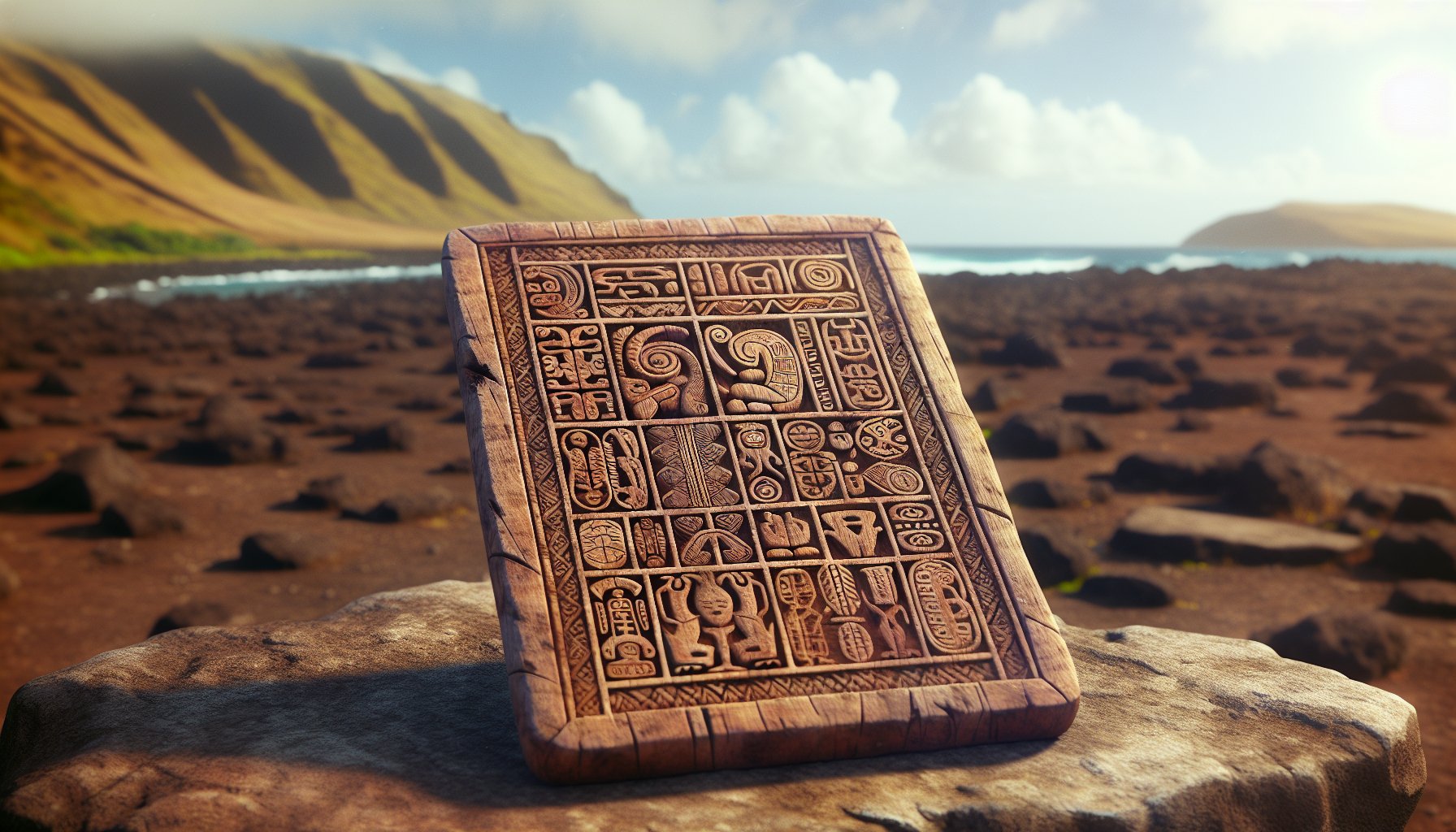
The tablets of Rongorongo are a marvel of ancient craftsmanship, each carefully carved from the wood of the toromiro tree—a species once abundant on Easter Island but now alarmingly scarce. These artifacts stand as testaments to Polynesian artistic engraving, adorned with intricate glyphs that both confound and fascinate modern scholars. The carvings, deep and deliberate, suggest artisans possessed not only exceptional skill but a profound, possibly sacred or ceremonial purpose.
- Variability in Size and Shape: Each tablet varies, ranging from small, palm-sized pieces to larger, elongated planks, challenging the concept of portable writing materials.
- Glyph Details: The glyphs—the heart and mystery of Rongorongo—are arrayed in neat rows. Each glyph is a complex assembly of curvilinear forms that mirror the dynamic contours of human and animal figures, intertwined with abstract, geometric patterns.
Distribution and Current Holdings
The Rongorongo tablets, whispers of the past etched into wood, represent precious remnants of a cultural tapestry once tightly interwoven around Easter Island. Today, these artifacts are scattered far from their Pacific origins, residing in the guarded sanctuaries of the world's museums.
- Notable Museum Holdings: These tablets can be found in prestigious locations including the British Museum and the quieter corners of the Vatican Museum, kept in archival repose.
- Private and Academic Collections: Additionally, private collectors and academic institutions across the globe hold several fragments. Each piece is a part of a larger, enigmatic puzzle that spans continents and centuries.
The widespread distribution of these tablets not only highlights the historical intrigue they sparked upon discovery but also raises important questions about cultural heritage and the ethics of artifact possession. This dispersion complicates efforts for comprehensive study and preservation, leaving researchers to rely on digital images and descriptions to unlock the secrets held by these engraved timbers.
In essence, the Rongorongo tablets are not merely ancient relics; they are vibrant narratives frozen in wood, awaiting the light of understanding to reveal the stories of a civilization that continues to speak through these enigmatic symbols. The ongoing global custody and care of these tablets underscore their universal value and the mystery that Rongorongo represents in the saga of human history.
The Script and Its Glyphs
Characteristics of the Glyphs
The glyphs comprising the Rongorongo script are nothing short of a visual enigma. Crafted with meticulous skill on wooden tablets, each character carries with it an air of profound mystery. The artisans of Rapa Nui utilized sharp tools to etch deep, continuous lines into the wood, creating forms ranging from simple geometric shapes to complex anthropomorphic figures. These glyphs are not merely artistic expressions but are thought to embody a form of communication—be it religious, calendrical, or narrative records hinting at ancient Proto-Oceanic languages.
Visual inspection reveals a curious aspect of these inscriptions: they are typically arranged in what appears to be a boustrophedon manner. This method, where one reads a line from left to right, then the next line from right to left, adds a layer of complexity to an already cryptic text. It's speculated that this layout could be indicative of an evolved form of writing tailored to the material and tools available on the isolated island.
Linguistic Classification Efforts
When it comes to embedding the Rongorongo script within the broader framework of Polynesian symbols and global writing systems, linguists face a particularly daunting challenge. Unlike other ancient scripts which may align more predictably within established linguistic groups or families, Rongorongo eludes simple classification. This resistance to categorization stems partly from its status as one of the few undeciphered scripts worldwide, and partly from the unique context of its usage by the Rapa Nui civilization.
Expansive efforts have been made to draw parallels between Rongorongo and other indigenous scripts, as well as to identify any phonetic patterns that could provide keys to decipherment. Scholars like Thor Heyerdahl and Steven Fischer have pored over the glyphs, looking for clues that could connect these symbols to broader Polynesian traditions or even wider Oceanic linguistic phenomena. Comparative studies often reference the intricate Polynesian petroglyphs and hieroglyphic scripts, noting stylistic similarities and shared symbolic motifs. Yet, the question of whether the Rongorongo script was purely symbolic or included phonetic elements remains a pivotal subject of debate in anthropological circles.
The quest to classify Rongorongo touches on various disciplines, from historical linguistics to ethnology, each bringing its toolbox to chip away at the stone of Rapa Nui’s linguistic legacy. Whether these glyphs turn out to be a full-fledged writing system or a sophisticated form of proto-writing reflects directly on our understanding of pre-colonial Oceanic cultures and their capacities for written communication.
Through examining such characteristics and the exhaustive classification attempts, we delve deeper into the intricate tapestry of Rongorongo—each study uncovering a little more about this profound cultural artifact, which continues to hold its secrets tight, centuries after its creation. Each glyph, each line tells a story awaiting decipherment, offering a potential gateway into the rich, enigmatic history of Easter Island.
Attempts at Decipherment
The journey to decode the Rongorongo script, steeped in mystery and academic challenge, is a testament to the resilience and ingenuity of those intrigued by one of the world's most enigmatic languages. Since its discovery in the early 19th century, numerous scholars and cryptographers have grappled with its complex glyphs and symbols, hoping to unlock the narratives possibly hidden within its lines.
Early Investigations
The initial quest to decipher Rongorongo began with Bishop Florentin-Étienne Jaussen, who was bewildered by the script upon receiving a tablet from Rapa Nui. Jaussen's attempts set the foundational stones, although his progress was stifled by the script's isolation from any known writing systems. As no verifiable links to Polynesian languages or other ancient scripts were apparent, the bishop's efforts were akin to finding a needle in a hayfield—challenging yet driven by a glimmer of hope.
Throughout the 20th century, scholars like Thomas Barthel and Steven Fischer tried to make headway with sophisticated linguistic models. Barthel's approach was technical, cataloging each glyph systematically, while Fischer proposed that Rongorongo was not purely ideographic or syllabic but perhaps a mixture of both, a theory that stirred much debate among linguists.
Modern Decipherment Attempts
In the contemporary landscape, decipherment techniques have evolved, merging traditional linguistic scholarship with technological advancements. Modern researchers, equipped with digital imaging and database management, have compiled comprehensive glyph libraries that are accessible worldwide. This has fostered a collaborative academic environment where theories can be shared and scrutinized across continents.
Current theories range from viewing Rongorongo as a form of proto-writing, used primarily for ceremonial purposes, to considering it a complete writing system meant for narrative records. Ethnographic research suggests that the Rongorongo tablets may have served diverse functions, from calendrical to mythological storytelling, hinting at a sophisticated societal role.
The linguistic enigmas presented by Rongorongo seem to deepen with each investigative layer peeled back. Every glyph and symbol is a piece of a larger puzzle, each stroke potentially a whisper from the past, calling to be understood. While the full decipherment of Rongorongo remains elusive, the ongoing academic pursuit underscores a broader quest for human connection across time and cultures, revealing our intrinsic desire to understand and preserve our collective historical heritage. Each attempt, whether yielding breakthroughs or raising further questions, enriches the global understanding of the Rapa Nui people and the broader domain of undeciphered scripts.
Cultural Relevance and Oral Traditions
Intertwining with Rapa Nui Lore
The Rongorongo script isn't just a collection of cryptic texts; it’s a deeply ingrained element of the Rapa Nui's rich heritage. This script, discovered on the remote Easter Island, which is also known as Rapa Nui, represents more than just written communication—it embodies the cultural and spiritual wisdom of the Polynesian inhabitants. The integration of the script with the island's lore is evident as many believe these inscriptions contain key mythological texts that narrate the ancestry and cosmology of the Rapa Nui people. Local oral traditions, which have been the backbone of Rapa Nui culture, may offer clues to this undeciphered script. They carry the whispers of the past, potentially echoing the narratives captured on the wooden tablets.
These narratives are not mere stories; they are the retentions of a civilization's identity, wrapped in symbolism and woven through the Rongorongo glyphs. The potential connection between these glyphs and oral traditions might unlock the script's purposes, which some hypothesize could range from religious to calendrical use, capturing the ebb and flow of daily and spiritual life on the island.
Ethnological Significance
Understanding the Rongorongo script does more than satisfy academic curiosity—it provides a window into the social and cultural fabric of the indigenous Rapa Nui people. Ethnographic research suggests that the scripts are a key artifact in piecing together the societal structure and rituals of this isolated civilization. The scripts’ content, once fully deciphered, could offer unprecedented insights into pre-Colonial Polynesian life, linking the old with the new and the oral with the written.
Ethnologists and anthropologists treasure these scripts for they encapsulate an epoch where oral traditions were perhaps transitioning into written forms, marking a significant cultural evolution. The study of Rongorongo not only enriches our understanding of Rapa Nui's past but also enhances our knowledge of Polynesian symbols and linguistic enigmas in the broader context of Oceanic history.
Furthermore, the script holds a pivotal role in the cultural preservation efforts of Easter Island's modern inhabitants. For the descendants of the original carvers, these symbols are a source of national pride and cultural identity. They are not merely relics to be stored away in museum collections across the world but are living embodiments of a resilient culture that survived centuries of isolation and external pressures.
In this context, the cultural relevance of Rongorongo extends beyond the confines of academic debate into the heart of identity, continuity, and the human desire to maintain a tangible link to one’s ancestors. Through meticulous preservation and continued ethnographic studies, the secrets of the Rongorongo script continue to unfold, ensuring that the voices of the ancient Rapa Nui do not fade into silence but resonate through the ages.
Archaeological and Ethnographic Context
Exploring Connected Cultural Artifacts
Within the shadowy confines of Easter Island's mysterious past, numerous artifacts accompany the enigmatic Rongorongo script, each adding depth to the island’s storied cultural tapestry. These include:
- Carved Wooden Tablets: Central to the script’s mystery.
- Moai Statues: Iconic of Easter Island and reflective of the islanders' spiritual and social life.
- Ceremonial Altars (Ahu): These structures provide essential clues about the religious practices associated with Rongorongo.
- Various Smaller Carvings and Tools: Indicative of intricate Polynesian craftsmanship.
The integration of these artifacts within the broader archaeological narrative helps paint a more comprehensive picture, suggesting a society complex enough to create its own system of writing or symbols. Researchers studying these items alongside Rongorongo tablets gain insights into the script’s potential roles in rituals, record-keeping, or as sacred narratives.
Comparative Linguistic and Symbolic Studies
Comparative studies with other ancient scripts illuminate Rongorongo's uniqueness and potential connections:
- Artistic Styles and Engraving Techniques: Parallels drawn with the petroglyphs across Polynesian islands suggest a shared lexicon of symbols.
- Phonetic Patterns Analysis: Researchers like Steven Fischer and Robert Langdon have examined potential linguistic links between Rongorongo glyphs and known Polynesian languages, as well as distant scripts.
- Comparison with Other Ancient Scripts: The comparative analysis extends to hieroglyphics and the undeciphered Indus script, focusing on challenges in preservation, decipherment, and categorization.
These studies not only aim to decode the script but also place it within a global framework of ancient communication, exploring the development of complex writing or symbolic systems in isolated societies.
The Role of Ethnography in Interpretation
Ethnographic research, particularly studies into oral traditions and myths about Rongorongo among the Rapa Nui people, provides a critical interpretive tool:
- Oral Histories: Recorded insights from ethnologists like Father Sebastián Englert suggest that Rongorongo had narrative and religious importance.
- Cultural Significance: Ethnography reveals how the script might have been perceived and used by its original writers and readers.
Englert’s studies indicate that the tablets were likely read during important gatherings, potentially reciting genealogies, legends, or chants crucial for the transmission of knowledge and culture in an oral society. This perspective is vital for understanding the sociocultural framework in which Rongorongo existed, offering clues that are invisible to purely linguistic or archaeological methods.
By examining the broader archaeological finds and conducting comparative and ethnographic studies, researchers can assemble the scattered pieces of the Rongorongo mystery, adding dimension to our understanding of this isolated, yet profoundly intricate island civilization. The narrative built around these scripts enriches our comprehension of human history's diversity in expressing and preserving its stories and knowledge.
Preservation and Continued Mystique
Conservation Issues
Navigating the tides of time, the Rongorongo tablets, etched delicately on various wooden objects, face significant conservation issues that threaten their longevity. Many of these ancient artifacts have succumbed to the demands of age, climate factors and, unfortunately, neglect. Due to the organic nature of wood, these artifacts are inherently vulnerable to environmental deterioration—moisture, temperature fluctuations, and invasive biological organisms have all played a hand in degrading these precious cultural relics.
Moreover, the scattered nature of these tablets across the globe poses another significant hurdle. Residing in institutions like the British Museum and the Vatican Museum requires coordinated efforts for standard conservation practices. However, differences in conservation technology and approaches can lead to inconsistent care, further endangering the artifacts. Efforts towards sustainable inscriptions involve sophisticated preservation methods, including controlled atmospheres and minimal direct handling, yet the battle against time is relentless.
Enduring Mystery and Global Interest
Despite these concerns, the mystery of the Rongorongo script continues to be a magnet for global interest. The allure of this undeciphered script lies not just in its enigmatic symbols but in what it represents—a lost language and the untold history of the Rapa Nui civilization. This undecoded aspect of the glyphs creates a puzzle that appeals to both academic scholars and the general public alike, giving it a mythological status akin to the Rosetta Stone.
Historians, linguists, and cryptographers have been drawn to the Rongorongo like moths to a flame. The possibility that these scripts could unlock the narrative of a pre-Columbian Oceanic society makes them an invaluable resource in the realm of linguistic enigmas and Polynesian history. Comparative studies with other ancient scripts, such as hieroglyphics or even the distant Mayan writings, have woven a tapestry of interdisciplinary research that spans across continents and cultures.
As technology advances, so too do the methods available to potentially decipher these ancient messages. Digital archiving and artifact scanning offer new horizons for preservation and interpretation. Meanwhile, the growing field of computational linguistics might one day crack the code that traditional methods have struggled with.
This enduring mystique ensures that Rongorongo remains not just a topic of scholarly pursuit but a symbol of the complexities of human communication and the profound impact of cultural heritage. As each generation brings new techniques and fresh perspectives to the table, there remains hopeful anticipation that the secrets of the Rongorongo will not remain silenced forever, providing a voice once again to the ancient Rapa Nui people. Through this dance of preservation and discovery, the script continues to enchant and inspire, a testament to the enduring intrigue of lost languages and ancient civilizations.