By Emilia Wellesley · Published May 4, 2026 · Updated May 13, 2026
Last reviewed: May 4, 2026.
Dive into the mystical world of the Moai statues on Easter Island, colossal monoliths carved by the indigenous Rapa Nui people. These statues are not just giant stone figures but symbols deep-rooted in the island's history, culture, and religion.
Origins and History
Tracing the Roots of Moai
The mysterious moai statues of Easter Island, known locally as Rapa Nui, first began to captivate and mystify the world shortly after European explorers stumbled upon the island in 1722. Created by the indigenous Rapa Nui people, these majestic stone figures were carved from the volcanic tuff obtained largely from the Rano Raraku quarry. This location on the island served not only as a monumental workshop but also as a symbolic gateway into the heart of the Rapa Nui's rich and enigmatic culture.
Techniques of Creation
Carving a moai was an exercise steeped in religious and cultural significance, linked to ancestral worship and the Rapa Nui’s beliefs in mana, a spiritual force. The craft involved intricate methods where:
- Sculpting Tools: Sculptors utilized basalt stone tools to meticulously shape the volcanic tuff.
- Effort and Precision: An endeavor that required skill, precision, and communal effort.
As the moai slowly emerged from the rock, so too did the Rapa Nui’s connection to their ancestors, believed to watch over their living descendants through the statues’ commanding eyes.
Challenges in Moai Placement
Once carved, the statues were transported from Rano Raraku to various ahu sites around the island. This transportation process remains one of Easter Island’s great mysteries. Theories abound:
- Wooden Rollers or Sleds: Traditional thoughts on mechanical movement.
- "Walking" statues: An intriguing idea suggesting that the statues were "walked" using ropes in a rocking motion, aligning with local legends that say the moai walked to their ahu.
Cultural and Historical Milestones
Throughout its history, Easter Island faced periods of tribal wars and population decline, particularly following the initial European contact which brought diseases and slave raids, dramatically altering the island’s demographic and cultural landscape.
- Statue Toppling: The moai themselves sometimes fell victim to these conflicts, toppled during disputes between rival clans.
- Restoration Efforts: Their restoration in modern times, as part of UNESCO’s designation efforts in 1995, marked a significant stride towards preserving and honoring this unique heritage.
These restoration works underline a broader narrative of resilience and revival, reflecting a renewed respect and recognition of Rapa Nui's ancestors and their indelible legacy.
Modern Archaeological Insights
Contemporary studies and archaeological excavations at sites like Anakena Beach or the inner regions of Rano Raraku provide further clarity to the moai's origins and functions.
- Leading Researchers: Archaeologists like Jo Anne Van Tilburg have played a pivotal role in unearthing these insights.
- Construction Dates: Offering a more nuanced understanding of the moai's construction dates, which range broadly from as early as 1250 CE to around 1500 CE.
Each moai stands as a monolithic testament to the Rapa Nui’s ambitious ingenuity and their profound connection to their environment and ancestors. These statues are not merely relics of stone but are enduring symbols of a people steeped in complexity and rich historical narratives. Through ongoing research and preservation, the mysteries of these formidable figures continue to unfold, offering timeless insights into one of the world’s most isolated and intriguing cultures.
Spiritual and Ancestral Importance
Central to the heart of Rapa Nui culture, the Moai statues represent more than just impressive monolithic achievements; they are profound symbols of spiritual and ancestral reverence. Carved from the volcanic tuff of Rano Raraku, each Moai is believed to embody the spirit of an esteemed ancestor, acting as a physical manifestation of those who have passed yet still watch over their descendants.
The Rapa Nui people, deeply rooted in a culture that emphasized the connection between the terrestrial and the spiritual, utilized these statues to maintain a tangible link with their ancestors. It’s a widely held belief that these stone giants harnessed 'mana,' a supernatural force that provided prosperity and protection to the community. Positioned strategically, most Moai faced inwards towards the island—a layout suggesting their role as protectors of the living, gazing over the villages with an almost custodial presence. By integrating these colossal figures into their daily lives, the islanders created an environment where the line between the past and the present blurred significantly.
Furthering their spiritual importance, the placement of Moai on sacred platforms known as Ahu turned these locations into critical communal and ceremonial hubs. The ceremonial aspects cannot be overstated; major gatherings, rituals, and significant decisions under the watchful eyes of these ancestral effigies affirmed their integral part in both society and spirituality of Rapa Nui.
Accompanying this spiritual stewardship was the integral role these figures played in the societal fabric of the island. The construction and erection of a Moai were not only spiritual endeavors but also monumental projects that united various clans under common goals, fostering a complex web of cooperation and social unity. Thus, in a socio-spiritual context, these megaliths transcended their physical form, becoming pivotal to societal cohesion and spiritual fidelity—a duality that underpinned the ancient Rapa Nui civilization.
Construction and Features
Materials and Techniques
The mystifying figures of Moai that spear the horizons of Easter Island are hewn primarily from volcanic tuff, a soft, compressible stone sourced from the Rano Raraku quarry. This pivotal site forms an essentially unmitigated chapter in the saga of these statues—roughly 95% of all Moai are cut from this solitary volcanic crater, a testament to its significance and the geological benevolence it provided to the Rapa Nui artisans. The softer nature of tuff allowed for the detailed carving necessary to achieve the Moai's intricate facial features, though the craft required sophisticated grasp over stone technology and an intimate understanding of its fracture mechanics to avoid catastrophic collapses during the carving and transportation stages.
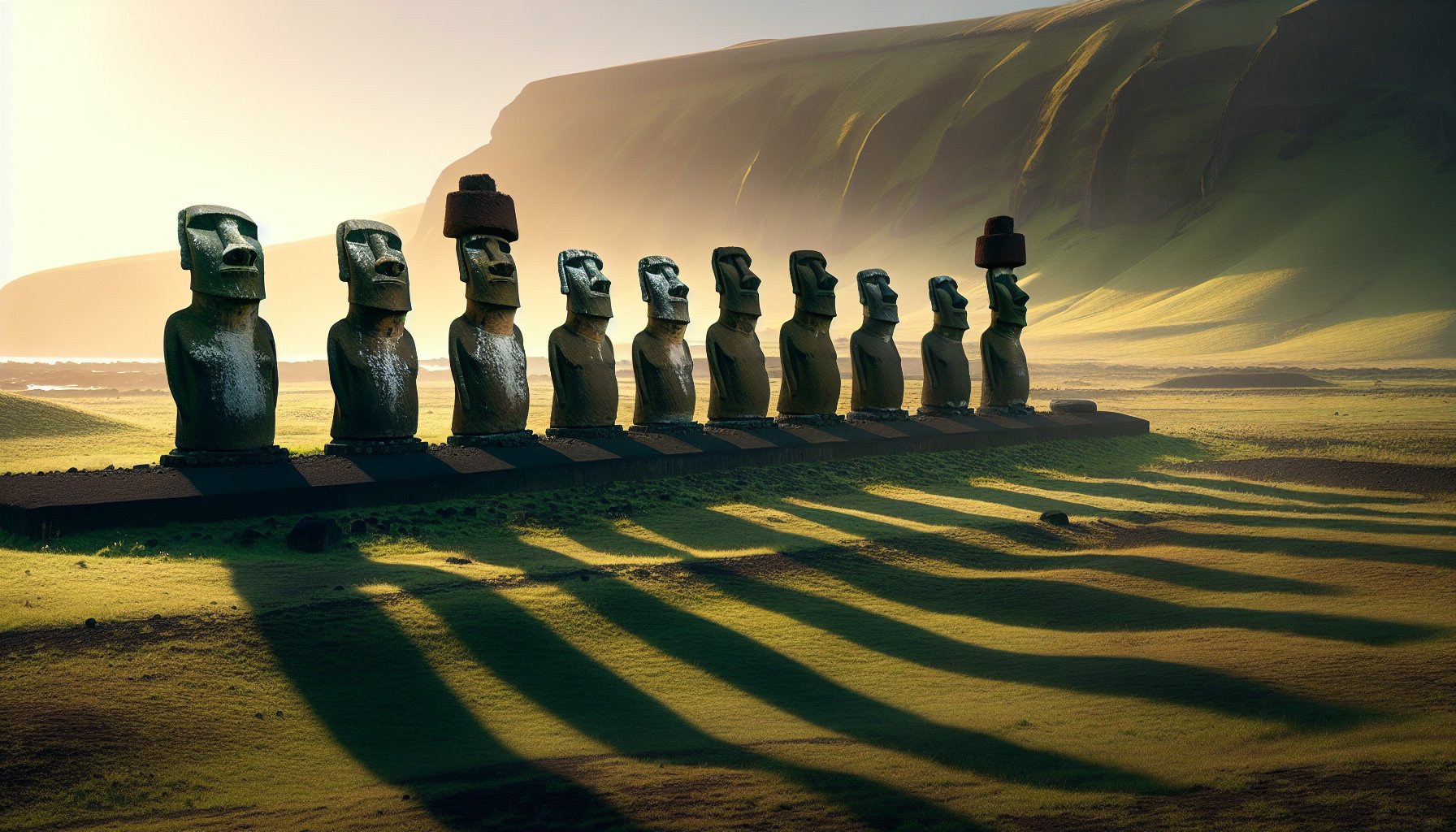
Additionally, certain Moai flaunt red scoria pukao—a lighter, more porous stone—positioned majestically atop their heads. Interestingly, these pukao or "hat-like" topknots not only enhanced the statues' aesthetic prominence but are thought to represent dressed hair or symbolic headdresses, denoting higher mana (spiritual power) of the figures they crowned. Furthermore, elements like coral eyes were occasionally inset to bring a lifelike essence to the statues, an embodiment meant to bridge the ancestral spirits with the physical world.
Iconic Design
When dissecting the iconic anatomy of the Moai, the most startling aspect that leaps out is the proportionally oversized heads, overshadowing their more slender bodies. This design choice isn't merely an artistic exaggeration but resonates deeply with the spiritual and cultural emphases of the Rapa Nui—they believed the head housed the mana, thus rendering it the most potent part of the statue and, by extension, the human form. Each Moai, averaging around 4 meters tall and weighing close to 12.5 tonnes, reflects not just exemplary craftsmanship but a nuanced understanding of symbolic representation, making these statues veritable monoliths of the island's metaphysical convictions.
The features carved into each Moai, from the deep-set eye sockets intended for coral eyes to the pronounced chins and nostrils, were not universally standardized. Variabilities exist, suggesting individually tailored representations possibly linked to the distinct lineages or characteristics of the tribal leaders they immortalized. Their fixed forward gaze inland is perhaps their most mystical characteristic, believed to watch over the village clans and provide protection; this alignment starkly contrasts with typical Polynesian deity depictions which usually oversee the ocean to guide fishermen and travelers. Thus, Moai are not mere sculptures but guardians of yore, towering testaments to a faith deeply woven into the fabric of Rapa Nui society.
Logistics of Moai Movement
Delving into how the imposing Moai statues were transported across the rugged terrains of Easter Island opens a Pandora's box of theories and academic disputes. The exact methodology remains one of the sweet mysteries of ancient engineering though several plausible theories have gained traction over the decades. Historically, the Rapa Nui people, recognized for their innovative minds and practical skills, are believed to have moved these monolithic figures—some weighing as much as 82 tons—from their carving site at the Rano Raraku quarry to various ceremonial platforms known as Ahu across the island.
One of the enduring theories suggests that the statues were moved upright in a rocking motion, a method colloquially termed as "walking" the Moai. Experimental archaeology has lent some credence to this idea, as modern-day experiments using concrete replicas have shown it's possible to move large figures with just ropes and manpower, mimicking a swaying motion that would shift the statue forward. Advocates of this theory argue it encapsulates the Rapa Nui's connection to their figures, metaphorically allowing the Moai to "walk" amongst their communities.
However, some scholars throw their weight behind the idea that the Moai were transported lying flat on wooden sledges or log rollers, which would have been dragged by large teams of laborers. This perspective points to evidence of postholes along old transport roads that might have supported such activities. Though the environmental impact of such massive deforestation—largely for moving statues and general settlement expansion—paints a dire picture of ecological decline.
Both methods underscore a sophisticated understanding of early Polynesian engineering and highlight the sheer will of the Rapa Nui to make the impossible, possible. However, they also open discussions about the societal structure, as such feats would require cooperative societal planning and immense organization, reflecting a hierarchically sophisticated society deeply embedded in communal and spiritual pursuits.
Architectural Ingenuity
Amid these transportation marvels, the architectural strategies employed in erecting these statues upon their final resting places, the Ahu, are no less fascinating. These platforms not only served as sturdy pedestals for the Moai but were integral to their spiritual significance, elevating the ancestors to a position where they could oversee and protect their descendants.
The construction of an Ahu was a labor-intensive endeavor, requiring precise stone masonry skills that ensured the platform could support the colossal weight of a Moai. The Ahu were typically built using a mix of quarried stones, fitted together without the use of mortar—a technique reminiscent of other Polynesian stone structures but adapted uniquely on Easter Island to cater to the island's specific geological and environmental conditions.
The ingenuity extends to the orientation of the Moai, most of which face inward towards the island, rather than outward toward the sea. This arrangement is symbolic, portraying the Moai as watching over the island's inhabitants, rather than guarding against external threats. It's a distinction that underscores the community-centered nature of Rapa Nui culture and hints at the deeply ingrained spiritual relationships between the living community and their revered ancestors.
These feats of engineering not only underline the technical expertise and innovative capabilities of the Rapa Nui but also their deep-seated cultural and spiritual motivations, echoing through their monumental legacies that continue to stand resilient against the tests of time and nature. Even today, these structures offer profound insights into the island's past, drawing in scholars and tourists alike, all eager to unlock further secrets held tightly by these stone giants.
Environmental and Preservation Concerns
The Echoes of the Island’s Ecological Shifts
For centuries, the stark yet captivating landscape of Easter Island has borne witness to significant ecological transformations, many of which have been intimately tied to the carving and transportation of its iconic Moai statues. The journey of these monolithic creations from the quarries of Rano Raraku to their strategic ahu platforms scattered across the island isn’t just a marvel of ancient engineering but also a narrative of environmental impact.
The Price of Moving Giants
Digging into the heart of the matter, it's clear that the Rapa Nui people faced colossal challenges—not just physically monumental but also ecologically taxing. The process of carving these statues from the volcanic tuff, a soft rock found abundantly in the island's quarries, and transporting them to various sites required enormous amounts of timber. Historical accounts and archaeological evidence suggest a high likelihood that the island's once-lush palm forests were heavily deforested to provide logs as rollers or sleds for moving these stone giants.
The environmental toll was steep; deforestation led to soil erosion, a reduction in the capacity to grow crops, and a consequent blow to the local wildlife and overall biodiversity. This ecological collapse, coupled with the island’s isolation, crafted a challenging survival scenario for the indigenous population.
Conservation in the Face of Erosion
Transitioning to the current era, the focus shifts to mitigating past damages and preserving what remains of these monumental testaments to human ingenuity and cultural expression. The Moai statues now face threats from erosion—a slow yet persistent enemy that wears away at their volcanic stone structures. Added to this are the impacts of lichen growth and weathering exacerbated by climate change, which continue to mar the enigmatic faces of these ancestral figures.
Recognizing these threats, various international and local groups have initiated restoration projects aimed at halting further deterioration and restoring the Moai's former grandeur. These efforts are not just acts of physical refurbishment but are also crucial in protecting the island's cultural heritage.
The Role of Modern Technology in Ancient Preservation
Innovative technology has become a beacon of hope in these preservation efforts. Techniques like 3D mapping and digital archiving offer new ways to monitor and manage the erosion impacts more effectively. These tools also help in creating detailed replicas and models that provide both scholars and the public with an insight into what the Moai might have originally looked like.
Meanwhile, stringent regulations on tourist interactions with the sites are being enforced to ensure that foot traffic and human activity do not accelerate the degradation of these statues. This delicate balance between fostering tourism—a primary economic driver for the island—and preserving its cultural and historical assets is a modern challenge that the Rapa Nui and global conservation communities continue to navigate.
In conclusion, while the Moai statues of Easter Island stand as resilient symbols of cultural identity, they also serve as poignant reminders of the environmental costs of human endeavors. The ongoing efforts to preserve these monoliths are as much about honoring the past as they are about safeguarding a future—a future where both culture and nature can thrive in harmonious coexistence on this remote island.
Moai and Modern Identity
Cultural Heritage and Identity
In the midst of the Pacific Ocean lies a story of resilience carved in stone — the Moai statues of Easter Island. These monoliths, beyond their immense archaeological value, stand as a beacon of cultural heritage for the Rapa Nui people. Despite centuries of challenges, from colonial disruptions to ecological crises, the Moai remain a potent symbol of the islander's enduring identity. They echo the ancestral voices of the Rapa Nui, serving not just as reminders of a bygone era but also as embodiments of cultural pride and survival. Each statue, crafted with meticulous skill from the volcanic tuff of the Rano Raraku quarry, tells a tale of a civilization’s artistic prowess and its spiritual devotion to ancestor worship.
Tourism and Economic Impact
As remote as Easter Island is, the allure of its giant stone figures draws thousands of tourists each year, turning these icons into key economic pillars. However, with tourism comes the challenge of balancing commercial gains with cultural and environmental preservation. The influx of visitors, while providing necessary revenue streams, also poses risks to the delicate sites, prompting necessary debates about sustainability and conservation. Strategies are being implemented to safeguard these megaliths, ensuring that the Moai continue to stand not only as monumental testaments to Polynesian culture but also as sustainable assets that support the local community. From regulated visitation to educating tourists on the profound cultural significance of the statues, Easter Island's approach serves as a model of how remote, culturally-rich communities can thrive in the face of global exposure.
Thus, the Moai statues, more than ever, are crucial not only in preserving the past but also in shaping the future of Easter Island, ensuring that the legacy of the Rapa Nui people remains vibrant and intact.
Insights into the Birdman Cult and Its Connection to Moai
The transition from the monumental Moai statues to the enigmatic Birdman Cult is a testament to the evolving cultural dynamics on Easter Island. After the era of constructing Moai—an era marked by significant social and environmental investments—the island witnessed the rise of the Birdman Cult, which represented a pivotal shift in spiritual and societal focus.
Transition from Moai to Birdman Cult
Towards the end of the Moai carving period, around the 17th to 18th centuries, the Rapa Nui society was undergoing profound transformations, partly due to over-extension of resources and internal conflicts. Archaeologists suggest that the Birdman Cult emerged during this period of social strife and ecological stress, symbolizing a transition in religious practices and political power structures. The cult focused on an annual competition to retrieve the first sooty tern egg of the season from the islet of Motu Nui. The winner, or the "Birdman," was bestowed with sacred honors and significant control, marking a shift from the ancestral veneration seen in the colossal Moai to a competitive ritual that instilled a new form of governance and spiritual significance.
Orongo and Petroglyphs
Orongo, a stone village perched precariously on the rim of the Rano Kau crater, served as the ceremonial center of the Birdman Cult. This site is distinct from the ahu and Moai statuary elsewhere on the island—it embodies the architectural and ideological shift characteristic of the late Rapa Nui culture. The village consists of nearly fifty elliptically shaped, low-slung buildings, constructed with slabs of basalt and linked to this annual competition. The walls of Orongo are adorned with petroglyphs depicting Make-make (the chief god of the Birdman Cult), birdmen, and composite creatures, indicating a rich iconographic continuity and adaptation from the Moai era.
The actual carvings at Orongo are significant, as they not only illustrate the Birdman but also various figures in different poses and styles, suggesting a narrative or sacred storyboard that continues to fascinate ethnographers and archaeologists alike. These images likely served as a permanent reminder of the winners and the religious lore of the Rapa Nui, connecting the physical to the metaphysical.
Interaction Between Moai and the Birdman Cult
While the Moai and the Birdman Cult are from distinctly different periods in the Easter Island chronology, they are connected by underlying themes of competition, chieftainship, and mana—spiritual power or life force—which remained central to Polynesian culture. Scholars argue that although the Moai phase focused on ancestral worship and solidified social hierarchies through static representations (the Moai statues), the Birdman Cult encapsulated a dynamic shift toward achieving mana through physical prowess and bravery, reflective of changing environmental and social conditions on the island.
In wrapping up, while the stoic Moai are the most visible emblems of Easter Island's ancient heritage, the Birdman Cult offers a profound insight into a society adapting to changing times and challenges. Both represent significant but different responses to the island's evolving cultural narrative, offering a window into the Rapa Nui people's endurance and ingenuity in the face of isolation and limited resources.