
By EsoVitae Editorial · Published
Drafted with AI assistance from the sources listed; images are AI-generated illustrations. How EsoVitae is made
A masked prisoner died inside the Bastille on the night of 19 November 1703, and the parish register of Saint Paul recorded his burial under the name Marchioly. He had been moved through four French fortresses across thirty four years, always in the personal custody of the same jailer, and the velvet that covered his face was, according to the Bastille’s own register, neither iron nor a spectacle. The legend grew later, in the hands of a satirist with a gift for invention.
The Direct Answer for the Hurried Reader
The Man in the Iron Mask was a real prisoner of Louis XIV held under the surveillance of the warden Bénigne d’Auvergne de Saint-Mars from 1669 to 1703, transferred between Pignerol, Exilles, Sainte-Marguerite, and the Bastille, and buried as Marchioly. Modern archival scholarship, led by Paul Sonnino’s 2016 study, identifies him most plausibly as Eustache Dauger, a valet entangled in delicate state secrets. The mask was velvet, not iron.
An Order Dated Late July 1669
The story begins not with a face but with a piece of correspondence. In late July 1669, the Marquis de Louvois, Louis XIV’s secretary of state for war, wrote to Bénigne d’Auvergne de Saint-Mars, then governor of the small Alpine fortress of Pignerol, instructing him to prepare a separate cell for a prisoner whose name he gave as Eustache Dauger. The letter, preserved among the Louvois papers in the Bibliothèque nationale de France, specified that the prisoner be kept in the strictest secrecy, that he be allowed contact with no one save his jailer, and that any attempt by him to speak of anything other than his immediate needs be answered with the threat of immediate death [1].
Saint-Mars received the prisoner on 24 August 1669. The man was described in the receiving correspondence as a valet, that is, a servant of low rank, and the unusual security conditions surrounding so modest a captive were, even at the time, a curiosity to the warden himself. Saint-Mars wrote back to Louvois more than once asking what kind of man his charge actually was. The replies repeated the original instruction. The cell was to be silent. The mouth that mattered was the prisoner’s.
The Fortresses, in Order
The masked prisoner moved with his jailer. Saint-Mars was promoted from Pignerol to Exilles in 1681, and the prisoner went with him. From Exilles he was transferred in 1687 to the citadel on the Île Sainte-Marguerite, off the Provençal coast near Cannes, again in Saint-Mars’s personal custody. On 18 September 1698, Saint-Mars was named governor of the Bastille in Paris, and on 5 November of that year, after a slow and conspicuously discreet journey north, the prisoner crossed the threshold of the most famous prison in Europe [2].
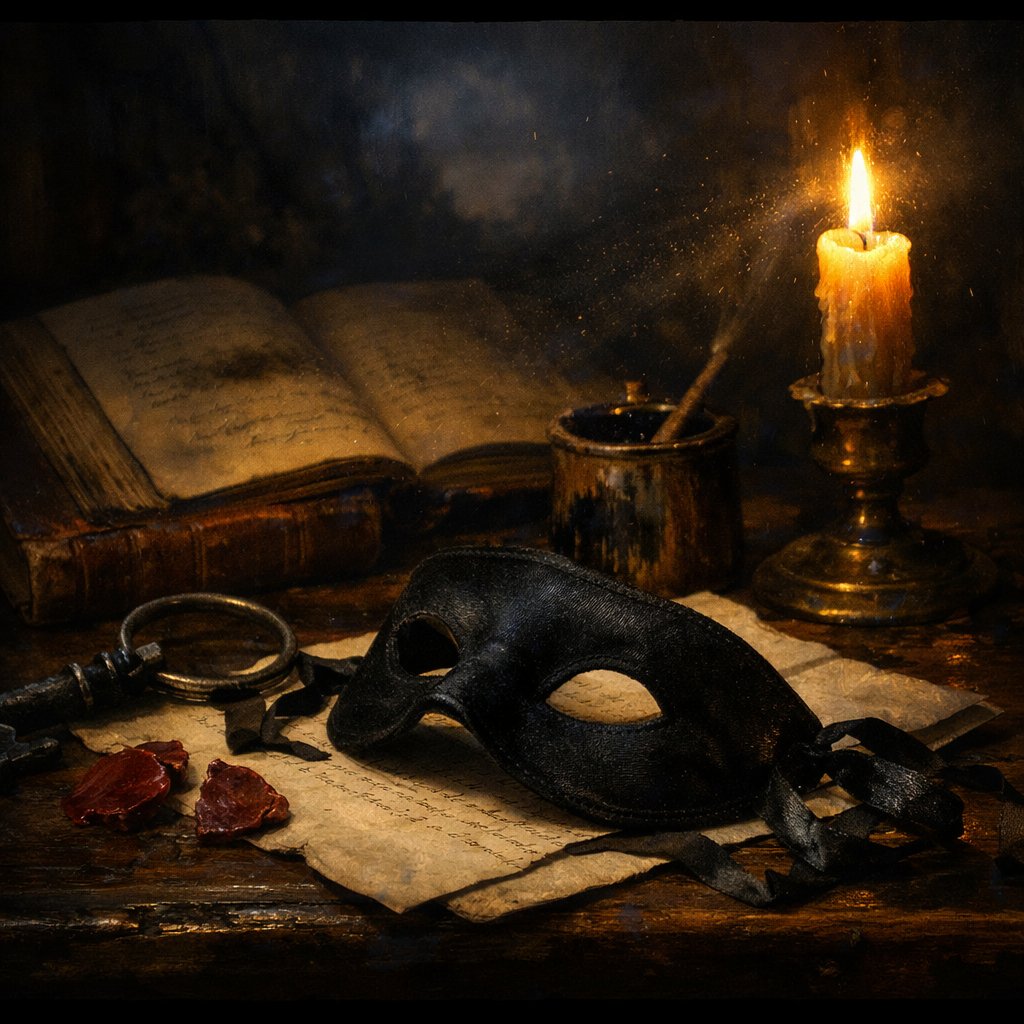
It is during this transit, and during the long custody on Sainte-Marguerite, that the masking enters the documentary record. Lieutenant du Junca, the King’s Lieutenant at the Bastille, kept a journal of arrivals and departures. His entry for the prisoner’s arrival notes, in plain administrative French, that the man wore a mask of black velvet. He repeats the detail in his entry for 19 November 1703, the night the prisoner died. The mask was velvet. It was iron only later, in print.
The Death and the Burial Name
Du Junca’s death entry records that the prisoner was buried the following day in the cemetery of Saint Paul under the name Marchioly, with an estimated age of about forty five years. The estimate is suggestive. If du Junca’s guess was even approximately right, the prisoner had been roughly eleven years old at the time of his original arrest in 1669, which is implausible for a valet of long experience and a holder of dangerous secrets, and which is one of the reasons later historians treat the recorded age with caution. Saint-Mars himself, who had known the man for three decades, did not record his real name in any surviving correspondence.
How the Iron Got Into the Mask
The legend, in the form most readers inherit it, is the work of François Marie Arouet, who wrote as Voltaire. In Le Siècle de Louis XIV, published in 1751, Voltaire devoted a brief but combustible passage to a masked prisoner of the late reign, and he embellished freely [3]. He gave the mask iron hinges. He hinted at a captive of the highest birth, possibly a brother of the king. In a footnote added to the 1771 Questions sur l’Encyclopédie, Voltaire pushed the speculation further toward the idea that became almost fixed in French popular culture: the prisoner had been an elder twin of Louis XIV himself, sequestered for reasons of dynastic stability.
There is no evidence in the Saint-Mars correspondence, in the Louvois papers, or in the Bastille registers for any of this. The twin hypothesis is a literary device, and it acquired enormous narrative momentum because Alexandre Dumas père took it up in the third volume of his Vicomte de Bragelonne, published as a feuilleton in 1847 to 1850, where it became the engine of the novel’s political climax. The iron of the mask, in the strict archival sense, is theirs and Voltaire’s.
The Modern Archival Reading
The serious scholarly tradition runs along a different track. In 1801, Pierre Roux-Fazillac published Recherches historiques et critiques sur l’homme au masque de fer, the first book length study to argue from the surviving correspondence that the prisoner was Eustache Dauger, a valet acquired by Louvois and Louis XIV through a still partially obscure incident in the late 1660s [4]. Roux-Fazillac’s work was rough by modern standards, but it set the methodological template that has shaped serious research since: read Saint-Mars first, treat Voltaire as a reception document rather than a source, and explain why a valet would be worth thirty four years of personal custody by the same warden.
The fullest answer in modern scholarship is Paul Sonnino’s The Search for the Man in the Iron Mask, published by Rowman and Littlefield in 2016 [5]. Sonnino, a historian of seventeenth century French diplomacy, argues that Dauger was a valet who had become incidentally privy to negotiations between Louis XIV and Charles II of England concerning the secret Treaty of Dover of 1670, and to certain financial arrangements involving Cardinal Mazarin’s estate that the French crown preferred to keep buried. The argument relies on a careful reconstruction of who knew what and when, on the chronology of the arrest, and on the peculiar continuity of Saint-Mars’s custody. It is not a confession in a hand. It is a reconstruction from absence, and it is, on present evidence, the leading reading.
The Mattioli Counter-Hypothesis
A minority position, kept alive by the suggestive coincidence of the burial name Marchioly, holds that the masked prisoner was Antonio Ercole Mattioli, an Italian diplomat in the service of the Duke of Mantua who was kidnapped by French agents in 1679 after he attempted to double cross Louis XIV in a secret negotiation over the fortress town of Casale [6]. Mattioli was imprisoned at Pignerol, and the phonetic kinship between Mattioli and Marchioly is striking. The difficulty is chronological. Mattioli, by the best surviving evidence, died on Sainte-Marguerite in April 1694, nine years before the masked prisoner’s death at the Bastille. The hypothesis survives not as a confident identification but as a reminder that more than one secret prisoner moved through Saint-Mars’s custody.
What the Velvet Actually Means
A working historian, asked why the mask was velvet rather than iron, will usually answer with the practical question first. A velvet mask, lined and tied behind the head, can be worn for hours without injury and removed for meals, sleep, and grooming. An iron mask, riveted shut, would have been cruel to the point of homicide over a captivity of thirty four years, and there is no medical record consistent with such a regime. Andrew Lang, writing in 1903 in his essay The Valet’s Mask, was already pressing this point with the dry impatience of a folklorist who had seen too many literary inventions ossify into common knowledge [7]. The mask, Lang argued, was a signalling device, not a torture: it told everyone the prisoner met that this man’s face was not for them to see, and it relieved the warden of any need to explain why.
The point changes the texture of the case. The masked prisoner, on the archival evidence, was a man of unknown but apparently low rank who held information dangerous enough to justify the constant attention of one of Louis XIV’s most reliable wardens for more than three decades, and whose face was kept covered because the regime preferred no one to be in a position to identify him later. The velvet was an instrument of state forgetting. The iron was Voltaire’s gift.
What the Sources Say, In Plain Order
Marcel Pagnol’s Le Masque de Fer, published in 1973, is the most rigorous popular treatment in French of the late twentieth century, and it argues, with charm and some strain, for the twin hypothesis Voltaire originated [8]. Edmond Pognon, working in the Archives nationales in the same generation, produced more sober archival surveys that anchor the documentary chain. Read in sequence, the literature follows a familiar arc: an eighteenth century invention, a nineteenth century novelistic amplification, a twentieth century rediscovery of the documentary record, and a twenty first century synthesis in Sonnino. The mystery has not been solved. It has been narrowed.
For the curious reader who wants to keep going, the parent overview of comparable cases on this site is the Historical and Archaeological Mysteries pillar page, where the same evidence first methodology is applied across two dozen other archival puzzles. The relevant external scholarship begins with the Britannica entry on the Man in the Iron Mask, which gives a creditable summary, and continues to the open access reference text of Voltaire’s Le Siècle de Louis XIV at the Internet Archive, where the founding embellishment can be read in its original setting.
Frequently Asked Questions
Was the mask actually iron?
No. The Bastille register kept by Lieutenant du Junca describes the mask as black velvet, and the term iron entered the legend through Voltaire’s 1751 history of Louis XIV. No surviving administrative document from any of the four fortresses where the prisoner was held describes a mask of metal, and the medical implausibility of a riveted iron mask worn over decades reinforces what the velvet record already implies.
Who was Saint-Mars?
Bénigne d’Auvergne de Saint-Mars was a career officer of Louis XIV’s prison service who began as warden of Pignerol in 1665, was promoted to Exilles in 1681, then to Sainte-Marguerite in 1687, and finally to the governorship of the Bastille in 1698. He held the masked prisoner in personal custody across all four postings, a continuity unique in the records of the Sun King’s secret prisoners.
What is the strongest evidence for Eustache Dauger?
The Louvois letter of late July 1669 names Dauger as the prisoner being delivered to Saint-Mars, and the surrounding correspondence chains him to Pignerol on the same week the masked prisoner first appears in the warden’s documents. Paul Sonnino’s 2016 study reconstructs the diplomatic context in which a valet might plausibly have known sensitive information about the secret Treaty of Dover and Cardinal Mazarin’s estate, and his account is, on present evidence, the most coherent identification on offer.
Why is the burial name Marchioly significant?
Marchioly is a phonetic near match for Mattioli, the Italian diplomat kidnapped by French agents in 1679, and the resemblance fuelled a competing identification through much of the nineteenth and twentieth centuries. The chronological difficulty is that Mattioli appears to have died on Sainte-Marguerite in April 1694, well before the masked prisoner’s recorded death in 1703, which makes Marchioly more likely a deliberate alias than a transcription of a real surname.
Did Voltaire invent the twin theory?
Voltaire originated the literary insinuation that the prisoner was a hidden brother of Louis XIV in his 1751 Le Siècle de Louis XIV and developed it further in the 1771 Questions sur l’Encyclopédie. Alexandre Dumas père then made the twin a load bearing plot device in The Vicomte de Bragelonne, the third novel of his musketeer cycle, and the resulting fiction has dominated popular imagination ever since.
How long was the prisoner held in total?
From his arrival at Pignerol on 24 August 1669 to his death at the Bastille on 19 November 1703, the masked prisoner was held in continuous custody for approximately thirty four years and three months. He was moved among Pignerol, Exilles, Sainte-Marguerite, and the Bastille, but he passed every day of those decades under the warden Saint-Mars.
What did Marcel Pagnol contribute?
Marcel Pagnol’s 1973 study Le Masque de Fer is the most thorough popular defence of the twin hypothesis in modern French scholarship. Pagnol read the surviving correspondence with attention and made the strongest narrative case any modern historian has built for the Voltaire inherited reading. Most archival historians have not been persuaded, but the book is essential for understanding why the twin theory has had such a long life.
Are the original letters still readable?
Yes. The Saint-Mars correspondence and the Louvois papers survive in the Bibliothèque nationale de France and the Archives nationales, and they have been transcribed at length in the modern editions used by Roux-Fazillac, Pagnol, Pognon, and Sonnino. They are written in a working seventeenth century French that requires patience but not specialist palaeography for the determined reader.
Why does the case matter beyond curiosity?
The Man in the Iron Mask is the cleanest example in early modern Europe of a state secret kept by procedural means rather than execution. Louis XIV’s regime preferred to forget the prisoner rather than to silence him in the more direct way available to absolute monarchies. The case shows what bureaucratic discretion looked like when it worked, and it shows how an oral and literary aftermath can outgrow a buried administrative record by an order of magnitude.
Is the mystery solved?
Not in the strict sense. Sonnino’s identification of Eustache Dauger is the leading scholarly reading and rests on a careful reconstruction of motive, opportunity, and chain of custody, but no surviving document names the masked prisoner outright. The case has moved from open mystery to narrowed hypothesis. A definitive answer would require a document the archive does not yet appear to hold.
Closing the Folio
A historian who reads Saint-Mars and du Junca side by side comes away with the impression of a small administrative engine, kept turning quietly for thirty four years, by men whose duty was not to know more than they had to. The masked prisoner is not, in their letters, a romance. He is a problem, contained. The velvet was the seal on that containment, and the iron is the noise the seal made when later writers shook it. Read the letters first. The man behind the velvet is the one the archive actually holds.
For deeper context across the historical and archaeological mysteries archive, consider The Tower of Babel: Historical Evidence and Indus Valley: Trade and Communication.