By Emilia Wellesley · Published May 7, 2026 · Updated May 13, 2026
Last reviewed: May 7, 2026.
The Indus Valley left no decipherable archive of its own commerce. What it left, instead, is a material vocabulary so consistent that scholars have been able to reconstruct the routes, the freight, the partners, and even something of the regulatory grammar of one of the longest-running long-distance trade systems of the third millennium BCE. Etched-carnelian beads from Sindh turn up in the royal tombs of Ur. A cubical chert weight from Mohenjo-daro will register the same value as one from Lothal a thousand kilometers to the east. An Akkadian-period scribe at the court of Sargon of Akkad recorded “ships of Meluhha” tied at his quay. The Harappans wrote no narrative of their own commerce, but the commerce wrote them anyway, in lapis lazuli and copper, in seal impressions and standardized weights, in the small archaeology of a tin-bearing route running over the Hindu Kush.
Direct Answer: How the Indus Valley Traded and Communicated
Between roughly 2600 and 1900 BCE the Indus or Harappan civilization ran a long-distance trade system reaching Mesopotamia through the Persian Gulf, identified in cuneiform records as Meluhha. Its exports moved via the intermediate hubs of Magan (Oman) and Tilmun (Bahrain), regulated by a standardized weight series, marked by stamp seals, and inventoried by a script that may itself have functioned primarily as a record-keeping device for trade [1].
The Tripartite System: Meluhha, Magan, and Tilmun
The Mesopotamian textual record preserves a three-part geography of long-distance trade reaching south and east of Sumer. Meluhha is the Akkadian and Sumerian designation that most scholars identify with the Indus region, principally on the strength of the goods that Meluhhan ships are recorded to have carried, on the appearance of Indus-style seals and beads in southern Mesopotamian sites, and on the absence of any other competing region of comparable scale at the relevant date. Magan, the second name in the triad, is now placed in the Oman peninsula and the southeast coast of the Arabian shield, where Bronze Age copper-smelting at Maysar and elsewhere supplied much of the metal that flowed northward up the Gulf [2]. Tilmun, the third, is identified with the island of Bahrain and its surroundings, the location of the great pearl banks and a transhipment node that intermediates between the Mesopotamian world and what lay beyond [3].
Steffen Laursen and Piotr Steinkeller, in Babylonia, the Gulf Region and the Indus (Eisenbrauns, 2017), have traced the chronology of this system in unusual detail through Akkadian and Ur III administrative texts, working from the names of the goods, the personnel, and the ship classes recorded in cuneiform alongside the surviving archaeology at Bahrain and the Oman coast [3]. The picture that emerges is of a maturing third-millennium network in which Mesopotamian merchants and their counterparts at Tilmun handled the transhipment of Magan copper and Meluhhan goods on terms that the central administrations were able to monitor without controlling outright. Meluhha, in this reading, was the far end of a working trade structure, not the legendary periphery a romantic earlier scholarship sometimes made of it.
The Sargonic Cuneiform: “Ships of Meluhha at His Quay”
The single most-cited piece of textual evidence is the inscription preserved in late copies of the original Akkadian-period royal record of Sargon of Akkad, who reigned in the twenty-third century BCE. The text declares that the boats of Meluhha, of Magan, and of Tilmun were tied at the quay of Akkad. The list is hierarchical and concrete: a king celebrating that ships from the three named regions, including the most distant of them, docked at his city’s wharf. Daniel Potts, in Mesopotamia and the East (Oxford, 1997), discusses the wider corpus of Akkadian and post-Akkadian cuneiform references to Meluhha alongside the comparative archaeology, and notes that the references are dense enough through the Akkadian and early Ur III periods to read as a routine commercial relationship rather than a one-off diplomatic flourish [4].
Other tablets from the period describe a Meluhhan interpreter, a settled Meluhhan community at Lagash, and inventory entries for Meluhhan boats. The presence of a designated translator, Shu-ilishu by name, is itself a piece of evidence about how communication across this system worked. Specialized linguistic intermediaries lived in the Mesopotamian cities; their job was to register what the Indus boats carried and what the Sumerian ledger required them to declare. Trade did not depend on a shared script. It depended on a shared apparatus of seals, weights, and sworn oral testimony backed by literate brokers on the receiving end [4].
The Export Portfolio: Carnelian, Lapis, Copper, Cotton, Timber
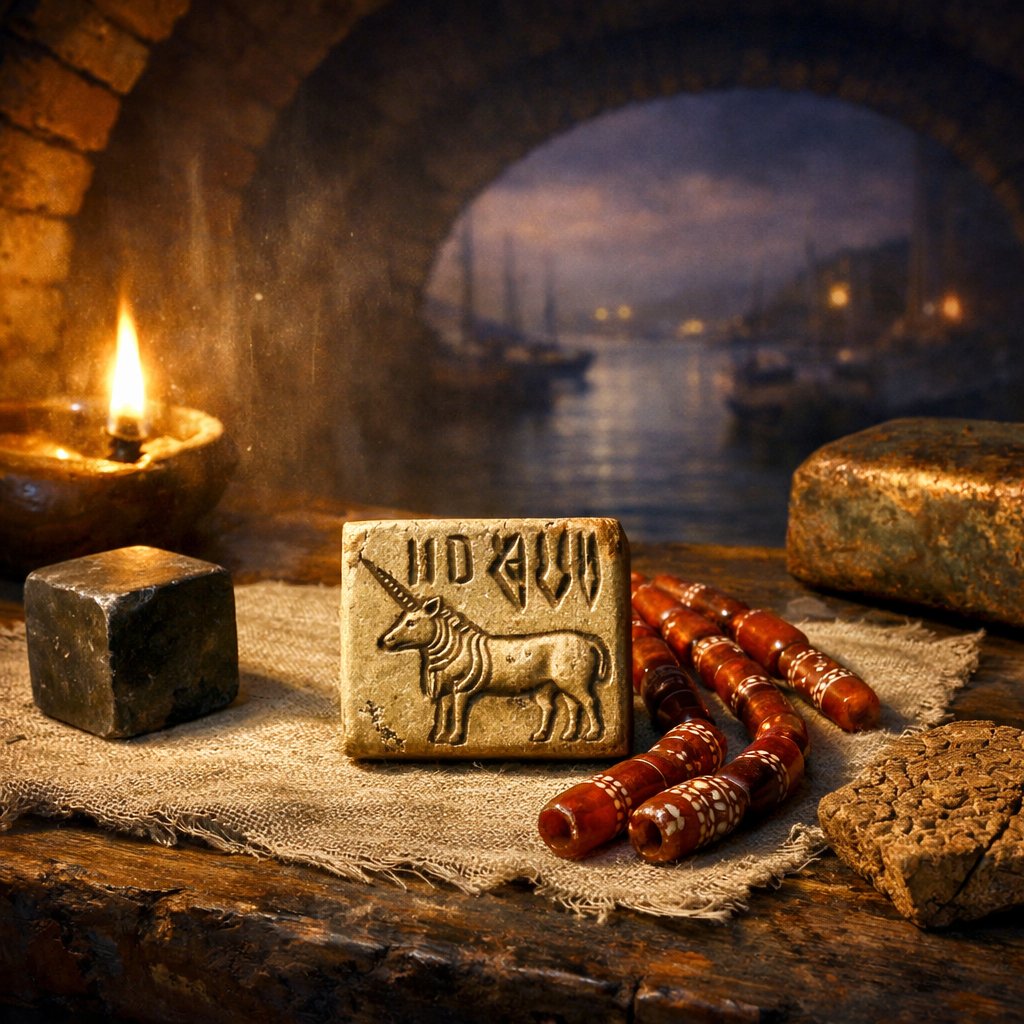
The single most archaeologically visible Indus export is the etched carnelian bead. Long, barrel-shaped, and often patterned with a white alkali-resist design fused into the red stone by a high-temperature fire, these beads were produced in Harappan workshops at Chanhu-daro, Lothal, and Mohenjo-daro using a specialized pyrotechnology that Mesopotamian artisans never replicated. Sir Leonard Woolley recovered a sequence of them from the Royal Cemetery at Ur, in third-millennium burial contexts that anchor the chronology firmly to the mature Harappan period. J. Mark Kenoyer, in The Bronze Age Indus (Oxford, 1998), describes the manufacture as a multi-stage process moving from raw nodule to roughed-out blank to drilled cylinder to alkali application to the final firing, with each stage reflecting a distinct workshop hand and a distinct apprenticeship [5].
The wider export portfolio extends across hard and soft goods. Lapis lazuli, sourced almost exclusively from Badakhshan in northeastern Afghanistan, reached Mesopotamian and Egyptian elites through Harappan-controlled overland routes that crossed the Hindu Kush passes and entered the Indus Valley before being transhipped down-river and across the Gulf. Massimo Vidale, in his work for CISMEC and in his many papers on the metallurgy and material culture of Magan and Meluhha, has reconstructed the lapis route in detail, alongside the parallel routes for tin (the strategic alloying component for bronze) running from the Hindu Kush via the Indus and onward to Sumer [6]. Cotton, almost certainly first domesticated in the Indus basin, was probably exported as finished textile and as raw fiber, although the perishable nature of the material leaves the textile trade more strongly attested in indirect indicators (spindle whorls, dye residues, archaeological cotton seeds at Mehrgarh) than in surviving cloth. Timber, ivory, shell, gold, and Magan copper round out the inventory recoverable through the combined material and textual record [5, 6].
The 1.13-Gram Unit: Standardized Weights as Communication
The Harappan cubical chert weight system is the most legible piece of administrative communication in the entire Indus material record, and it is, paradoxically, mute. Cubical, polished, and cut to a binary-then-decimal sequence (1, 2, 4, 8, 16, 32, 64, 160, 200, 320, 640) on a base unit conventionally given as approximately 0.857 grams or, in alternative reconstructions, around 1.13 grams depending on the seriation chosen, the weights are consistent across sites separated by more than a thousand kilometers. The series implies a regulatory authority that was able to enforce standardization across the entire territory without leaving an account of how it did so. Shereen Ratnagar, in Trading Encounters: From the Euphrates to the Indus in the Bronze Age (Oxford, 2004), has argued that this is the system’s most subversive feature: a Bronze Age trade network of Mesopotamian dimension running on weight standards rather than on temple bureaucracy [1]. The Mesopotamian shekel weighed roughly 8.4 grams; Indus weight units bear no obvious commensurability with it, and the burden of conversion presumably fell to brokers at the Tilmun and Magan transhipment points.
The Indus Script as Trade Record-Keeping
One serious reading of the Indus script, advanced in different forms by Asko Parpola and explored at greater length in The Roots of Hinduism: The Early Aryans and the Indus Civilization (Oxford, 2015) where Parpola devotes a chapter to the trade-route question, holds that whatever else the signs may have encoded, much of the surviving inscribed corpus is short enough, repetitive enough, and concentrated enough on stamp seals and small portable objects to suggest a primary function in commercial bookkeeping rather than in literary or religious record [7]. The proposal does not require resolving the deeper linguistic question of which language the script encodes. It merely observes that the corpus’s distribution, with the bulk of inscriptions on seals used for marking sealed bales, jars, and packaged commodities, is consistent with a writing system whose principal job was to register an identity, an origin, an owner, or a quantity for goods in transit.
If the script was largely a trade-record device, several otherwise-puzzling features fall into place. The brevity of the inscriptions (typically four to six signs) matches what an inventory tag would carry. The repetition of a small set of common signs at the end of sequences, sometimes interpreted as terminators or grammatical markers, also fits the structure of a closed-vocabulary trade ledger. The high incidence of pictographic signs depicting jars, animals, and tools is comprehensible in commodity-ticketing terms. Whether this exhausts what the script was, or whether longer literary or sacred texts existed in perishable media that have not survived, is a separate question, and Parpola is careful to keep it open [7].
Tilmun and the Bahrain-Centered Brokerage
Bahrain, identified with cuneiform Tilmun, sits in the middle third of the Persian Gulf and was the structural intermediary that allowed Indus and Mesopotamian merchants to transact at scale without either side becoming dependent on the other’s port infrastructure. Excavations at Qala’at al-Bahrain and at the Saar settlement have yielded the recognizable forms of a Bronze Age trading hub: storage facilities, weight assemblages combining both Indus and Mesopotamian standards, and seal impressions that mix iconographic conventions from both ends of the system. Laursen and Steinkeller’s reconstruction places Tilmun’s commercial maturity in the late third and early second millennia, with the Akkadian-period and Ur III-period traffic visible in the cuneiform archives at Lagash, Umma, and Ur reaching its peak around 2200 to 2000 BCE [3]. The famous tilmun-shaped circular stamp seals, distinct from but in dialogue with the Indus square seals, are the visible administrative artifact of this brokerage class.
Reciprocity: Mesopotamian Goods at Indus Sites
The trade was not unidirectional. Mesopotamian-style cylinder seals have been recovered at Mohenjo-daro and Harappa in numbers that argue against accidental losses; conversely, Indus-style square seals appear at Ur, Susa, Tepe Yahya, and Bahrain. Bitumen from the Mesopotamian and Iranian sources, certain copper-alloy compositions, and a small number of distinctively Sumerian items in Harappan deposits round out the picture. Trade networks of this scale leave a faint but symmetrical trace at both ends, and the Indus-Mesopotamian system, on the present record, satisfies that test. The Bahraini middle node, by sitting between them, allowed each side to specialize: Sumer in the disposition of the agricultural surplus and in the regulatory bureaucracy that converted it into bullion-equivalent value, the Indus in the harder material technologies (carnelian fire, drilled-stone seal cutting, lapis routing) that Sumer wanted but did not produce [4, 6].
The Late Third-Millennium Contraction
The Indus-Mesopotamian trade system did not last forever. After about 1900 BCE, the references to Meluhha thin out in cuneiform, the etched-carnelian bead trail goes cold in Mesopotamian deposits, and the Harappan urban centers themselves enter their late phase. Whether the trade contraction is a cause or an effect of the broader Indus deurbanization is unsettled. The leading line of explanation links it to the same compounding pressures (monsoon weakening, river-channel reorganization along the Ghaggar-Hakra, tectonic shift in the Rann of Kutch) that produced the late third-millennium Harappan transition more generally. The result is that the visible trade signature, the carnelian beads, the standard weights at Tilmun, the Meluhhan ship records, fades over a few centuries. By the early second millennium the Persian Gulf trade had shifted to a Mesopotamia-and-Tilmun bilateral model, with Meluhha receding from active mention. Read against the Sargonic cuneiform of seven hundred years earlier, the contraction is the closing parenthesis of one of the deepest commercial reaches in the Bronze Age world [3, 4].
What Is Still Open
Several first-order questions remain unresolved. The exact tonnage and frequency of Meluhhan shipping is not recoverable; cuneiform mentions ships, not annual freight. The precise mechanism by which Indus weight standards were enforced, whether by inspectors, by sealed bales accompanied by bonded brokers, or by a class of magistrates with no surviving portrait, is unknown. The relative weight of overland versus maritime traffic for the Hindu Kush lapis and tin trade is debated. Whether the Indus script was primarily a trade record-keeping device or also encoded literary and sacred texts that have not survived in the archaeological record continues to divide the field. The honest position is that the trade itself is well-attested at both ends, the personnel only partially attested in the middle, and the inner administrative apparatus visible mainly in its consequences. The dust on the carnelian and the chert weights settles a little, and the rest waits for a long literary text or a longer cuneiform archive that may not exist.
A Note on Reading Further
For readers who want to follow the trade record in detail, four doors open the field. Shereen Ratnagar’s Trading Encounters: From the Euphrates to the Indus in the Bronze Age remains the indispensable synthesis on the Indus side. Steffen Laursen and Piotr Steinkeller’s Babylonia, the Gulf Region and the Indus assembles the Mesopotamian textual record with archaeological cross-corroboration. Daniel Potts’s Mesopotamia and the East places the Meluhha references in their wider Akkadian and Ur III diplomatic context. J. Mark Kenoyer’s The Bronze Age Indus walks through the manufacturing technologies (carnelian, faience, shell, bronze) at the heart of the export portfolio. Read them in that order, and the lapis-and-carnelian trail comes back into focus.