By Emilia Wellesley · Published May 7, 2026 · Updated September 10, 2026
Last updated: September 10, 2026.
On the morning of 3 April 1848, a forty-seven-year-old Prussian-born naturalist named Ludwig Leichhardt rode west from a sheep outstation on the Cogoon River and into the most thoroughly silent disappearance in the recorded history of Australian exploration. He led five companions, seven horses, twenty mules, and fifty bullocks. He carried his own carefully kept journals, instruments, a draft route to the Swan River nearly three thousand miles away on the opposite coast, and a brass plate bearing his name and the year. None of it ever came back. No body was found. No camp on the far side of the continent was identified in his lifetime or in the lifetimes of those who searched for him. The historiography of the case is, in its way, a tutorial in how to read absence.
The Direct Answer
Ludwig Leichhardt (1813–1848?), a Prussian-born Australian explorer, vanished with his entire party of six men, seven horses, twenty mules, and fifty bullocks during a 1848 attempt to cross the continent from the Darling Downs of Queensland to the Swan River in Western Australia. His last verifiable letter was dated 3 April 1848 from Allan Macpherson’s Cogoon outstation. Despite four major search expeditions, an Aboriginal-witness oral record, scattered ‘L’-marked trees, and a brass nameplate found at Sturt Creek in 1900, no remains have ever been recovered.
The Man Who Read the Continent
Friedrich Wilhelm Ludwig Leichhardt was born on 23 October 1813 in Sabrodt, a Brandenburg village in what was then the Kingdom of Prussia. He read philosophy and natural history at Göttingen and Berlin and arrived in Sydney in February 1842 with letters of introduction, a botanist’s eye, and almost no money. The Australian colonies in the 1840s were a thin coastal arc of pastoral leases pressing inland, with the interior north of the Tropic of Capricorn still rendered on British Admiralty charts as conjectural shading. Leichhardt set out to fill it in [1].
He was, by every contemporary account, an awkward leader and a precise observer. He suffered weak eyesight, poor marksmanship, and a quarrelsome relationship with men under his command. He was also better at reading country than nearly anyone working in the colony. The two facts together explain the shape of his career.
The First Expedition: Brisbane to Port Essington, 1844–1845
Leichhardt’s reputation rests on what he did before he disappeared. On 1 October 1844, he led a privately funded party north from Jimbour Homestead, the farthest pastoral outpost on the Darling Downs, with the British military settlement at Port Essington on the Cobourg Peninsula as his target [2]. The route arced almost the full breadth of the northern continent: up the Dawson and Mackenzie watersheds, across the Burdekin and the headwaters of the Suttor, over the divide to the Mitchell, around the Gulf of Carpentaria, and finally west-northwest into the wet tropics of Arnhem Land. He arrived at Port Essington on 17 December 1845 after a journey of approximately 4,827 kilometres in fourteen and a half months, having been long given up for dead in Sydney [3].
The journey produced the first systematic European description of vast tracts of country that would, within a decade, become some of the richest pastoral leases in colonial Queensland. He returned to Sydney in March 1846 a public hero, voted a purse of more than £1,500 by subscription and awarded the Patron’s Medal of the Royal Geographical Society [3]. The success was real. It also created the appetite that the next two journeys could not satisfy.
The Second Expedition: A Premonition Disguised as a Failure, 1846–1847
Leichhardt’s second attempt, launched in December 1846, was conceived on a continental scale. He proposed to march from the Darling Downs to the Swan River settlement on the opposite coast of Western Australia — a journey roughly twice as long as the Port Essington route and through country no European had crossed. Heavy rain, malarial fever, and rapidly thinning supplies forced the party to turn back after roughly 800 kilometres. They limped back to the settled districts in June 1847, the Aboriginal guide Harry Brown effectively leading the retreat [1].
A more cautious man would have read the failure as a verdict on the route. Leichhardt read it as a logistical problem to be solved by better stock and a quicker pace.
The Final Expedition: Departure from the Cogoon, April 1848
The third expedition was assembled at Cecil Plains and the Cogoon over the late summer of 1848. Its objective was unchanged: a transcontinental crossing from the Condamine River to the Swan. Its composition is recorded in detail. Leichhardt led five subordinates — the Europeans Adolph Classen, Arthur Hentig, Donald Stuart, and the ticket-of-leave man Thomas Hands — and two Aboriginal guides from Port Stephens, Wommai and Billy Bombat. They drove fifty bullocks, seven horses, and twenty mules, the heaviest stock complement of any of his expeditions and the basis of his confidence that they could outlast the dry interior [4].
Allan Macpherson, the proprietor of Mount Abundance Station west of the present town of Roma in southern Queensland, watched the party leave his Cogoon outstation on 3 April 1848. The letter Leichhardt wrote that day — a brisk, almost businesslike note to his patron Lieutenant-Colonel George Barney — is the last document the explorer is known to have produced. Macpherson’s sheep men were the last people, on the colonial side of the frontier, to see them alive [4].
The Searches: Hely, Gregory, McIntyre, Forrest
Concern began in 1849 and hardened into action by 1851. Four substantial expeditions and a long parade of smaller private parties went looking, and each returned with fragments only.
Hovenden Hely, 1852
Hely had served on the failed second expedition and knew the country and the men. The New South Wales government sent him out in 1852. After months in the field he returned with a single tangible find: a tree on the Maranoa marked ‘L’ over ‘XVA’, which he interpreted as a numbered camp from the early stages of the third journey [5]. The expedition’s most useful contribution was a body of testimony from Aboriginal informants describing the party’s direction of travel, none of which Hely was able to ground-truth at distance.
Augustus Gregory, 1855–1856
Gregory’s North Australian Expedition of 1855–56 was the most ambitious response. Departing Moreton Bay in August 1855, his party of eighteen reached the Victoria River by sea, then traversed eastward across the Victoria, Roper, and McArthur catchments before turning south down the Barcoo and home through Queensland. In April 1856, on the Barcoo, they found a tree marked ‘L’ that Gregory believed beyond reasonable doubt to be Leichhardt’s [6]. The river he named on the same expedition still carries Leichhardt’s name.
Duncan McIntyre, 1864
In 1864 the pastoralist Duncan McIntyre, working privately near the Flinders River in north Queensland, located two further trees marked ‘L’ in proximity to old horse bones. McIntyre’s telegram to the Royal Society of Victoria on 15 December 1864 sparked the Ladies’ Leichhardt Search Committee — an under-remembered chapter of nineteenth-century women’s organisational history — which raised funds for an additional 1865 expedition under McIntyre’s own command [1].
John Forrest, 1869
The Western Australian explorer John Forrest led a search east of Perth in 1869 prompted by Aboriginal reports of horse skeletons in the interior. He found the bones, but they could not be tied to the Leichhardt party with any rigour [1].
The Aboriginal-Witness Record: Coothalla, Coobardoo, Cambool
The richest body of evidence in the case is the one most often relegated to a footnote. Archibald Meston, who served as Queensland’s Protector of Aboriginals from 1895 to 1904, recorded oral testimony from Western Aboriginal elders that he believed accounted in detail for the fate of the third expedition. Three of his informants — whose Aboriginal names he transliterated as Coothalla (eagle-hawk), Coobardoo (gidya), and Cambool (bloodwood) — claimed to have been present at the camp where Leichhardt’s party died [7]. Their account, reinforced by independent corroboration that Meston elicited across the Warrego, Maranoa, Mackenzie, Paroo, and Thompson districts, ran roughly as follows: Leichhardt himself, whom the Warrego people called ‘Goorigann’ (the ‘tall man’), fell ill and died during a flying reconnaissance to the north. The remainder of the party was attacked the following night by a large group of armed men and most were speared or struck with nullas. One survivor — a red-haired European treated as ‘noolah’, a friend, because the creator-figure Biamee was held to have red hair — was spared.
A second strand reaches the same general conclusion by an independent route. A letter dated 2 April 1874, written by W. P. Gordon to the colonial cleric and geologist William Branwhite Clarke and rediscovered in the State Library of New South Wales in 2003, recorded a Wallumbilla account of a white man driving mules and bullocks along the Maranoa, encircled and killed by a large gathering of warriors [1]. The two records do not perfectly agree on geography, but they agree that the party was attacked, that the attack was decisive, and that surviving material from the camp was traded along established songlines — which would explain how artifacts ended up two thousand kilometres from any possible site of death.
A scholarly historiography that takes Aboriginal oral records seriously as primary evidence — rather than as folkloric ornament around a Western archive — treats Coothalla, Coobardoo, Cambool, and the Wallumbilla informants as eyewitnesses or near-eyewitnesses, and weighs their testimony accordingly. The case for an attack on the party in the country between the Warrego and the Maranoa rests in significant part on this body of evidence.
The Sturt Creek Nameplate, 1900
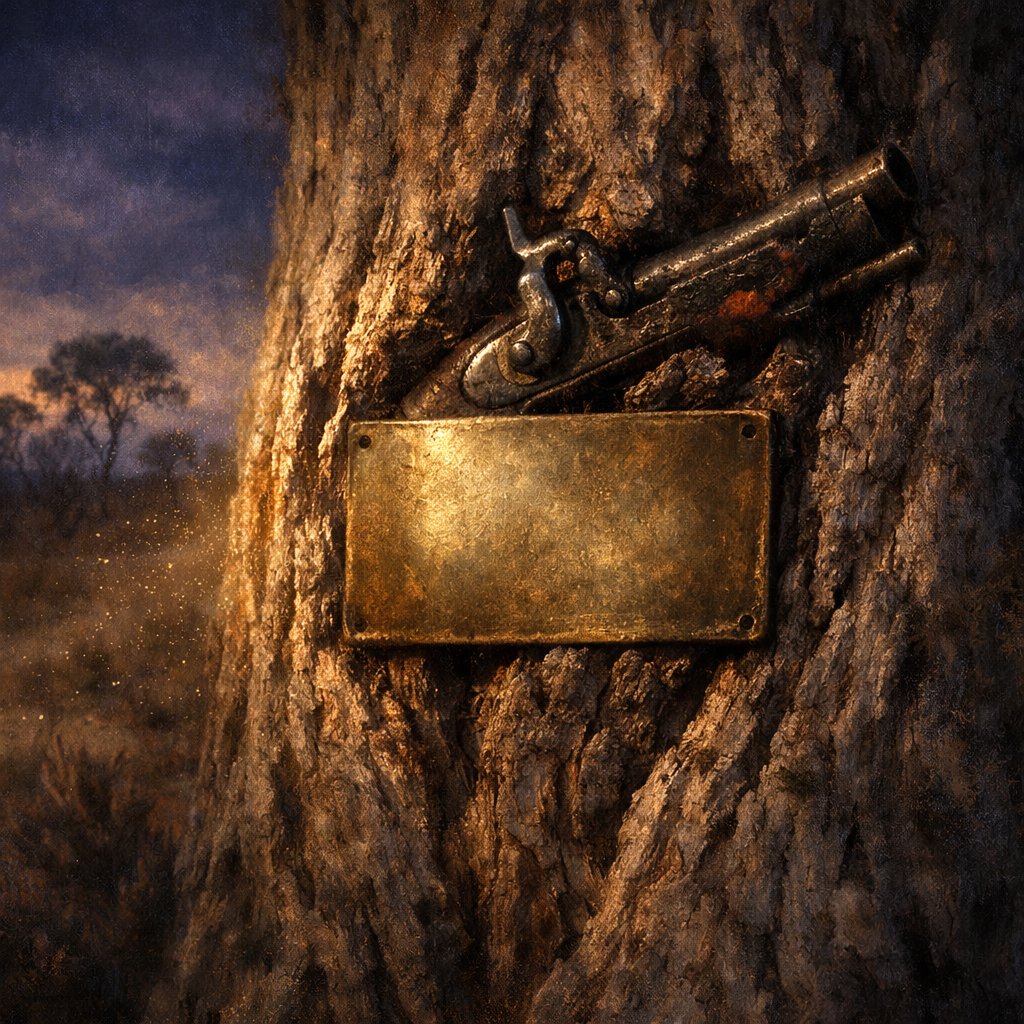
The single most evocative piece of physical evidence surfaced more than half a century after the disappearance. Around 1900, in the Sturt Creek country between the Tanami and Great Sandy deserts — just inside Western Australia from the Northern Territory border — an Aboriginal stockman known to the historical record only as Jackie, working with the prospector and bushman Charles Harding, prised a small brass plate from a partly burnt firearm wedged into the trunk of a boab. The boab itself was inscribed with the letter ‘L’. The plate measured roughly 15 by 2 centimetres and bore the engraving LUDWIG LEICHHARDT 1848. Harding kept the plate and discarded the corroded firearm [8].
The artifact passed through several private collections before being acquired in November 2006 by the National Museum of Australia from the Bristow-Smith family. A year of metallurgical and corrosion analysis conducted at the Museum’s laboratories — including scanning electron microscopy keyed to the lead content typical of mid-nineteenth-century brass — concluded the plate was genuine and consistent with an 1840s manufacture [8]. The location of recovery, on a long-presumed line of Leichhardt’s westward route, indicates the party reached at least two-thirds of the way across the continent before whatever happened to them happened.
What the Evidence Will and Will Not Carry
A careful historian holding all of this together at once will note three things. First, the documentary trail and the Aboriginal-witness trail diverge geographically: the Meston and Wallumbilla testimonies place the attack in the country between the Warrego and the Maranoa, comparatively early in the journey, while the Sturt Creek nameplate sits more than 2,400 kilometres further west. Second, the gap can be reconciled, but only by introducing an intermediate hypothesis: that material from the Maranoa attack site travelled along Aboriginal trade routes deep into the Kimberley, where it was eventually deposited in a tree by hands not necessarily Leichhardt’s. Third, neither the documentary nor the oral record produces a body, and so neither carries the weight needed to close the case. What survives is a constellation of partially congruent fragments around a void.
The void is the part that holds. A man crossed two-thirds of an unmapped continent, marked his trees, kept his journals, and disappeared so completely that even his bones — in a country where the bones of horses and bullocks survive in the open for decades — have never been recovered. Whatever ended the third expedition ended it tidily, on a continent that did not generally do anything tidily. That, more than the brass and the trees, is what has kept the case alive for almost two centuries.
Frequently Asked Questions
Who was Ludwig Leichhardt?
Ludwig Leichhardt (1813–1848?) was a Prussian-born naturalist and explorer who emigrated to the Australian colonies in 1842 and led three major expeditions into the interior. His successful 1844–45 traverse from the Darling Downs to Port Essington made him a public figure; his 1848 attempt to cross the continent west to the Swan River ended in a complete disappearance.
When did Leichhardt disappear?
The last verifiable communication from Leichhardt is a letter dated 3 April 1848, written from Allan Macpherson’s Cogoon outstation in southern Queensland. Macpherson’s station hands were the last colonial witnesses to see the party leave. No further documentary trace has ever been recovered.
How many people were in the lost party?
Six men in total: Leichhardt, four Europeans (Adolph Classen, Arthur Hentig, Donald Stuart, and Thomas Hands), and two Aboriginal guides from Port Stephens (Wommai and Billy Bombat). The party also included seven horses, twenty mules, and fifty bullocks.
What route did the 1848 expedition intend to follow?
Leichhardt planned to march west and northwest from the Cogoon, skirting the Channel Country, then traverse the central deserts on a roughly trans-continental arc to reach the Swan River settlement near present-day Perth — a journey of approximately 4,800 kilometres through country no European had crossed.
Who searched for Leichhardt?
Four major expeditions: Hovenden Hely (1852), Augustus Gregory (1855–56), Duncan McIntyre (1864 and 1865), and John Forrest (1869). Numerous smaller private and pastoral parties also searched, particularly in the Maranoa, Cooper Creek, Barcoo, and Channel Country districts during the 1860s and 1870s.
What is the Leichhardt nameplate?
A small brass plate, roughly 15 by 2 centimetres, engraved ‘LUDWIG LEICHHARDT 1848’. It was discovered around 1900 attached to a partially burnt firearm in a boab tree at Sturt Creek in Western Australia by an Aboriginal stockman named Jackie working with the prospector Charles Harding. The National Museum of Australia authenticated and acquired it in 2006.
What do Aboriginal oral histories say happened?
Aboriginal informants from the Warrego, Maranoa, Mackenzie, Paroo, and Thompson districts — recorded most fully by Queensland Protector of Aboriginals Archibald Meston between 1895 and 1904 — described an attack on the camp after Leichhardt himself died of illness during a flying reconnaissance. A separate Wallumbilla account preserved in W. P. Gordon’s 1874 letter independently described an attack on a white-led party driving mules and bullocks on the Maranoa.
Was Leichhardt’s body ever found?
No. Despite multiple searches over more than a century, no human remains have ever been securely identified as belonging to any member of the third expedition. Horse bones, ‘L’-marked trees, and the Sturt Creek nameplate are the only physical traces with credible provenance.
How far did the party get before disappearing?
The Sturt Creek nameplate, recovered in Western Australia roughly 2,400 kilometres west of the Cogoon outstation, suggests the party — or at least some of its material — reached approximately two-thirds of the way across the continent. Whether the party itself reached Sturt Creek, or whether the nameplate travelled along Aboriginal trade networks after an earlier attack, remains an open question.
Why is the case still unsolved?
No body, no contemporary written record from the journey’s later stages, and no single physical site has ever been identified as the location of the party’s death. The documentary record from Aboriginal informants and the geographically distant nameplate both point toward an attack, but neither produces a defensible terminal site, and the geographical gap between them admits multiple competing reconstructions.
Why was Leichhardt’s 1846 second expedition a failure?
Heavy seasonal rain, malarial fever among the men, dwindling supplies, and the loss of stock forced the party to turn back after approximately 800 kilometres. The Aboriginal guide Harry Brown is credited with leading the retreat in good order. The failure did not deter Leichhardt from re-attempting the same route in 1848 with greater stock numbers and a smaller European complement.
Where can the Leichhardt nameplate be seen today?
In the collection of the National Museum of Australia in Canberra, which acquired the artifact from the Bristow-Smith family in November 2006 after a year of metallurgical authentication. It is occasionally displayed alongside the ‘Patron’s Medal’ awarded to Leichhardt by the Royal Geographical Society in 1846.
Sources
- Roderick, Colin. Leichhardt: The Dauntless Explorer (Sydney: Angus & Robertson, 1988); supplementary biographical material in the Australian Dictionary of Biography entry by M. Aurousseau, available at adb.anu.edu.au.
- Leichhardt, Ludwig. Journal of an Overland Expedition in Australia, from Moreton Bay to Port Essington (London: T. & W. Boone, 1847).
- State Library of New South Wales, ‘Leichhardt’s Continental Treks’, available at sl.nsw.gov.au.
- Queensland State Archives, ‘Ludwig Leichhardt’s Final Expedition’ (2022), available at blogs.archives.qld.gov.au.
- Hely, Hovenden. ‘Report of an Expedition in Search of Dr. Leichhardt’, Votes and Proceedings of the Legislative Council of New South Wales, 1853.
- Gregory, Augustus C. Journals of Australian Explorations (Brisbane: Government Printer, 1884), Chapter XVII.
- Meston, Archibald. ‘Where Leichhardt Died’, oral testimony recorded 1895–1904, Queensland Protector of Aboriginals papers, transcribed at chapelhill.homeip.net.
- National Museum of Australia, ‘The Leichhardt Nameplate and Medal’ (collection record and acquisition history, 2006), available at nma.gov.au.
- Australian Museum, ‘Trailblazers: Ludwig Leichhardt’, available at australian.museum.
For further reading on the broader landscape of vanished expeditions, see the parent collection at Historical and Archaeological Mysteries.
For deeper context across the historical and archaeological mysteries archive, consider The Tower of Babel: Historical Evidence and Indus Valley: Trade and Communication.