
By EsoVitae Editorial · Published
Drafted with AI assistance from the sources listed; images are AI-generated illustrations. How EsoVitae is made
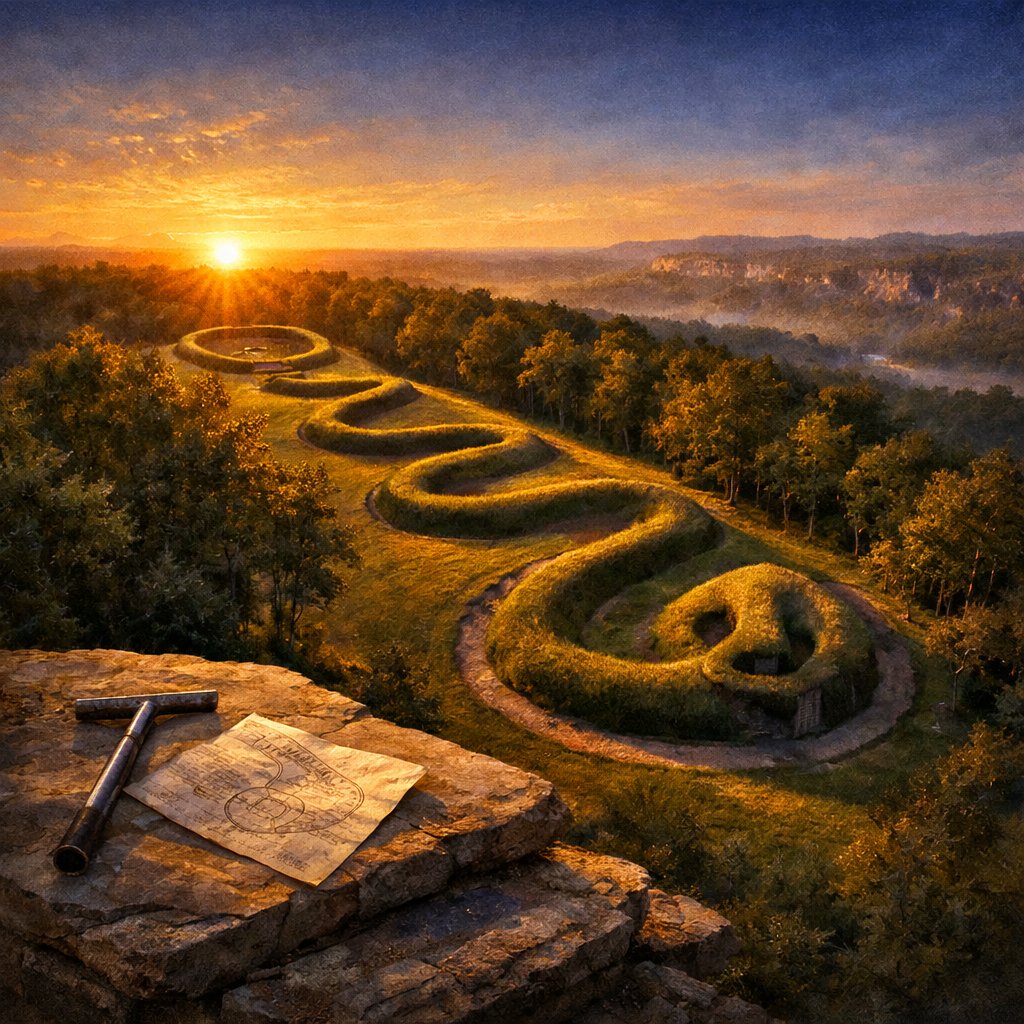
In Adams County, Ohio, on a forested ridge above Brush Creek, an earthen serpent runs along the contour of a high plateau for roughly four hundred and eleven meters. Its head opens onto an oval embankment that some readers see as an egg, others as the eye of a great beast, others as the orb of a swallowed sun. Seven undulations work back along the spine before the body coils into a tight spiral at the tail. The serpent is low against the ground, between three and four feet high, but the plan is unmistakable from above. The ridge itself is anomalous: it sits inside an eroded geological scar called the Serpent Mound cryptoexplosion structure, an impact site whose origin geologists have debated for more than a century. Two unrelated histories converge on this single hill, one geological and one human, and the tension between them is part of what has made the mound such an unusual page in North American archaeology.
Direct Answer: What Is the Serpent Mound?
The Serpent Mound is a 411-meter-long prehistoric earthen effigy in Adams County, Ohio, shaped as a serpent with seven undulations, a spiraled tail, and an oval feature at the head. Built by Indigenous peoples of the upper Ohio Valley, it has been attributed variously to the Adena culture (around 320 BCE) and to the Fort Ancient culture (around 1070 CE). Both readings are still under active scholarly debate.
The Site and Its Setting
The mound runs along the crest of a narrow plateau bounded on three sides by the deep gorge of Ohio Brush Creek. The plateau itself sits inside the rim of an ancient impact structure, the Serpent Mound cryptoexplosion feature, a roughly fourteen-kilometer disturbance whose deeply faulted limestone bedrock is unusual for the region. Modern geological consensus, summarized in the U.S. Geological Survey reports of the 1990s and reaffirmed in subsequent dating studies, treats the structure as a meteorite impact site between approximately 250 and 330 million years old. Whether the mound’s builders chose this particular ridge because of the visible faulting and the unusual feel of the ground, or whether the choice was driven by the sweep of the creek and the height of the bluff, is a question the archaeology cannot decide. The setting nonetheless gives the site a geological strangeness that is felt even today by visitors who walk the loop trail.
The serpent winds along this ridge in a sustained S-curve. The head points roughly north-northwest, toward the cliff edge above the creek; the tail coils to the south. Between them lie the seven undulations, each about five to seven meters across at the body, gently rising and falling in a regular rhythm. At the head, an oval embankment, roughly thirty meters along its long axis, opens directly in front of the open jaws. The oval is the most contested element of the figure. Frederic Ward Putnam (1839 to 1915), the first scientific excavator of the site, called it an egg. Later readers have proposed that it represents a swallowed body, the rising sun, or simply the head’s terminal punctuation. The honest position is that the iconography is not recoverable from the surface alone.
The Putnam Excavations and the 1900 Acquisition
The earliest scientific record of the site comes from Frederic Ward Putnam of Harvard’s Peabody Museum of Archaeology and Ethnology. Putnam first surveyed the mound in 1883, returned to excavate from 1886 to 1889, and remained involved with its preservation through the end of the century. He cut a series of test trenches into the body of the serpent, into the oval, and into nearby conical mounds on the same plateau, recovering ash, charcoal, fragmentary human remains in the conical mounds (though not in the serpent itself), and a small assemblage of lithics and ceramics that he assigned, on stylistic grounds, broadly to the moundbuilding cultures then under study in the Ohio Valley [1].
Putnam’s other contribution was civic. The site, in private hands during the 1880s, faced active threat of plowing. Working with a circle of Boston supporters led by the ethnologist Alice C. Fletcher, Putnam raised the funds in 1886 to buy roughly sixty acres encompassing the serpent and its associated earthworks. The Peabody Museum held the property and operated it as an early public archaeological park. In 1900, the Peabody deeded the land to the Ohio Archaeological and Historical Society, the predecessor of today’s Ohio History Connection, which has stewarded the site since [2]. The 1885 to 1900 acquisition is widely cited as one of the earliest archaeological preservation projects in the United States, predating the Antiquities Act of 1906.
Putnam’s Reading: A Generic Adena Attribution
Putnam published his findings in the 1890 Century Illustrated Magazine and in subsequent Peabody reports. He attributed the serpent and the conical mounds to the moundbuilders, a category that, in the late nineteenth century, mostly meant the Adena and Hopewell cultures known from the wider Ohio Valley. The conical mounds on the plateau yielded human burials with grave goods consistent with the Adena horizon (roughly 1000 BCE to 200 CE), and Putnam read the proximity as a probable cultural association. This attribution, though made on inferential grounds rather than direct dating of the serpent itself, set the framework that nearly every subsequent reader of the mound has had to negotiate.
The Adena Hopewell Fort Ancient Sequence
A reader who wants to follow the dating debate must keep three Indigenous cultural horizons of the upper Ohio Valley in view. The Adena complex, an Early Woodland tradition centered on the middle Ohio drainage, ran from roughly 1000 BCE to 200 CE and is best known for its conical burial mounds, copper ornaments, and tubular pipes. The Hopewell, a Middle Woodland tradition that overlapped and partly succeeded Adena (about 200 BCE to 500 CE), built the great geometric earthworks at Newark, Hopewell Mound City near Chillicothe, and the Hopeton works, recently inscribed as part of the Ohio Hopewell Ceremonial Earthworks UNESCO World Heritage site (2023). The Fort Ancient culture, a Late Prehistoric Mississippian-influenced tradition, ran from roughly 1000 to 1650 CE in the upper Ohio Valley and is associated with palisaded villages, maize agriculture, and a small but recurrent serpent iconography in shell gorgets and rim sherds [3]. The argument over who built the Serpent Mound is, in essence, an argument about which of these horizons the surviving evidence fits.
The Fletcher Cameron 1996 Charcoal: A Fort Ancient Reading
In 1991, Robert V. Fletcher and Terry L. Cameron, working with Bradley T. Lepper of the Ohio Historical Society, reopened a portion of one of Putnam’s original trenches into the body of the serpent. The new excavation recovered three small fragments of charcoal from what they read as an undisturbed core layer of the embankment. Two of the three fragments returned a calibrated radiocarbon date averaging 1070 CE, with a margin of around seventy years; the third, anomalously, returned a Late Archaic date roughly two thousand years older [4]. Fletcher, Cameron, and Lepper published the result in 1996 in the journal Ohio Archaeologist, arguing that the two consistent eleventh-century dates anchored construction in the Fort Ancient horizon and that the older third sample was a residual fragment redeposited from earlier soil [5].
Lepper extended the argument across subsequent papers and in his Ohio History Connection scholarship. His case rested on three pillars beyond the radiocarbon dates. First, the Adena tradition of the upper Ohio Valley produced abundant burial mounds but no large-scale effigy mounds in serpent form, whereas the Fort Ancient tradition (and the broader Mississippian horizon to its west) included serpent imagery in portable art and at least one other effigy mound, the Alligator Effigy Mound near Granville, Ohio, with its own Fort Ancient associations. Second, the eleventh century in the Northern Hemisphere coincided with the bright apparition of Halley’s Comet in 1066 CE, an event Lepper has noted as a possible motivating sky-prodigy for an oversized serpent in the celestial vocabulary of the period. Third, the radiocarbon dates from the undisturbed body of the serpent, on Lepper’s reading, do the work that surface iconography cannot. For nearly two decades after the Fletcher publication, the Fort Ancient attribution stood as the working consensus in mainstream Ohio archaeology [6].
The Romain Herrmann 2014 Rebuttal: An Adena Reading Returns
In 2014 the question was reopened. William F. Romain, an independent scholar with two decades of ground-survey work on Ohio earthworks, and the geomorphologist Edward W. Herrmann of Indiana University, working with the Ohio History Connection’s site files and a fresh series of soil cores extracted between 2011 and 2012, published a rejoinder in the journal Cambridge Archaeological Journal [7]. The Romain and Herrmann sequence of eight new accelerator mass spectrometry radiocarbon dates from soils sealed beneath and within the embankment fill returned a tight cluster around 321 BCE, with a calibrated range of approximately 381 BCE to 44 BCE. Their reading places original construction firmly in the Early Woodland Adena horizon and treats the Fletcher 1996 eleventh-century charcoal as evidence of a later episode of repair or recontouring of an already centuries-old monument, not of original construction.
Lepper replied in 2018 in the Midcontinental Journal of Archaeology, defending the Fort Ancient attribution against Romain and Herrmann’s critique [8]. Romain and Herrmann replied in turn. The exchange is unusually civil for a long-running disagreement, and it has clarified what is at stake. Both teams agree that the Fletcher 1996 charcoal returned eleventh-century dates from samples taken from the embankment body; both agree that the Romain and Herrmann 2014 cores returned fourth-century BCE dates from samples beneath and within other portions of the embankment; both agree that some Indigenous activity at the site is attested for both horizons. Where they differ is in the question of which dates record the original construction and which record later modification. The matter is not, as of this writing, settled.
What the Two Readings Imply
If Romain and Herrmann are right, the Serpent Mound is the earliest known large-scale effigy mound in the eastern woodlands and pushes serpent symbolism in Adena material culture earlier than has been previously attested. If Lepper is right, the mound is a Fort Ancient masterwork comparable in scale, if not in form, to the Hopewell geometric earthworks and reflects a celestial iconography of the early second millennium. Either reading reorganizes the inventory of Ohio Valley moundbuilding in a different way. The honest reader holds both readings open. The geometry of the surviving embankment is the same in both cases. What differs is the chapter into which it should be filed.
The Astronomical Alignments
A separate strand of research, partially independent of the dating debate, concerns the astronomical alignments of the figure. In 1987 Clark and Marjorie Hardman published an analysis arguing that the alignment from the spiraled tail through the body to the open jaws falls on the azimuth of summer-solstice sunset at the latitude of Adams County, Ohio. William Romain, in a series of ground surveys conducted between 2003 and 2014, extended the argument to the seven undulations themselves, proposing that successive curves of the body align with significant lunar standstill points (the maximum northern moonrise, the minimum northern moonrise, the maximum southern moonrise) as well as with equinox and winter-solstice sunrises. Other readers, including Lepper, accept the summer-solstice alignment as plausible and treat the more elaborate lunar matrix with caution, noting that with seven curves and a roughly twenty-degree azimuthal tolerance, alignments will tend to materialize on any sufficiently complex body of horizon astronomy [9].
The minimum claim, well-supported, is that the head and oval do indeed point toward the setting sun on the longest day of the year. Visitors gather at the site every June 21 to watch this. The maximum claim, more speculative, is that the entire serpent is a built calendar threading multiple celestial events into a single figure. Whether one accepts the maximum claim depends in part on which dating reading one prefers. A built calendar is more easily imagined for a Fort Ancient construction whose builders had the developed maize-cycle agricultural needs to track such events; a more compact symbolic intent better fits an Adena reading. Iconography here is doing the work that radiocarbon cannot.
UNESCO Tentative Listing and Recent Stewardship
In 2008 the United States Department of the Interior selected Serpent Mound, alongside eight other Ohio Indigenous earthworks, for inclusion on the U.S. Tentative List for UNESCO World Heritage inscription. Of those nine, the eight Hopewell sites were inscribed together in 2023 as the Ohio Hopewell Ceremonial Earthworks World Heritage Site. Serpent Mound, attributed neither to Hopewell nor unambiguously to a single horizon, was held back from that inscription cycle and remains on the U.S. Tentative List as a candidate for a future, separate nomination [10]. The Ohio History Connection, which has owned the site since 1900, manages it today through a partnership with the Arc of Appalachia Preserve System; recent stewardship work has included improved interpretive signage, restored prairie habitat on the surrounding acres, and the careful management of the annual solstice gatherings.
Reading the Serpent Today
A visitor walking the modern observation tower above the mound sees a long, low, sinuous figure on a forest plateau, half-revealed under the canopy. The head with its open jaws faces the cliff above the creek; the seven undulations roll back along the spine; the tail coils into the southern end of the plateau. The geological backdrop is the unusual cryptoexplosion structure that gives the ridge its faulted limestone. The cultural backdrop is two competing radiocarbon stories, an unresolved Adena and Fort Ancient debate carried in the literature with rigor and patience. The astronomical backdrop is the certainty of the summer-solstice alignment and the live argument over whether more is encoded in the curves.
No human burials were ever recovered from the body of the serpent itself. No artifact assemblage anchors it conclusively to a single material culture. The figure is, on the ground, a sustained earthen line whose meaning is reconstructed from its plan, its setting, and the dates the soil samples return. Hold the readings open. Walk the loop. The mound has held its silence for at least a thousand years and possibly two thousand three hundred. It is in no hurry to give up the rest.