By Emilia Wellesley · Published May 7, 2026 · Updated September 10, 2026
Last updated: September 10, 2026.
The 1864 Burial, the Curse List, and the Hollywood Bowl Dig
The Cahuenga Pass treasure is a Los Angeles folktale anchored to a real geopolitical moment and a thin documentary record. The legend places, somewhere in the foothills of the Cahuenga Pass north of Los Angeles, six buckskin parcels of Mexican gold and silver coin, diamonds, pearls, and watches, valued in 1864 dollars at roughly two hundred thousand and reckoned in present-day metals at four to five million United States dollars. The burial, attributed to a shepherd named Diego Moreno, is said to have occurred in the spring of 1864 against the backdrop of the French intervention in Mexico, when Napoleon III had installed Archduke Maximilian of Austria as emperor and President Benito Juárez’s republican government was running clandestine fundraising operations in California to buy arms. Moreno, having intercepted four Juarista couriers carrying the war chest, is said to have died before recovering it. Four successive seekers across seventy-five years are said to have died trying. In November 1939 a syndicate dug a forty-two-foot pit in the parking lot behind the Hollywood Bowl on the strength of a “doodlebug” reading and found nothing. The legend, situated within the broader landscape of historical and archaeological mysteries, is folklore the historian can reconstruct cleanly only by separating the verifiable Mexican-civil-war substrate from the unverifiable curse list grafted onto it across the late nineteenth and early twentieth centuries.
The principal documentary source for the burial is Major Horace Bell’s posthumous memoir On the Old West Coast: Being Further Reminiscences of a Ranger, edited by Lanier Bartlett and published by William Morrow in 1930, three years after Bell’s death [1]. Bell, a Los Angeles lawyer, newspaper editor, and California Ranger born in 1830, claimed to have heard the story directly in the early 1880s from a Sonoran prospector named Malcolm and from a Los Angeles policeman whose name he did not preserve. Everything in the legend that predates the 1939 dig descends, by chains of citation that always pass through Bell, from those two oral testimonies as Bell remembered them more than four decades later. The historian’s first move in any reconstruction is to mark that fact clearly: the documentary substrate of the 1864 events is one memoirist’s recollection of two informants’ accounts, written down in old age and printed posthumously.
The Juarista Context: Real, and Necessary to Get Right
The geopolitical frame the legend places around the 1864 burial is historically robust. In the spring of 1862, Napoleon III dispatched a French expeditionary force to Mexico under Charles de Lorencez, ostensibly to enforce European debt claims, in practice to install a client monarchy on the western flank of the United States while Washington was occupied with its civil war. The French were turned back at Puebla on May 5, 1862, the engagement that gave Mexico the Cinco de Mayo holiday, but reinforced and re-engaged, and by June 1863 had taken Mexico City. In April 1864, Maximilian von Habsburg, second son of Archduke Franz Karl of Austria, accepted the Mexican crown at Miramare Castle on the Adriatic and arrived at Veracruz with his consort Carlota in May. The republican government of Benito Juárez, displaced from the capital, conducted the resistance from a movable headquarters in the northern states and depended for war materiel on supplies funneled through Pacific and Gulf ports.
California was a logistically important node in that operation. The state held a large Mexican-born population, an active Juarista support network in San Francisco and Los Angeles, and a position outside the operational reach of the French navy. Juárez’s California agents, working through commercial fronts in San Francisco, raised funds across 1863 and 1864 from sympathetic merchants and from contributions of bullion and jewelry pledged by exiles. That part of the legend’s frame, the bare fact of a Juárez fundraising operation moving valuables north out of Mexico through California, is documented in the diplomatic correspondence of the period and in the postwar memoirs of figures such as Plácido Vega, Juárez’s principal Pacific-coast agent. The Cahuenga Pass legend’s specific claim is that one such consignment, after entering California by sea at Mazatlán’s northern shipping lanes, was intercepted before delivery by a shepherd who knew the country.
Diego Moreno and the Dream Beneath the Ash Tree
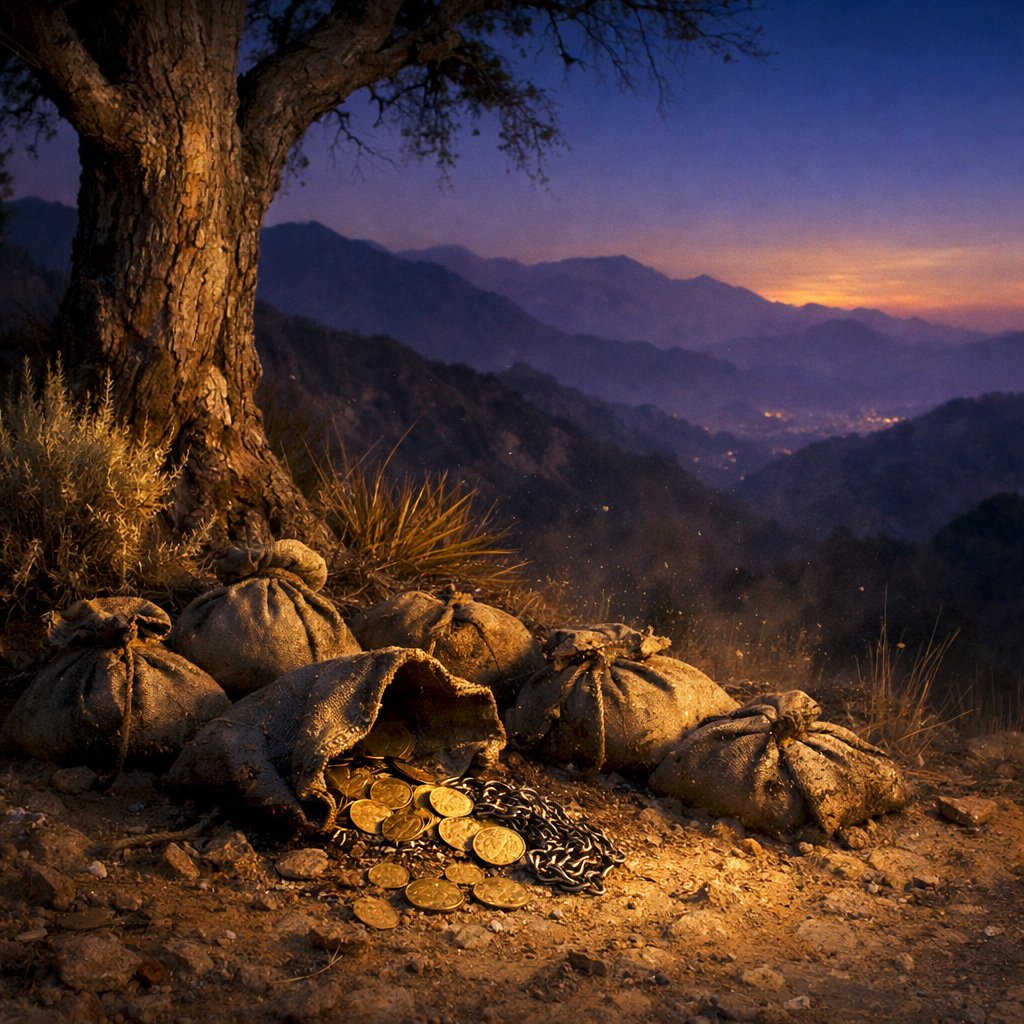
In Bell’s account, the four Juarista couriers carrying the consignment camped in the hills back of San Mateo on a rest stop on the road north and buried the parcels overnight for safekeeping. Moreno, watching from cover, observed the burial, returned in their absence, recovered the six buckskins, and rode south for Los Angeles intending to disappear into the city with the find. Resting at Cahuenga Pass, the long defile through the Santa Monica Mountains that connects the Los Angeles basin to the San Fernando Valley, Moreno fell asleep and dreamed of his own death if he entered the city carrying the cache. He woke at dawn and walked into the foothills west of the pass, halfway up the summit ridge, where a single ash tree stood in the chaparral. He buried the six parcels at distances of a few paces from the tree in different directions, and rode into Los Angeles empty-handed.
The death sequence in Bell’s text begins almost immediately. Moreno is said to have fallen ill within a year, taken refuge at the home of his friend Don Jesús Martínez, told Martínez where the parcels lay before he died, and expired in 1866. Martínez, in Bell’s account, returned to the pass with a stepson and a shovel, was overtaken near the ash tree by a fatal heart attack, and never spoke of the location to the boy. The two original Juarista couriers, having returned to find the cache stolen, are said by Bell to have shot one another in a recriminatory quarrel. Captain Henry Malcolm, the Sonoran prospector from whom Bell heard the story, is reported to have been killed years later in Tombstone in unrelated trouble. A shepherd, often given as a Basque from southern France, who reportedly found one of the six buckskins in 1885 and recovered the coins, is said to have drowned soon after at Barcelona harbor on his return passage. The pattern, in Bell’s hands, is a curse narrative worked through the surviving family memories of the late nineteenth century, with the early 1880s newspaper coverage Bell helped generate furnishing it later embellishment.
The Newspaper Cycle of the 1880s and 1890s
The story passed from oral memory into printed circulation through the Los Angeles English-language press in the 1880s, the period when Bell himself was editing the satirical weekly The Porcupine (1882 to 1888) and feeding local color to the daily papers. The clearest contemporary documentary trace of the legend in this period is a series of short notices in the Los Angeles Herald and the Los Angeles Times reporting on minor digs in the foothills west of Cahuenga Pass, several of which named the buried-treasure motif explicitly. None of these notices survives in the archival catalogues with the detail or named witnesses a careful historian would want; they are paragraphs, often anonymous, of the kind the period produced in volume.
A second documentary anchor enters the file in the 1890s with the death of José Correa, sometimes rendered in later retellings as Jose Garcia, who was shot by his brother-in-law on Boyle Avenue in Los Angeles in 1894 in what the police record treated as a domestic homicide and the curse-narrative tradition treated as the third death in the series. Bell’s text, written more than three decades later, places Correa at the ash tree shortly before his death and joins the homicide to the curse. The contemporary 1894 newspaper coverage of the killing, which can be consulted in the Los Angeles Times historical archive, does not. The legend’s pattern by this point is established: a death in the city or in the chaparral attaches itself, on the strength of a Bell-mediated remembrance, to the buried buckskins. The historian holds the homicide as documented and the treasure connection as folkloric.
The 1939 Hollywood Bowl Dig
The single contemporaneously documented episode in the case is the November 1939 excavation in the parking lot behind the Hollywood Bowl shell. The Bowl, built in 1922 in the lower stretch of the Cahuenga Pass on land donated to Los Angeles County, had grown by the late 1930s into a heavily trafficked civic property; a permit to dig in its parking lot required, and received, county engineering supervision. The syndicate that secured the permit consisted of Henry Jones, a San Francisco mining engineer who had worked the story for several years; Ray Johnson, a Hollywood stuntman who had grown up on the legend; and Frank Hoekstra, a Highland Park inventor and his two sons, who supplied the gold-detection apparatus they marketed under the colloquial name “doodlebug” — an electrochemical pendulum device of the kind common in 1930s amateur prospecting [2].
Hoekstra’s instrument indicated a strong reading at a depth of roughly fourteen feet under the asphalt. The syndicate broke ground on November 27, 1939, with three Hollywood film crews, a CBS radio team, and an audience of several hundred reporters and curious locals on hand. The dig ran for twenty-four days. The crew moved more than one hundred tons of earth and mud, opened a nine-foot-wide shaft to a recorded depth of forty-two feet, and at the bottom of the cut struck a boulder that the doodlebug reportedly identified as a treasure return; the boulder, when removed, was a boulder. The hole flooded. The syndicate gave up. Henry Jones returned to San Francisco to face an impending divorce and unpaid debts, and on January 26, 1940, was found in the front seat of his car in a parking lot, asphyxiated by exhaust fumes routed through a hose into the cabin, with a note beside him on the seat. The San Francisco coroner’s office ruled the death a suicide. The curse-narrative tradition treated it as the next death in the sequence.
The Folklore Layer the Mainstream Historian Disputes
A careful reading of the documentary record produces three observations. The first is that the Mexican civil-war substrate of the legend is real but generic: Juárez’s California agents did move valuables north in 1863 and 1864, and a small consignment lost to a shepherd would not have been the kind of incident that produced an official paper trail at either end. The second is that the burial sequence and the early curse deaths attach themselves to Bell’s 1930 memoir and disappear, when run back through the underlying contemporary record, into a thin scatter of unsourced Los Angeles paragraphs from the 1880s and a domestic homicide from 1894. The third is that the 1939 dig is the only event in the file that survives independent verification: it has Los Angeles County permit records, contemporaneous coverage in the Los Angeles Times and the Los Angeles Examiner, the Hollywood Bowl management correspondence, and a documented death by suicide at the end of it [3].
The treatment in the modern Los Angeles historical literature has been correspondingly cautious. W. W. Robinson, the most cited mid-twentieth-century historian of Los Angeles County and a scholar generally hospitable to the city’s folklore, treats the Cahuenga Pass treasure in his Los Angeles from the Days of the Pueblo (California Historical Society, 1959) as a story without independent confirmation that nonetheless illuminates the period imagination. Cecilia Rasmussen, who covered Los Angeles county history in the Los Angeles Times‘s “L.A. Then and Now” column from 1995 to 2007, returned to the legend several times across the 2000s and consistently framed it as a folkloric tradition with a real geopolitical kernel and an unverifiable specific narrative [4]. The pattern in both authors is the same: the historian honors the Juárez-Maximilian context as cultural history that mattered to nineteenth-century Mexican Los Angeles; the historian declines to vouch for the buckskins.
What the Pass Itself Holds
The Cahuenga Pass as a geographical fact is older than the legend by ten thousand years. The defile through the eastern Santa Monica Mountains takes its name from the Tongva village of Kawé’nga, “at the mountain,” that stood at its mouth before Spanish contact. The pass carried the El Camino Real between the San Fernando Mission and the pueblo of Los Angeles from 1797. It was the site of two minor nineteenth-century engagements, the 1831 Battle of Cahuenga Pass between Mexican federal and Californio forces and the 1845 Battle of Providencia. It became the right-of-way for the Cahuenga Pass Parkway, opened in 1940 as a precursor to U.S. Route 101, and the Hollywood Bowl natural amphitheater on its eastern slope. The hillsides west of the pass, where Moreno is said to have buried the parcels, are now the residential canyons above Hollywood, an area where the geology is decomposed granite and chaparral, where ash trees of the kind a single specimen would have anchored the legend’s compass have been displaced by century-grown urban planting, and where any remaining undeveloped land is private, mapped, and surveyed.
A treasure that was buried in 1864 in a chaparral hillside, never recovered by the people who knew its position, and overlaid in the twentieth century by ten million cubic yards of road cut, residential foundation, and freeway grading would not, in any reasonable physical reconstruction, be findable today by the kind of metal-detector amateurism the legend has always attracted. The pass’s history of failed digs, from the unnamed 1880s notices through the 1939 Hollywood Bowl excavation to the periodic modern attempts that flare up on treasure-hunting forums, has not produced a single coin from the legendary cache. What the pass actually holds, the documented record says, is the geological substrate of a Tongva village name, two minor nineteenth-century military engagements, a 1922 amphitheater, and the longest folktale in California treasure-hunting tradition.
Folklore as Historical Evidence
A historian of the case has, in the end, two records to read. The first is the verifiable one: the French intervention in Mexico, the Juárez fundraising network in California, the 1894 homicide of José Correa, the 1939 dig, the 1940 suicide of Henry Jones, the unbroken silence of the chaparral. The second is the legendary one: the dream at the ash tree, the curse on the four seekers, the moral arithmetic that punishes recovery. The two records do not converge. They illuminate one another. The legendary record carries the period’s anxieties about the cost of the Mexican civil war on the Mexican-Californian community, the moral ambivalence of refugee wealth, and the tension between sudden discovery and the discipline of work. The verifiable record carries the actual paths of capital and labor through 1860s California. Read together, the Cahuenga Pass treasure is a piece of cultural history in which a thin documentary substrate has carried a heavy interpretive burden for more than a century, and in which the absence of recovered coin is, for the historian, the most telling fact in the file.
Frequently Asked Questions
Is the Cahuenga Pass treasure real?
The 1860s geopolitical context (the French intervention in Mexico and the Juárez fundraising network in California) is documented historical record. The specific 1864 burial by a shepherd named Diego Moreno rests almost entirely on Major Horace Bell’s posthumous 1930 memoir On the Old West Coast, written down more than four decades after the events. Mainstream Los Angeles historians, including W. W. Robinson and Cecilia Rasmussen, have treated the burial story as folklore with a real geopolitical kernel and an unverifiable specific narrative. No coin from the cache has ever been recovered.
How much was the buried treasure worth?
The legend places the cache at approximately two hundred thousand United States dollars in 1864 valuation, consisting of Mexican gold and silver coin, diamonds, pearls, and watches in six buckskin parcels. Adjusted for the present price of bullion and the rarity premium on nineteenth-century Mexican coin, the figure runs to roughly four to five million United States dollars in current value, depending on the assumed proportion of jewelry to coin in the parcels.
Who was Diego Moreno?
Diego Moreno is the central figure in Major Horace Bell’s account of the legend, given as a Mexican shepherd who intercepted the Juarista couriers’ overnight burial somewhere on the road north from Los Angeles, recovered the six buckskins, rode south to Cahuenga Pass, and reburied the parcels under a single ash tree on the western slope after a warning dream. Bell’s text places his death at his friend Don Jesús Martínez’s home in 1866. No independent contemporaneous documentation of Moreno survives in the Los Angeles archives.
What did the 1939 Hollywood Bowl dig find?
Nothing. The November 1939 excavation, led by San Francisco mining engineer Henry Jones with Hollywood stuntman Ray Johnson and Highland Park inventor Frank Hoekstra, opened a forty-two-foot shaft in the Bowl’s parking lot behind the bandshell on the strength of a “doodlebug” electrochemical-pendulum reading. After twenty-four days and more than one hundred tons of earth removed, the cut struck a boulder, flooded, and was abandoned. No coins, parcels, or artefacts of any kind from the legendary cache were recovered.
Did Henry Jones die because of the curse?
Henry Jones was found dead in the front seat of his car in a San Francisco parking lot on January 26, 1940, asphyxiated by exhaust fumes routed through a hose into the cabin. The San Francisco coroner ruled the death a suicide; a note beside the body cited an impending divorce and the financial losses from the Hollywood Bowl excavation. The curse-narrative tradition treated the death as the next in the sequence; the documentary record treats it as the suicide it appears to have been.
Who else is said to have died seeking the treasure?
Major Horace Bell’s account names four pre-1939 deaths in the curse sequence: the two original Juarista couriers, who shot one another after returning to find the cache stolen; Don Jesús Martínez, who suffered a fatal heart attack while searching with his stepson near the ash tree in 1866; and a shepherd often described as a Basque from southern France, who reportedly recovered one of the six parcels in 1885 and drowned soon after at Barcelona harbor. José Correa, shot in 1894 on Boyle Avenue in Los Angeles in a domestic homicide, was retrofitted into the sequence by the post-1894 retellings.
Where is the Cahuenga Pass?
The Cahuenga Pass is a low defile through the eastern Santa Monica Mountains in Los Angeles County, California, connecting the Los Angeles basin south of the range to the San Fernando Valley to the north. The crest sits at approximately seven hundred forty-five feet elevation. The pass is now traversed by U.S. Route 101 (the Hollywood Freeway) and Cahuenga Boulevard. The Hollywood Bowl natural amphitheater occupies the eastern slope of the pass, on the Los Angeles side of the crest.
What was the Juárez fundraising operation in California?
During the French intervention in Mexico from 1862 to 1867, President Benito Juárez’s republican government, displaced from Mexico City, ran a clandestine fundraising and arms-procurement network through California to circumvent the French naval blockade of Mexico’s Pacific ports. Plácido Vega, Juárez’s principal Pacific-coast agent, operated from San Francisco. The network solicited contributions of bullion and jewelry from Mexican exiles and sympathetic merchants and routed war materiel south through California ports. The Cahuenga Pass legend’s claim that one such consignment was lost in transit attaches to this documented network.
Why hasn’t the treasure been found with modern equipment?
A treasure buried in 1864 in a chaparral hillside, never relocated by the persons who knew its position, and overlaid in the twentieth century by extensive freeway construction, residential foundation work, and grading for the Cahuenga Pass Parkway and U.S. Route 101 would not, on any reasonable reconstruction of the site’s topography, be findable today by surface metal-detector survey. The hillsides west of the pass that the legend identifies as the burial ground are now residential canyons under private ownership and continuous mapped land use since the early twentieth century. The undisturbed chaparral the legend imagines no longer exists.
What is Major Horace Bell’s role in the story?
Major Horace Bell (1830 to 1918) was a California Ranger, Los Angeles lawyer, newspaper editor, and Civil War Union officer who knew nineteenth-century Los Angeles intimately. His posthumous memoir On the Old West Coast: Being Further Reminiscences of a Ranger, edited by Lanier Bartlett and published by William Morrow in 1930, three years after Bell’s death, contains the principal narrative of the Cahuenga Pass treasure. Bell heard the story in the early 1880s from a Sonoran prospector named Malcolm and from a Los Angeles policeman. Every later retelling of the legend descends, by chains of citation, from Bell’s text.
Did the legend appear in Los Angeles newspapers before Bell’s 1930 memoir?
Yes, in scattered form. The Los Angeles Herald and the Los Angeles Times ran short notices on minor foothill digs in the 1880s and 1890s that named the Cahuenga Pass buried-treasure motif. The notices are typically anonymous, brief, and lacking named witnesses. The 1939 Hollywood Bowl excavation produced the first sustained mainstream press coverage, with day-by-day reporting in both papers, photographic spreads, and CBS radio coverage of the dig. The pre-1939 newspaper trace is real but thin.
Is the curse historically credible?
No. The curse narrative is a folkloric pattern of the period, common across Spanish-American buried-treasure tradition and the broader nineteenth-century treasure-hunting literature, in which a sequence of deaths attaches itself retrospectively to an unrecovered cache. Each documented death in the Cahuenga sequence has an independent and ordinary explanation: domestic homicide, heart attack, drowning, suicide, accident in unrelated contexts. The pattern reflects the cultural function the legend served — moralizing the moral ambivalence of refugee wealth and the discipline of patient work — rather than any underlying causal mechanism.
What would convince a historian the cache was real?
Three classes of evidence would carry weight. First, a contemporary 1864 to 1866 document — a letter, a Mexican consular report, a Juarista financial accounting — naming a specific lost consignment of the size the legend describes. Second, a recovery of period Mexican coin, in a buckskin or canvas wrap consistent with 1860s field practice, from the relevant hillside, with provenance documentation that survives forensic scrutiny. Third, an archival recovery of pre-1930 Los Angeles documentation that names Diego Moreno, Don Jesús Martínez, or the ash-tree compass independently of Major Bell’s memoir. None of these has appeared.
For deeper context across the historical and archaeological mysteries archive, consider The Tower of Babel: Historical Evidence and Indus Valley: Trade and Communication.